On 29 July 2026, a drone struck two natural-gas storage vessels at Damietta’s Mediterranean port, according to a brief Cabinet statement the following day. It did not identify the responsible party, saying the “relevant authorities” were investigating and taking steps to protect Egypt’s interests and national security.
Those authorities had issued no further clarification by this report’s publication. Roughly two weeks after the strike, a Facebook group inspired by SpongeBob’s Bikini Bottom—known in the Arabic version as Qaʿ al-Hamour—appeared and amassed more than 1.8 million members in just ten days. The entertainment group then became the subject of scrutiny.
Twelve days after launch, on 23 August, the group was closed amid reports that administrators had been arrested and allegations involving public incitement, the Muslim Brotherhood and even “invading the world.” One administrator denied that any of them had been arrested. Those circulating claims were not established findings.
The contrast is striking: the identity of whoever targeted the Damietta vessels remained unannounced, while a satirical online space was rapidly shut down. The official account of why the group closed remained unclear.
Members’ jokes often touched on economic conditions and indirectly on state policy. Criticism of the treatment of virtual life appeared alongside crushing problems in real life, before the group closed.
Original evidence: closure and administrators’ statements
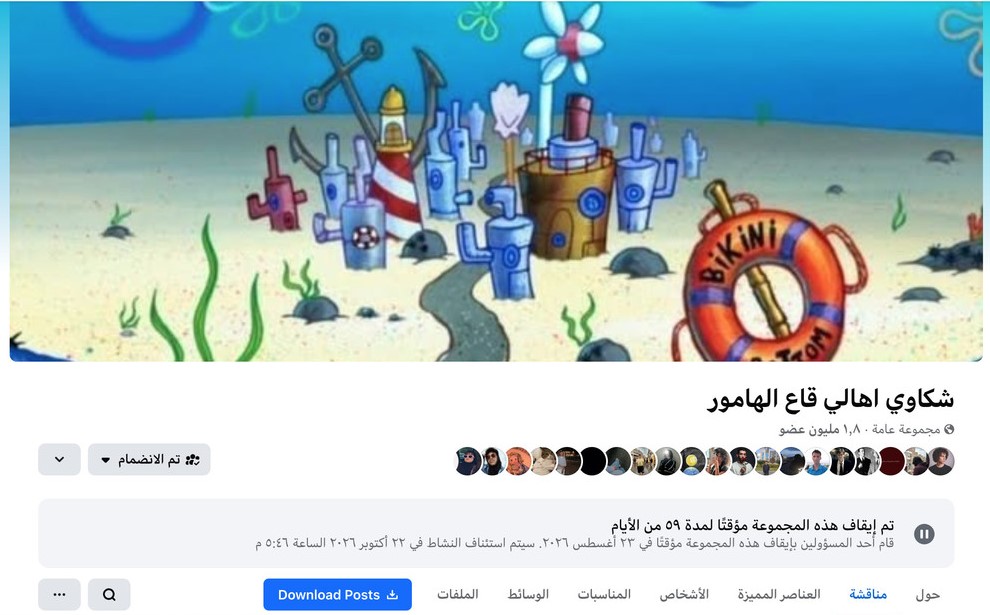
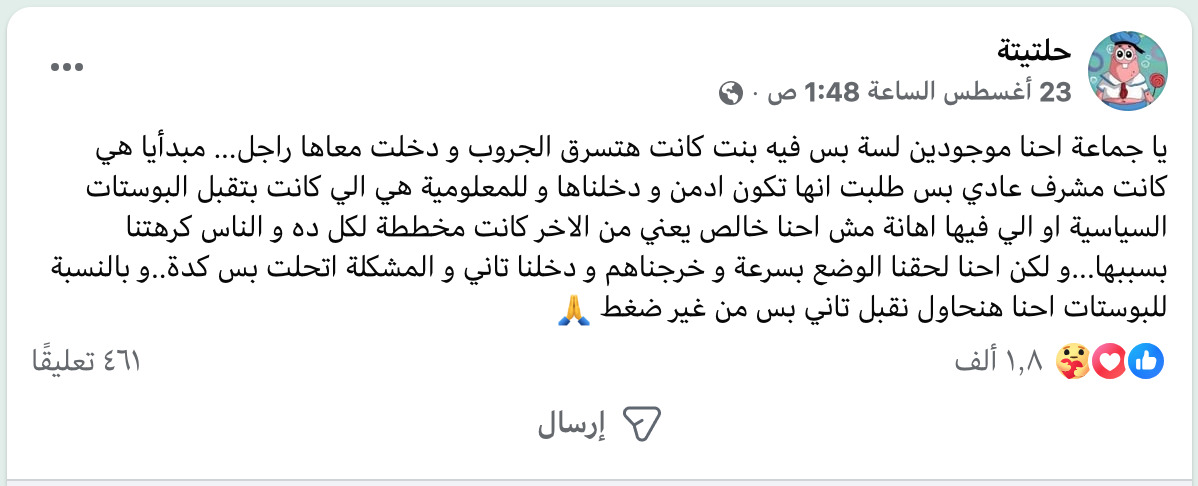
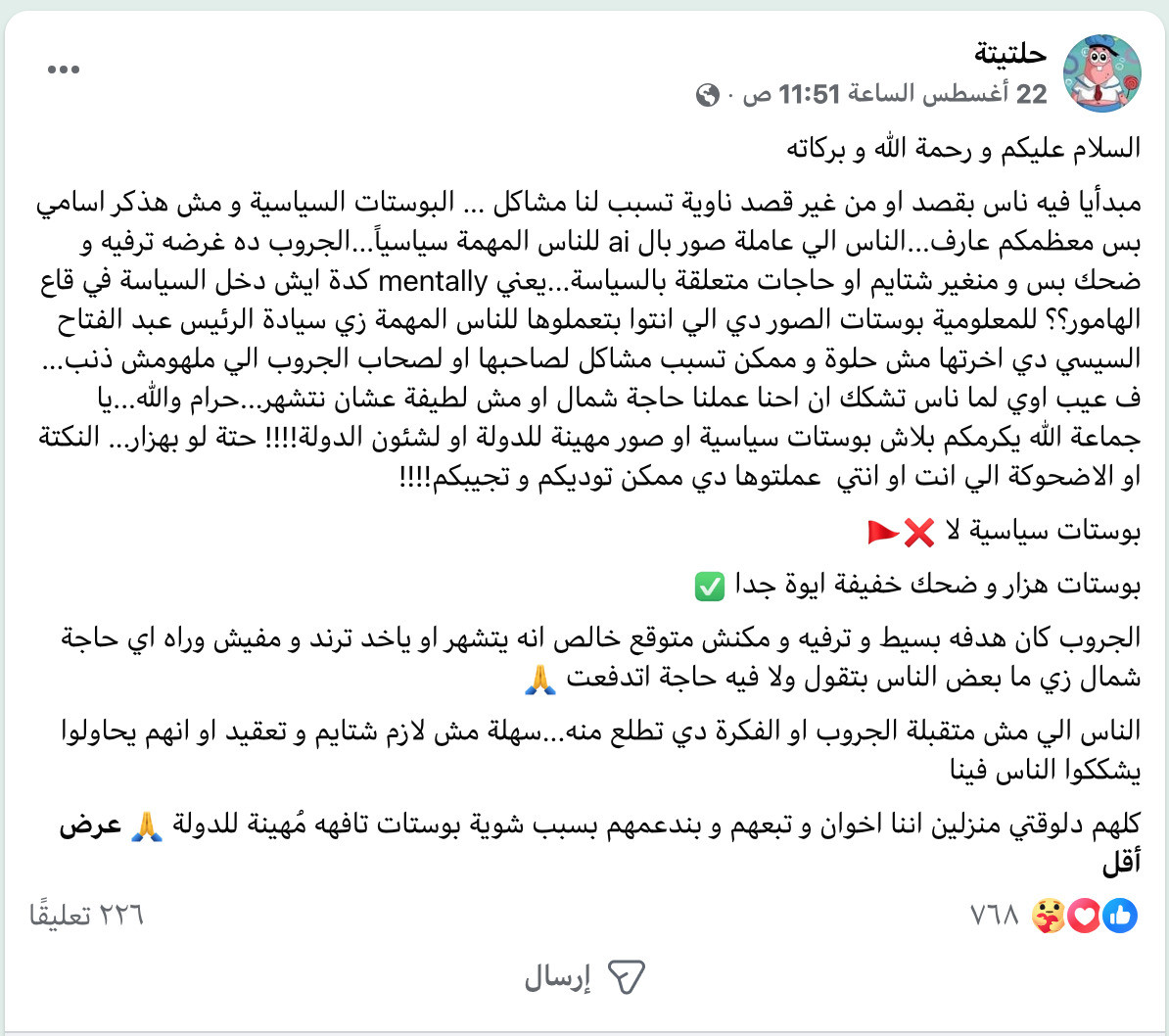
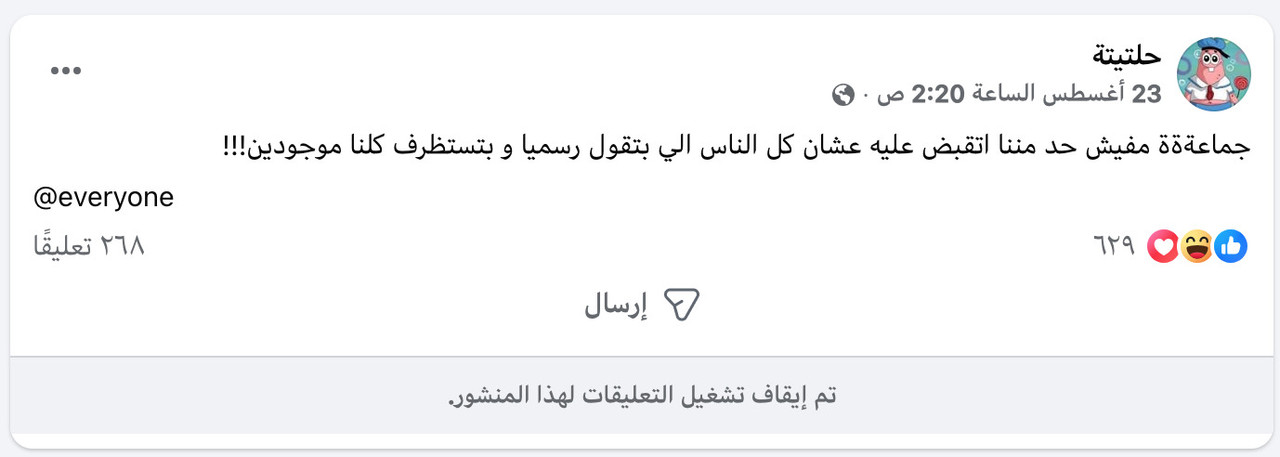
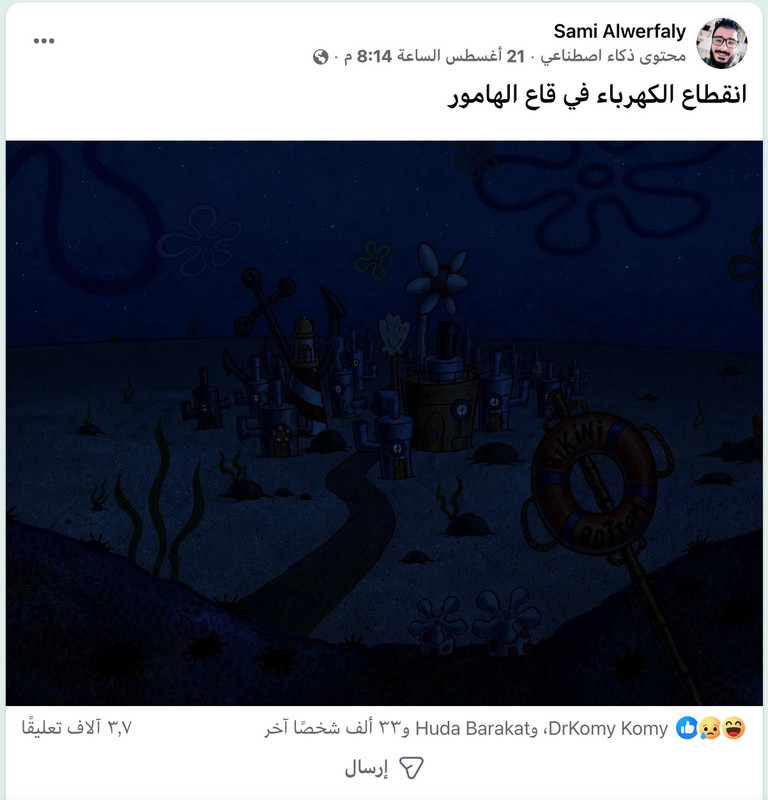
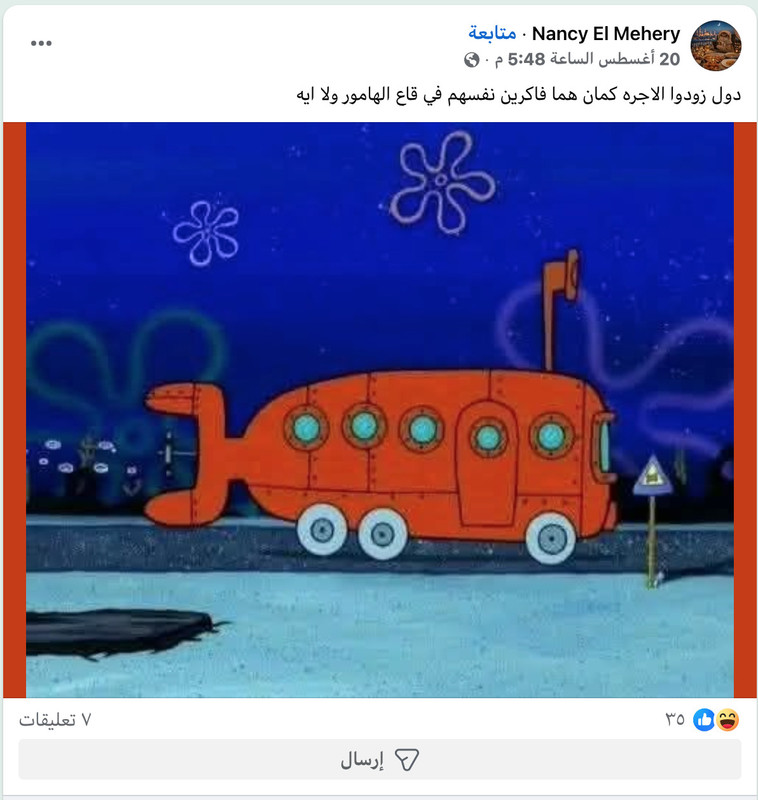
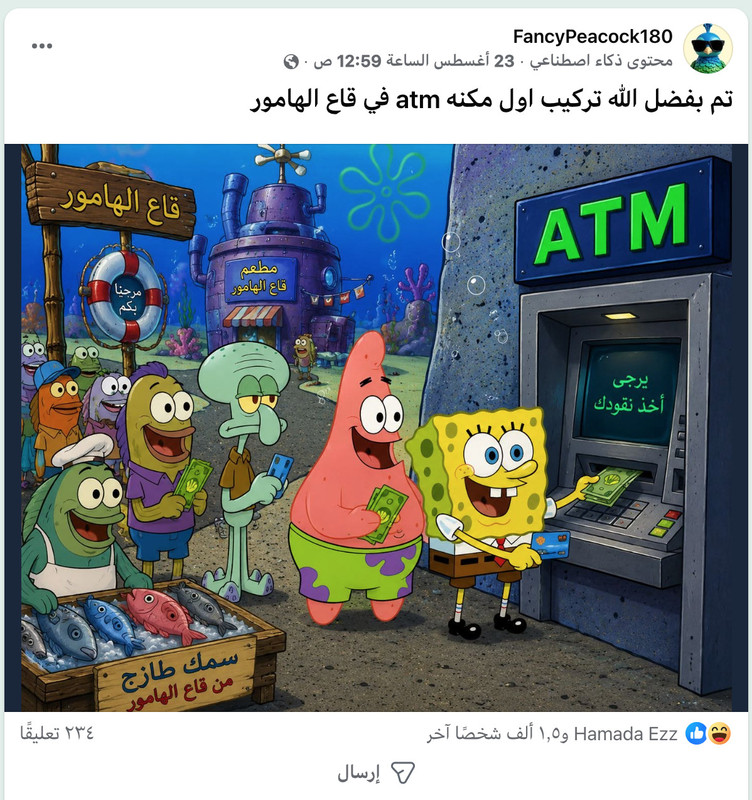
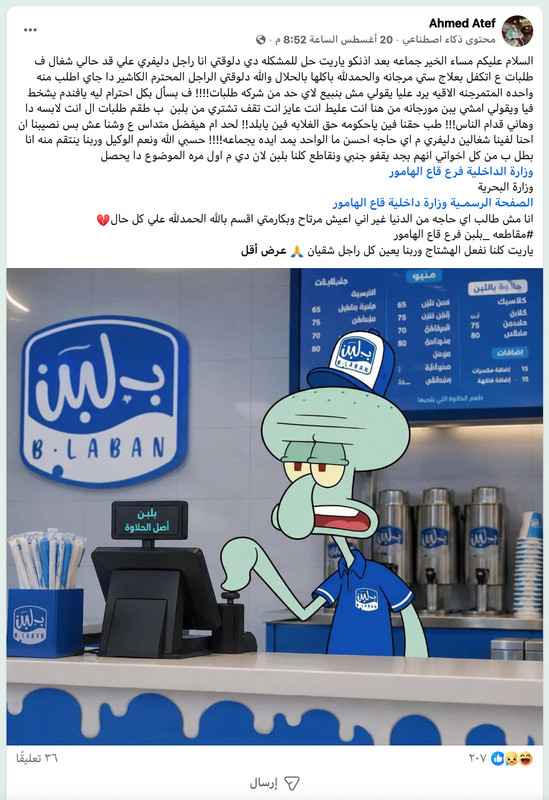
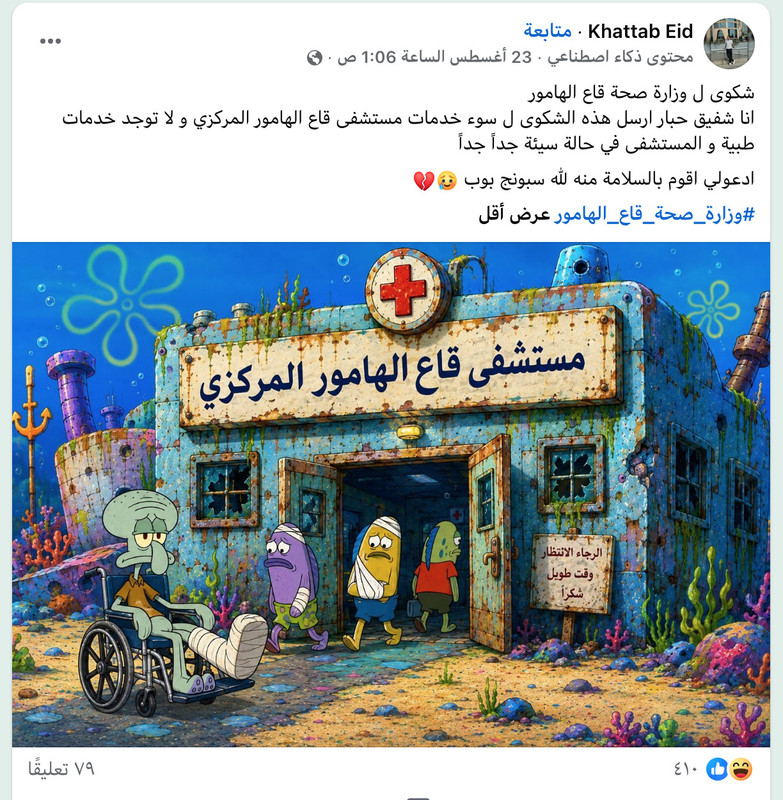
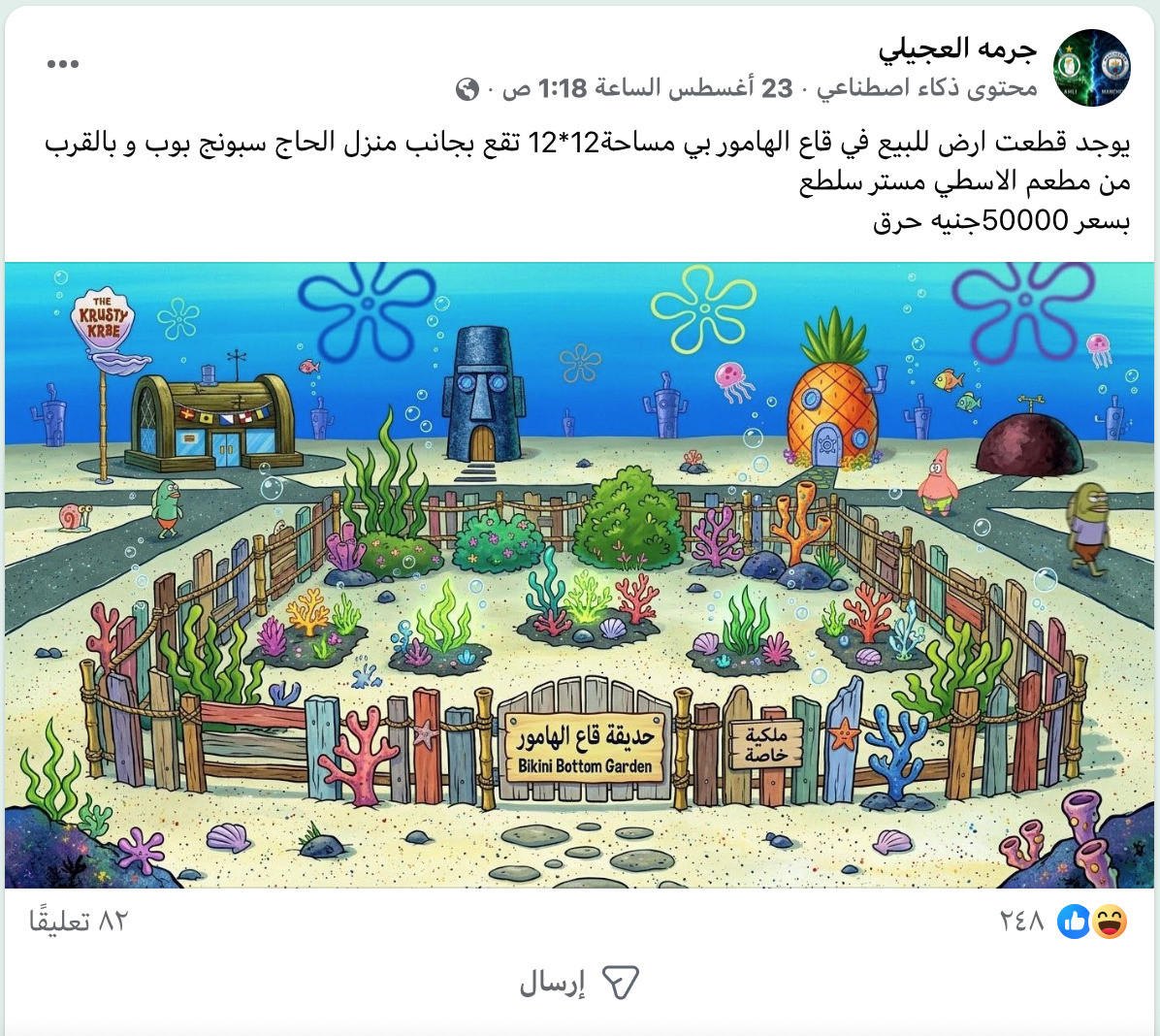
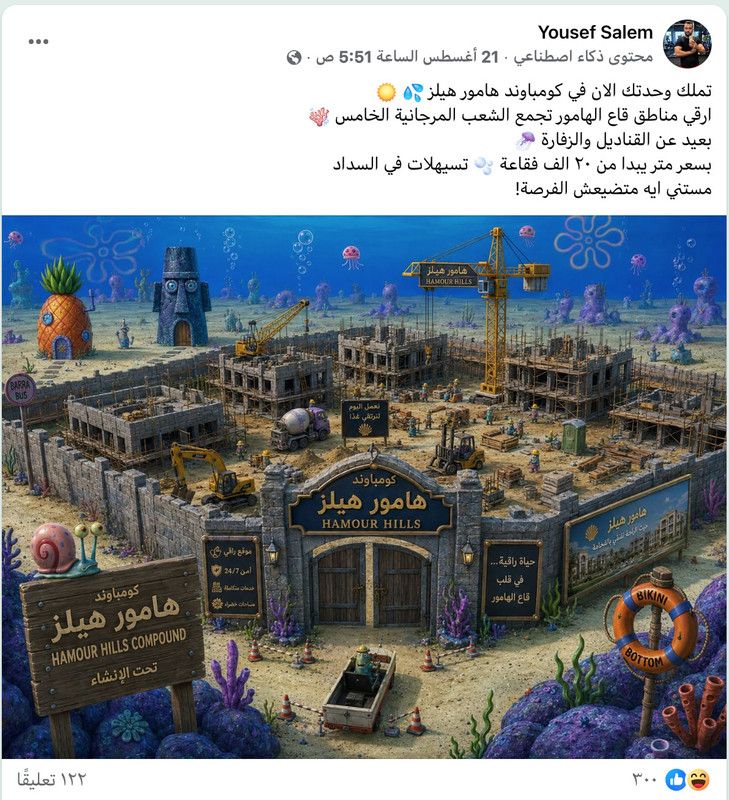
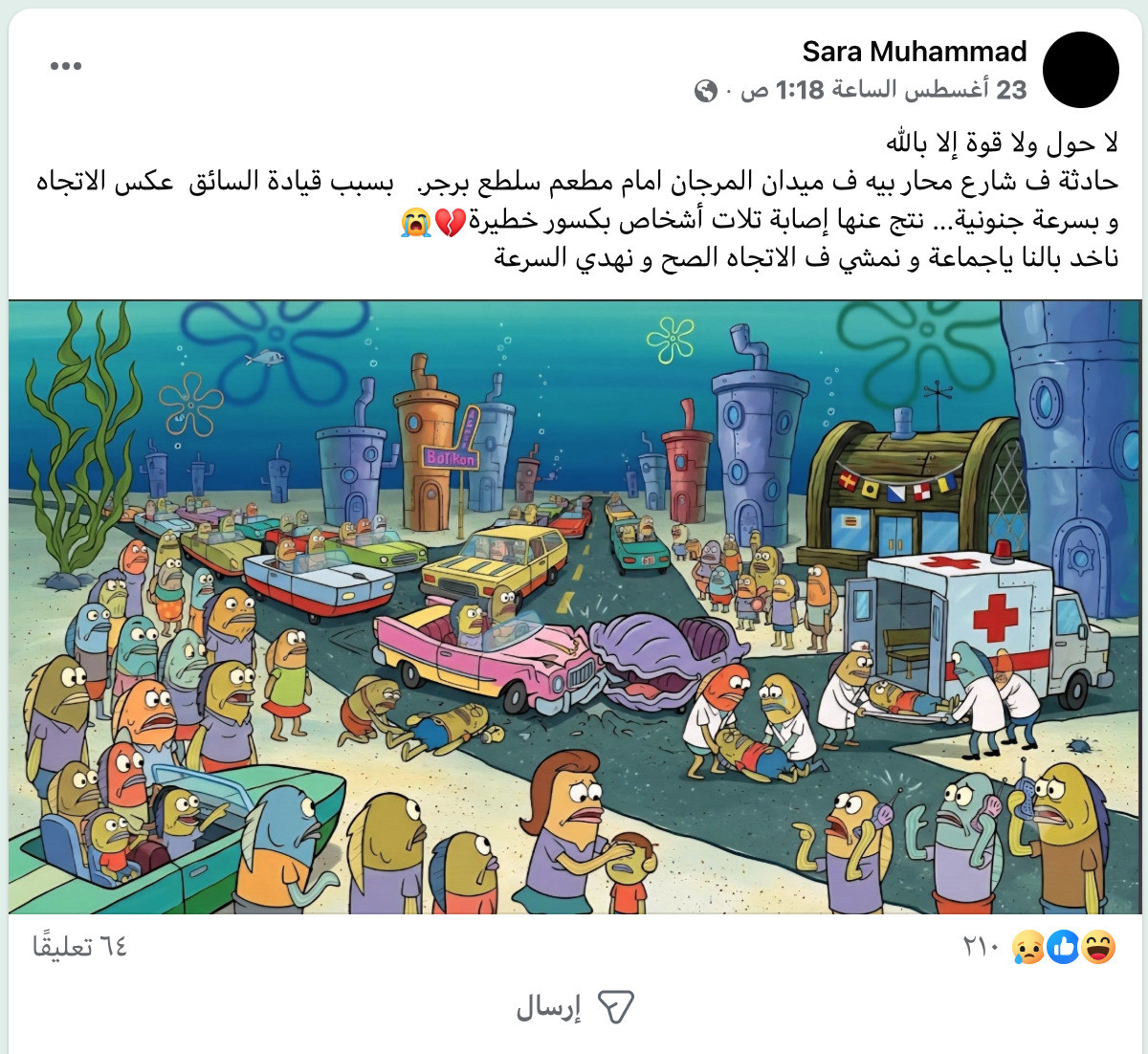
“Bikini Bottom Residents’ Complaints” began as a joke drawn from SpongeBob’s world. Members discussed imagined social housing, rents “beneath the bottom,” Mr Krabs and Krabby Patty restaurants, underwater private-tutoring centres and the late Diaa al-Awady’s “tilapia” diet. Cartoon language intersected with poverty and economic pressure.
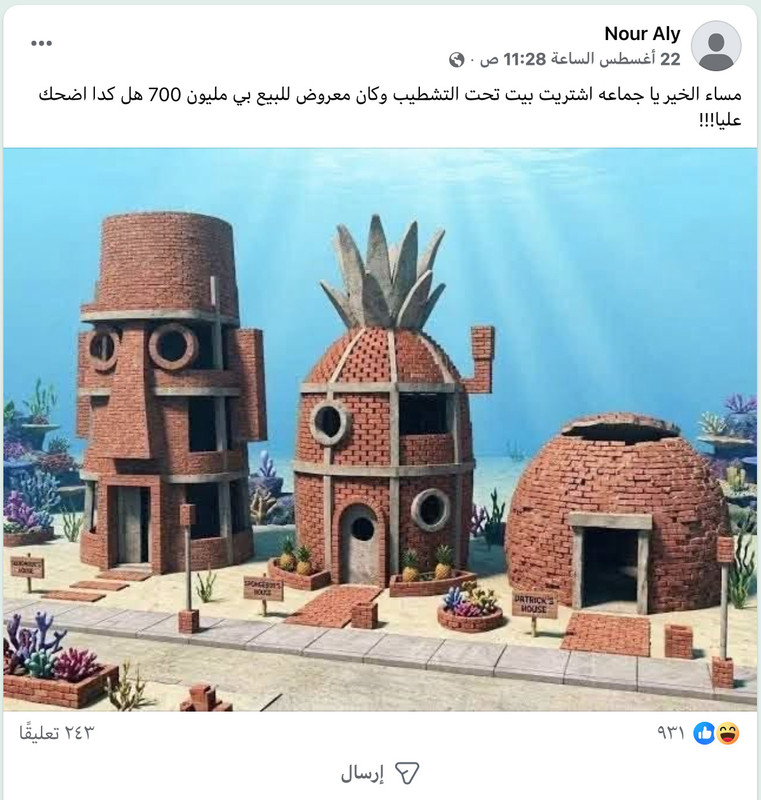
Examples of original satirical posts
The following original Arabic screenshots document the group’s cartoon vocabulary and everyday complaints discussed above.
Was Bikini Bottom political?
Behind memes and cartoon characters, members found a place to discuss prices, wages, work and government decisions. Zawia3 surveyed 46 members to examine what the group meant to them. This small respondent sample describes those participants and cannot represent all 1.8 million members.
About 63% of respondents were aged 20–29 and 33% aged 30–39. Most were observers rather than prolific creators: roughly 93% said they mainly followed the group.
More than 65% said satirical posts motivated joining and about 33% wanted to follow local issues. Some response tables allow overlapping selections, so their percentages do not necessarily total 100%.
Around 70% believed discussions resembled broader economic or political issues. Rising prices were the leading topic named, at about 59%, followed by political conditions at 22%, government decisions at 17% and unemployment or work at 15%.
People entered for memes and laughter but found themselves discussing wages, work, unemployment and policy, a Benha University sociology professor tells Zawia3. Cartoon characters became an alternative vocabulary, with satire offering release, criticism and ways to say what could not easily be stated directly.
The professor, who requested anonymity, says the group was not political in a conventional sense: politics and economics entered through the joke rather than the front door.
Asked why it closed, about 41% selected satirical criticism of general conditions and 26% pointed to the symbolic, satirical character of its content. Around 22% did not know the direct reason. These are respondents’ interpretations, not proof of the closure’s cause.
Survey results: seven tables on participation, content and closure
Reasons for joining
| Response | Percent |
|---|---|
| Satirical posts | 65.22% |
| News and problems | 32.61% |
| Submitting a complaint | 4.35% |
| It was trending | 2.17% |
How respondents used the group
| Response | Percent |
|---|---|
| Following only | 93.48% |
| Commenting | 10.87% |
| Posting satire | 4.35% |
| Public discussions | 2.17% |
| Posting complaints | 2.17% |
General topics seen in discussions
| Response | Percent |
|---|---|
| Rising prices | 58.7% |
| Political conditions | 21.74% |
| Government decisions | 17.39% |
| Unemployment and work | 15.22% |
| Wages and income | 13.04% |
| Social violence | 2.17% |
| Other entertainment | 4.35% |
How respondents interpreted satire
| Response | Percent |
|---|---|
| Just entertainment | 43.48% |
| Release of anger | 30.43% |
| Criticism of conditions | 19.57% |
| Saying what is hard to say directly | 13.04% |
How respondents described the group
| Response | Percent |
|---|---|
| Entertainment only | 58.7% |
| Satire of general conditions | 17.39% |
| Release of anger and frustration | 15.22% |
| Expression of difficult-to-state views | 13.04% |
| No importance | 2.17% |
Why the group mattered
| Response | Percent |
|---|---|
| Brought many citizens together | 34.78% |
| Enabled collective opinions | 28.26% |
| Revealed daily problems | 19.57% |
| Sometimes enabled public discussion | 19.57% |
| Did not consider it important | 19.57% |
Perceived reasons for closure
| Response | Percent |
|---|---|
| Satirical criticism of conditions | 41.3% |
| Symbolic/socially satirical content | 26.09% |
| Do not know | 21.74% |
| More intense discussions | 8.7% |
| Administration-related reasons | 4.35% |
| Politicisation or political issues | 4.35% |
Why does authoritarian power fear satire?
An anonymous political-sociology professor argues that authoritarian power fears satire because it damages the image of strength and control on which obedience depends. Humour can turn authority into an object of laughter and strip away its aura.
A joke or image can communicate criticism without stating it explicitly, the professor says, making humour an indirect political language that can cross barriers created by fear and censorship.
This is not new: Serbia’s Otpor! movement used humour and symbols against Slobodan Milošević, helping break fear and widen public expression.
An academic study cited in the report argues that repressive authorities are sensitive to satire because it simplifies public issues, increases awareness, expresses anger and gives space to voices constrained from direct speech. In Zawia3’s survey, roughly 20% viewed satire as criticism and 13% as a way to say things otherwise difficult to express.
The study suggests satire can encourage greater boldness. About 70% of surveyed members said humour made them more willing to express views, either substantially or to some extent. Roughly 70% also connected the discussions with wider economic and political issues.
Agreement with the statement “satire is a means of expressing anger” averaged 3.91 out of five. The average was 4.07 among respondents aged 30–39 and 3.79 among the younger group.
Survey results: seven tables on age, satire and expression
Respondents’ ages
| Response | Respondents | Percent |
|---|---|---|
| 20–29 | 29 | 63.04% |
| 30–39 | 15 | 32.61% |
| Under 20 | 2 | 4.35% |
Did the group’s problems resemble broader economic/political issues?
| Response | Respondents | Percent |
|---|---|---|
| Yes, somewhat | 17 | 36.96% |
| Yes, clearly | 15 | 32.61% |
| Rarely | 14 | 30.43% |
Was the group used to express wider dissatisfaction?
| Response | Respondents | Percent |
|---|---|---|
| Sometimes | 19 | 41.3% |
| Often | 13 | 28.26% |
| Rarely | 8 | 17.39% |
| I do not think so | 6 | 13.04% |
Presence of satire about economic and political conditions
| Response | Respondents | Percent |
|---|---|---|
| Moderate | 20 | 43.48% |
| High | 13 | 28.26% |
| Limited | 9 | 19.57% |
| Almost absent | 4 | 8.7% |
Did satire make members bolder in expressing opinions?
| Response | Respondents | Percent |
|---|---|---|
| Yes, somewhat | 18 | 39.13% |
| Yes, greatly | 14 | 30.43% |
| No | 8 | 17.39% |
| Do not know | 6 | 13.04% |
Use of satire to express dissatisfaction with general conditions
| Response | Respondents | Percent |
|---|---|---|
| Sometimes | 20 | 43.48% |
| Yes | 19 | 41.3% |
| No | 4 | 8.7% |
| Rarely | 3 | 6.52% |
Did the group become a space for engagement with prices and income?
| Response | Respondents | Percent |
|---|---|---|
| Yes | 18 | 39.13% |
| Somewhat | 18 | 39.13% |
| No | 6 | 13.04% |
| Do not know | 4 | 8.7% |
Satire and resistance to dominant discourse
In his work on humour against oppression, philosopher Chris Kramer argues that satire’s power lies not only in making people laugh but in reversing discourse’s function: entertainment can expose contradictions and prompt a reconsideration of reality. The survey likewise found that about 65% joined for satire, while roughly 40% did not describe the group solely as entertainment.
An OpenGlobalRights analysis of political satire in Egypt describes humour as resistance in societies where fear constrains speech, providing psychological release, courage and empowerment. It cites Bassem Youssef’s view that comedy can counter fear by freeing people to judge and think. About 30% of Zawia3’s respondents described the group’s satire as a release for anger.
Another study characterises political satire as “opposition disguised as comedy,” carrying criticism in forms difficult to treat as direct protest. Restrictions encourage symbols, implication and indirect language whose meaning audiences recognise. About 26% of respondents thought the group’s symbolic content helped explain closure.
Vocabulary analysis suggests economics was the group’s deeper language, though rarely in technical terms such as budget deficits or monetary policy. Instead, posts repeatedly mentioned price, salary, rent, food, transport and bills alongside SpongeBob imagery. Economic complaints were expressed through cartoons.
Vocabulary in the group: translated terms and reported frequency
| English rendering | Frequency |
|---|---|
| Coincidence / shell | 4,556 |
| Mr Krabs | 4,143 |
| Price | 3,947 |
| Burger | 3,821 |
| Squidward | 3,567 |
| Prices | 3,489 |
| Work | 3,356 |
| Bill | 3,174 |
| High prices | 3,086 |
| Money | 2,967 |
| Expenses | 2,913 |
| Rent | 2,847 |
| Algae | 2,734 |
| Seashell | 2,618 |
| Food | 2,543 |
| Water | 2,476 |
| Home | 2,347 |
| Salary | 2,263 |
| Transport | 2,218 |
| Apartment | 2,154 |
| Cashier | 1,936 |
| Electricity | 1,873 |
| Fare | 1,826 |
| Dollar | 1,784 |
| Kilogram | 1,756 |
| Budget | 1,693 |
| Bus | 1,627 |
| Instalment | 1,584 |
| Rock | 1,537 |
| Manager | 1,486 |
| Boat | 1,453 |
| Coral | 1,417 |
| Oil | 1,384 |
| Card | 1,356 |
| Pineapple | 1,327 |
| Top-up / shipping | 1,294 |
| Offers | 1,267 |
| Network | 1,238 |
| Subsidised supplies | 1,216 |
| Discount | 1,163 |
| Engagement | 1,127 |
| Wage | 1,094 |
| Tariff | 1,058 |
| Inflation | 967 |
| Meter | 943 |
| Experience | 918 |
| Insurance | 887 |
| Schools | 856 |
| Reduction / load shedding | 827 |
| Dowry | 793 |
| Debt | 764 |
| Shift | 738 |
| Broker | 716 |
| Resignation | 683 |
| Shrimp | 647 |
| Unemployment | 618 |
| Property | 573 |
| Interest | 447 |
| Bonus | 318 |
Zawia3 analysed posts from midnight on 21 August to midnight the following day. Themes included purchasing power, work and income, housing, utilities, food, transport, instalments and debt. Politics appeared indirectly through subsidised supplies, electricity and water tariffs, wages and prices rather than dominating through conventional political terminology.
The source’s topic graphic lists overlapping or otherwise unreconciled approximate percentages that total more than 100%. They are reproduced below as reported indicators, not as exclusive shares of a single whole.
Topics in the 24-hour post analysis
| Topic | Reported approximate percent |
|---|---|
| SpongeBob world | 26% |
| Prices and spending | 22% |
| Work and income | 16% |
| Housing and property | 14% |
| Services and utilities | 11% |
| Food | 10% |
| Transport | 8% |
| Finance and debt | 4% |
| Marriage costs | 4% |
| Government services: supplies/load shedding | 3% |
The accusation: satire
Since July 2013, restrictions in Egypt have extended beyond direct political organising to music, cartoons, video and comedy. Hamza Namira’s songs were barred from state radio in 2014, and Cairokee faced censorship restrictions in 2016.
The 2018 “Balaha” song case brought detention of video director Shady Habash, lyricist Galal al-Behairy and other production members. Habash later died in custody, while others received prison sentences.
Cartoonist Islam Gawish was detained after a workplace raid in 2016. Ashraf Omar was arrested in 2024 and brought before State Security prosecutors on allegations including false news and joining a terrorist group, following cartoons addressing economic and service crises.
The Street Children troupe’s members were detained in 2016 over satirical videos about official decisions, economic conditions and politics. A police-themed satirical video by Shady Abu Zeid and Ahmed Malek also triggered repercussions that year; Abu Zeid was later held in pretrial detention in a State Security case.
Independent artistic spaces also faced restrictions. Townhouse Gallery and Rawabet Theatre were raided and closed in 2015, Merit publishing house faced measures, and a military court sentenced publisher Khaled Lotfy in 2019 over a book’s publication.
Bassem Youssef ended Al-Bernameg in 2014 amid pressures he said made independent political satire impossible, then left Egypt.
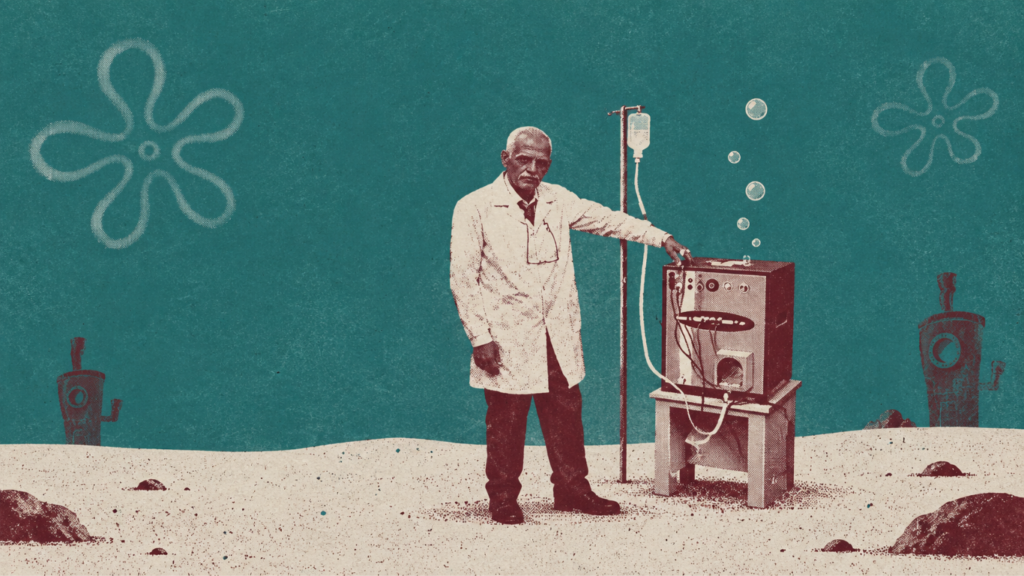
A study of the programme argues that satire shapes public perceptions of political issues. It examined the purported hepatitis C and HIV detection device dubbed the “kofta device,” whose promises the programme repeatedly mocked, and its more serious, evidence-based treatment of coal-fired power’s environmental and health consequences.
The group did not begin as an opposition platform, and people did not necessarily join seeking politics. They arrived for laughter, then discussed wages, prices, rents, services and policy. Cartoon characters became a language, memes a space for release, and individual grievances a collective conversation. Its experience sits alongside earlier restrictions on singers, cartoonists, video creators, writers and publishers.
Where the identity of those behind a strike on Damietta vessels can remain pending while a joke group closes within days, the contrast is larger than a SpongeBob story. Perhaps power fears not only what people say, but their ability to laugh while saying it.