
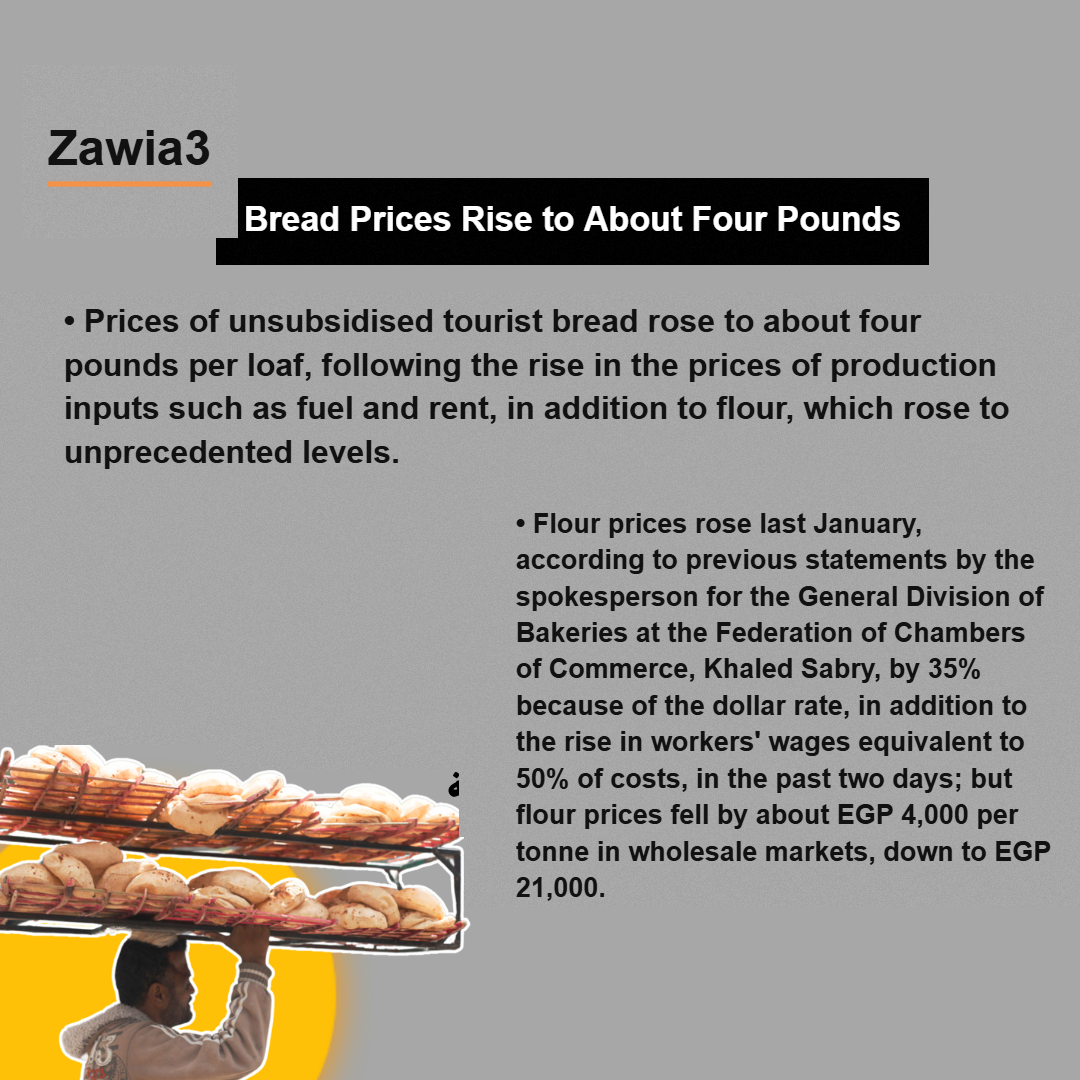
Prices of unsubsidised “tourist” bread have risen to about four pounds a loaf, following rises in the prices of production inputs such as fuel and rent, in addition to flour, which has risen to unprecedented levels.
Flour prices rose by 35% in January, according to earlier statements by the spokesperson for the general bakeries division at the Federation of Chambers of Commerce, Khaled Sabry, because of the dollar rate, in addition to higher workers’ wages equivalent to 50% of costs, which affected the price of tourist/unsubsidised bread. He added that “flour for fino bread has reached EGP 32,000 per tonne. The loaf weighed 60 grams at one pound, then we reduced the weight to 40 grams at the same price to maintain prices, and now it is a pound and a half; the 70-gram popular loaf now costs a pound and a half, and in some areas it may reach three pounds, but its weight has decreased”. He stressed that the state produces 270 million loaves a day through 31,000 subsidised bakeries and bears the cost of the subsidy.
In the last two days, flour prices fell by about EGP 4,000 per tonne in wholesale markets to EGP 21,000 on average after the declines in exchange rates, and the average price of wheat fell with them to EGP 20,000 per tonne on average, instead of EGP 23,000 in January.
Minimum Wage Raised Amid Expectations of a Record Price Increase
The government announced on Wednesday the application of a new social protection package from next month, based on a decision by President Abdel Fattah El-Sisi, to confront the high cost of living amid the economic challenges Egypt is witnessing and the rising prices of all goods. These increases are the ninth since President El-Sisi took power in 2014.
The new decisions included:
- Raising the minimum wage by 50%, to EGP 6,000 a month.
- Increasing the wages of employees of the state and economic authorities as follows: EGP 1,000 for grades six to four, EGP 1,100 for grades three to one, and EGP 1,200 for grades from director general to first undersecretary.
- Periodic raises for those covered by the Civil Service Law of 10% of the job wage, and 15% of the basic wage for those not covered, with a minimum of EGP 150 and a total cost of EGP 11 billion.
- An additional incentive starting at EGP 500 for grade six and increasing by EGP 50 for each grade to reach EGP 900 for the excellent grade, at a cost of EGP 37.5 billion.
- Allocating EGP 6 billion to hire 120,000 members of the medical professions, teachers and employees of other administrative bodies.
- EGP 15 billion in additional increases for doctors, nurses, teachers and university faculty members.
- EGP 8.1 billion for an additional increase in the wages of pre-university teachers, ranging from EGP 325 to EGP 475.
- EGP 1.6 billion for an additional increase for faculty members and their assistants at universities, institutes and research centres.
- EGP 4.5 billion for an additional increase for members of the medical professions and nursing bodies, ranging from EGP 250 to 300 in the risk allowance for medical professions, and an increase of nearly 100% in the night-shift and overnight allowance.
- A 15% increase in pensions for 13 million citizens, at a total cost of EGP 74 billion.
- A 15% increase in “Takaful and Karama” pensions at a cost of EGP 5.5 billion, bringing the increase over one year to 55% of the pension value, and allocating EGP 41 billion for “Takaful and Karama” pensions in the 2024-2025 fiscal year.
- Raising the tax exemption threshold for all state employees in the government and the public and private sectors by 33%, from EGP 45,000 to EGP 60,000.
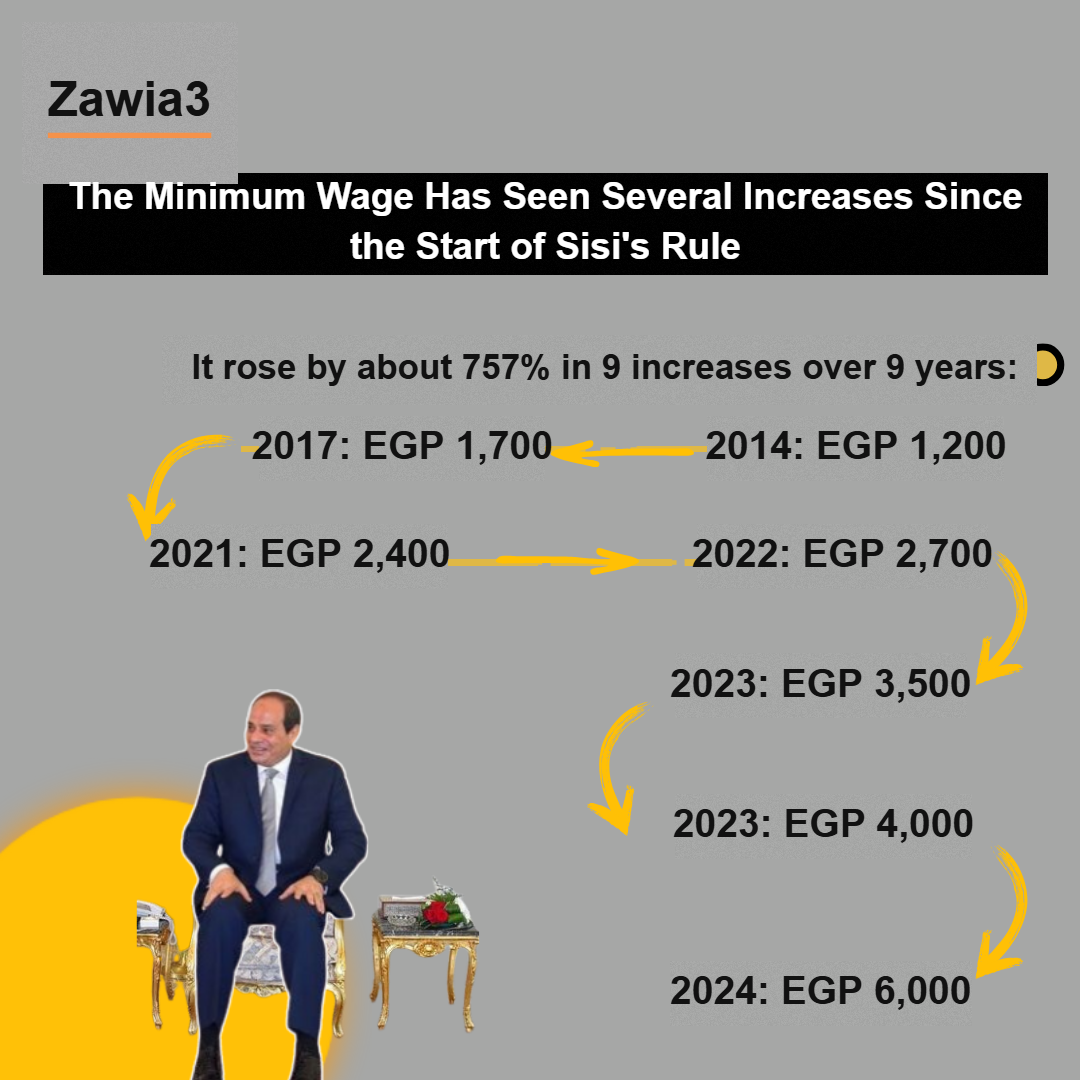
The minimum wage has seen several increases since the start of El-Sisi’s rule, rising by about 757% over 9 increases in 9 years, as follows:
The new social bonus package comes after Cairo saw a broad wave of price rises since the start of this year, covering all goods and services, which are expected to double, as the dollar on the black market reached record levels approaching EGP 75. The country is suffering an acute foreign currency crisis that has intensified since 2023, despite the currency being floated three times, from levels of EGP 16 to about EGP 30.9, amid inflation rates that reached 34.1% for consumer prices on an annual basis at the end of last December.
The First Government Response on Ras El-Hekma Investments
Hossam Heiba, head of the General Authority for Investment, said the government received offers from several international investment consortia for the Ras El-Hekma project, and an Emirati consortium was chosen to implement it, adding that initial investments are estimated at about USD 22 billion, in instalments he did not specify.
This is the first official Egyptian confirmation regarding the Ras El-Hekma project, after several statements spread in recent days about the intention of the Abu Dhabi government and Emirati investors to implement a project in Ras El-Hekma with investments of USD 22 billion, followed by a wave of anger and questions from citizens about whether the city was really being sold to a foreign investor, which is considered a kind of change and escalation in the Egyptian government’s policies.
The Government Raises the Public Debt-to-GDP Ratio to 92.2%
The Ministry of Finance said in a report that it has raised its estimate of the public debt-to-GDP ratio to 92.2% by the end of next June, compared with 91.3% in previous forecasts, as a result of raising domestic debt estimates to 71.7% by the end of next June, compared with 70.2% when the draft budget was prepared, while external debt estimates fell to 20.6% by the end of next June, compared with 21%.
The Ministry of Finance aims to put public debt on a downward path to reach 85% by June 2027, as it succeeded in reducing debt by 3.3% over the past four years. Total interest rose by EGP 200 billion as a result of higher interest on domestic debt, bringing the total interest bill to EGP 1.320 trillion, of which EGP 1.167 trillion is interest on domestic debt, compared with EGP 967.5 billion when the budget was prepared, while interest on external debt remained stable at EGP 152.6 billion. Total interest on domestic debt rose as a result of the increased financial burdens arising from the reform packages and higher interest rates by the central bank.
Prosecution Releases Three Women Journalists
The Public Prosecution on Wednesday released three women journalists who had been held in pretrial detention: Manal Agrama, Safaa El-Korbigy and Hala Fahmy.
Diaa Rashwan, general coordinator of the national dialogue, commenting on the decision, said the dialogue’s board of trustees welcomed the Public Prosecution’s decisions to release a group of pretrial detainees, including three fellow women journalists and media professionals. The head of the Journalists’ Syndicate, Khaled El-Balshy, welcomed the decisions to release a number of pretrial detainees and the three journalists, calling for the release of the remaining prisoners of conscience.
The prosecution had earlier brought charges against journalist Manal Agrama, deputy editor-in-chief of Radio and Television magazine, in case 1893 of 2022, known in the media as the case of “calls for the 11/11 protests”, after she was arrested at her home, and against journalists Safaa El-Korbigy and Hala Fahmy, who were charged in case 441 of 2022 because of their activism defending the rights of workers at Maspero and the Radio and Television Union magazine. All of them, however, faced charges of joining a terrorist group and promoting its ideas and broadcasting false news and data, in addition to Manal Agrama being charged with financing a terrorist group and taking part in a criminal act intended to commit a “terrorist act”.
The State Security Prosecution ordered the release of 60 citizens, women and men, held in pretrial detention pending cases related to expressing opinions, the peaceful use of social media and peaceful protest, who had been charged with contacting and cooperating with terrorist groups, and other charges of incitement, spreading false news and rumours, and misusing social media. They include 14 male and female teachers who were arrested and held in pretrial detention because of their protests against being excluded from appointments and their gathering in front of the Ministry of Education headquarters in the New Administrative Capital, despite passing the official tests of the 30,000 teachers competition, for discriminatory reasons set by the Military Academy that were not stipulated in the announced conditions of the competition.
The prosecution also ordered the release of Amr Abdel Rahman Zaki, held in pretrial detention since the end of 2022 pending case 2515 of 2022, and Mumtaz Ahmed Lotfy, held since September 2022 after being arrested at his home over a video he posted on his Facebook account about a “fire at Gamasa prison”, for which he apologised and which he later deleted when he realised it was untrue. However, the State Security Prosecution charged him with belonging to a terrorist group, spreading false news and misusing social media in case No. 1539 of 2022, State Security, and has since renewed his detention several times.
One Year in Prison for Tantawy and His Campaign Manager in the Presidential Endorsements Case
An Egyptian court on Tuesday sentenced former would-be presidential candidate and former head of the Karama Party, Ahmed Tantawy, to one year in prison with labour and a fine of EGP 20,000, and banned him from running in parliamentary elections for five years, on the charges against him of circulating papers related to the presidential election without the authorities’ permission, according to lawyer and Tantawy’s campaign manager Mohamed Abu El-Diyar, speaking to Zawia3.
The ruling included one year in prison and bail of EGP 20,000 for his campaign manager Mohamed Abu El-Diyar, and one year in prison with labour and immediate enforcement for 21 of his supporters and campaign members, in the case known in the media as the “presidential endorsements” case. Under the law, Tantawy and his supporters can appeal the rulings against them in Supreme State Security case No. 2255 of 2023.

“Law No. 45 of 2014 regulating the exercise of political rights” stipulates imprisonment of no less than one year or a fine of between one thousand and 5 thousand pounds for anyone who “printed or circulated by any means a ballot paper or papers used in the electoral process without permission from the competent authority”. Commenting, Human Rights Watch said using this article to restrict activists’ ability to collect popular endorsements or mobilise support in the context of a political campaign is inconsistent with the rights to both freedom of expression and association under international human rights law.
Also, under the law on forming Egyptian political parties, upholding the ruling against Tantawy and his team means obstructing them from founding the “Tayyar Al-Amal” (Current of Hope) party, because the ruling deprives them of exercising their political rights for the next five years.
The Egyptian Foreign Ministry Responds to the Occupation’s Provocations Over the Salah al-Din Corridor
Ambassador Ahmed Abu Zeid, the Foreign Ministry spokesperson, said in an interview on Al-Ghad TV that the Salah al-Din Corridor, which the occupation authority tries to call the Philadelphi Corridor, is part of the Gaza Strip and the Palestinian territories, stressing that any dealing with that area must be done with great caution because it is close to the Egyptian border, and that operations in the area pose a grave danger given the large number of displaced Gazans at the border.
The Foreign Ministry spokesperson refuted claims that Egypt has closed the Rafah land crossing on the border between Palestine and Egypt, saying delegations visit Egypt and the crossing daily, at the level of officials from the United Nations, international relief organisations and the World Food Programme, as well as foreign ministers and prime ministers of other countries, and none of them has stated that the crossing is closed. He commented: “The reality on the ground confirms that the crossing is open and aid is flowing from the Egyptian side, and any obstruction comes from the Israeli side, as a result of the obstacles it imposes and inspections that take a long time”.
The Foreign Ministry Responds to the Ethiopian Prime Minister’s Statements on the Renaissance Dam
Ambassador Ahmed Abu Zeid, the Foreign Ministry spokesperson, described in a TV interview on Al-Ghad the statements of Ethiopian Prime Minister Abiy Ahmed, in which he said his country is ready to negotiate on the Renaissance Dam, as “vague”.
He said Cairo announced its official position some time ago and has stopped continuing negotiations that lead to no solutions, stressing Egypt’s declaration that it is not against Ethiopia’s development but wants to guarantee its people’s rights to the Nile waters.
Cairo had held a number of negotiating rounds with the Addis Ababa government since 2011, after the latter exploited the events following the January revolution in Egypt to announce the construction of the Renaissance Dam. The Ethiopian prime minister proposed forming a joint tripartite technical committee including the water ministers of the three countries to meet, study the issue of the dams from all its aspects and reach a common vision on the issue and an agreement on which all parties agree. The negotiations resulted in the “Malabo” declaration, which led to the resumption of negotiations after an eight-month break, and to the signing of the Declaration of Principles on the Grand Ethiopian Renaissance Dam in 2015.
An Expected USD 12 Billion From the IMF Loan and Development Partners
A government source told the “Al-Shorouk” website that the old and new International Monetary Fund loans, in addition to what development partners provide, will reach USD 12 billion.
He explained that of the old loan, estimated at three billion dollars, only the first tranche of USD 347 million has been disbursed, and it was agreed to increase the loan by USD 3 billion, in addition to USD 6 billion from development partners, namely friendly countries, development banks and major global funds.
This comes after consultations the Fund’s representatives held with the Egyptian government during their visit to Cairo, which lasted from 17 January to the beginning of February, with Cairo to receive the new loan in nine successive tranches and the disbursement of the rest of the old loan to be rescheduled gradually. According to the source, behind the scenes of the negotiations, the IMF had required the Egyptian government to liberalise the exchange rate of the local currency, but it opposed this, refusing to liberalise the currency before six billion dollars were injected into the central bank, to raise its ability to cope with the effects of the expected flotation.
The source also revealed that more than 20 state companies will soon be offered to the private sector and foreign investors, especially Gulf investors, as part of the first government offerings programme, which will end in June 2024, in order to provide hard currency in dollars, including Banque du Caire, The United Bank and Arab African International Bank, in preparation for listing them on the stock exchange at the beginning of next year, in addition to a number of companies operating in the chemical industries, financial investments, transport and container handling, electricity and renewable energy, petroleum and insurance sectors, to be offered under the initial public offering programme.
Hala El-Said, Minister of Planning and Economic Development, had announced the completion within the next 48 hours of a deal to buy a stake in the National Company for Selling and Distributing Petroleum Products “Wataniya”, affiliated with the National Service Projects Organisation, and Cairo will decide the fate of the deal to sell the Gabal El-Zeit wind power plant by the end of the first quarter of this year, 2024.
Netanyahu Orders the Israeli Army to Prepare for a “Rafah Operation”
Israeli occupation Prime Minister Benjamin Netanyahu said he has ordered his forces to prepare for a military operation in Rafah, despite international fears of a humanitarian catastrophe in the city to which more than a million Gazans have been displaced.
He added: “Our soldiers are fighting today in Khan Younis, which is Hamas’s main centre. We have instructed the army to continue fighting and to prepare for an operation in Rafah”, stressing that “there will be no immune part of Gaza”.
He pledged repeatedly that Hamas “will not in any way be part of the post-war phase”, and he also opposes any role for the Palestinian Authority, as Washington wants, backed by several Arab countries including Egypt and Saudi Arabia. In response, Sami Abu Zuhri, head of Hamas’s political department abroad, replied to Netanyahu, saying his statements are a kind of political arrogance and that he is interested in prolonging the conflict in the region, stressing that Hamas dealt flexibly with the Paris paper, from a position of strength, not weakness, and that the movement is ready to deal with all options.
The “Jerusalem Post” quoted Netanyahu as saying the occupation authority will not accept Hamas’s latest conditions on the hostage deal, but he did not rule out continuing negotiations to reach an acceptable agreement to secure the release of about 130 hostages held in the Gaza Strip, while the newspaper hinted that Defence Minister Yoav Gallant may be indicating that Tel Aviv could reject the resistance’s conditions for a deal to release more than 130 hostages it holds in Gaza.
Hamas proposed a ceasefire plan that includes the release of all hostages, the withdrawal of Israeli forces from the Strip and reaching an agreement to end the war.
According to Hamas’s draft response, during the first phase of the truce, lasting 45 days, all women hostages, as well as children under 19, the elderly and the sick, would be released in exchange for the release of Palestinian women and children held in occupation prisons, and Tel Aviv would withdraw its forces from populated areas in Gaza. The second phase would include the release of all male detainees and the exit of occupation forces beyond the boundaries of the Gaza Strip’s areas.
Agreement Between the Sudanese Army and the Rapid Support Forces to Hold a Meeting in Switzerland
The United Nations said in a statement today that its efforts to persuade the two parties to the conflict in Sudan (Sudanese army commander Abdel Fattah Al-Burhan and his rival, Rapid Support Forces commander General Mohamed Hamdan Dagalo) to hold a meeting, most likely to be set in Switzerland, have succeeded.
UN humanitarian coordinator Martin Griffiths said they were invited to a UN-sponsored meeting between representatives of the two warring parties to discuss delivering humanitarian aid to the people of Sudan, about 25 million of whom need assistance, pointing out that the two sides proposed coming to Switzerland to hold the meeting.