
In today's brief:
A new security denial of accounts of abuses inside prisons, this time with a threat against those who publish them, and a rights group’s reply demanding proof. Two detention cases that reveal what statements do not say: a prisoner placed in his sixth case, and a writer denied his medication before his hearing. A content creator before prosecutors on a new charge, and rulings and releases without names.
In public affairs: the electricity law passes and a sentence is struck from the record, a grid loan with no announced terms, fertilizer and gas, the minimum wage, social insurance, the plan, housing, teachers, and a nursery in Agami. Regionally: Saudi Arabia and Bahrain, Bab al-Mandab, Ethiopia, Chad, and Gaza.
Denial of "sexual assaults": no prison named, no investigation, and a threat of prosecution
A “security source” denied, on the evening of yesterday, Sunday 15 November, “in whole and in detail the validity of what was circulated” on pages it said the Muslim Brotherhood runs from abroad “regarding the claim that a number of inmates of one of the reform and rehabilitation centers were subjected to sexual assaults and indecent assault”, described what was published as claims that are “illogical and baseless”, said inmates are treated “in accordance with the highest international human rights standards”, and added: “Legal measures are being taken against those promoting these claims.” The same text was repeated on other sites.
The source did not name the prison, the number of inmates, or the pages or persons who published the claim, did not announce an investigation by the Public Prosecution or a forensic examination of the inmates, and did not specify the legal measures it said are being taken or against whom. Zawia3 did not find the original claim attributed to a named body or person.
Today, Monday, the Shehab Center for Human Rights replied that “denial does not negate the violations”, asked “Where is Ahmed Sobaie?”, said a media denial does not refute testimonies of torture and physical and sexual assaults in Badr 3 prison, and called on the Interior Ministry to publish a recent, unedited video of the journalist speaking freely, to allow his family, the Journalists Syndicate and his lawyer to visit him, to have him examined by an independent medical committee, to preserve the prison’s camera recordings, and for the Public Prosecutor to open an independent investigation. The center had reported on 14 November that Sobaie was beaten and dragged inside the prison and moved to a disciplinary cell, as Sunday’s brief noted.
This is the second denial by a “security source” in less than a week: on 10 November a security source denied claims of mistreatment of an inmate it did not name, with the same phrase about “the highest international standards”. On 5 October 2026, a security source denied “in whole and in detail” what the Journalists Syndicate said about the mistreatment of the detained journalists of the Matsadaqsh platform. On 6 October 2024, a security source denied claims attributed to a Brotherhood-affiliated platform about violations in reform and rehabilitation centers. What is new in yesterday’s statement is the announcement of legal measures against those who published the claim.
Abdullah Ramadan: the sixth case in 11 years, after a release order that was not carried out
The Egyptian Initiative for Personal Rights said, yesterday, Sunday 15 November, that the renewal judge ordered on Tuesday 10 November the detention of Abdullah Rabie Ibrahim Ramadan, aged 30, for 15 days pending case No. 24225 of 2026 Abu Hammad misdemeanors, after he was brought before the Zagazig prosecution on 7 November. The Initiative said: “This is the sixth case in which Ramadan has been included during 11 years of detention and rotation.”
According to the Initiative, an order was issued on 9 August 2026 to release him with precautionary measures in case No. 12225 of 2024 Zagazig Center misdemeanors, “but the Interior Ministry did not carry out the order”, so he was held for ten days in Port Said, then moved to Zagazig police station, then disappeared from late August to an unknown place until he appeared before prosecutors in November. The Initiative said he suffers from coronary artery insufficiency and was assaulted where he is held, and called for an investigation into the failure to carry out his release orders.
The first case, according to the Initiative, dates back to 2015, when a military court sentenced him to two years with hard labor in an assembly case under Law No. 10 of 1914; he then served three years in case No. 1485 of 2020 Zagazig misdemeanors on a charge of possessing publications, then two years in pretrial detention pending a case before the Supreme State Security Prosecution; then, on 26 February 2024, an order was issued to release him in a fourth case, before he was placed in a fifth case. Zawia3 did not find a response from the Interior Ministry or the Public Prosecution on why the August order was not carried out, or on where he was held between August and November.
Peter Tawfik Kamal: his medication refused, and a renewal hearing tomorrow
The Egyptian Commission for Rights and Freedoms and the Law and Democracy Support Foundation said, in a joint statement today, Monday 16 November, that the health of writer Peter Tawfik Kamal, held in Mallawi prison, is deteriorating, that he suffers from a back abscess, high fever and weight loss, in addition to bipolar disorder requiring specialized follow-up, and that he has been denied exercise, blankets and books. The statement added: “On 12 November 2026, the administration of Mallawi prison refused to let in his medication”, before it was allowed in after an objection and a threat to file a complaint. His detention renewal hearing is tomorrow, Tuesday 17 November.
Kamal is held pending case No. 1184 of 2026 Mallawi police station, on charges of “contempt of religions” and “leading and organizing a group allegedly aiming to spread atheism, show contempt for the heavenly religions and spread sectarian strife”. According to the statement, he was arrested on 14 April 2026 after being summoned to the National Security office in Minya, and did not appear before prosecutors until 22 April, the eight days the statement described as enforced disappearance. The defense team said what was recorded in the minutes of one hearing about his refusing to have a lawyer present is untrue.
Zawia3 did not find an official statement on the case since his arrest seven months ago. The Law and Democracy Support Foundation had called for his release on 14 August, another joint statement was issued in October with the same demand, and the new statement called for his “immediate and unconditional release” and for him to be examined by an independent psychiatrist.
Lily Fouad: four days' detention on a charge different from the one announced on the day of her arrest
The competent investigating authorities in Cairo ordered, today, Monday 16 November, the detention of content creator Lily Fouad for four days pending investigation, on a charge of “publishing immoral content and electronic begging”. The report linked the detention order to the Interior Ministry statement announced yesterday, Sunday, on the arrest of a content creator it did not name, in the district of Al-Ahram police station in Giza, after the General Administration for the Protection of Morals monitored her publishing clips containing “pornographic words and innuendos offensive to modesty” and “electronic begging in a vulgar manner” “to increase viewership and make financial profits”, and the statement said she “has a criminal record” and that she confessed.
The charges announced when Lily Fouad, known as “Om Donna”, was arrested on Saturday 14 November were “misuse of social media, undermining family values, and contempt of religions”, after a clip spread in which a worker of hers threw a copy of the Quran, as Sunday’s brief noted, and on the same day the worker was detained for four days pending investigation. Neither the Interior Ministry statement nor the detention report mentioned contempt of religions, the case number, the prosecution handling it, the legal articles applied, whether the defendant has a lawyer, or a legal definition of the charge of “electronic begging”.
Terrorism circuit: 15 years for an unnamed defendant, and the release of 12 without names
The First Terrorism Circuit, sitting in Badr and presided over by Counselor Mohamed El-Sayed El-Sherbiny, sentenced, yesterday, Sunday 15 November, a defendant in case No. 1263 of 2026 Nozha felonies to 15 years’ aggravated imprisonment, on charges of assuming leadership of a terrorist group and joining Al-Qaeda abroad, and placed him and “the Al-Qaeda entity” on the terrorism lists. The defendant’s name, the length of his detention before trial, and his defense were not published. The court had reserved the case for judgment on 19 September, and it was published one day earlier that a terrorism circuit handed down life and aggravated sentences to six defendants in what was called the “Old Cairo cell”.
Today, Monday, it was published that “the competent prosecution” released 12 defendants “on residence guarantee” pending investigation, on charges of joining a group “established in violation of the provisions of the law and the constitution” and promoting its aims, criminal conspiracy to commit a terrorist crime, and using private internet accounts to commit crimes. The report did not mention their names, the case number, the prosecution, the length of their detention, or the date of the decision.
Electricity law: final approval, and "corrupt ministry" struck from the record
The House of Representatives approved definitively, today, Monday 16 November, the government’s bill amending some provisions of Electricity Law No. 87 of 2015, despite parliamentary objections. The law expands the powers of the Electricity Utility and Consumer Protection Regulatory Agency in licensing energy-efficiency services, obliges producers and importers to put energy-efficiency labels on appliances, and allows the confiscation of non-compliant appliances. The joint committee reduced the minimum fine in Article 76 from EGP 500,000 ($9,300) to EGP 200,000 ($3,700), according to the committee’s report, and MP Ahmed Khalil, head of the Nour Party’s parliamentary bloc, criticized penalties of up to EGP 2 million ($37,200).
MPs objected to the bill during the debate: MP Salah Shreiba said: “The ministry saves and the people pay”, MP Yasser El-Hawary asked: “How long will we stay with coded meters?”, and Ahmed Khalil asked: “Are we preparing penalties before we have an existing, organized market?” On the other hand, MP Rasha Ramadan, deputy head of the Energy Committee, said the amendments “aim to establish binding legislative and regulatory frameworks to enhance electrical energy efficiency”.
During the session, MP Hussein Heridy, of the Adl Party, accused the Electricity Ministry of corruption, and said “the crisis is not only in the coded meters but also in the ordinary meters”, and the Minister of Parliamentary Councils, Counselor Hani Hanna, objected, saying: “Describing a government ministry as corrupt is something criticism should not include; I ask that it be deleted from the record”, and the House agreed to the deletion. The number of those who approved the law and its effective date were not published.
Khalil’s question has a precedent in the committee’s own discussions: the electricity minister’s legal adviser said, in reply to MP Rasha Ramadan, that no companies operate in the energy-efficiency field so far and that the agency has not issued any licenses, as Sunday’s brief noted. The law passes while the administrative court is hearing a challenge to billing coded meters at cost price, adjourned to 16 January 2027.
Grid loan and conservation points: €600 million with no announced terms
The House Energy and Environment Committee, chaired by MP Tarek El-Molla, began today, Monday, discussing the presidential decree approving an agreement with the European Investment Bank on a €600 million loan, a €90 million European Union grant and a €10 million technical-assistance grant, “to expand and modernize Egypt’s electricity grid”, in the presence of Electricity Minister Mahmoud Esmat, in a joint meeting with the bureaus of the Economic Affairs and Planning and Budget committees. Until the writing of this brief, what the minister said had not been published, nor the interest rate, the repayment period or the grace period.
On the same day, Prime Minister Mostafa Madbouly followed up on measures to rationalize electricity consumption and shift to solar energy, and an initiative was presented at the meeting to give subscribers points or bill discounts in exchange for reducing consumption, about which Minister Esmat said: “This initiative and its implementation mechanisms are currently being studied.” The meeting included the “Shams Al-Sinaa” program to install 1,000 megawatts of solar energy for about 7,000 factories, without announcing its cost or timetable.
The European Investment Bank had announced the loan on 15 June, and the cabinet approved the agreement on 30 July, meaning parliament is discussing it about four months after government approval. The new foreign-currency loan comes a day before the Planning and Budget Committee discusses tomorrow briefing requests on “the risks of refinancing debt” and its exposure to foreign currencies.
Fertilizer: "enough for two months", and the minister acknowledges LNG challenges
Agriculture and Land Reclamation Minister Alaa Farouk said, before the House Agriculture and Irrigation Committee today, Monday 16 November, that “the state faces major challenges in securing the liquefied natural gas needed to operate factories”, that “the fertilizer stock currently available is enough to cover farmers’ needs for two months”, and that some decisions related to exports “raised objections among a number of farmers”. The minister spoke of “the agreement to contract for 250,000 tons of fertilizer”, and said the Finance Ministry “will bear the cost difference, estimated at about EGP 15,000” ($279), without specifying the unit on which the difference is calculated.
The minister did not specify the size of the cut in gas supplies to the factories, what will happen after the two months, which export decisions he meant, or the total cost to the budget. The meeting’s agenda included briefing requests on halting the disbursement of subsidized fertilizer for orchards, sugar beet and strawberries, and to farmers in arrears on installments for Reconstruction Authority land.
The minister’s language differs from previous statements: on 11 November the Cabinet Media Center said the stock is “safe and sufficient” and that “the full quotas will be disbursed”, as Sunday’s brief noted. On 12 November, Mohamed Shata, head of the Central Administration for Directorates Affairs at the Agriculture Ministry, said the warehouses hold 7.8 million sacks, enough for two months, and that there is no local shortage of nitrogen fertilizers. The figure the minister gave today is the same duration, but with an acknowledgment of a gas crisis.
Minimum wage: EGP 8,500 from January, and the question of enforcement
The National Wages Council, in an extraordinary meeting chaired by the prime minister announced yesterday, Sunday 15 November, decided to raise the minimum wage for private-sector workers from EGP 7,000 ($130) to EGP 8,500 ($158) a month as of 1 January 2027, set the minimum hourly wage for temporary or part-time work at EGP 34 net (63 cents), and the minimum annual raise at EGP 350 ($6.5), provided it is not less than 3% of the insured wage. Planning Minister Ahmed Rostom said about 26.5 million people work in the private sector out of about 32 million employed in 2025.
Today, Monday, Labor Ministry spokesman Abdel Wahab Khedr said “the principle is commitment to applying the decision without exceptions”, based on Articles 104 and 105 of Labor Law No. 14 of 2025, and that complaints are filed with the labor directorates. The number of establishments that complied with the previous minimum, the number of inspectors, the value of penalties for violators, and the situation of workers in the informal sector were not announced. The council had raised the minimum from EGP 6,000 to 7,000 in February 2025, effective March of the same year.
On the evening of yesterday, Sunday, Labor Minister Hassan Radad said, in a phone intervention, that “250,000 people applied for 100 temporary jobs” in agriculture in Spain, or 2,500 applicants per job, and announced a national platform to review employment contracts before travel abroad, without mentioning the wages of these jobs or how applicants are selected.
Social insurance: "by next January", after two deadlines passed
The head of the National Social Insurance Authority, Major General Gamal Awad, said before the House Manpower Committee yesterday, Sunday 15 November, that the problems of the electronic pension system are “on their way to a final solution, by next January”, and that “disbursement of dues for cases of death of the insured has been completely finished, with a completion rate of 100%”, and cited completion rates of 96% for files of deceased pensioners, 91% for end-of-service files due to disability or reaching retirement age, and 92% for pension applications.
The authority’s head did not mention the numbers of delayed files or the value of the dues, so the percentages alone do not show how many are waiting. January is the third deadline: on 17 June the same committee recommended that the authority commit to the 1 August date its head had announced for fixing the faults, and study applying Article 130 of Insurance Law No. 148 of 2019 to pay delay compensation automatically by 1 September; then MP Mohamed Fouad said on 3 October that “the two deadlines have passed”, as Sunday’s brief noted.
The plan: 5.4% growth, and "new financing mechanisms" to ease pressure on the currency
President Abdel Fattah El-Sisi reviewed, yesterday, Sunday 15 November, with the prime minister and the planning minister the plan for fiscal year 2026/2027, which targets growth of 5.4% and investments of EGP 3.7 trillion ($68.8 billion), and directed, according to presidential spokesman Mohamed El-Shennawy, the completion of the regulatory and institutional frameworks to launch new financing mechanisms involving international institutions and the private sector in infrastructure “to reduce pressure on foreign currency”, and the study of financing requests to choose the most suitable in terms of cost and terms.
The statement did not specify the private sector’s share of the targeted investments, what the new mechanisms are, or the inflation and debt targets. The directive comes in a week in which the Energy Committee is discussing a new European loan, and the Planning and Budget Committee discusses tomorrow the rise in non-residents’ holdings of treasury bills, after foreigners bought a net EGP 101.5 billion in a single week. Egypt is hosting today and tomorrow a meeting with the World Economic Forum in the New Administrative Capital with more than 70 representatives of international companies and economic institutions, without announcing their names or any pledges so far.
Housing: 500,000 units needed annually, and the state builds half
Housing Minister Randa El-Menshawy said, in a television interview on the evening of yesterday, Sunday, that “annual demand for housing units in Egypt reaches about 500,000 units”, while the state builds between 200,000 and 250,000 units a year, and that about 1.9 million units have been built since 2014. She described social housing as one of the most prominent challenges she faced when she took over the ministry, with stalled projects and delays in handover, and attributed part of this to weak funding in some periods.
The minister did not mention the number of people waiting to receive social housing units, or the number of stalled units. The statement comes as the lawsuit challenging the constitutionality of the old rent law was adjourned to 13 December, and on the same day the Socialist Popular Alliance Party in Dakahlia criticized the rise in housing unit prices and rents, and demanded that New Mansoura serve young people.
The 30,000-teacher competition: the ministry requests a postponement, and an MP cites Article 136
The head of the House Education Committee, Ashraf El-Shiehy, announced the postponement of a meeting scheduled for today, Monday, to discuss the crisis of the 30,000-teacher competition, at the request of the Ministry of Education to study the committee’s recommendations, to a date “to be set later”. The recommendations include reviewing the minimum pass mark, distributing teachers according to place of residence, a strategic plan to fill the shortage, and speeding up appointments.
MP Rawya Mokhtar said the minister’s attendance before the committee is not optional, citing Article 136 of the constitution, and criticized the repeated response that the matter is “under study”. The ministry has not announced the number of those excluded from the competition or the size of the teacher shortage. The committee had set at the end of October an earlier meeting on those excluded in early November.
Agami: the ceiling of an unlicensed nursery collapses, injuring four children
The ceiling of a children’s nursery operating without a license collapsed yesterday, Sunday 15 November, in the Al-Bitash area of Agami in Alexandria, injuring three girls and a boy who were taken to Agami General Hospital; one of them needs surgery on the skull bones, with confirmation that the child’s life is not in danger. The building’s owner and the nursery’s tenant were detained, and Alexandria’s local rapid-intervention team went to the site after a report from the Social Solidarity Directorate.
The nursery’s name, how long it had operated without a license, the structural condition of the building, and the number of unlicensed nurseries in the governorate were not announced. The incident is the third in Alexandria within days, after the collapse of the Sheikh Tamoum Street building on Saturday and the evacuation of the Komy Street building on Sunday, as Sunday’s brief noted.
Saudi Arabia: "preventing the resumption of military operations" on the day of the missiles on Riyadh
Foreign Minister Badr Abdelatty and his Saudi counterpart, Prince Faisal bin Farhan, agreed, in a phone call today, Monday 16 November, on continuing coordination and dialogue “to de-escalate”, and on “continuing to work to prevent the resumption of military operations”, according to the ministry’s spokesman, Ambassador Nader Zaki. Hours before the call, the Houthis’ military spokesman, Brigadier General Yahya Saree, announced targeting King Khalid International Airport and a financial center in Riyadh with two ballistic missiles, and two pumping stations on the East-West pipeline with two drones, while the Saudi-led coalition said it intercepted two missiles and drones heading to Riyadh and the Eastern Province, then drones over Mecca and Medina.
The Egyptian statement did not mention the Houthis or Yemen, did not specify which military operations it is working to prevent “resuming” while the attacks continue, and did not touch on the Egyptian forces present in Saudi Arabia. Until the writing of this brief, Zawia3 did not find an Egyptian condemnation of Sunday’s attacks on Riyadh, after the ministry had condemned, in an earlier statement, “the continued attacks on the Kingdom’s territory”.
Abdelatty said in an interview published on 10 November that Egyptian forces have been in Saudi Arabia for months, that their missions are defensive, and that they will not go beyond Saudi territory towards Yemen. The number of these forces has not been officially announced, nor whether they took part in intercepting the missiles and drones.
Bahrain: condemnation without naming Iran, and a quartet with Turkey and Pakistan
The Foreign Ministry condemned, yesterday, Sunday 15 November, “the attacks targeting the Kingdom of Bahrain”, and described them as “a violation of the Kingdom’s sovereignty”.
Neither the title of the Egyptian statement nor what was reported from it named the party responsible for the attacks. On the same day, Abdelatty discussed with Turkish Foreign Minister Hakan Fidan de-escalation within the framework of the regional quartet comprising Egypt, Turkey, Saudi Arabia and Pakistan, and joint communication with Washington and Tehran, and discussed with Pakistan’s Deputy Prime Minister and Foreign Minister, Mohammad Ishaq Dar, creating the conditions for resuming the US-Iranian dialogue, without the statements mentioning what Cairo is asking of Tehran.
The coordination with Ankara in the Gulf is taking place while Egypt rejects the maritime memorandum of understanding between Turkey and Libya, which the Libyan House of Representatives in the east ratified in October, as Sunday’s brief noted.
Bab al-Mandab: government forces withdraw from Dhubab, days after the canal's record figures
The southern forces within the Yemeni government camp announced, yesterday, Sunday 15 November, what they described as a redeployment to reinforce other fronts, after Houthi media said their forces had forced government forces to withdraw from Dhubab airport and the Bab al-Mandab area and its surroundings. This comes about 40 days after the government launched Operation “Dawn of Yemen” on 5 October.
Zawia3 did not find a comment from the Foreign Ministry or the Suez Canal Authority on the development. The authority’s chairman, Lieutenant General Osama Rabie, had announced on 5 November revenues of $724 million in October against $373 million a year earlier, from the transit of 1,490 ships, and the same coverage linked the canal’s recovery to the passage of Saudi oil exports through it due to the disruption in Hormuz and Bab al-Mandab, the strait on whose eastern bank the Houthis now announce advances.
Ethiopia: an accusation of arming with no response from a named executive official
Two days after the Ethiopian army chief of staff, Field Marshal Birhanu Jula, accused Egypt of providing “logistical support and military supplies” to the attack in Tigray, and the Ethiopian water minister said Egypt built the High Dam “without sufficient regard for Ethiopia’s interests”, as Sunday’s brief noted, no response had come from the Foreign Ministry or the Ministry of Water Resources and Irrigation until the writing of this brief. The named Egyptian response came from outside the government: the head of the Senate Foreign Affairs Committee, former foreign minister Mohamed El-Orabi, said the claims are baseless.
On 4 October, President El-Sisi issued, with the presidents of Eritrea and Somalia and the Sudanese army chief, a quadrilateral declaration in New Alamein warning against unilateral measures that harm downstream states, that is, with Eritrea, the country the Ethiopian chief of staff said led the attack.
Chad: military meetings and a land road, and Sudan absent from the statement
The Egyptian ambassador to Chad, Mohannad Mazaree, and the military attaché, Colonel (Staff) Ahmed El-Barbary, met the chief of staff of the Chadian armed forces and the commanders of the Presidential Guard, the branches of the armed forces and the police, according to what the Foreign Ministry published, and discussed preparing for the second meeting of the joint military cooperation committee, signing cooperation protocols, treating and training Chadian military personnel in Egyptian armed forces hospitals, and the land road between the two countries as one of the strategic connection axes in Africa.
The statement did not mention Sudan, Darfur or border control, although Chad borders Darfur. Abdelatty had said on 10 November that Egypt will put forward “specific ideas” for a humanitarian truce in Sudan “without any external interference”, and on 2 November Egypt expressed, in a joint statement with Sudan, its readiness to take measures under the “Joint Defense Agreement”. Yesterday, Sunday, the Kordofan Observatory said a Sudanese army drone strike killed 15 civilians, including four children, in West Kordofan.
Gaza: about 4,000 trucks since the start of November, against 18,200 a month in the agreement
Awad El-Ghannam, correspondent of the state-run Extra News channel at the Rafah crossing, said today, Monday 16 November, that “the number of trucks that entered the Strip since the beginning of November did not exceed about 4,000 trucks”, against an agreed “about 18,200 aid trucks per month”, attributed this to Israeli restrictions, and said about 70,000 tents were damaged by floods. On the same day, the Egyptian Red Crescent launched convoy No. 313 of the “Zad Al-Ezza” convoys with more than 1,959 tons of aid.
Until the writing of this brief, the Foreign Ministry and General Intelligence had issued no statement attributed to a named official on aid entry rates or on opening the crossing for the passage of people. The heads of the intelligence services of Egypt, Turkey and Qatar had agreed in Cairo on Friday 13 November to “complete the first phase” of the agreement and “increase humanitarian aid”, as Sunday’s brief noted, and according to the correspondent’s figure, about 22% of the monthly target entered in the first half of the month, less than half the agreed rate for this period.
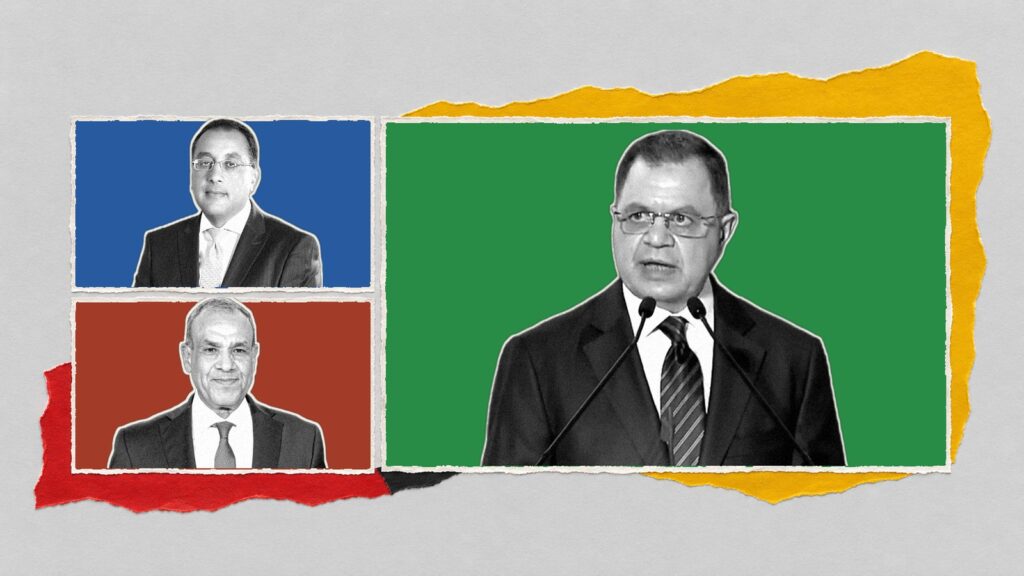
Photos: Interior Minister Mahmoud Tawfik, Egyptian Channel One via Wikimedia Commons (CC BY 3.0); Prime Minister Mostafa Madbouly, Office of the Prime Minister of Egypt via Wikimedia Commons (public domain); Foreign Minister Badr Abdelatty, photographed by the U.S. Department of State via Wikimedia Commons (public domain).