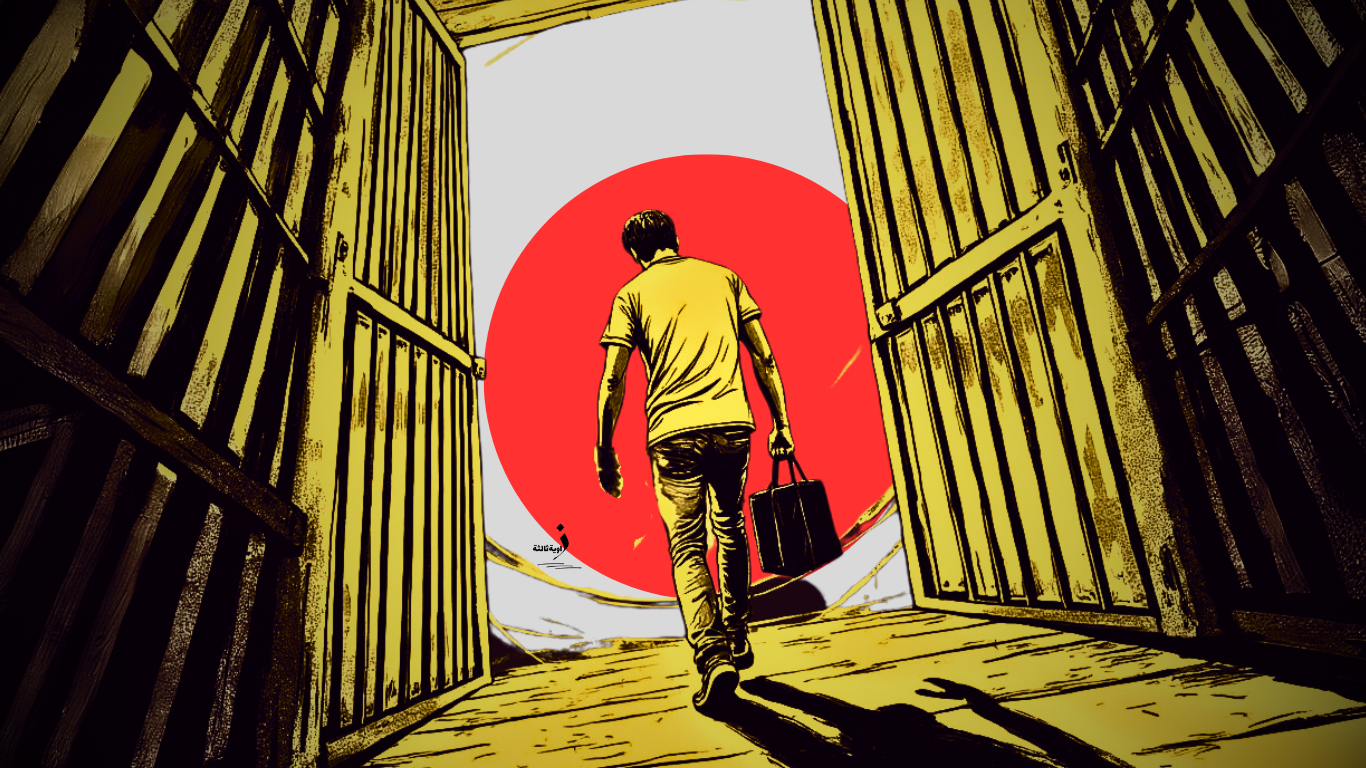
“I want nothing from life except the freedom of my son, the family’s breadwinner, who lost his youth and his university. I am a mother of three daughters, my husband died, I lost my health and my energy has run out, and for things to continue like this means the destruction of an entire family.” With these words, Amal Selim El-Adawy, the mother of Omar, one of the prisoners in Badr prison, began speaking about her son, who has been imprisoned on political grounds for about ten years.
Omar Mohamed was arrested in early June 2015 in front of a restaurant along with two friends, Esraa El-Taweel and Sohaib Saad. He was 22 at the time, a student at the Faculty of Engineering, and working at one of the military factories. On 29 May 2016, the military court in Cairo issued its verdict in the case known in the media as the “Cairo cell”, sentencing eight to death, 12 to life imprisonment and six defendants to 15 years, and acquitting two. Omar was one of those sentenced to life imprisonment, on charges of disclosing military secrets, planning to target state officials and other charges. In September of the same year, the Minister of Defence ratified the verdict against him.
Omar’s mother tells Zawia3: “My son is now over 30 years old and held in Badr prison. His poor psychological state has gone far beyond his deteriorating physical condition, as he now suffers from spasms and depression, which led him to go on hunger strike twice before with the aim of ending his life. He also suffers from multiple health problems, including recurrent high body temperatures of unknown cause, and other pains and psychological and physical complications resulting from imprisonment.”
She adds: “Omar is now denied paper and pen, which were his outlet. He has been alone in his cell since last September, after the release of the cellmate who shared the same cell with him.” Last April, for the second time, during her visit to him at his place of detention, Omar begged his mother to grant him permission to take his own life. He did this under the weight of despair, having bid farewell to the dream of freedom and seeing no option before him but this one.
Omar Mohamed is one of the prisoners in the Badr prison complex, which the Egyptian authorities opened at the end of 2021 in the Badr area northeast of the capital, Cairo. There are no accurate statistics on the number of political detainees, whether in pretrial detention or those against whom a final sentence has been issued.
The Prisoners’ Families Initiative
In early July, a number of families of political prisoners launched an initiative appealing to the relevant agencies to release their relatives. In its first post, the initiative published a form for prisoners’ families wishing to join the initiative, as well as for signatures from citizens and others standing in solidarity.
Zawia3 contacted one of the initiative’s organisers through its official Facebook page, who preferred not to be named for fear of security prosecution and on lawyers’ advice. He says: “There are tens of thousands of families whose relatives are detained, whether in pretrial detention pending investigations or under final sentences. The initiative includes families from all governorates whose relatives were arrested in various events from 2013 up to the recent protests in solidarity with Gaza.”
He adds: “Our children finish one case only to find themselves in another for no reason; years and years are lost from their lives, not to mention the depletion of our psychological and physical energy that we, the detainees’ families, suffer. Our lives are being wasted in visit queues.”
He continues: “Over the past years, we turned to a number of institutions in the hope of our relatives’ release, such as the National Council for Human Rights and the Public Prosecution, to no avail. When the Pardon Committee started, hope returned to us; we repeatedly submitted our relatives’ names and contacted members of the Pardon Committee, but unfortunately with no result so far.”
The organiser of the newly launched initiative stresses that the prisoners’ families who have joined it are prepared to accept any conditions if that means their relatives returning from prison to life, stressing that the initiative is independent, does not belong to any group, party or institution, and that no one represents it except the prisoners’ families. He points out that the initiative’s purpose is not an attempt to apply pressure, but rather a plea, an appeal and hope.
A few days later, the number of signatories to the initiative’s form reached 7,295, the majority of them prisoners’ families, at 5,222, while the number of signatories in solidarity reached about 2,073. A number of public figures joined and supported the initiative, including MP Abdel Moneim Emam; lawyer Tarek El-Awady, a member of the Presidential Pardon Committee; former Minister of Manpower Kamal Abu Eita, a member of the Presidential Pardon Committee; and politician Yasser El-Hawary.
A Troubling File
Commenting, lawyer Tarek El-Awady, a member of the Presidential Pardon Committee, says that this initiative is presented by prisoners’ families demanding the release of their relatives in exchange for providing all guarantees and pledges, pointing out that the families’ awareness of the importance of organising themselves as an initiative to launch collective appeals and speak collectively is commendable.
The member of the Presidential Pardon Committee explains that the initiative contacted him and Minister Abu Eita, and that they in turn submitted this initiative to the relevant agencies in Egypt, adding: “We hope there will be direct communication between the state and the families, and clear messages to reassure them.”
El-Awady believes that the statement by the Minister of Parliamentary and Legal Affairs and Political Communication, Counsellor Mahmoud Fawzy, about reviving presidential pardons is a response to this initiative. He expressed his hope that all those detained in opinion cases will be released, stressed the need to close the file of political prisoners, which he described as “troubling”, and pointed out that it is also in the Egyptian state’s interest to close this file urgently.
In press statements, Counsellor Mahmoud Fawzy, Minister of Parliamentary and Legal Affairs and Political Communication, said that lists of young people detained for showing solidarity with Palestine are currently being prepared, pointing out that they will be sent to the competent judicial authorities for consideration.
He said he had received directives from Prime Minister Mostafa Madbouly to intensify communication with the Presidential Pardon Committee and similar committees, expressing optimism about a breakthrough in this regard in the coming few weeks. He continued: “I was tasked by Madbouly with intensifying communication with the Presidential Pardon Committee and all similar committees, so that the state of openness that has taken place in Egyptian society widens and an atmosphere of relief prevails. We hope for the best, and God willing we will see quick positive steps in the coming few weeks.”
In the same context, politician Yasser El-Hawary, one of those the initiative approached to adopt it, says: “The initiative contacted me from its first day, and I did not try to ask about their identity, because for me the issue is not who is behind the initiative but what its subject is. After reading the initiative, I found that its wording and the appeal it contains are very acceptable, which prompted me to share the initiative and sign it.”
El-Hawary favours this type of initiative, which he described as rational, adding: “We have been two sides in a conflict for more than ten years now without reaching a result, and this type of initiative is highly rational. In my estimation, the state responds to this kind of initiative and appeal, and in the end we want and hope for the crisis to end and for those detained in opinion cases to be released; this is the goal, not merely recording positions, because that has not borne fruit over the past years.”
It is worth noting that in April 2022, the Presidential Pardon Committee was reactivated following the Egyptian Family Iftar, at which President Abdel Fattah El-Sisi called for a national dialogue, saying: “The homeland has room for all of us, and difference of opinion does not spoil the homeland’s cause.” Since then, a number of release decisions were issued for some pretrial detainees, in addition to pardon decisions for those who had received final sentences, but those decisions disappeared again in mysterious circumstances without reasons.
Pretrial Detention
The war on Gaza and the economic crisis the country is going through have taken the lion’s share of public attention over the past months, casting a shadow over the file of political prisoners, amid a sharp decline in the number of those released and pardoned.
For his part, human rights lawyer Mamdouh Gamal believes that this initiative will revive the file of detained political figures, whether held in publication or opinion cases, and whether in pretrial detention or sentenced to criminal penalties, especially since interest in the file declined in recent months because of successive crises, from economic conditions to regional issues, which pushed this file to the bottom of public opinion’s priorities. He pointed to the importance of the humanitarian rather than political discourse the initiative adopted.
He explains that the continued pretrial detention of political figures, and the use of imprisonment in general against politicians because of their opinions or positions against the current government and authorities, is completely misplaced, both politically and in security terms.
The human rights lawyer points out that the relevant agencies’ resort to pretrial detention during 2013 and 2014 “had a justification given what the country was going through, with targeted terrorist operations and violence, so the authorities had their reasons for widening the circle of suspicion, but this situation no longer exists, and there is no longer any justification for using this measure and continuing with it.”
He goes on to say that the pretrial detention of politicians, assuming good faith, undermines all the indicators and the talk of a political opening between the authorities and the opposition, and if the state is talking about the New Republic, this certainly requires new policies in dealing with opponents.
Gamal stresses that the prisons crisis is not overcrowding, but holding the accused between walls without any activities, which makes him feel a slow death. Prison is supposed to be a centre of reform and rehabilitation, as the modern name, the Community Protection Sector, which replaced the former Prisons Sector, implies, and the accused is supposed to be rehabilitated within the sector, but the opposite happens, for both political and criminal prisoners. He explains that the decision to release political prisoners is issued by the Public Prosecution, while those with final sentences can only look to a presidential pardon from the Presidency. We hope to see release decisions from the prosecution and presidential pardons in the coming period.
The human rights lawyer stresses that there are many means and mechanisms the relevant authorities could resort to instead of pretrial detention, most importantly the electronic bracelet, which has been applied as a model in some societies, although this requires a legislative amendment; other measures could be applied instead of people’s lives being wasted in detention.
Regarding the decline in the Pardon Committee’s activity, Mamdouh believes the committee is not to blame, since it prepared the necessary lists, and that the heavy blame falls on the security and sovereign agencies that did not take the decision, and that throwing people into prisons is not a national rescue, because the result is very costly. “I think it is in everyone’s interest, citizens and the political system alike, to end this file quickly.”
More Detainees
Information received by Zawia3 shows an escalation of security campaigns in recent days against the backdrop of anonymous calls to protest tomorrow, Friday, as the authorities intensify random searches of citizens in streets and public places, search their mobile phones and detain anyone they suspect, so the number of political prisoners is rising. Reports have circulated of the arrest of a number of citizens and their interrogation at the Supreme State Security Prosecution, and so far there are no official statements or remarks regarding those reports.
Human rights and political researcher Mostafa Shawky says there is a fundamental contradiction in the discourse of the government, represented by the Prime Minister, who stressed before parliament that one of the government’s most important goals is to implement the outcomes of the National Dialogue and prepare for a new round of it, explaining that the guarantees on the basis of which the political forces agreed to take part in the dialogue are still pending, foremost among them the file of prisoners of conscience.
Shawky explains that, in addition to the stalled file of prisoners of conscience, there is a security free-for-all against citizens over any anonymous calls to protest, which has blatantly increased the number of prisoners of conscience since the arrest of citizens over solidarity with Gaza and the events and movements that followed. He points out that all of these are signs that the authorities are retreating from the calls for political reform and the paths of de-escalation they had adopted over the past two years. From this climate, it appears there are no real chances for competitive parliamentary elections in which all parties are allowed to reach and interact with the public, which means reproducing the scene of the 2020 elections, a scene that is offensive and harmful to the country.
In May 2022, a number of human rights organisations launched a proposal setting out criteria and controls for the release of all political prisoners in Egypt, as part of the “First Seven Steps” initiative, launched and signed in 2021 by more than 50 civil society organisations, parties, Egyptian groups at home and abroad, and regional and international human rights bodies.
The proposal set urgent priorities for decisions to release political prisoners, including the cases of the sick, minors and the elderly, those detained in publication cases in violation of the constitution, and all those who have exceeded the maximum period of pretrial detention, even if they were detained in new cases, in what is known as the phenomenon of “recycling political detainees”. It also called for releasing all pretrial detainees held for a maximum of six months without the prosecution having sufficient evidence to refer them to trial, and pardoning the remainder of the sentence for those previously convicted on political charges who have served more than half of their sentences and been denied their right to conditional release for no reason other than the nature of the charges against them.