
Five years ago, Hoda Mohamed, from Beni Suef governorate, began working as a community outreach worker for the Ministry of Social Solidarity, without a contract and on an allowance basis. She received a few hundred pounds each month for work extending beyond monitoring families receiving Takaful and Karama cash support to raising awareness in rural villages about issues such as child marriage, female genital mutilation, domestic violence and school dropout. The hope of a permanent appointment and access to social and health insurance kept her in a job whose pay did not provide even a minimum decent standard of living.
But her dream of a permanent appointment, shared by thousands of her colleagues, faded, and their economic circumstances worsened after they were forced in 2022 to sign volunteer contracts. These deprive them of basic labour rights, including health and social insurance, and make their continued work dependent on the ministry’s wishes. Hoda recalls receiving a monthly allowance of no more than EGP 1,500, which might not even cover transport and the monthly internet package she uses for work. Payments are sometimes delayed, reduced or suspended for a month or two for some workers.
Despite these difficulties, outreach workers play an essential role in national initiatives, particularly Decent Life. Each follows up with around 200 families, documents their needs and connects them with government services. Hoda says they faced intense pressure during the coronavirus vaccination campaign, when they were assigned long hours without additional pay, receiving only a meal each, and threatened with dismissal if they refused. They also mobilise village voters and encourage participation in elections, while helping campaigns become familiar with local areas and residents.
She tells Zawia3: “They deceived us. They said, ‘Come and sign the contracts.’ We went happily, thinking we would sign ordinary employment contracts. Instead, they made us sign ‘volunteer’ contracts. When we tried to read them, they said, ‘Sign quickly, there’s no time to read.’ They even prohibited photographing the contract, although some women managed to photograph it secretly. They exploited our happiness, our desire to have contracts and our lack of legal knowledge. Those who refused eventually had to sign, like drowning people clutching at a straw. You know how difficult things are.”
Describing her working conditions, Hoda adds: “Five colleagues and I are responsible for my town, and each of us is responsible for 200 families. I am supposed to visit them monthly and follow up on their health, financial and economic problems, including school dropout and female genital mutilation. Recently, however, we have been under great pressure, and some of us are not being paid. I personally received not a single pound last month, and for three months I have received no more than EGP 500 a month. Yet we are afraid to speak because they threaten to dismiss us. They say we have no right to demand permanent appointments or anything else, and force us to work for free on the grounds that we are volunteers, without considering our circumstances.”
She continues: “They have now connected us to GPS, and we must activate location services to prove we are at work, while paying for internet packages ourselves. They promised us tablets, but that never happened. Our mobile phones are now completely worn out. If a colleague’s phone breaks, she cannot record her work, so she will not receive her allowance and cannot afford a new phone.”
She calls on the Ministry of Social Solidarity to introduce formal employment contracts guaranteeing health and social insurance, raise minimum allowances to reflect the effort required and pay them regularly without deductions, so the workers can continue performing their community role effectively.
Although she shares Reem’s difficulties, Ola El-Sayed, a pseudonym, from Qena governorate, took a somewhat different path into outreach work. She began in 2014, attached to women’s clubs. For years, her duties were limited to organising trips, recreational and training activities, and educational seminars in her community. Ola recalls that there were 3,000 outreach workers then and that their conditions were much better. Their lives were turned upside down when they were forced to sign volunteer contracts for the Ministry of Social Solidarity.
The number of outreach workers subsequently rose sharply to between 15,000 and 20,000. They then began experiencing irregular payment of their EGP 1,500 monthly allowances, from which EGP 300 is deducted for social insurance. In some months they receive nothing. When they complain, officials tell them, ‘You are volunteers.’ Their work has also changed in recent years: each small group is now responsible for following up with and visiting 200 village families receiving Takaful and Karama support, Ola says.
She tells Zawia3:
“We are suffering. We have no salaries to live on and no guarantees protecting our rights. The head of any social unit can withhold the allowance of any worker she dislikes. We have faced threats since organising an online campaign in 2020 to protest our conditions and the low clothing allowance. The former social solidarity minister, Nevine El-Kabbag, expressed solidarity with us then. Now we work under threats and humiliation, alongside deductions and irregular payments.”
Explaining their current duties, the outreach worker adds: “Each of us must visit the cases assigned to her and register electronically at the family’s home, sharing our location through GPS on our personal phones. Otherwise, we are deprived of the allowance. The ministry provides neither paid internet packages nor work phones.”
Despite all this, Ola is not considering leaving her work. She wants a decent life. Her demands are clear: a minimum wage, formal contracts, health and social insurance, suitable work tools and treatment that respects outreach workers’ role in protecting society from poverty, ignorance and violence.
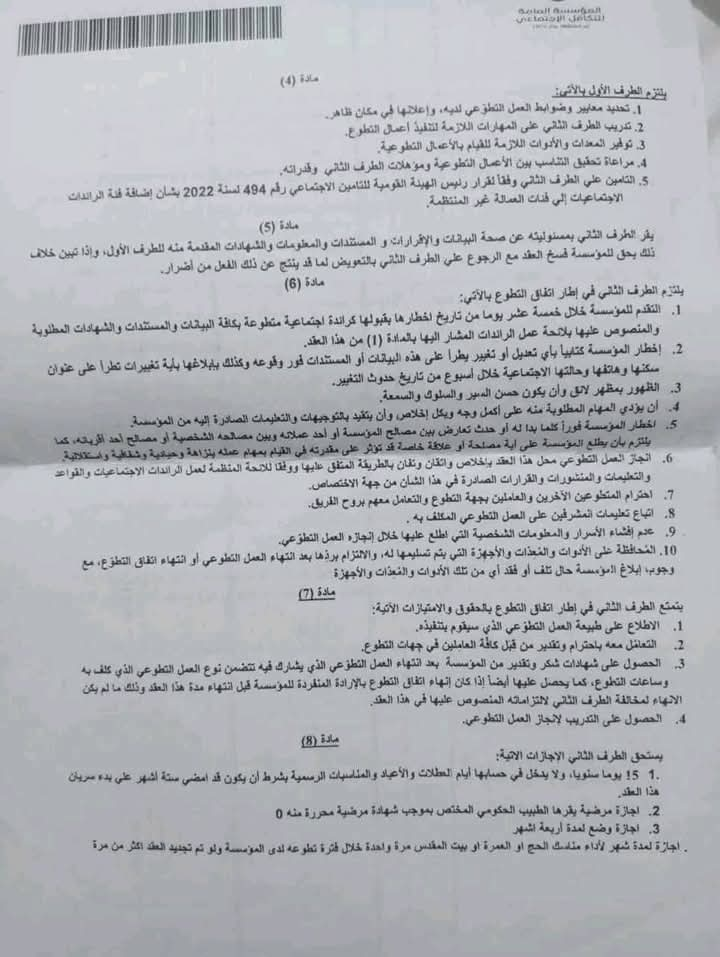
Zawia3 obtained a copy of a community outreach worker’s volunteer contract. It provides for an agreement between the General Foundation for Social Solidarity, the first party, and the volunteer, the second party, to work as a community outreach worker on a voluntary basis for one year, automatically renewable unless either party notifies the other one month before expiry. The volunteer must perform specified tasks, participate in community and awareness activities, comply with laws, regulations and instructions, preserve confidentiality, provide a criminal record certificate, inform the foundation of changes to her details, and obtain its consent before volunteering for more than one organisation.
The contract obliges the foundation to specify duties, provide the necessary resources and training, facilitate contact with the community and pay the prescribed monthly incentives. It lists the volunteer’s rights as being informed of her rights and duties, participating in activities, receiving training and certificates of appreciation, 15 days of annual leave, sick leave and three months of maternity leave for women. It also allows assignment to training courses inside or outside Egypt at the foundation’s expense when it makes the assignment. The contract ends on expiry or written notice, and either party may take action if its terms are breached.
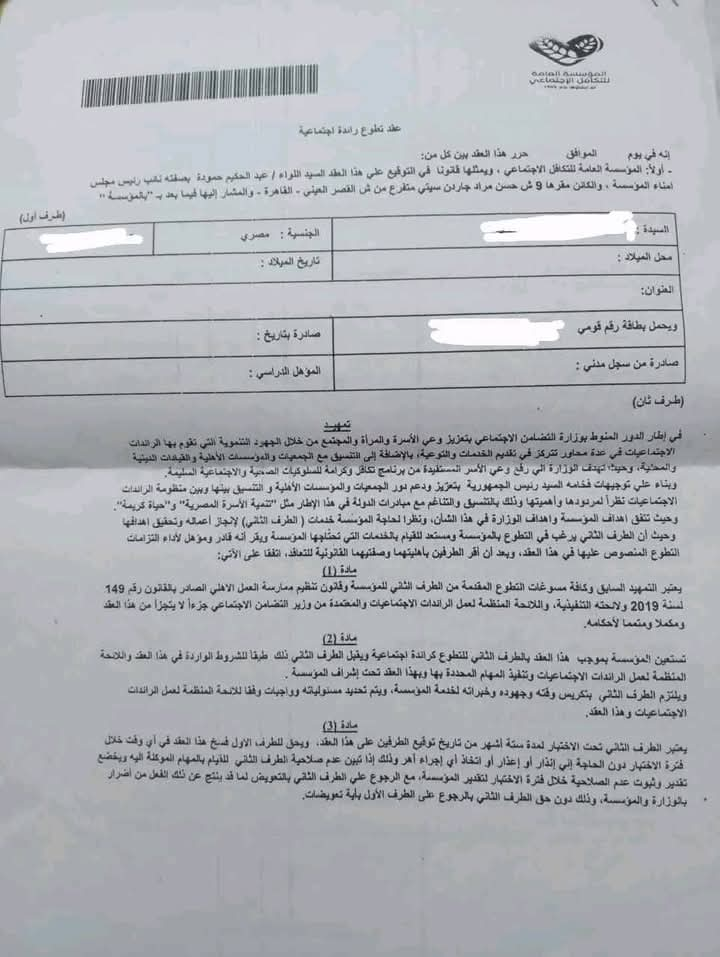
The contract explicitly states that it is a volunteer agreement, meaning the relationship is not one of paid employment and that Labour Law provisions concerning wages, social insurance or unfair dismissal therefore do not apply. It also denies the second party insurance or employees’ rights in the event of a dispute. Despite describing the work as voluntary, it imposes specific obligations on the outreach worker resembling employment duties, which could create ambiguity in a dispute. Its reference to incentive regulations indicates a payment or token allowance, but not a ‘wage’ in the legal sense. Nor does any provision require the foundation to cover medical treatment or life insurance.
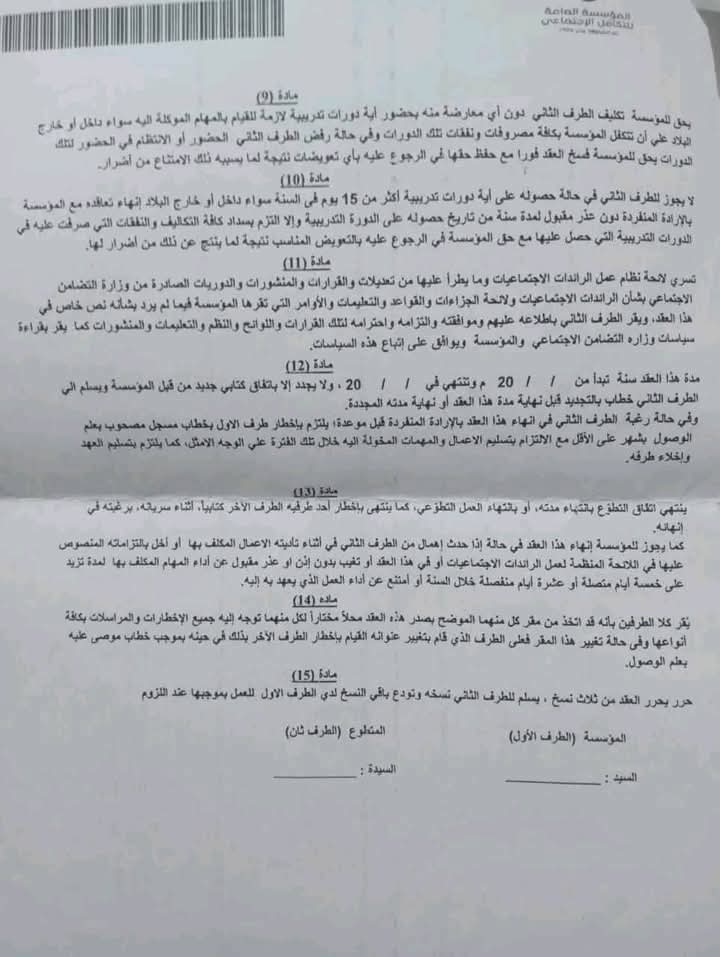
The contract gives the foundation, the Ministry of Social Solidarity, the right to assign tasks, terminate the contract and prohibit work with other organisations, without an obligation to compensate the worker. Articles 1 and 2 require the second party to carry out tasks that may be daily or seasonal, without clear flexibility. Article 3 allows the first party to terminate the contract easily. Article 5 requires confidentiality of information and documents, exposing the worker to legal accountability for a breach. Article 6 contains a non-combination clause that may restrict her freedom to volunteer elsewhere, while Articles 12 and 13 permit unilateral termination.
Outreach workers as a link to the community
Explaining their role, Lamia Lotfy, executive director of the Rural Women’s Initiative, says rural outreach workers educate men and women in rural communities about reproductive health, women’s rights, health and population issues, including female genital mutilation and early marriage, as well as family counselling. Their geographical and social closeness to residents, as women from the same or neighbouring villages, creates trust that staff sent from outside the community would lack. Their work relies on knocking on doors and visiting homes, rather than holding public seminars. They also connect civil society organisations with women and target groups in villages, even when they do not implement economic empowerment or assistance programmes themselves.
She tells Zawia3:
“The amount paid to rural outreach workers employed by the Ministry of Social Solidarity is extremely small. It reflects a prevalent approach to government employment that uses temporary or volunteer contracts to avoid permanent appointments, social insurance or any insurance and healthcare protection. Despite being called ‘volunteer contracts’, these are in reality employment contracts. The workers are assigned difficult tasks covering entire villages, their extensive areas and surrounding hamlets, and large populations.”
Lamia believes that the absence of monitoring and regular performance evaluation through accurate reports prevents professional development, leaving success or failure dependent on personal abilities and experience acquired through trial and error. Workers lack training as well as material and knowledge resources, making their financial, professional and social protection circumstances difficult. She stresses that workers need training and awareness of the issues they address to fulfil their role. They need education and a deeper understanding of those issues: a lack of genuine belief in a cause can obstruct the intended impact and sometimes produce the opposite result.
Former social solidarity minister Nevine El-Kabbag announced on 22 February 2022 that 3,000 rural outreach workers would join the social insurance system for the first time, effective January 2022, at an annual cost of EGP 4.5 million. They were included as irregular workers covered by Social Insurance Law No. 148 of 2019.
She explained that the ministry was establishing a central association for community outreach workers to pay their contributions and protect their interests, while providing comprehensive social protection in coordination with the relevant bodies. The decision was coordinated with the National Organisation for Social Insurance, granting workers the new law’s benefits, including retirement and occupational injury pensions and a survivors’ pension then worth at least EGP 916, with gradual increases in the minimum.
On 17 May 2025, Social Solidarity Minister Maya Morsi thanked the workers for their voluntary efforts supporting community issues and affirmed the ministry’s respect for their role. She welcomed their working with other organisations to increase their income, particularly since they were volunteers, and stressed the ministry’s commitment to providing them with social insurance.
Policies entrenching the feminisation of poverty
Gender specialist Mai Saleh, director of the Labour and Economic Rights Programme at the New Woman Foundation, tells Zawia3 that the crisis has two dimensions: the workers’ own conditions and the Ministry of Social Solidarity’s treatment of them. The ministry relies heavily on outreach workers for important campaigns and events, including door-to-door awareness campaigns, voter mobilisation during presidential elections, work during the coronavirus pandemic and administrative duties inside social units that fall outside their remit. Yet it treats them with considerable intransigence and imposes strict restrictions obstructing access to their entitlements.
She says: “The ministry treats them as ‘volunteers’ and insists on volunteer contracts, depriving them of permanent employment. This has become more explicit under the current minister, Maya Morsi, who has openly refused to appoint any of them. Under the previous minister, Nevine El-Kabbag, there were slow steps towards possible solutions.”
The programme director says the crisis dates back to the ministry’s refusal to grant permanent appointments to the first cohort of around 2,000 workers, whom it directly threatened. The same conditions continued for subsequent cohorts until their number reached around 15,000, all without permanent appointments. She also says the ministry previously suspended many contracts, citing favouritism or poor performance, then reinstated some workers following complaints and appeals, without reinstating everyone affected.
She adds: “New conditions for payment, including registering on the electronic system, recording presence at workplaces through GPS and attending training courses, have deprived many women of their meagre pay, usually no more than EGP 1,300 after deductions. Administrative corruption has also led to deductions for social insurance that were never actually remitted, leaving workers without real insurance protection.”
Mai believes the ministry exploits the workers’ vulnerability. Most are divorced, widowed or from households below the poverty line, making them accept low pay and unfair conditions. She describes a clear gender contradiction: while the state promotes women’s empowerment, the Ministry of Social Solidarity pursues policies entrenching the feminisation of poverty, resembling the private sector’s exploitation of women as cheap labour. She stresses that this goes beyond a labour dispute. Volunteer contracts have legally insulated the ministry from obligations towards the workers, within a broader government approach of relying on contractor labour or temporary service contracts across sectors to avoid financial and social obligations.
Saleh concludes that the solution does not lie in protests or individual demands, but in workers collectively stopping work altogether. This would create real pressure on a ministry dependent on them to implement activities and initiatives on the ground, particularly after repeated unfulfilled promises concerning allowances and incentives.
Zawia3 also obtained audio recordings containing instructions from a government official at the Ministry of Social Solidarity to outreach workers. She apologised for the delay in paying August entitlements, stressing that monthly allowances depend primarily on the work performed under the contract and governing regulations. They are not permanent government employees entitled to a fixed monthly salary regardless of performance, she said. This is the nature of voluntary work: the monthly allowance is paid for tasks performed and completed.
In recordings sent to workers via WhatsApp, the official warned that anyone failing to perform the required work might not qualify for payment at the end of the month. Work is evaluated against several criteria determining entitlement. These include registering visits to beneficiary families from their actual locations using GPS. There is also a verification mechanism: even if a visit is registered on the platform, the ministry calls families to check. If they say the visit did not take place, phone numbers are wrong, or visits are fictitious and consist only of passing through the street, this is not considered quality work or fulfilment of requirements and may result in non-payment. Failure to attend activities, training and seminars inside or outside the worker’s governorate, or to attend the unit on the designated day, also results in non-payment.
Addressing workers, the official added: “The idea that the allowance will automatically be paid every month is completely wrong. Your personal financial arrangements, instalments or rotating savings schemes, are none of our concern. If you want to keep receiving this allowance, you must perform your work fully and continuously. When asked to attend training, we do not accept excuses such as, ‘I’ll bring my daughter because I have nowhere to leave her.’ When asked for photographs of the month’s three seminars, you must submit them. When a seminar is organised with important bodies such as Mawadda, Decent Life or the Drug Control Fund, effective mobilisation is required. If you do not do all this, on what basis do you deserve the allowance?”
She continued: “Please do not regard the allowance as an acquired right paid routinely every month. It is not routine and may not be available monthly. It depends on the quality of your work and whether you fulfil your assigned tasks. As for inappropriate comments we sometimes hear, such as, ‘How much do you give us?’ or ‘What can this amount do?’, our response is: this is our voluntary work. If it does not suit you or your capabilities, you can leave, and we wish you success elsewhere. We are not obliged to listen to such comments.”
A complicated position for outreach workers
Human rights lawyer Malek Adly, director of the Egyptian Centre for Economic and Social Rights, describes the case of around 15,000 rural outreach workers on volunteer contracts with the Ministry of Social Solidarity as ‘extremely complicated’. The central problem is the absence of clear employment contracts. They work under volunteer agreements and receive monthly allowances of only EGP 1,300, if they receive them at all, paid from the state budget.
Adly tells Zawia3 that some have worked under these conditions for more than ten years, further complicating the crisis. Some began protesting, leading to suspensions for a number of workers and others being ignored. Some were even told that the ministry had ‘no contracts of this kind’.
Lawyer Essam Reda Rekiba explains that outreach workers fall into three main categories: health or rural outreach workers affiliated with the Ministry of Health, the Ministry of Social Solidarity or a funding body affiliated with the World Bank. His office handles cases for these different categories, seeking permanent appointments, changes in job titles or other employment demands. The Health Ministry uses two arrangements: a worker may be employed under a contract, or already appointed and seeking a change in job title. The Social Solidarity Ministry, however, does not appoint them at all. They all work under volunteer agreements for an allowance, payment-for-work arrangements or allowance-based contracts, none providing genuine employment benefits. The World Bank offers better pay than the other two bodies, but also concludes volunteer contracts.
He tells Zawia3:
“Some cases I brought resulted in rulings granting workers permanent status, even under volunteer contracts. Depending on the court’s assessment, it grants either a permanent employment contract or an appointment. We obtained a direct judicial ruling appointing outreach workers.”
Rekiba says the law allows workers to sue for their rights, explaining that after three years a volunteer contract gives its holder the right to seek permanent employment. Most hesitate to go to court for fear of dismissal, which he describes as a mistake because the law protects their rights. He says the problem is widespread throughout Egypt’s villages, and many accept existing conditions despite receiving no real benefits.
The court had ruled to annul the administrative authority’s negative decision refusing to take steps to appoint the claimant to a permanent position and grade under the fixed wages item in Chapter One, Wages, with the resulting consequences. The judgment, a copy of which lawyer Essam Reda Rekiba published, admitted the case procedurally and, on its merits, annulled the authority’s refusal to initiate the claimant’s permanent appointment under that budget item, as detailed in its reasoning. It ordered the administrative authority to pay costs.
Parliamentary action
In November of the previous year, MP Mohamed Hamdy Moussa submitted a briefing request to the social solidarity minister about rural outreach workers’ temporary contracts and lack of health insurance. The House of Representatives’ Social Solidarity, Family and Persons with Disabilities Committee discussed it.
The MP tells Zawia3 that he submitted the request concerning outreach workers’ conditions. Former minister Nevine El-Kabbag had agreed to include them in health and social insurance, while current minister Maya Morsi discussed improving their pay during 2024.
He says:
“We also discussed wages, and they promised increases. They said they would introduce them in stages because the state budget did not allow a single increase.” He notes that pay recently rose to EGP 1,500, from which insurance contributions are deducted, but is provided as irregular allowances rather than fixed salaries. These payments fall under a particular budget heading and are considered allowances, not fixed wages.
The MP adds: “The workers’ role is very important. They make valuable contributions, but these need to be properly activated through government direction and support. They do visit homes and sit with women, particularly in rural areas, and perform a very substantial awareness-raising role.”
He stresses their importance in health and community awareness, especially in villages and rural areas, where they visit families and raise awareness of health, behavioural and social issues. “They are indispensable, but urgently need better working conditions and a stronger role,” he adds.
Ultimately, the outreach workers’ crisis reveals a stark paradox between their substantial social role in confronting poverty, ignorance and violence, and their precarious employment and living conditions. Volunteer contracts deny basic labour rights, allowances are small and irregular, and fieldwork and administrative pressures continue. Thousands of women in villages and hamlets remain essential to state initiatives without guarantees or protection. As complaints and deferred promises accumulate, there is a growing need for serious political will and legislative reforms that restore recognition of their role and transform forced voluntary effort into decent work, guaranteeing a minimum of dignity and a decent livelihood, and giving substance to official slogans of women’s economic empowerment and gender equality.