
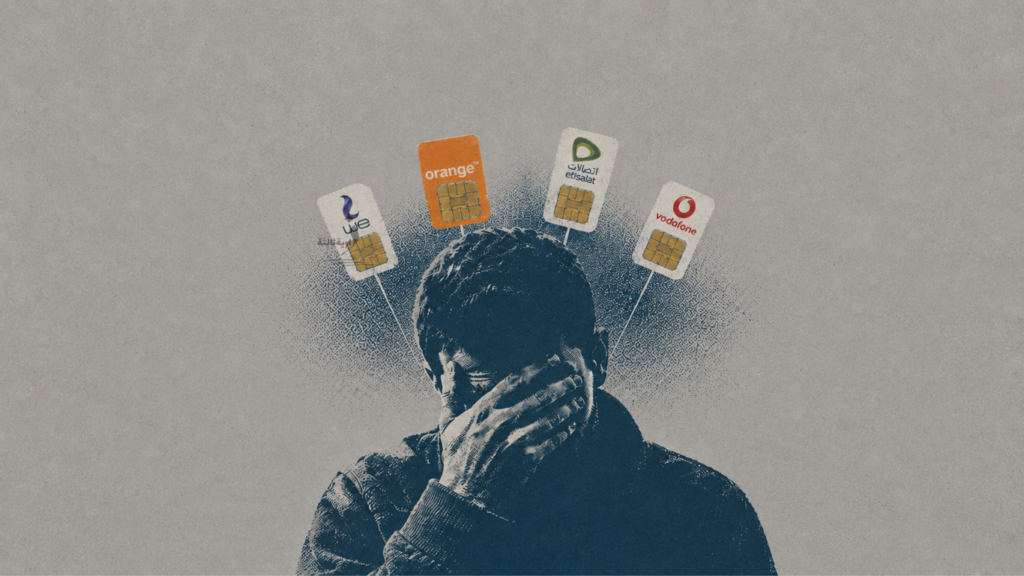


The case of 19-year-old Amr Emara has intensified concern about mobile lines registered using people’s details without their knowledge. He reportedly received an in-absentia life sentence, described in coverage as 25 years, in a drug-trafficking case linked to a SIM registered in his name without his knowledge.
The controversy gained new momentum as “My Numbers” became available within the National Telecom Regulatory Authority’s My NTRA app. People checking lines linked to their identity discovered numbers they neither recognised nor contracted for, raising questions about subscriber verification and safeguards against unauthorised registration.
A number tied to someone’s official identity can expose them to suspicion or investigation if another person uses it unlawfully. The app helps people discover unknown lines, but does not itself answer how they were registered, who verified the subscriber or how an uninvolved citizen’s position is cleared.
Human-rights lawyer Malek Adly, head of the Egyptian Centre for Economic and Social Rights, calls the problem extremely serious because services are linked to national-ID or passport information and misuse can have legal and security consequences.
A line registered to somebody else can be used for online offences such as defamation, blackmail or threats, he explains. Information-technology crime investigators tracing it may reach the registered person despite their having no connection to the offence or knowledge of the line.
Adly says citizens should notify NTRA and information-technology crime investigators promptly after discovering an unauthorised line, so the incident and their lack of connection to its use can be documented. This is the interviewed lawyer’s advice within the report.
Telecom companies already impose strict rules for issuing and renewing lines, he says. Registration without consent may therefore indicate gaps in implementation that must be identified, assigned responsibility and prevented from recurring.
He describes several possible scenarios: someone hands an identity card to another person for help obtaining a line and fails to follow up; more than one line is issued where only one was requested; distributors pursue sales targets; or people use others’ identity cards to obtain subscriptions. Some situations may begin without malicious intent.
These possibilities point to internal processes needing review, Adly argues, particularly subscriber identity checks, so citizens are not held responsible for lines they neither obtained nor authorised.
If an unauthorised line connects a citizen to a criminal case, the matter requires investigation into their lack of connection to the line and alleged offence. Registration can lead to suspicion, summons or arrest before fraudulent registration or use by another person is established, he says; registration alone should not be confused with proof of guilt.
Evidence can include the sales contract held by the operator and examination of the purported signature, as well as usage records and the line’s location during the relevant period. These may help identify its actual user and demonstrate the registered person’s lack of involvement.
Parliamentary recommendations and planned amendments
Ahmed Badawy, chair of parliament’s Communications and Information Technology Committee, tells Zawia3 the committee previously examined inaccurate or unauthorised registrations and recommended regular subscriber-data updates to establish that the user and registered owner are genuinely connected.
If a user is asked to update their information and fails to do so, the line can be suspended, he says. Continued updating reduces the persistence of lines with outdated records.
Badawy also stresses maintaining electronic tools that let people check registered lines. Periodically reviewing lines associated with a national ID has become necessary to establish whether their owners actually possess and use them.
NTRA has already taken steps to update records and investigate recent complaints about unauthorised registrations, he says.
Relevant bodies, especially NTRA and the General Department of Information Technology, handle reports, while the parliamentary committee follows the response and issues recommendations alongside legislative efforts, Badawy adds.
He says amendments expected to be discussed in October would add provisions to information-technology legislation and toughen penalties for manipulation and unlawful use of mobile lines. These were proposed future measures at the time of publication, rather than enacted amendments.
The Communications and Information Technology Ministry’s monthly report put subscriptions at around 126.91 million lines at the end of May 2026, against 116.70 million in May 2025. The source cited in the Arabic report gives a rise of 10.12 million and 8.67%; the two rounded totals printed here instead differ by 10.21 million, so the reported increase does not fully reconcile with them.
Growing public anger
Social media filled with appeals from angry subscribers after My NTRA revealed unknown lines: some discovered three or four, others five or more, and some ten associated with their national ID, despite saying they had never obtained or used them.
Mohamed al-Sayed, 29, from Giza, found three unfamiliar numbers. “I did not know these lines existed, did not apply for them and do not know who registered or uses them,” he tells Zawia3. “What worries me is that they are officially linked to my personal information although I have nothing to do with them.”
Sahar Abdel Rahman of Sohag found two lines in her name despite neither using nor knowing of them. She says she had lived abroad with her husband in a Gulf country and had not used an Egyptian mobile line for over ten years. She tested the app without expecting any numbers, and says she will pursue legal action and can prove she was abroad.
Engineer Shaaban Ali found five lines after a lengthy period outside Egypt. “I had not used an Egyptian mobile line during that time. I want to know how they were registered, who used them and whether I could be held responsible for uses I knew nothing about,” he says. He fears criminal misuse and intends to take legal steps to protect himself and his family.
Heavy demand for My Numbers prevented many people from receiving the OTP needed for registration. NTRA deputy executive president and spokesperson Mohamed Ibrahim said a permanent technical solution would be announced within a month at most.
In televised remarks, Ibrahim said a temporary fix restored normal operation pending technical and regulatory updates, including biometric verification to establish that the person making the request is the identity-card holder rather than another user of a line registered to them.
My NTRA is the regulator’s official interactive app for individuals and businesses, intended to simplify telecom services, explain rights and responsibilities, and let users perform tasks without visiting operator branches or calling customer services.
Ibrahim said it had more than seven million users, and existing users with activated accounts could access My Numbers directly without entering an OTP.
Facial verification and a temporary fix
On Friday, 7 August, NTRA announced upgraded identity checks using facial verification when purchasing mobile lines or accessing My Numbers. Ibrahim said the aim was to ensure that the person viewing registered-line information is its officially registered owner, preventing others from seeing it.
He said the regulator discovered that some people possessing a line could access information on other numbers registered to its owner if they knew that owner’s national ID. The service was temporarily suspended for technical updates.
A temporary solution then restored access while masking the middle digits of phone numbers and leaving enough visible for recognition. This lets people identify unknown registrations without exposing complete numbers belonging to other users, he explained.
Ibrahim called for regular checks and action on unknown lines, saying a citizen may obtain up to ten lines from each of Egypt’s four operators. These checks secure access to registration information; they do not by themselves resolve every disputed registration.
He also urged correction of lines used by someone other than their registered owner, particularly children using a parent’s line, by transferring ownership after the user reaches the legal age.
Legal safeguards and digital identity
Legal specialist Mahmoud al-Rouby, a lawyer practising before the high appeal courts, tells Zawia3 that registering lines without knowledge or consent is more than a procedural irregularity: it threatens citizens’ electronic identity and can turn their details into a tool for digital offenders.
Phone numbers are keys to digital identity, linking bank accounts, electronic wallets, social platforms, government services, financial apps and verification systems. Unauthorised use can therefore create serious legal and technical consequences without the registered person’s actual involvement, he says.
Risks include fraudulent wallets and transactions, phishing messages, impersonation, fictitious accounts and cybercrime. The registered person may face suspicion until investigations establish their lack of connection to the line or its use.
Al-Rouby points to Egypt’s Anti-Cybercrime Law No. 175 of 2018 and Personal Data Protection Law No. 151 of 2020 as legal frameworks addressing such risks, with the latter governing unlawful collection, processing or use of personal data where its provisions apply.
As personal-data dependence expands, protection becomes part of digital security, he argues. Weak subscriber verification can facilitate cybercrime that develops into financial or organised crime and potentially cross-border activity.
Rapid advances in artificial intelligence intensify impersonation and fraudulent-call or message risks, he adds, making an unlawfully registered line a possible entry point into a broader criminal system.
Al-Rouby calls for a review of registration procedures, stronger identity verification, mandatory immediate notification whenever a new line is registered in someone’s name, and a fast, effective process for reporting and cancelling unfamiliar lines.
“Trust in technology is built through legal and supervisory guarantees that prevent misuse before a crime occurs,” he says. Digital transformation needs reliable personal-data safeguards. He urges operators to examine biometric methods, including facial verification, as recognised tools for strengthening subscriber checks.
The crisis goes beyond finding unknown numbers in an app. It exposes broader questions about digital identity and responsibility when someone’s information is used to obtain an unsolicited service that later becomes connected to a criminal case.