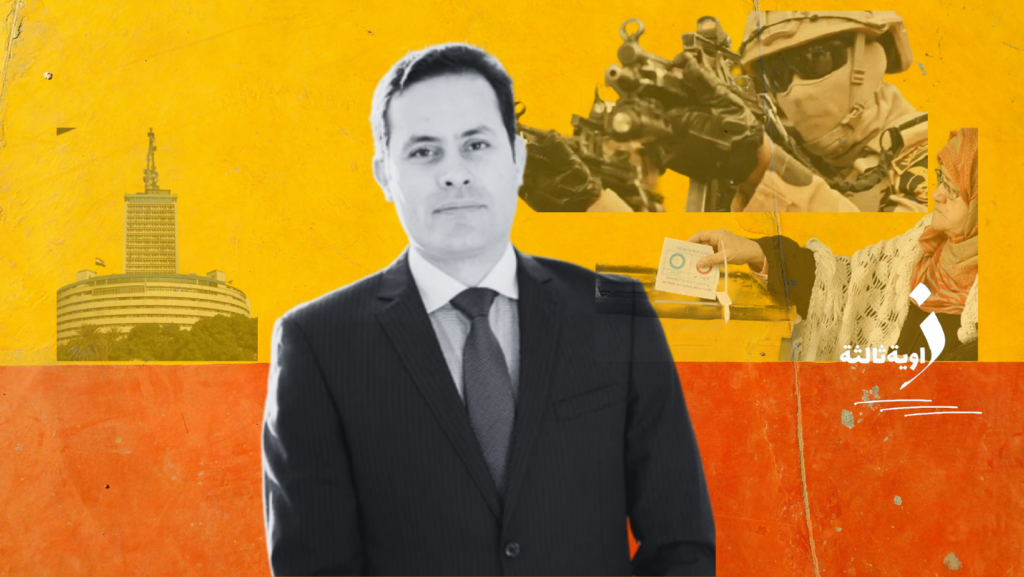
Last April I wrote an article about the paths of authoritarianism with Egyptian opposition figure Ahmed Tantawy, who intended to run for the presidency of Egypt and was unable to do so. At the time, I considered it likely that Tantawy would not be arrested after arriving in Egypt and that the authorities would leave him free, but at the same time would seek to restrict him, his followers and the members of his election campaign so that he would not be able to meet the condition for running in the presidential election. This is indeed what happened. From the first moments after Tantawy arrived in his homeland, returning from Beirut last May, he began meetings with public figures and political parties and hurried to organise his election campaign, with its various offices covering political, media and legal work. These committees began their work when the National Election Authority announced on 25 September that it was opening the door for any citizens who wished to issue an endorsement for any presidential candidate. Since then, we have seen new scenes in politics in Egypt, and indeed a new round in the battle of authoritarianism with presidential candidate Ahmed Tantawy.
The Battle of the Endorsements
Before the door opened for citizens to issue endorsements, authoritarianism achieved its goal of dividing the Egyptian opposition represented by the Civil Movement and its parties. The movement did not agree, for example, on choosing a representative to run in the presidential election: the head of the Egyptian Social Democratic Party announced that he would run in the presidential race, and days later the head of the Constitution Party, Gameela Ismail, announced her candidacy before withdrawing again. All this led to the division of the opposition, and this is precisely what was mentioned in a press report about the authoritarian plan to coordinate with candidates from the Civil Movement to run in the race. Through a scene of pluralism, so that the election appears democratic and includes faces counted as opposition, and through division, the current President can get past the election over their heads without needing any restrictions on their election campaigns or having to falsify election papers, because of their lack of popularity on the Egyptian street, unlike candidate Ahmed Tantawy.
From the first day endorsements began to be issued, dozens of active social media pages supporting prospective presidential candidate Ahmed Tantawy, as well as political and cultural public figures, began supporting him and calling on everyone to issue endorsements in his name, as did the campaign coordinators in all governorates, who in turn took on the tasks of announcing the names and locations of notary offices, in addition to collecting the endorsements from people after they had been issued. Indeed, thousands of Tantawy’s supporters went to issue endorsements, but authoritarianism was waiting for them after preparing itself well: it mobilised hundreds of citizens in front of notary offices claiming they wanted to issue endorsements for current President Abdel Fattah al-Sisi or for candidates Hazem Omar and Abdel Sanad Yamama, in addition to the obstinacy of notary office employees in registering any endorsements in the name of candidate Ahmed Tantawy.
During the first two days of issuing endorsements, we saw many people on social media publishing photos and video clips documenting the Mostaqbal Watan Party, affiliated with the authorities in Egypt, distributing food (boxes) and money to citizens in order to mobilise them in front of the offices and issue endorsements for President Sisi. The photos and videos also showed thugs attacking Tantawy’s supporters with insults and beatings, and the security services arrested dozens of his supporters and campaign members. On the evening of the second day, Tantawy came out in a video on his personal Facebook page denouncing the violations against his campaign members and supporters, and then announced the suspension of the campaign’s activity for two days so that the campaign’s coordination team could take other decisions in response to the authorities’ repression of his campaign.
On the third day, dozens were allowed to issue endorsements for Ahmed Tantawy, as the restrictions decreased but did not end. This was interpreted as the authorities responding by opening the public sphere, leaving the door of endorsements ajar for Tantawy and his campaign, but the reality was that it was a strategy of opening the door without allowing entry. The dozens of endorsements registered that day gave great hope to thousands, and Tantawy came out addressing his supporters that evening to announce the end of the decision to suspend the campaign for two days. He called on people to go to notary offices across the republic, and to support people against the repressive measures, we found Tantawy visiting all the governorates and meeting his supporters in front of the doors of notary offices and at his campaign headquarters, or his supporters from other parties, such as the Karama Party and the Socialist Popular Alliance.
Tantawy visited all the governorates of the republic and met thousands of citizens; he addressed them and openly criticised the authorities and their head, accusing them of failure and describing them as despotic, and said that his rival in the election is the “perfect rival”, whom Tantawy would beat if he competed with him.
Tantawy’s tour sparked a large social movement; people chanted “Bread, freedom, social justice”, the chants of the January revolution, and chanted his name as a new president for Egypt.
This movement intensified on 2 October, when the Mostaqbal Watan Party organised a rally that day to support President Sisi, and the rally turned into protests demanding the President’s departure, tearing down his hanging pictures and chanting for Tantawy, prompting the intervention of the Egyptian security forces, which arrested 400 people following these demonstrations.
With this impressive political and social movement, the like of which had not happened for years (even the movement of 20 September 2019 differed from the movement Tantawy created), authoritarianism continued to repress the endorsement process, which led Tantawy to direct an appeal directly to Egyptians abroad to go to embassies and consulates to issue endorsements, since issuing endorsements outside Egypt is less repressed and restricted than inside Egypt. Indeed, hundreds of Egyptians responded to Tantawy’s calls, especially in Saudi Arabia, Kuwait and other Arab and non-Arab countries. The campaign received nearly 8,000 endorsements, most of them from outside Egypt, in addition to hundreds of endorsements that were issued but have not yet reached the campaign headquarters.
With time running short, the days passing quickly and the authorities continuing to prevent citizens from issuing endorsements, Tantawy called on Egyptians on 8 October to start issuing popular endorsements, to serve as documentation of the endorsements of citizens who were unable to issue them. Citizens would print the same form found inside notary offices, record their data and leave the place for the state’s stamp empty, as evidence that citizens have endorsements and that it is the state that refuses to register them. This would be clear evidence to submit to the Higher Election Committee in support of the campaign’s complaint about the repression and obstruction it faced throughout the days of collecting endorsements.
The campaign and citizens responded to this call, and the collection of popular endorsements from people and their delivery to the campaign’s coordinators in the governorates indeed began, but the security services tracked this call, and 8 people were arrested with more than 500 endorsements in their possession. They were brought before the State Security Prosecution and, as usual, were detained pending a case on the usual charges of the arbitrary detention the authorities have practised for years. On the evening of that day (9 October), Tantawy came out in a speech among his campaign members announcing a halt to collecting popular endorsements, preferring the safety and security of citizens to collecting these endorsements. He decided to head, together with many political figures and party leaders, to the headquarters of the Higher Election Committee.
On the evening of 10 October, in another attempt, Tantawy’s campaign announced the launch of an electronic form containing a declaration with the name and national ID number of the Egyptian citizen, as an alternative electronic model for issuing endorsements, to be submitted later to the Egyptian judiciary as documentary evidence of the obstruction of issuing endorsements at notary offices. During the first days, tens of thousands of electronic endorsements supporting Tantawy’s candidacy were collected. On the evening of 13 October, Tantawy’s campaign held a conference at the headquarters of the Conservative Party in Cairo and announced that it was out of the presidential race, because it had only been able to collect about 14,000 endorsements, two thirds of which were from outside Egypt. Tantawy announced that he would not surrender to authoritarianism and would launch a political project, to be announced in the future, as an alternative to the authority that he described as set to vanish within a few years.
What Comes after Being Barred from the Election?
One week before the door closed on collecting endorsements, specifically on 7 October, the Al-Qassam Brigades, the military wing of Hamas, attacked the Israeli occupation state, both military forces and civilians in the settlements of the Gaza envelope, under what it called “Al-Aqsa Flood”. This operation resulted in the detention and capture of dozens of Israelis and the killing of hundreds of them. From the first hours, Israel began punishing the entire Gaza Strip for this operation with siege and bombardment: Israeli air strikes began that have not stopped for a single hour, destroying thousands of buildings and displacing hundreds of thousands from their destroyed homes, in addition to killing and injuring thousands, a toll that rises by hundreds around the clock.
This fierce war has preoccupied the whole world without exception, with Egypt at its heart: the authorities and the Egyptian street became preoccupied with the war and its consequences, and the echo of the endorsement battle, and indeed of the entire presidential election, faded, even in the Egyptian media itself. The Egyptian and international media and human rights echo that had been following the process of collecting endorsements, the prevention of Tantawy’s supporters from issuing them and the authorities’ attacks, which had been increasing Tantawy’s chances of occupying a greater political space inside and outside Egypt, shrank and almost disappeared as soon as this war began. Even the political authority’s preoccupation in Egypt turned towards the war, specifically towards the Egyptian position on the displacement of Palestinians into Sinai, as well as the entry of humanitarian aid through the Rafah crossing, in addition to the constant mediation Egypt carries out between Hamas and Israel.
But this political preoccupation did not prevent the security approach of arresting all Egyptian opposition figures, whether they were part of Tantawy’s campaign or not. On 20 October, Egyptian demonstrators took to the streets in most of Egypt’s governorates to support Palestine in the face of the Israeli aggression against it. These demonstrations were divided into two parts. The first part was simple demonstrations, brought out in order to practise what is known as the “mandate” that the Egyptian President requested from them, in order to authorise him to protect Egypt’s national security. The second were called for and organised by Egyptian political movements and figures, along with other spontaneous demonstrations by Egyptians angered by the Israeli aggression on Gaza.
In Cairo, these demonstrations managed to meet, especially the demonstrations that gathered initially at the Al-Azhar and Mostafa Mahmoud mosques; after meeting, they headed towards Tahrir Square via Talaat Harb Street, and despite the massing of security forces and their initial prevention of entry, the demonstrators managed to storm the square, gather in it and chant for Palestine. Other chants rose, such as the chants of the January revolution: “Bread, freedom, social justice, Palestine is Arab”. The demonstrations chanted despite the security forces and kept chanting. Then the security forces asked the demonstrators to leave. The demonstrators refused, which led to the forcible dispersal of these demonstrations and the pursuit of the demonstrators; dozens were arrested that day in and around Tahrir Square, and in other governorates, most notably Alexandria.
Amid the Palestinian events, the Higher Election Committee announced that four people had entered the presidential race: first, current President Abdel Fattah al-Sisi; Hazem Omar, head of the Republican People’s Party; Abdel Sanad Yamama, head of the Wafd Party; and Farid Zahran, head of the Egyptian Social Democratic Party. All of them managed to pass the candidacy condition through parliamentary recommendation, except President Sisi, who completed his candidacy through recommendation and popular endorsements as well. With this announcement, the authorities carried out what they wanted: a theatrical scene with election candidates, one of whom represents an opposition party within a civil movement taking part in the National Dialogue. As for the candidate around whom hundreds of thousands rallied, and who could defeat the authorities and their head through “the ballot box and the curtain”, as he often declared, the authorities excluded him.
According to his statements, Tantawy, together with his campaign team and other political figures and parties, is preparing an alliance for hope: a project through which he represents the January revolution, whose paths achieve the demands of the January revolution and restore legitimacy and rule to the people, not to the failed repressive regime that refuses to leave power and refuses to listen to any opposition voices. In the coming period, authoritarianism is preparing to contain Ahmed Tantawy. It wants to end the “headache” he caused it and the scandal that confused it over the past weeks. Going forward, authoritarianism does not want to play politics with any parties not coordinated with it, or that may become strong and influential on the Egyptian street, as happened with Tantawy. Therefore, most likely, authoritarianism will quickly end Tantawy’s project by arresting his partners in this project, which is what it is doing now: the latest count of detainees from Tantawy’s campaign has reached more than 130 citizens. Or Tantawy himself may even be arrested, whether during this period, amid the noise of events and conflicts, which reduces the echo of the news of his arrest, or even after Sisi is declared President of Egypt for a third term of 6 years.
As for the Civil Movement and its parties, their political future has been fragile since their beginning if we weigh it on the scale of social mobilisation. Even for political authoritarianism, it will be weaker than before: the authorities needed it at an earlier time to complete the sessions of the National Dialogue through its participation, since it is the only alliance representing the civil parties inside Egypt. But now the National Dialogue has ended and its recommendations have been submitted. In the coming weeks, the current President will renew his presidential term. Authoritarianism will arrange its papers away from political and human rights files, or more precisely, will marginalise them to a greater degree than they already were within the framework of marginalisation, and will give priority to the economic crisis in which the country is drowning. Perhaps what remains of the negotiations between the Civil Movement (after its current disintegration) and the authorities is talk of the continued release of political detainees, but even these demands will have a lower ceiling, since the Civil Movement no longer has anything to offer authoritarianism: neither political pressure as before, represented by its constant threat to withdraw from the National Dialogue, nor even popular pressure, as it is not like Tantawy, able to form a mass bloc under its umbrella, let alone a political project through which to address and pressure authoritarianism.
In the last 10 years, Egypt has fallen under the grip of a repressive authoritarianism the country has not witnessed in its modern history. This authoritarianism and its philosopher saw, and over time became convinced, that it came to save the country and its people from terrorism and the people of evil, represented by religious groups, both peaceful political movements and armed ones, just as it saved the country from the path of conspiracy, chaos and the collapse of the nation-state, represented by the January 2011 revolution and the protests that followed. In light of this vision, the top authority, the President and his close associates, exercised the right of total management of everything that exists within the state: bodies, politics, economy, judiciary, security, culture, media, education, health, arts and other diverse political and social spaces.
In contrast, the Egyptian opposition at home and abroad was unable to confront this repressive authoritarian ogre, which insisted on uprooting it and excluding it from its right to political practice. This inability has many causes that we have mentioned, but the most important was the fear of repression, which everyone has tasted in different proportions, as well as division and the failure to line up to confront authoritarianism. To date, this opposition has not come together to look for other solutions to confront authoritarianism in Egypt. The opposition still stands scattered at its edges; it does not refuse to have a centre through which to address authoritarianism, and it searches seriously for intellectual and organisational means it possesses to pressure and negotiate with this authoritarianism, especially after authoritarianism lost its popular support among many groups of Egyptian society, which it harmed with the impoverishment policies it adopted towards them.
Many groups of Egyptian society, too, are trying to adapt to authoritarianism’s repressive and impoverishing policies in politics and the economy, policies they cannot bear and wish would end and change, but the tools of change and reform have been lost for many reasons, the most important of which was society’s fear of authoritarianism’s brutality, as well as the despair and loss of confidence in revolution and reform, and in their representatives, that took hold in society. The assault on the January revolution by the authoritarianism that restored itself, and even strengthened its tools for hegemony and survival, created helplessness and frustration among many, which made them lose hope in reform or revolution and everything surrounding or resulting from them.
Opinion articles do not necessarily reflect the views of Zawia3.