
Last Monday, the district of Abnub in Asyut governorate witnessed a mass shooting that became known in media coverage as the “Abnub Massacre,” documented in widely circulated video footage showing a man opening fire randomly on groups of citizens, resulting in the killing of 9 people and the injury of 5 others, among them women and children.
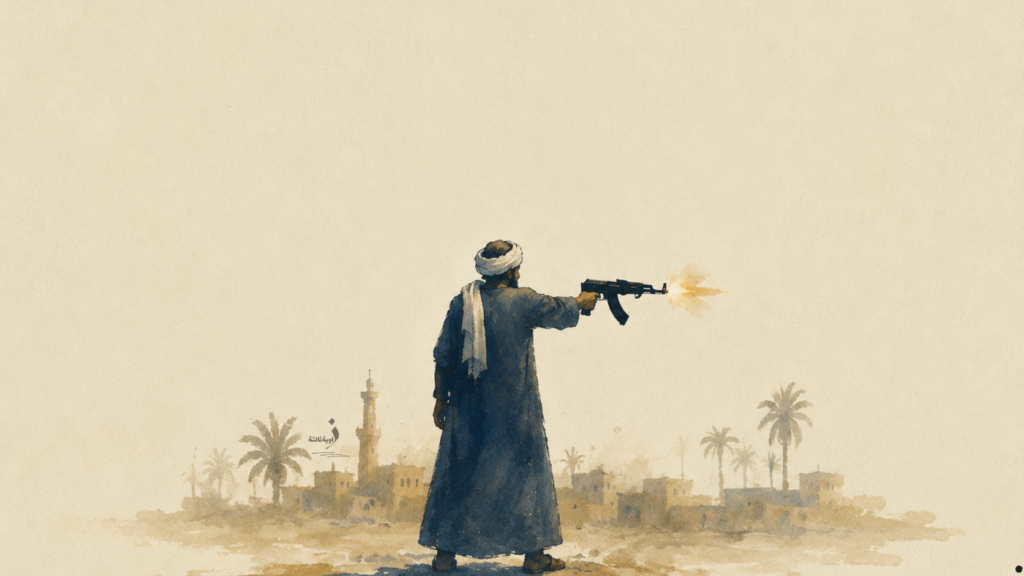
The incident, which ignited a sweeping wave of controversy and anger, began near the religious institute in the Sheikh Hassan area, after the perpetrator’s car struck a motorcycle rider and left the scene without attempting to help or check on the injured man. A number of residents gave chase, demanding he stop and help transport the victim to hospital, but he responded by pulling an automatic weapon from his car and opening fire on the crowd, as one eyewitness recounted to Zawia3.
The witness adds that the shooting continued randomly at citizens at various distances as the perpetrator drove through the streets of Abnub, causing victims to fall one after another at more than one location, from different ages without distinction, including children and women, before he fled to a farmland area in the village of Beni Mohammediyat. When police forces raided the location, he opened fire on them, and was killed during the confrontation along with his only son, a law school student.
Circulating information about the perpetrator identifies him as Atef Khalaf Ahmed Selim, 48 years old, from the village of Beni Mohamed in the Abnub district of Asyut governorate, belonging to a family locally known for a number of community contributions, among them the donation of land for the construction of schools, including one bearing his father’s name “Khalaf Abu Selim,” who a local source, in testimony to Zawia3, claimed was involved in drug and weapons trafficking and was killed in a blood feud years ago.
According to widely circulated accounts and local testimonies obtained by Zawia3, “Atef” was a member of customary reconciliation committees in the Abnub district and participated in settling disputes and blood feuds between families, in addition to his party activity. He held the position of assistant secretary of the Republican People’s Party in Asyut governorate, while residents indicate that he “used political positions as cover for illegal activities such as drug cultivation and trafficking.” In another account, one resident points to the perpetrator’s use of “Shabou,” a synthetic drug.
The Interior Ministry stated in a Monday announcement that security agencies received a report of a person firing randomly at citizens inside the Abnub transport station in Asyut governorate while driving a private car, resulting in the killing of 8 people and the injury of 5 others.
It added that security forces immediately moved to the scene and managed to identify the suspect before investigations revealed his flight to a farmland plot within the district, noting that the suspect opened fire as soon as he sensed the forces approaching, leading to an exchange of fire that ended in his death.
While preliminary investigations indicated that the perpetrator had been suffering from psychological disorders for some time and was receiving treatment at a psychiatric hospital in Cairo, according to the Ministry’s statement, residents’ testimonies in contrast affirmed that the killer was assistant secretary of the Republican People’s Party, a member of the reconciliation committee, and was in constant contact with security leadership and officials in the Abnub district.
Amro Hussein, a pseudonym for a resident of the village of Beni Mohamed in the Abnub district of Asyut governorate, affirms to Zawia3 that the bloody massacre the town witnessed was not a sudden or isolated incident but the result of what he described as long-accumulated failures of security and laxity in dealing with those who operate outside the law. He explains that the suspect was known to residents, regularly visiting the police station, and moved about carrying an automatic weapon “in full view of everyone,” without any deterrent measures being taken against him.
Hussein accuses certain criminal elements in the village of involvement in weapons and drug trafficking, opium cultivation, and land seizures, questioning why no action was taken against them earlier before the incident occurred. He also expresses his surprise at the suspect’s participation in reconciliation committees despite the criminal suspicions surrounding him, calling for a broad investigation into what he considers security failures at Abnub police station and accountability for any negligence. He affirms that the incident caused widespread anger and grief among district residents, particularly given the number of women and children among the victims.
Peter Hani, a pseudonym for a resident of the village of Beni Mohammediyat in the Abnub district of Asyut governorate, explains that the suspect in the shooting enjoyed, in his account, broad influence within the district by virtue of his leadership position in a political party and membership in local reconciliation committees, which placed him above legal accountability, in his words.
He told Zawia3: “The suspect and his family were associated, according to what circulates among residents, with arms and drug trafficking, as well as the cultivation of narcotic plants on some Nile islands in the area. These activities were known inside the district,” accusing some local security leadership of turning a blind eye to those activities and failing to take decisive measures against them.
Hani reveals that the suspect moved openly while carrying firearms inside his car without facing any security pursuit, affirming the anger prevailing among village residents following the incident and the fall of civilian victims.
In her comments on the incident, parliamentary MP Marwa Mamdouh Kadwani, representing the northern, central, and southern Upper Egypt sector, described the incident as “painful and horrific,” affirming that it represents an unusual manifestation of violence in Egyptian society. She stressed the need for serious steps to confront the spread of unlicensed weapons through tightening security surveillance and monitoring firearm possession, while praising the swift response of security agencies and their handling of the suspect, which in her view prevented a higher number of casualties.
She told Zawia3: “The full circumstances of the incident are still under investigation, given the multiple circulating accounts regarding the location and details of the event, and we await the results of the official investigations. Simultaneously, the governorate’s MPs are monitoring the condition of the injured and the families of the victims, coordinating with the Ministry of Social Solidarity in preparation for the procedures to disburse compensation to the injured and the families of the deceased.”
Regarding the customary reconciliation committees of which the perpetrator was a member, the MP explains that these committees comprise figures of social standing and aim to contain blood feuds and stop disputes between families, describing the vendetta file in Upper Egypt as extremely complex and impossible to fully resolve as long as the possession of firearms continues. She adds that awareness efforts and community seminars have contributed to reducing the intensity of some disputes but have not ended the phenomenon entirely, due to social customs, traditions, and inherited misconceptions, affirming that the spread of unlicensed weapons in Upper Egypt remains a direct threat to community security.
MP Nefeen Iskander, a member of the House of Representatives representing the Youth Parties and Politicians Coordination, explains that the nature of some Upper Egypt areas, and the social customs and culture of carrying weapons associated with them, contribute to the complexity of the phenomenon. She affirms that the mass shooting in the Abnub district of Asyut governorate revealed the need for urgent interventions to confront the spread of unlicensed weapons and narcotics, calling for the containment of public anger among residents and the prevention of any social escalation.
She told Zawia3: “The full circumstances of the incident are still unclear, and the random violence that characterized the event raises questions about its motives and whether it is linked to blood feuds, psychological disorders, or the influence of drugs,” affirming that individuals suffering from psychological disorders or involved in drug use possessing unlicensed firearms, particularly automatic weapons, represents an extremely serious threat to community security.
She adds: “Confronting criminal hotspots and drug trafficking is not limited to the security role alone but requires coordination between security agencies, residents, and civil institutions, alongside strengthening education and awareness and achieving economic development, as essential factors in reducing crime and violence.”
Regarding the suspect’s membership in customary reconciliation committees and his association with political activity, the MP explains that the nature of Upper Egyptian society is characterized by complex entanglements, where some families may participate in efforts to end disputes while simultaneously holding weapons according to inherited customs and traditions, affirming that confronting this phenomenon requires comprehensive solutions that do not rely solely on the security approach but encompass community awareness, voluntary weapons surrender, and addressing the social and psychological causes linked to violence.
A Worrying Escalation of Community Violence
Dr. Hind Fouad al-Sayed, associate professor of sociology and head of the Rural and Desert Communities Department at the National Centre for Social and Criminological Research, holds that the recurrence of mass crimes linked to drug use or criminal dominance reflects a worrying escalation in community violence rates, noting that the latest incident represents a shocking model of this type of crime in which loss of control is linked to the use of narcotic substances and excessive violence.
She told Zawia3: “The spread of synthetic drugs such as ‘Shabou’ and ‘Strox’ has contributed in recent years to an increase in violent crimes, due to their direct effect on the nervous system and the psychological state of users, as they cause auditory and visual hallucinations, a sense of persecution, acute irritability, and loss of the ability to distinguish, which may turn simple quarrels and disagreements into mass killings.”
She adds that the danger of the phenomenon is not linked to drugs alone, but also to a culture of imposing influence through force and violence in some environments suffering from the spread of weapons, weak awareness, and the declining role of family and social deterrence. She notes that some perpetrators resort to excessive violence as a means of compensating for feelings of marginalization or powerlessness, turning crime into a tool for asserting control and instilling fear in those around them.
She also points out that mass crimes leave widespread social impacts, including a decline in the sense of security, the fragmentation of family bonds, and the normalization of scenes of violence, particularly with their repeated circulation through social media, in addition to the threat posed to young people who are the most targeted by synthetic drug networks.
She also links the escalation of these crimes to a number of factors, including economic pressures, unemployment, family breakdown, weak psychological support for young people, and the spread of violent content on digital platforms, stressing that security confrontation, despite its importance, is not sufficient on its own, affirming the necessity of adopting a comprehensive approach that includes family awareness, expanding addiction treatment programs, supporting mental health services, providing activities for young people, alongside developing the media and educational discourse to confront the culture of violence.
Upper Egypt governorates, including Asyut, have witnessed a spread of “Shabou” in recent years, amid warnings about its security, social, and health repercussions. Specialists attribute this spread to the declining price of the drug compared to previous years, alongside the ease of manufacturing it locally using relatively available raw materials.
“Shabou” is known for its violent effects on the nervous system and psychological state, causing hallucinations, paranoia, acute violence, and sleep disorders, which has led some reports to link it to murder crimes and domestic violence witnessed across several Upper Egypt governorates in recent years.
The spread of Shabou is linked to the existence of criminal hotspots combining drug trafficking and the possession of unlicensed weapons, particularly in some Nile islands and agricultural areas. In response, security agencies have intensified their campaigns against trafficking and local manufacturing networks for synthetic drugs.
Weapons in Upper Egypt: A Ticking Time Bomb
Major General Mohamed Nour al-Din, former assistant Interior Minister for northern and central Upper Egypt, affirms that the shooting incident in the Abnub district of Asyut governorate reflects the danger of the spread of unlicensed automatic weapons, particularly in some Upper Egypt areas that still witness a wide presence of weapons linked to disputes and blood feuds. He affirms that security agencies carry out continuous campaigns to collect weapons and apprehend their holders, alongside tracking trafficking and transport networks, and that the Interior Ministry has tightened procedures for pursuing illegal weapons in recent years due to the grave danger they pose to public security.
He told Zawia3: “The spread of weapons in Upper Egypt is linked to social and cultural factors, among them the belief of some families in the necessity of keeping weapons for protection or deterrence, which complicates voluntary weapons surrender efforts. The state has launched legal mechanisms allowing the surrender of unlicensed weapons, but some residents are still reluctant to give them up given that other families possess weapons.”
He also notes that Egypt’s extended borders with Libya and Sudan represent one of the sources of arms smuggling into Egypt, affirming at the same time that security agencies continue daily campaigns to control weapons and criminal hotspots. He calls for the integrated role of media, religious institutions, and educational bodies in confronting the culture of weapons and violence, alongside the efforts of reconciliation committees and community figures in reducing blood feuds.
He explains that circulating information among residents and in local reports about the perpetrator’s use of narcotics, particularly synthetic drugs such as Shabou, may explain the state of excessive violence that accompanied the incident, considering this type of drug more dangerous than traditional narcotics given the neurological and behavioral disorders it causes and the loss of control over actions.
The Weapons and Ammunition Law No. 394 of 1954 and its successive amendments regulate the rules of carrying and possessing firearms in Egypt, with legislation built on the principle that possession is prohibited as the default, while a license is granted as an exception subject to specific security and health conditions.
The law requires that the license applicant be no younger than 21, of good reputation, and free of a criminal record, prohibiting licenses from being granted to those convicted of felonies or crimes of violence, drug offenses, theft, or crimes related to weapon use, as well as suspects or those under police surveillance, those with psychological disorders, or those not meeting the required health fitness standards.
The law also requires license applicants to submit documents including a criminal record certificate, a copy of the national identity card, medical certificates, and a memo explaining the justification for the weapon request, with applications subject to the discretion of the Interior Ministry represented by the Public Security Sector, with annual license renewal required.
It also defines multiple weapon classifications, ranging from bladed weapons to automatic and heavy weapons, with varying penalties depending on the type of weapon and the nature of the violation. Penalties for possessing automatic or heavy weapons without a license can reach aggravated imprisonment or life imprisonment, particularly if the crime involves carrying weapons in public places or using them in acts of violence.
Egypt has seen in recent years the launch of a number of voluntary weapons surrender initiatives, most notably President Sisi’s initiative in Sinai (2013) for weapons to be surrendered within a set timeframe, and an initiative in Matrouh (2014-2015) for the surrender of unlicensed weapons, which yielded 3,459 pieces in a single phase.
The Interior Ministry announced time limits for surrender without immediate prosecution before intensifying security campaigns after those periods ended, while sporadic local calls appeared in some Upper Egypt villages to clear areas of weapons, though the response remained limited compared to the volume of weapons seized during security raids.
Authorities in Upper Egypt governorates rely more heavily on large-scale security campaigns and direct raids to control unlicensed weapons, compared to voluntary surrender initiatives that have remained relatively limited in impact. This is linked to the social and cultural nature of weapons proliferation in some Upper Egypt areas, while reports indicate that some criminal hotspots in Upper Egypt are tied to drug trafficking and narcotics cultivation activities.
Colonel Hatem Saber, expert in international counter-terrorism and information warfare, affirms that shooting incidents linked to the possession of unlicensed weapons in Upper Egypt governorates are a historically persistent phenomenon tied to the nature of customs and traditions prevalent in some areas, resulting from the spread of weapons outside the legal framework and the existence of blood feuds and family disputes, despite the tightening of legal penalties for the possession of automatic weapons.
He told Zawia3: “The use of automatic weapons, such as rifles of caliber 7.62×39, represents a serious danger to public security, particularly with the escalation of mass shooting incidents in close succession. What happened in the Abnub crime cannot be considered normal behavior, but only investigations can determine whether the perpetrator suffered from psychological disorders or was under the influence of narcotics.”
Commenting on the suspect’s membership in customary reconciliation committees, he explains that these committees are tied to the traditional social structure in Upper Egypt, with their primary role being the containment of disputes and vendettas, though this does not preclude the possibility of some individuals being involved in criminal activities or drug use.
He adds that the spread of synthetic drugs, foremost among them Shabou, has been linked in recent years to the expansion of unlicensed arms trafficking, noting that the use of these substances may lead to loss of behavioral control and rising rates of violence. He also notes that some criminal hotspots in Upper Egypt rely on tribal loyalties and a social support base, making confronting them more complex, affirming that curbing the phenomenon requires a continued security grip alongside raising community awareness.
Amid conflicting accounts about the motives of the crime, the “Abnub Massacre” remains one of the most shocking mass violence incidents of recent years, not only because of the number of victims, but for what it reveals about the intersection of deeper crises: the spread of unlicensed weapons, the escalation of synthetic drug trafficking, and the limits of community and security oversight in some parts of Upper Egypt.