In the 1980s, officials in Matrouh governorate on Egypt’s northern coast began developing the Agiba project. According to Donald Cole’s account in a book about Matrouh’s Bedouin residents and holidaymakers, then governor Yousri El Shami and the prime minister of the time, whom the account does not name, took coastal plots to build chalets before the project was publicly offered.
Cole describes officials wanting a socially homogeneous group that excluded the newly wealthy. Rather than publicly announcing the scheme, the governor marketed it through personal contacts.
Coastal construction was subject to restrictions and approvals. The original report describes a historical 500-metre restriction, while Article 73 of Environment Law No. 4 of 1994 addresses construction within 200 metres inland of the shoreline, requiring the relevant authority’s approval in coordination with the environmental agency. These distances belong to different legal provisions and should not be treated as proof that every coastal restriction was uniformly reduced.
Water Resources and Irrigation Law No. 147 of 2021 also regulates construction in protected coastal zones, with approvals from the water-resources and environment authorities and specialised protection studies where required.
Local planning decisions add further conditions. Decision No. 154 of 2019, for example, designated an area extending from Cleopatra’s Rock in the east to the eastern boundary of the Armed Forces hotel at El Abyad in the west, and south to the Marsa Matrouh–Agiba road, for replanning under Article 44 of Unified Building Law No. 119 of 2008.
Permits and approvals therefore depend on the applicable national and local framework, involving bodies such as the water-resources and environment ministries and the Egyptian Shore Protection Authority.
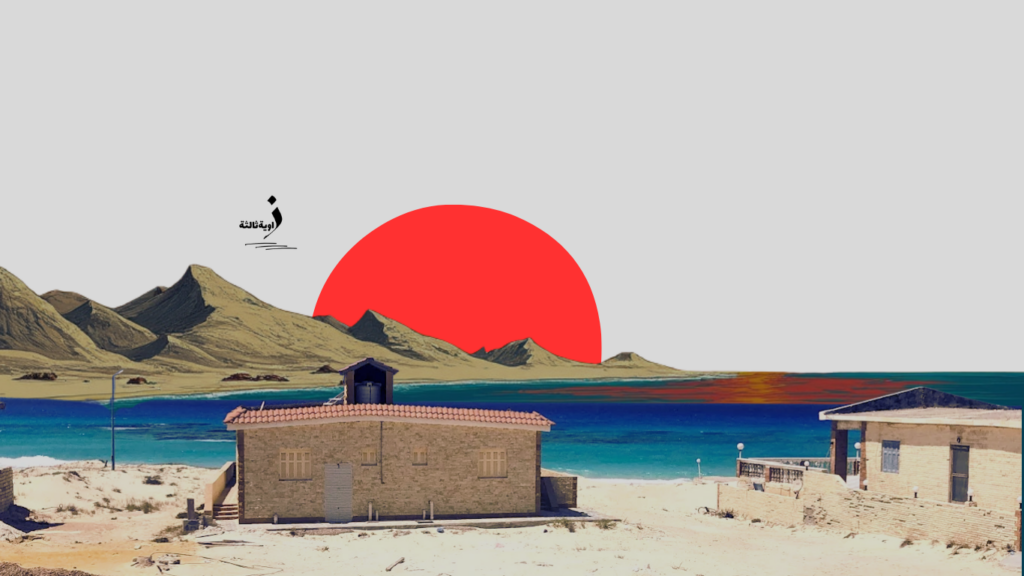
Agiba differs from other North Coast tourist villages: it belongs to the governorate rather than a ministry, association or private developer. The village occupies a coastal strip described as two kilometres long and 200 metres wide, around 35 kilometres west of Marsa Matrouh near El Zawiya El Senousiya and Umm El Rakham.
The source’s geographical reference places Agiba beach close to the Agiba plateau, west of Marsa Matrouh. The area is known for its white sand.
Development plans fuel owners’ fears
In December 2024, Prime Minister Mostafa Madbouly announced a detailed plan to develop 260 kilometres of Egypt’s northwestern coastline as an international tourism destination.
He described three sectors: Ras El Hekma to Marsa Matrouh, Marsa Matrouh to Sidi Barrani, and Sidi Barrani to Salloum. Detailed plans would guide development alongside tourism on the Red Sea, with greater use of renewable energy to reduce reliance on fossil fuels.
The announcement worried people living in the area. In the final week of December, Agiba chalet owners circulated reports of demolition plans beginning in mid-January 2025. Facebook discussions reflected concern over unexpected decisions they believed threatened their property and social security.
Owners called for an official explanation from the governorate or other relevant authorities. They said the absence of clear communication encouraged rumours and uncertainty.
Their anger intensified after circulation of a paper dated December 14, 2024, addressed to Matrouh governor Khaled Shoaib and Defence Ministry secretary-general Ayman Naim Thabet. It referred to the Armed Forces Engineering Authority supplying the Agiba chalet area’s coordinates, a requested expropriation decision and coordination with the governorate to erect surrounding walls.
“Are these decisions trial balloons or actual plans? We know nothing and want officials to respond,” owner Salah Khaled tells Zawia3.
“We bought the chalets from the governorate itself, with officially registered contracts. If a citizen who buys from the government cannot feel secure, where should we go?” — Salah Khaled
Khaled says development must consider its social and human impact. He describes the area as established housing with water and electricity, rather than an informal settlement, and argues that nearby vacant land should be developed instead of displacing residents and erasing their memories.
The original report draws on a legal discussion of forced displacement and cites Article 63 of Egypt’s constitution, which prohibits arbitrary forced displacement of citizens and states that the offence is not subject to limitation.
It also places owners’ concerns alongside disputes over expropriation in Ras El Hekma and the Gomayma village area in Matrouh, El Gamil in Port Said, and Faisal and Ring Road areas in Giza during 2024. Whether a particular development or expropriation constitutes unlawful forced displacement depends on the circumstances and safeguards, rather than the development label alone.
Demolition without community dialogue
Assem Fayez says owners were initially given no clear boundary for the proposed decision. Through contacts with Matrouh governorate, they understood that all Agiba chalets would be removed, although people had bought them from authorities since the 1980s at prices considered high at the time.
He says residents had not been given an opportunity for dialogue with the responsible authority.
“We support development, but we want our rights,” Fayez says. “People bought these chalets under official contracts. Those contracts have legal value and cannot be disregarded.” He describes purchases over many years, from 1985 and 1986 through 2000.
Some owners’ arrangements involve ownership of the buildings with an annual usufruct payment for the land. Fayez says owners pay the governorate yearly and have also sought to regularise the chalets’ legal position through substantial payments in recent years, without receiving clear answers.
He questions whether the land is intended for outside investors and calls for transparency about the government’s position. These are owners’ concerns, not a confirmed account of a subsequent investment deal.
Sahar Abdel Wahab says her property is now worth tens of millions of pounds. She describes full ownership contracts for chalets bought from the government over many years.
“If taking our property is necessary for development, the government must provide suitable compensation or real alternatives. We do not want to lose everything we have invested over these years.” — Sahar Abdel Wahab
She calls for a fair solution respecting owners’ rights and Matrouh’s distinctive character.
Mahmoud Mahgoub says uncertainty remained over whether the decision was official and final. The governorate built 93-square-metre chalets in 1986, he says, and he bought one for EGP 25,000, an amount he compares with around five kilograms of gold at the time.
Owners later discovered that the land had not yet received a subdivision decision, according to Mahgoub. In 2020, the governor increased annual usufruct charges from EGP 120 to EGP 183,350, he says.
Demolition decisions then covered chalets built from 2000 whose status had been regularised. Owners approached the Housing Ministry’s technical inspection body for construction works, requesting suspension while the position was reviewed.
Mahgoub believes these steps prepared the way for removing owners from the area. He questions whether the purpose is public benefit or private investment and asks why vacant land between Agiba and Salloum cannot be developed instead.
“We have chalets and memories going back more than 25 years,” he says.
He says owners are willing to fund improvements such as water desalination or sewage treatment, even contributing EGP 1 million or EGP 2 million per chalet, if that allows them to remain.
“We do not reject development. We want to keep our homes and help improve them, without being excluded or expelled.” — Mahmoud Mahgoub
“We bought the chalet three times”
While several owners say a settlement could be reached through suitable compensation, Sara El Wakil focuses on successive rounds of payments.
She says her family first bought its chalet in the 1980s for around EGP 28,000. At the EGP 3 per gram gold price she cites, that corresponds to roughly 9.3 kilograms of gold. Her comparison reflects the price stated in her testimony, rather than an independently verified historical gold quotation.
The chalets initially lacked water and electricity, she recalls. Owners installed a water network, formed an association to arrange electricity, and built access roads and water tanks for individual properties.
In 2000, she says officials accused owners of building without permits. “We only built to provide water and electricity,” she says. She describes paying another EGP 30,000 during governor Samir Youssef’s tenure.
El Wakil compares this payment with gold at EGP 60 per gram. On those stated figures, EGP 30,000 equals 500 grams, or half a kilogram—not the three kilograms given in the original Arabic account.
In 2020, she says owners were again told they had built without permission, even though the government had constructed the original chalets. They were instructed to seek reconciliation through the New Urban Communities Authority at EGP 2,000 per square metre. Some paid EGP 100,000, while others paid a 25% initial reconciliation instalment, she says.
Her 1982 contract provided for land usufruct at EGP 120 a year. She says the government increased that charge to approximately EGP 183,350 for a chalet originally priced at EGP 28,000.
Owners brought a lawsuit that lasted three years and, according to El Wakil, won restoration of the old usufruct rate. They were then confronted with expropriation plans. She also says 96 owners’ contracts dating from 2000 had been cancelled.
The owners urge officials to suspend and review the decisions in a way that protects their rights. They want clear government statements to resolve uncertainty and negotiations in which residents are treated as participants rather than informed only after decisions have been made.