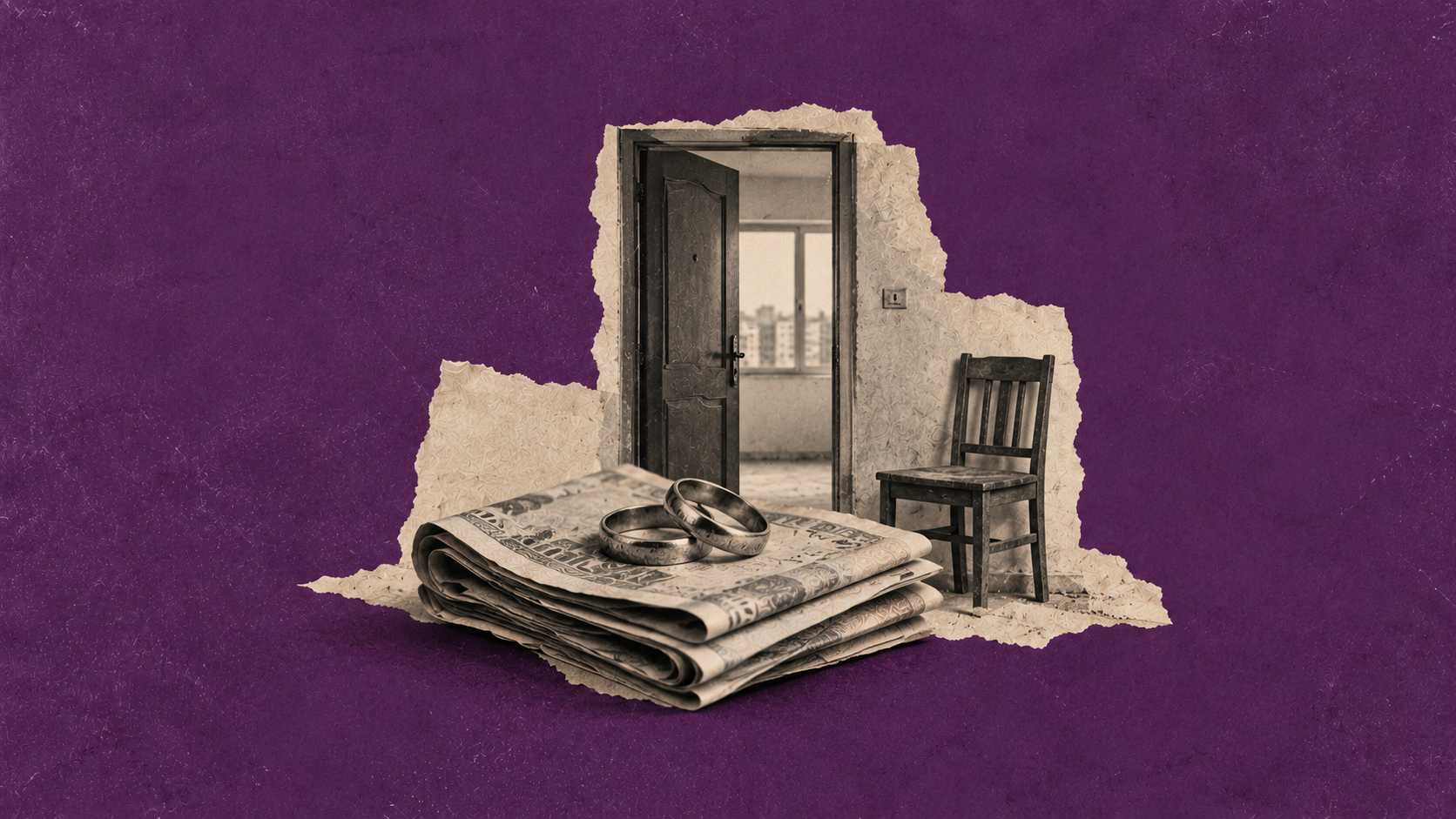

“What should we start with?” Mai Badawi asks her fiancé, Amr Gamal, as they discuss furnishing their future apartment with Zawia3. They have decided to make those choices together, away from the expectations of relatives and the pressure to have everything ready before the wedding.
Amr, in his late twenties, no longer imagines waiting until the apartment has a bedroom suite, living-room furniture, appliances and air conditioning before marrying Mai. Each new item on their list brings another price to reckon with. Their response has been to start crossing things off.
Figures from Egypt’s Central Agency for Public Mobilization and Statistics (CAPMAS) show that marriage contracts fell by 2.5% in 2024, to approximately 936,700, from 961,200 in 2023. Those figures alone do not establish why marriages declined or measure the contribution of rising prices.
Inflation has nevertheless changed the cost of everyday life and of setting up a household. World Bank data put average annual consumer-price inflation at approximately 5% in 2020 and 5.2% in 2021, rising to 13.9% in 2022 and 33.9% in 2023, the highest rate in that period, before easing to 28.3% in 2024 and 14.1% in 2025. Slower inflation means prices are rising more slowly; it does not mean they have returned to their earlier levels.
Listen to an excerpt from Zawia3’s interview with a woman preparing to marry (Arabic audio). The original player notes that the speaker’s voice has been altered.
Mahmoud El-Hawary and Aya Mohamed, who are engaged and preparing to marry, are working through the same choices. With housing, furniture, appliances and gold becoming more expensive, furnishing lists that once seemed ordinary have become harder to afford. Their agreements increasingly revolve around what their budget can sustain.
Mahmoud says the things he imagined buying around five years ago are not necessarily what he needs now. Rather than furnishing several rooms at once, he believes they can begin with the essentials and add other things later.
“Instead of buying a bedroom suite, a children’s bedroom, living-room furniture and a salon suite, I can make do with the bedroom and salon furniture I will use now,” he tells Zawia3.
Aya describes postponing some purchases as an option families can consider. Mahmoud interrupts to draw a distinction: “It is no longer a choice; it has become a necessity.”
“It is no longer a choice; it has become a necessity.”
Mahmoud El-Hawary, on postponing some household purchases.
For Aya, the change is about more than how many pieces of furniture they buy. It also involves deciding what counts as essential. She puts a microwave, air fryer, dishwasher and air conditioner among the extras they can do without. A refrigerator, washing machine, cooker and water heater are much harder to remove from the list.
Even when choosing smaller household items, she now weighs buying more at a lower quality against buying fewer, better-quality items. Her aim is less to make the apartment look complete at any cost than to buy things that will be useful and last.
Listen to an excerpt from Zawia3’s conversation with two people preparing to marry (Arabic audio). The original player notes that the voices have been altered.
“We will get through it together”
The families of Rahma El-Sayed and Mohamed Abdel Moneim recognize the burden that housing and furnishing costs place on young couples. Both families have relaxed some of their demands to help the marriage go ahead. For them, that need not mean abandoning a right or a responsibility.
Rahma says rising prices affect both partners. Women who work, she adds, are increasingly aware of the relationship between income and the cost of an apartment, furniture and household equipment.
“She will not make things more difficult. Getting married is already difficult, and a woman will not decide to add more burdens to something that is already hard,” Rahma says.
In these accounts, inflation is prompting not only couples but also their families to renegotiate what can wait and what must be available from the outset.
Hassan Abdel Fattah, who recently married, tells Zawia3 that higher prices affect both partners. In his view, economic pressure has made women’s contributions to setting up a home more substantial, with women and their families helping shoulder the cost of getting started.
“Low-income families turn to instalments and buy things gradually, even if that means paying higher prices and taking on cheques, trust receipts and debts that continue for years after marriage. Some families may also borrow from lenders charging high interest,” Hassan says.
Searching for a saving: even EGP 1,000
Mahmoud says higher prices have made even a difference of EGP 1,000 worth pursuing. He is prepared to travel to more distant shops or districts to buy furniture or appliances for less.
Previously, he explains, it might have been enough to buy a reasonably priced bedroom suite nearby. Now, searching for alternatives has itself become part of preparing the home.
Aya says some women are willing to marry with second-hand furniture while others are not. She does not feel ready to begin married life with used furniture or appliances. Rahma, meanwhile, says second-hand purchases do not automatically replace new ones, but rising prices have brought them into the range of options couples consider.
Mai believes limited budgets have encouraged couples to abandon the practice of shopping separately and instead sit down together to decide what they need and what each can afford.
Amr adds that higher prices have pushed families to drop items long treated as an indispensable part of furnishing a marital home. Among them is the nish, the display cabinet traditionally used for china and glassware. Families are also cutting back on linens and buying only the appliances they need, rather than purchasing duplicates.
For the young people interviewed, the difficulty extends beyond buying the engagement gold. It encompasses the apartment, furniture and the other costs of forming a household. Those costs can lead prospective couples to postpone engagement or marriage until they feel financially able to begin.
Slower inflation does not restore yesterday’s budget
Price changes help explain the distance between what Amr and Mai planned and what they can afford, but inflation figures require careful reading. Moving from a large annual increase to a smaller one means prices are rising more slowly, not falling by the same percentage. Someone preparing to marry can therefore read about slowing inflation while finding that a shopping list still exceeds their savings. There is no arithmetic contradiction: one measure describes the rate of change, while the other concerns the price level after successive increases.
The overall consumer-price increase also does not mean every appliance or piece of furniture rose by the same percentage. The index combines different categories and weights, whereas a household buys particular goods at a particular time and place. Multiplying an old wedding budget by the headline inflation rate would not produce a verified price for a new marriage. Comparisons require matching specifications and purchase dates, and distinguishing a cash price from the eventual cost of buying in instalments.
The decline in marriage contracts alone does not establish how many people postponed marriage because of prices. It compares registrations in two years, rather than following every person who decided to wait or identifying their reasons. Age, income, employment, housing and research that follows households over time can help explain changes. Causation cannot be established simply by placing the inflation rate beside the marriage rate. The interviews here document participants’ decisions and experiences; they do not constitute a representative sample of all Egyptians.
Those limits give the accounts their proper meaning. Mahmoud and Aya describe tangible changes to the things they choose, when they buy them and what quality they seek, rather than an estimate of every household’s behaviour. Similar price pressures can produce different responses: fewer items, an entire room postponed, or rejection of second-hand goods despite the cost of new ones. These differences are visible within the interviews themselves and rule out presenting one response as a universal model imposed by rising prices.
Housing and work come before the appliance list
A 2017 Economic Research Forum analysis places housing at the centre of the transition to marriage and examines how rental availability affected its timing in Egypt. Drawing on 2012 data, it puts initial housing costs at about two years of a groom’s wages and 28% of marriage expenditure. That is a historical comparison, not a current apartment price or a fixed share applicable to the couples interviewed here.
The comparison redirects attention to the difference between foregoing an appliance and securing somewhere to live. Removing an item reduces the initial bill but does not, by itself, answer the larger question of housing and its continuing cost. Mai and Amr’s purchases are already framed around a future apartment. Other participants similarly describe setting up a home as a package of commitments, rather than a single purchase that can be resolved by finding a cheaper shop.
A separate 2017 paper by Ragui Assaad and Caroline Krafft examines employment and marriage timing in Egypt, Jordan and Tunisia. It finds that job quality, not simply having a job, matters for men, considering factors such as security, earnings and the capacity to save. Its results concern the study’s data and period. They do not establish the employment circumstances of this report’s participants, for whom comparable detailed information was not collected.
This highlights the distinction between possessing enough money to buy furniture and being able to support a household after marriage. One is a stock of savings spent at a particular moment; the other involves continuing flows of income and expenditure. A family contributing to the initial purchases does not necessarily have the capacity to cover future commitments indefinitely. Rahma’s account of reducing demands concerns the timing of the start and the limits of family support, rather than a universal list of possessions every couple should acquire.
An ERF policy brief published in December 2024 reports a decline in median real hourly wages between 2018 and 2023 and notes that more than half of households relied on one income source in the years examined. Real wages refer to purchasing power after accounting for prices, not the nominal payment received. The findings provide background to the pressure on saving, rather than a direct measure of a marriage budget in 2026.
When social expectations become debt
The connection between marriage requirements and social pressure predates the most recent price increases. In a study published in 2016, Sherif Mohamed Awad examined marriage economics in a village in Damietta through questionnaires and interviews. He discussed expanding expectations around engagement, housing, furnishings and celebrations, and their effects on delayed marriage within that community. This documents a local experience; it does not justify portraying all rural communities as identical or unchanging.
The distinction is between needing an item and the meaning attached to owning it in other people’s eyes. Amr no longer treats a display cabinet as essential, while Aya does not place a dishwasher alongside a refrigerator in her priorities. Mai and Amr’s decision to furnish their home independently of relatives’ pressure shows that the discussion is not just about prices, but also about who defines a complete home. Agreeing to postpone purchases redefines that standard according to what the couple can afford.
In Fathia El Sayed El Hawaty’s study of women imprisoned in debt-related cases, the researcher examined 24 selected cases at Mansoura prison, linking family responsibilities, insecure resources, borrowing and criminal conviction. This restores a dimension present in the original reporting: preparing children for marriage can be understood as a family duty exceeding available means. The study does not provide a national percentage of debt-related imprisonment caused by marriage, or predict the outcome for every household using instalments.
Hassan Abdel Fattah’s description of gradual purchasing consequently concerns more than payment mechanics. Instalments shift part of the burden into subsequent months or years and can increase the total due, depending on the agreement. His interview does not include financing contracts or calculations from which specific charges or liabilities can be established. It should not be turned into an average debt estimate for married couples. What it documents is his awareness that completing a home’s furnishings can entail obligations continuing after the wedding.
The Hayah Foundation’s description of its debt-support programme combines debt repayment with economic assistance and help preparing daughters for marriage. Its programme page is not a current national count of cases. It does illustrate assistance aimed at both the consequences of borrowing and the needs behind it. The actual reach and eligibility conditions of any programme require separate evidence before it can be presented as a solution covering all affected families.
Dropping one item does not remove the budget pressure
Aya and Rahma’s different positions on second-hand goods show that a cheaper alternative is not an automatic choice. The decision may involve quality, expected useful life and personal acceptance as well as the advertised price. This report did not survey market prices or inspect used appliances and does not promise a particular saving or recommend a product. The interviews instead document a widening range of options under consideration, including some participants ultimately reject.
An ERF study published in December 2024 reports that the share of households experiencing shocks rose from 16% in the 2018 survey to 49% in 2023, with consumption rationing among coping mechanisms. These findings concern households generally and shocks as defined in the study, not the percentage postponing marriage or cutting wedding purchases. They place the pressures on establishing a household within a wider context of budget vulnerability.
Differences in family resources also matter when comparing savings and gradual purchasing. The reduction in demands described by Rahma enabled agreement between the families, but does not tell us what would happen to a household unable to afford even the basics. Similarly, Mahmoud’s search for a saving of EGP 1,000 shows the importance of relatively small differences to his budget. It does not imply that comparing shops can, on its own, close a large gap between income and housing and furnishing costs.
The accounts converge on reconsidering how to begin, while differing in the compromises participants accept. Some accept fewer rooms, some postpone an appliance, and some reject used goods while reducing quantities. For Mai and Rahma, sharing the task involves more than dividing a bill: it means negotiating what will be bought at all, what can wait and what each family can bear. A complete home emerges as a gradual process in these interviews, with the ability to begin a life together taking priority over completing a list set by others.
As Mahmoud puts it, the question shifts from “What will we buy?” to “Can we start at all?”