
In recent years, the Egyptian government has expanded its reliance on sovereign sukuk as a mechanism for reducing debt and boosting resources, especially with regard to foreign income, which amounted to $4 billion in the international market from the announcement of the project in 2023 until the end of 2025. Last November, the Ministry of Finance offered sovereign sukuk in the local market worth EGP 3 billion, as the first issuance under a local programme with a total target size of EGP 200 billion.
Sovereign sukuk in Egypt are defined, under Law No. 138 of 2021, as “nominal government securities of equal value, tradable on the stock exchange, issued for a specific period not exceeding thirty years, and representing undivided shares in usufruct rights to assets”. They differ from conventional bonds in that they rely on contracts compliant with Islamic sharia, such as ijara and murabaha, instead of interest, and they are used to finance infrastructure projects, cover the budget deficit, or support the economy.
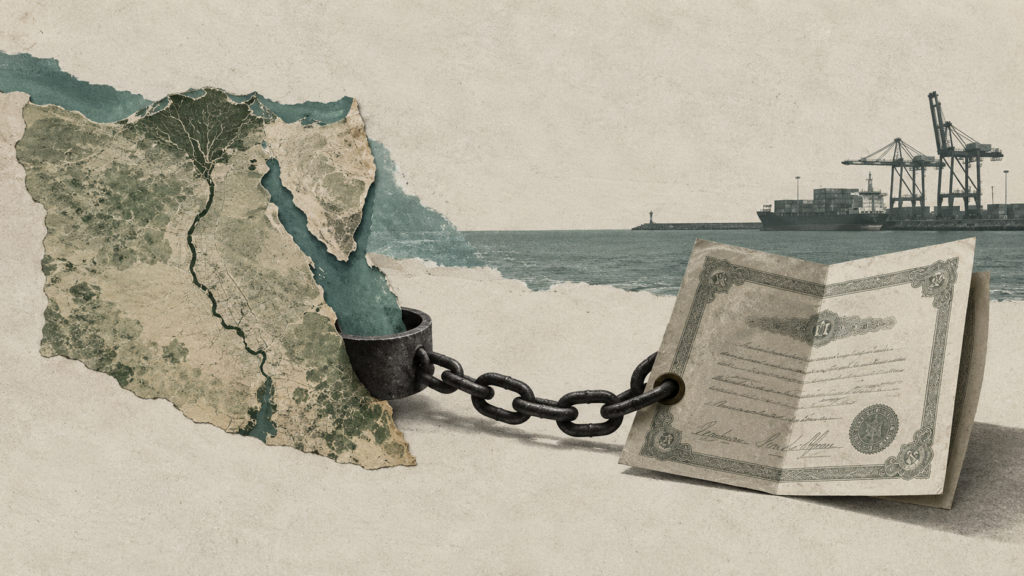
Observers describe the reliance on sovereign sukuk as a back door to selling “state assets”, since it allows usufruct rights over Egyptian assets for periods of up to three decades. The allocation of vast areas of state land, such as the Ras Shukeir area on the Red Sea, for use as collateral for sukuk has sparked a wave of controversy and questions about whether this is in fact paving the way for the sale or mortgaging of strategic or border assets. Although the law stipulates that ownership of the “collateral” remains with the state, opponents fear that an inability to repay could later lead to swapping debt for assets, which would mean liquidating public assets to pay financial obligations.
Amid this controversy, the Egyptian Ministry of Finance issued an official statement affirming that the allocation of the plot of land comes within the framework of issuing sovereign sukuk aimed at reducing debt, and not selling the land or ceding it in any form, stressing that ownership of the land will remain entirely in the possession of the state, represented by the ministry and other relevant government bodies.
The statement explained that the ministry will use part of the land to enter into partnerships with government bodies and economic authorities, with the aim of reducing debt by replacing it with joint investments that turn the land into service, tourism and real estate projects. According to the statement, this step would provide new job opportunities and enhance the economic and investment returns for the Egyptian state.
Egypt moved from a first entry into the international sukuk market to more issues, then to a mix of external and domestic funding
| Fiscal year | International sukuk | First domestic issue (USD equivalent) |
|---|---|---|
| 2022/2023 | 1.5 | 0 |
| 2023/2024 | 0 | 0 |
| 2024/2025 | 1 | 0 |
| 2025/2026 | 1.5 | 0.06 |
On 4 November, the Egyptian Ministry of Finance announced the offering of the first issuance of sovereign sukuk in the local market through the primary dealers system, worth EGP 3 billion (about $63.4 million) and with a maturity of three years, explaining that this comes “as part of its plan to broaden funding sources and reduce their cost, enhance competition in the debt instruments market, and attract new segments of savers to invest in government securities”. It noted that “the offering aims to attract a category of investors interested in instruments compliant with the provisions of Islamic sharia, supporting the diversification of borrowing instruments and the lengthening of the average life of the public debt portfolio”.
The ministry added that the issuance saw strong demand, as it was covered about five times its value, with a yield accepted below that of conventional bonds. The average yield on the sovereign sukuk reached 21.56%, about 0.262% lower than the indicative rate of 21.82% for conventional bonds issued during the previous week, and the average yield also fell by about 14.3 basis points compared with treasury bonds of similar maturity issued on the same day, on which bids were accepted at an average yield of 21.703%.
The ministry indicated that the offering was made through the primary market via public tenders in which 16 primary dealer banks participated, in addition to the four Islamic banks operating in Egypt: Faisal Islamic Bank, Abu Dhabi Islamic Bank, Al Baraka and Kuwait Finance House. The ministry also revealed the launch of a local programme of sovereign sukuk issuances with an ijara structure compliant with the principles of Islamic sharia, with a total value of EGP 200 billion, which includes carrying out several issuances that enjoy the same tax and accounting treatment applied to treasury bonds. The programme aims to broaden the investor base and reduce the cost of debt service, with sukuk issuances included in the quarterly schedule of offerings published on the ministry’s website.
Why Is Egypt Expanding Its Issuance of Sovereign Sukuk?
Professor of political economy Dr Karim El-Omda explains that sovereign sukuk represent a relatively new financing tool in the Egyptian market, even though they have been used in countries around the world for many years. He points out that sovereign sukuk resemble bonds in being a means of financing the state, but differ in being compliant with the principles of Islamic sharia, explaining that sukuk can be sovereign, issued by the government, or non-sovereign, issued by the private sector, as long as they adhere to sharia controls.
He explains, speaking to Zawia3, that sukuk are not sold by ceding an asset owned by the state, but through an undivided share in the usufruct right or in the return generated by the asset, stressing that the state retains full ownership of the asset, while the investor obtains part of the profits or the return generated by operating it. He describes this model as a form of partnership in profitability without partnership in ownership, in line with the provisions of Islamic sharia.
He adds that the term of sukuk extends for a period not exceeding 30 years, and that they attract a broad segment of investors, especially in Arab and Gulf countries and financial institutions that prefer to direct their investments to sharia-compliant instruments. He also points out that the return generated from sukuk goes entirely to the state’s general budget, as they are one of the financing tools available globally, and not a newly devised mechanism or one limited to Egypt.
Although sukuk stand out as one of the tools for containing public debt, the relationship between the two still appears to be a “qualitative” rather than a “quantitative” one, according to economic studies. The volume of sukuk issuances, in foreign and local currency, still represents a limited share of total external and domestic debt, compared with the huge accumulated stock of loans and conventional bonds. In the approximate figures available, the contribution of international sukuk hovers around a few billion dollars against external debt exceeding $160 billion, meaning that their effect on the debt-to-GDP ratio or on the overall structure of liabilities remains numerically limited, even if they enjoy a doubled political and media presence.
Nevertheless, sukuk carry political and economic weight beyond their numerical share because they represent a new direction in debt management and in relying on state assets and the usufruct rights to them as collateral. Choosing to expand the use of sukuk means in practice reshaping the mix of financing instruments by converting part of the financing needs into securities backed by public assets or benefits, instead of relying exclusively on loans and bonds that are not backed by specific assets. From a debt management perspective, they can be seen as a tool for trying to diversify investors and reduce the cost of borrowing at the margin, but at the same time they deepen the growth model’s dependence on borrowing.
Debts Devour Everything
Economic expert and vice-president of the Socialist Popular Alliance Party, Elhamy El-Merghany, affirms in exclusive statements to “Zawia3” that Egypt is suffering from an uncontrolled explosion in borrowing that is taking place without any oversight, and sometimes without an objective justification for the borrowing, as external debts exceed $165 billion, while domestic debts surpass the EGP 15 trillion mark, which constitutes a huge burden on government spending.
El-Merghany points out that Egypt’s (2025/2026) budget reveals that interest on loans amounts to EGP 2,298 billion, while instalments reach EGP 2,084.6 billion, so the state is paying EGP 4,382.6 billion in instalments and interest, representing 65% of total budget uses, leaving what is available for the remaining spending items at no more than 35%.
He adds that the Central Bank of Egypt, in its latest data, raises its estimates of external debt service during 2026 by about $1.3 billion, to reach $29.18 billion compared with $27.87 billion previously. The data also reveal an increase in the value of instalments due of about $1.1 billion, to stand at $23.79 billion. He stresses that this is the third time the bank has raised its debt service estimates for next year, bringing the total increase to about $4.5 billion.
El-Merghany warns that the expansion of domestic borrowing increases the burdens on the Egyptian economy as a result of high interest and the depletion of resources, in addition to the banking system becoming dependent on buying high-yield domestic debt instead of financing development projects, which achieves large returns for the banks, but means that any new addition to indebtedness turns directly into more burdens and reduced opportunities for public and investment spending.
He concludes that the new offering leads to an increase in domestic debt and an aggravation of the burdens of servicing it, along with a reduction in public and investment spending and a narrowing of development opportunities, which means lower growth rates and an inability to finance necessary projects in favour of covering the escalating burdens of debt service.
The last ten years have seen a marked rise in the volume of debt: in June 2015 it stood at only about $48 billion, rising in June 2016 to about $55.8 billion, and with the start of the economic reform programme backed by the International Monetary Fund in 2016 and the subsequent liberalisation of the exchange rate, debt jumped to $82.8 billion in 2017. The rise continued in the following years, reaching $96.6 billion in 2018, then $106.2 billion in 2019, before exceeding the $123.5 billion mark in 2020.
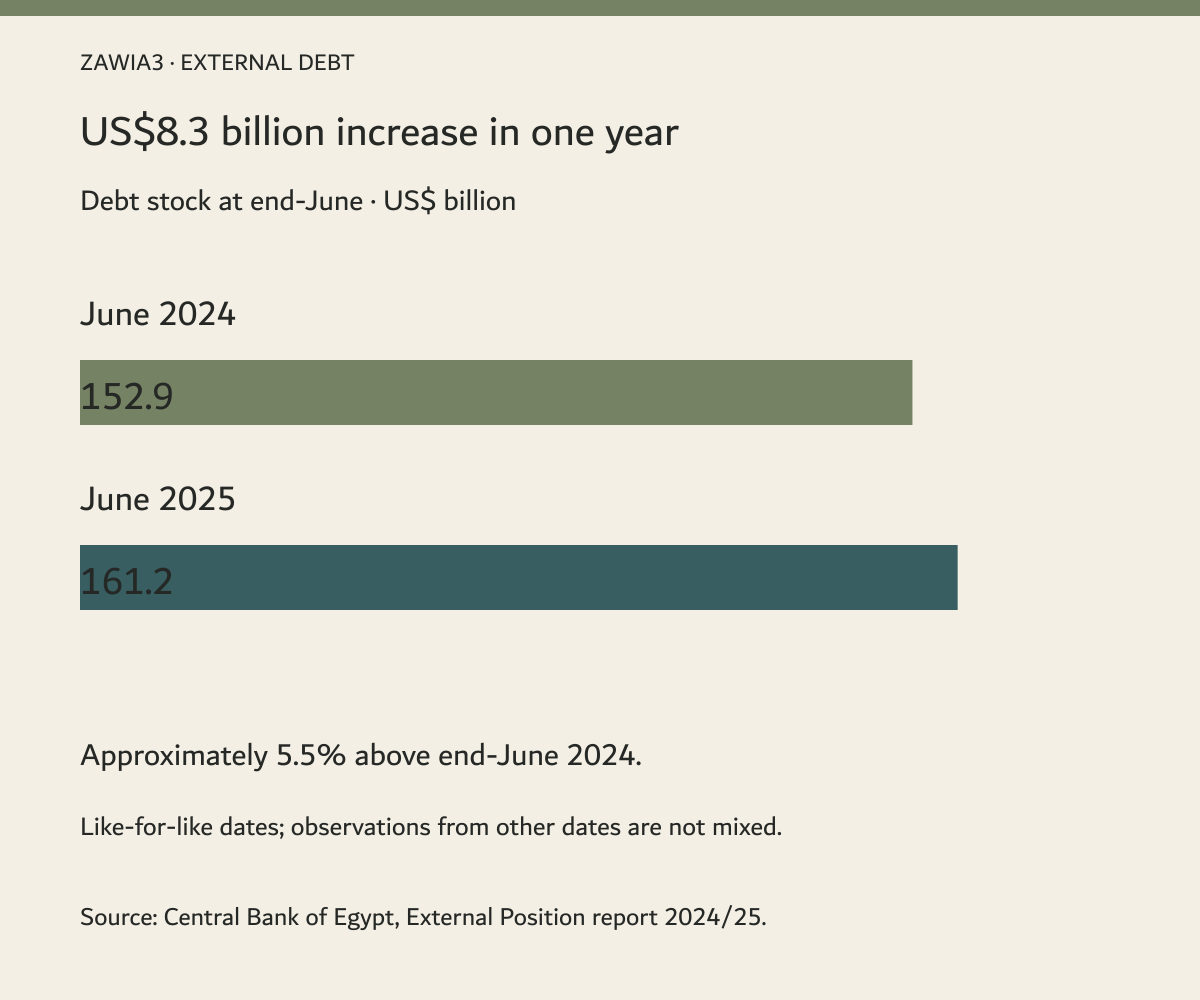
Amid the repercussions of the coronavirus pandemic, external debt rose to $137.8 billion by the end of June 2021, then to $162.9 billion at the end of 2022. In 2023, debt reached about $168 billion, before declining slightly to $155 billion at the end of December 2024, then rising to $161.2 billion at the end of June 2025, according to the latest data from the Central Bank of Egypt.
A Cautious Recovery
At the end of last October, the sixth economic census, released a few days ago by the Central Agency for Public Mobilisation and Statistics, presented a more recent picture of the composition of economic activity and the structure of establishments in Egypt, and showed changes in the distribution of sectors and the size of business establishments, but the census alone is not enough to judge whether or not there has been an economic recovery, according to observers. This is because the monetary, financial and external indicators that represent it in practical terms (real growth, inflation, the budget deficit, sources of foreign currency) show a tangible improvement since the beginning of 2024, but with continuing fragility.
Although growth has returned to approach rates of 4% to 4.5% in (2024/2025), according to the latest census, and the annual headline inflation rate has also fallen to 6.8% in December, the general deficit, public debt, external trade pressures and dependence on exceptional inflows, represented by Gulf investments and land sale agreements, still pose risks to sustainability and, according to observers, portend unoptimistic prospects, according to a report published by Zawia3.
At the end of last September, the Ministry of Planning, Economic Development and International Cooperation announced that the Egyptian economy grew by 4.4% during the fiscal year (2024-2025), compared with 2.4% in the previous fiscal year. The ministry explained that gross domestic product recorded a quarterly growth rate of about 5% in the fourth quarter of the fiscal year (2024-2025), the highest in three years, compared with 2.4% recorded in the same quarter of the previous year, according to the statement.
The fiscal year in Egypt begins on 1 July and ends on 30 June of the following year. The ministry affirmed that economic performance during the past fiscal year contributed to raising the annual growth rate to 4.4%, exceeding the year’s target growth rate of 4.2%, describing this as reflecting the resilience of the Egyptian economy in the face of repeated external shocks, and noting that the growth came as a result of economic policies supporting macroeconomic stability, the governance of investment spending, and the strengthening of the private sector’s contribution, within the framework of the National Structural Reforms Programme.
The ministry explained that growth in the fourth quarter of the fiscal year was driven by the strong performance of several key sectors, most notably: tourism, non-petroleum manufacturing, and communications and information technology. The non-petroleum manufacturing index also rose by 18.8% during the fourth quarter, compared with 4.7% in the same quarter of the previous year, supported by the expansion of industries such as vehicles (126%), pharmaceuticals (52%) and ready-made garments (41%).
The results of Egypt’s sixth economic census showed that 99.85% of economic establishments are owned by the private sector, which reflects an almost complete retreat of the public sector’s role in direct activity, but does not necessarily mean a development in efficiency or productivity. The number of these establishments reached about 3.852 million out of a total of 3.858 million establishments nationwide, against only 0.15% for the public sector and the public business sector.
Economic expert and chairman of the board of trustees of the Socialist Popular Alliance Party, Zohdy El-Shamy, believes, speaking to Zawia3, that Egypt has come to live under the impact of “news of privatisation and sales” on an almost daily basis, as if this had become the only economic policy available, asking: “Can this really represent a rational economic choice?”.
El-Shamy explains that the government, after pushing external debt to around $150 billion and becoming unable to secure new loans as before, chose the path of selling assets to pay its obligations, stressing that this policy does not offer a solution to the crisis, but rather deprives the state of the returns of profitable projects such as the fertiliser companies, Abu Qir, MOPCO, Eastern Tobacco, the pharmaceutical companies and the banks, in addition to allowing foreign investors to transfer their profits abroad in hard currency, which aggravates the pressures instead of addressing them.
The politician and economic expert affirms, in his conversation with us, that what is happening is “a sale of what it does not own to those who do not deserve it”, stressing that the government is sacrificing the future of current and coming generations, and pointing out that the risks are not limited to the economy, but extend to national security after the offering of ports and the privatisation of airports, a step he considers extremely dangerous.
For her part, Dr Taghreed Badr El-Din, assistant lecturer in economics at the Faculty of Politics and Economics, Beni Suef University, believes that what the Egyptian economy is currently witnessing can be described as a stage of “cautious recovery”, stressing that macro performance indicators show a tangible improvement in growth and monetary stability, but still need deep reform support to ensure their sustainability.
Taghreed explains, in exclusive statements to “Zawia3”, that International Monetary Fund estimates issued in May 2025 indicate that the Egyptian economy is set to achieve a growth rate of 4.3% in 2025, compared with only 3% in the previous year, while the World Bank raised its forecasts to 4.2% for the fiscal year (2025/2026), with the possibility of reaching 4.6% in the following year. She attributes this improvement to increased foreign investment in infrastructure and energy, in addition to the implementation of a new $8 billion fiscal and monetary reform programme backed by the International Monetary Fund.
Meanwhile, the census indicated that most private establishments are small, with limited capital, and operate in low value-added sectors such as commercial services and retail, which reflects an almost complete retreat of the public sector’s role in direct economic activity without necessarily indicating a development in efficiency or productivity. It also showed that the number of workers in these establishments reached about 15.234 million, of whom 14.311 million are in the private sector, at a rate of 93.9%, even though wages paid in the private sector account for 80.2% of total wages. These data reflect the model of the Egyptian economy, which relies heavily on small and informal private-sector establishments in low value-added activities.
Finally, it can be said that sovereign sukuk in Egypt represent an attempt to reshape government financing tools and diversify debt sources, opening the door to attracting new, sharia-compliant investments and enhancing the state’s economic return. Nevertheless, their numerical contribution to reducing total debt remains limited, compared with the huge stock of loans and conventional bonds, which makes their impact on fiscal sustainability relatively limited. With fragile economic growth continuing and the economy relying on borrowing and temporary foreign inflows, the success of sovereign sukuk in achieving their goals depends on their ability to integrate financing with productive investment and to reduce the risks associated with state assets, while maintaining ownership of them and control over their uses. Thus, sovereign sukuk remain a promising tool politically and economically, but they are not a comprehensive solution to the structural challenges facing the Egyptian economy.
Editorial correction: The first version of this report said Egypt’s sovereign sukuk issues on the international market totalled about $5 billion. They totalled $4 billion in three issues ($1.5 billion in February 2023, $1 billion in June 2025 and $1.5 billion in October 2025); $5 billion is the overall size of the international sukuk programme under which the first two issues were made, according to Ministry of Finance data.
Editorial correction: The first version of this report said external debt stood at about $55.8 billion at the end of 2016. It reached that level at the end of June 2016, then rose to $67.3 billion at the end of December 2016, according to Central Bank of Egypt data.
Editorial correction: The first version of this report said external debt reached $137.8 billion at the end of 2021. It reached that level at the end of June 2021, the end of the 2020/2021 fiscal year, according to Central Bank of Egypt data.
Editorial correction: The first version of this report said external debt fell to $155 billion in January 2025, according to the latest Central Bank of Egypt data. That figure is for the end of December 2024, and the latest central bank data at the time of publication showed $161.2 billion at the end of June 2025.