
On the evening of Monday, January 10, 2022, a pickup truck carrying twenty-three workers boarded an unlicensed ferry crossing the Rashid branch of the Nile from the village of Al-Qata in Monshaat Al-Qanater district in Giza to Ezbet Al-Taftish, belonging to the village of Tulia in Ashmoun district in Monufia. Most of the passengers were children between thirteen and seventeen years old, ten girls and thirteen boys, who had just finished a day’s work in a poultry farm collecting eggs. The driver lost control of the brakes as he drove the vehicle onto the ferry deck, and it slid off the other side and fell into the river, according to investigations by Giza criminal investigations. Fourteen survived and eight drowned, seven of them children: Saeed Saad Al-Tanani, Hajer Abd El-Samad, Doaa Nabil, and Nada Ahmed Hassan, all thirteen years old; Shrouk Yasser, sixteen; Ziad Ahmed Hassan and Zeinab Abd El-Mouneim Abd El-Aziz, both seventeen; and Mohamed Sabri Salem, who had passed childhood by a single year, according to the victims list published by local newspapers.
River rescue forces retrieved seven bodies during the following two days, while Shrouk remained underwater for seven days in the depths of winter, until divers found her on January 17, and her family identified her from her hair after the water had changed her features. She had been working daily for fifty Egyptian pounds like her peers, and had gone out to the farm, as her family told journalists, to buy a jacket for her younger brother to protect him from the winter cold. Her mother did not leave the accident site throughout the week, waiting for her daughter’s body to be buried in the family cemetery rather than carried away by the current.
The Public Prosecution moved quickly along the track it knows: it detained the ferry owner, three of his workers, and vehicle driver Ahmed Maher Said for four days pending investigation on charges of causing death, operating a vessel without a license, and transporting passengers in a pickup truck in violation of the law, then the opposition judge at the North Giza Court renewed their detention for fifteen days on charges of negligent homicide of eight children and endangering the lives of fifteen others. Absent from the charge sheet, as published by the press, was any mention of whoever employs thirteen-year-old children in a poultry farm for twelve hours a day, or whoever contracts a driver to transport them in a pickup truck bed across the river every evening. That is a separate crime under Egyptian law, but its penalty is not worth filing a case over: a fine of no less than five hundred Egyptian pounds and no more than one thousand per child.
One Child in Every Twenty
No one in Egypt possesses a recent count of working children, because the last specialized national child labor survey dates to 2010, when the Central Agency for Public Mobilization and Statistics conducted it with the International Labour Organization’s International Programme on the Elimination of Child Labour. That survey found, as summarized by Al Jazeera in December, that 1.6 million children were engaged in child labor, meaning 9.3 percent of Egypt’s children, one in every ten, that 82.2 percent of them worked in poor and unsafe conditions, that 16.9 percent worked more than six hours a day, and that agriculture claimed sixty-three percent of them, followed by mining, construction, and manufacturing at 18.9 percent, then services at 17.6 percent. The state has announced no new national survey since then, leaving the figure that opens every official statement on child labor one that is thirteen years old.
What is available instead is a side indicator in the Egyptian Family Health Survey, conducted by the Central Agency in 2021 and issued in preliminary findings on August 30, 2022, then in final form last March. Between the two releases the number changed: Agency head General Kheirat Barakat said in the preliminary announcement that the child labor rate among five-to-seventeen-year-olds reached 5.6 percent in 2021 against 7 percent in 2014, and that border governorates recorded the lowest rate (2.6 percent) while rural Upper Egypt recorded the highest (8.4 percent against 10.4 percent in 2014), before the final results reported that the rate was 4.9 percent, 6.8 percent among males and 2.8 percent among females. Whichever number is correct between the two, what the health survey measures is a single question within a questionnaire about fertility, nutrition, and circumcision, not a survey counting working hours, the nature of work, and its risks, so it cannot be compared to the 2010 survey except with caution. What is certain is that at least one child in every twenty in Egypt works, that the rate in rural Upper Egypt approaches one in every twelve, and that two-thirds of these children work in fields and farms where no labor inspector arrives and no law applies.
An Unbroken Chain
The drowning of Tulia’s children was not an exceptional incident but a link in a chain that repeats with the same details: a vehicle not designated for passenger transport, an unsafe road or crossing, a daily wage ranging between thirty and fifty Egyptian pounds, and children on their way to a farm or returning from it. Just one hundred days after the incident, on the morning of Saturday, April 30, 2022, a three-wheeled motorcycle overturned carrying fourteen people into the Sahal Marqus canal in front of the bridge at the village of Al-Sawalem in Itay Al-Barud district in Beheira. They were returning from work at a potato sorting and packing station in the Tawfiqiyya area. Eight children from the village of Nikla Al-Inab, between thirteen and fourteen years old, drowned, named by the press: Mohamed Amin Al-Abd, Hadi Hisham Badran, Salem Mohamed Ali Salem, and Ahmed Al-Sayed Taha Obeid, all thirteen; and Abd El-Rahman Reda Khalifa, Mohamed Abd El-Moneim Shaaban, and Ahmed Ezz Al-Assiouty, all fourteen. The prosecution ordered the detention of two defendants, a parliament member asked why the area had not been cleared of danger, and no one asked why fourteen children were returning from the potato station at dawn.
One month before the Tulia incident, in December 2021, two children were killed and twenty-four people, most of them children, were injured in the overturning of a pickup truck on the Al-Dawawis junction on the Qassasin road in Ismailia. They were on their way to a farm to harvest onions, and their ages ranged between ten and fifteen, the same junction that witnessed in March 2019 the death of a nineteen-year-old girl and the injury of sixteen children on their way to desert road farms. In May 2021, two children died and twenty-one were injured in the overturning of a pickup truck on the Western Desert highway during their return from work at a desert hinterland farm. In August 2021, a child in Atfih was found hanged in a cemetery; he had been working a tuk-tuk to support his disabled father, and three people killed him to seize the vehicle. Four incidents in fourteen months, in four governorates, with children from the countryside in every case, and by the same means: the back of a truck.
This chain intersects with another structure of neglect: ferries. After the drowning of Tulia’s children, MP Mohamed Abdullah Zein El-Din, a member of the House of Representatives’ Transport Committee, said that the ferries spread across the Nile in Egypt’s governorates suffer from deterioration and inadequacy for transporting people and goods, that Egypt has approximately ten thousand ferries serving around 144 islands along the river in addition to villages separated by one of its two branches, and that all are urgently in need of maintenance or replacement with bridges. The state’s response to the incident came as money and a promise: President Abd El-Fattah Al-Sisi directed the Prime Minister to build a bridge for residents of the area to prevent a recurrence, ordered the Tahya Masr Fund to pay twenty thousand Egyptian pounds to each deceased person’s family, the Ministry of Local Development allocated five hundred thousand pounds to Monufia Governorate to support families following social research, and the Monufia Governor paid one hundred and twenty thousand Egyptian pounds to each deceased. The state thus valued the drowned child’s life, after the drowning, at the equivalent of approximately two thousand four hundred days’ work in the poultry farm, while its law valued the penalty for employing the same child alive at the equivalent of twenty days’ wages.
From Al-Qata to the Quarries
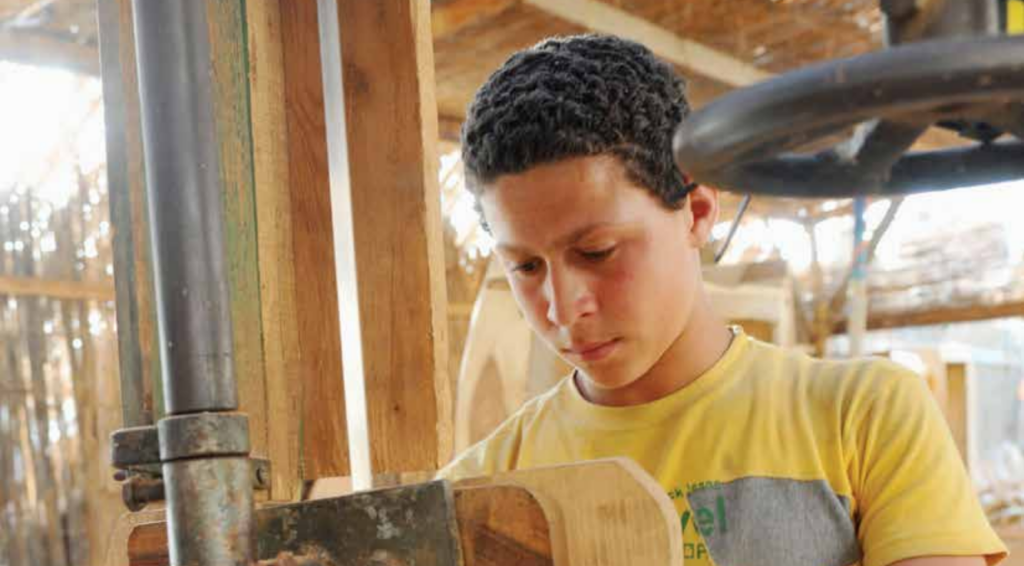
Agriculture represents the largest sector of child labor in Egypt but not the most dangerous. On the eastern side of Minya Governorate, over approximately three hundred square kilometers, hundreds of white limestone quarries producing bricks and construction materials operate, with children working at electrical cutting saws, crushers, and loading stone blocks. An investigation published by the ARIJ network last September, after a field visit between December 2021 and March 2022 examining fifty children, documented that 84 percent of the sample had sustained cuts during work, that records at the health unit in the village of Al-Dayaba registered injuries to thirty to forty children monthly in the first months of 2022, most of them work injuries according to the unit’s nurse, that a count conducted by the Nile Valley Foundation for Quarry Worker Protection and published by the Quarry Workers Union in 2019 identified 115 children injured due to quarry work, and that children represent approximately one-fifth of the workforce in this sector. The investigation told the story of Mahmoud Atef, a thirteen-year-old boy working under a stone-cutting machine for up to fifty Egyptian pounds a day, who stumbled while loading stones onto vehicles and cut his right eyebrow, then returned to the quarry the next morning with his younger brother.
Lacerations are only the visible effect. A 2014 investigation by Al-Shorouk newspaper documented that more than sixteen thousand children between fifteen and eighteen worked in Minya quarries without employment contracts, for a daily wage of eighty Egyptian pounds and a “death blood money” of one thousand pounds, and that their employment in blasting mountains with dynamite had killed dozens of them and left permanent disabilities in dozens more. The investigation author accompanied a fifteen-year-old who had worked in the quarries since the age of nine to the clinic of Mohamed Ali Moussa, Professor of Chest Diseases at Minya University, who found severe inflammation in his throat, nose, and larynx and a chronic bronchial condition, with the doctor explaining that limestone dust and asbestos extracted from the rock cause pulmonary fibrosis that may end in cancer. In that same year the Minya labor office filed five hundred reports against three thousand quarries it visited, for operating without a license, employing children, and using explosives: one report for every six quarries, with a fine not exceeding one thousand Egyptian pounds.
Quarry owners do not hide their logic. One of them, named Hussein Abd El-Hadi, told Masrawy in May 2019 that employing those under eighteen is a cost-saving measure, since one adult worker’s salary covers three children who do the same work and more. Quarries fall squarely within what ILO Convention No. 182 defines as the worst forms of child labor, yet Ahmed Mosailehi, head of the Child Defense Network, told the same investigation that the small fines applied deter no one, and called for penalties reaching five years’ imprisonment for quarry owners exploiting children.
Between the field and the quarry stretches a long list that every Egyptian city knows: children in carpentry, metalwork, and mechanics workshops, in brick kilns on the outskirts of Giza, in garbage sorting, in street vending on market sidewalks and on trains and metro carriages, in fishing in Lake Burullus and Lake Manzala, and in domestic service where girls work unseen by anyone. Agricultural work itself takes increasingly industrial forms: poultry farms that use minors to clean, feed, and collect and pack eggs; potato and onion sorting stations; and cotton fields, which are among the oldest child labor sites in Egypt, to the point that previous governments, as an expert recalled to Al Jazeera, used to give pupils from villages known for cotton cultivation exceptional leave to help their families harvest the crop, making child labor a declared educational policy rather than a violation to be caught.
The Law That Equates a Child With One Thousand Egyptian Pounds
On paper, Egypt possesses a complete legal framework. Article 80 of the 2014 Constitution commits the state to caring for and protecting children from all forms of commercial exploitation, prohibits their employment before completing basic education, and prohibits employing them in work that exposes them to danger. Article 64 of Child Law No. 12 of 1996, as amended by Law No. 126 of 2008, prohibits employing children before the age of fifteen and training them before thirteen, and prohibits employing them in any work endangering their health, safety, or morality, particularly the worst forms of child labor as defined by Convention No. 182. Yet the same article opens the door through which the entire countryside enters: it permits the competent governor, with the education minister’s approval, to license the employment of children between twelve and fourteen in “seasonal work that does not harm their health or development and does not disrupt their school attendance,” a description that any governor can apply to cotton harvesting and potato and onion picking.
Labor Law No. 12 of 2003, in Articles 98 through 103, regulates child employment: no employment before the age of completing basic education or fourteen, whichever is greater; no more than six hours daily with a rest period; no overtime or night work; with a register of children’s names and the nature of their work approved by the administrative authority. But Article 248 of the same law sets the penalty for violating all of this at a fine of no less than five hundred and no more than one thousand Egyptian pounds, multiplied by the number of children and doubled in cases of recurrence. The Council of Ministers approved on December 7, 2021, one month after the Ismailia incident and one month before the Tulia incident, a draft law to increase these penalties to a fine between one thousand and two thousand Egyptian pounds with a six-month closure of the establishment in cases of recurrence. It has not been issued as of this writing, while the new labor law approved by the Senate remains pending in the House of Representatives.
More significant than the smallness of the fine is who the law excludes from protection in the first place. The labor law does not apply to domestic workers, nor to members of the employer’s family actually supported by the employer, and the provisions of the child employment chapter do not apply to children working in pure agriculture, meaning the sector that contains two-thirds of Egypt’s working children. The child who collects eggs on a farm or harvests onions in a field is thus outside labor inspection reach by the text of the law, and if an inspector reaches them, the most the inspector can do is file a report for a one-thousand-pound fine, while no one is held accountable for the pickup truck that transports them unless it falls into the river.
Egypt ratified the Convention on the Rights of the Child in 1990, ILO Convention No. 138 on the minimum age for admission to employment in 1999, and Convention No. 182 on the worst forms of child labor in 2002, and launched in July 2018 with the ILO Cairo office the National Plan to Combat the Worst Forms of Child Labour and Support Families 2018-2025, with then-Manpower Minister Mohamed Saafan saying at its launch that child labor is a crime that must be stopped. In June 2022, Enrico Ochalan, Director of the ILO Cairo Office, said that the ILO was implementing, with Dutch support, the project to accelerate the elimination of child labor in supply chains in Africa, and that the National Council for Childhood and Motherhood had begun implementing it with them in Egyptian cotton supply chains. Five years after the national plan whose end date is two years away, not a single public report exists saying how many children were removed from work, nor a single survey saying how many entered it.
Three Decades of Programs
The current national plan is not the first attempt. Between 2004 and 2006, the Ministry of Manpower implemented with the World Food Programme, UNICEF, and the ILO a project to withdraw 4,300 children from the labor market in three governorates. According to the results published by the ILO and the Ministry, 632 children returned to primary education, 3,830 enrolled in literacy classes, 5,108 in community schools, and 2,005 in vocational training centers; 371 children were withdrawn from the worst forms of labor; social services were provided to 2,938 children, healthcare to six hundred, and financial assistance to 236; and 1,653 awareness sessions were held. These are numbers that appear large until measured against their scale: the entire project withdrew from the worst forms of child labor over two years a number approximating what a single health unit in the village of Al-Dayaba records in child injuries in a single year.
Then came the National Plan 2018-2025 to define the worst forms it targets: practices resembling slavery such as the sale of children and forced labor; use of the child in prostitution or pornographic material production; use of the child in illicit activities such as drug production; and work that harms their health and psychology. The child who collects eggs for twelve hours or loads stones onto saws barely appears in this definition except in its last clause, which is the one no labor inspector carries in their pocket when entering a farm, if they enter one. The ILO estimates, according to what the Diraya Center for Studies conveyed, that every one percentage point increase in the poverty rate corresponds to an increase of no less than 0.7 points in child labor rates: an equation that makes the figures of the past two weeks a preview of what will happen in the fields next season.
Poverty in July 2023 Numbers
Understanding the persistence of this phenomenon is impossible without looking at the numbers released two weeks ago. On July 10, the Central Agency for Public Mobilization and Statistics announced that annual urban inflation reached 35.7 percent in June, the highest level in the history of measurement, and the Central Bank announced that core inflation reached 41 percent, while food and beverage prices rose 64.9 percent in a single year, after the pound lost half its value against the dollar since March 2022. The last official poverty figure dates to the income and expenditure survey of 2019/2020, which said 29.7 percent of Egyptians were below the poverty line, before the pandemic, before the Ukraine war, and before three currency devaluations. In 2018, when poverty stood at 32.5 percent by the same agency’s calculation, Hassan Al-Khawli, professor of sociology at Ain Shams University, told Al-Monitor in commentary on the Tulia incident that pervasive poverty is the main reason behind child labor in Egypt, and that poor families typically force their children to leave school and work to earn a living.
The state’s response to this poverty is the Takaful and Karama cash support program, whose beneficiary families, according to the financial statement for 2023/2024, exceed five million after the support value was increased 25 percent beginning last April at an annual cost of 6.4 billion Egyptian pounds, with Upper Egypt claiming more than seventy percent of its families. “Takaful” requires the family to have children in pre-university education enrolled in school. The monthly support for a family, according to Social Solidarity Minister Nevine Al-Qabbaj, is between 620 and 740 Egyptian pounds. Here lies the equation governing the rural family’s decision: a child working daily for fifty pounds like Shrouk and Mahmoud Atef earns their family in a month of twenty-six working days one thousand three hundred Egyptian pounds, twice what the program conditioned on staying in school pays. With food inflation exceeding sixty percent, the father in Tulia or Nikla Al-Inab does not need a lecture on children’s rights to know which he will choose.
The School That Does Not Hold Them
Children’s entry into the labor market is linked to their departure from school, and rural Egypt knows both paths. The 2017 census revealed that a quarter of the population above ten years old is illiterate, and poor large families tend to pull their children out of education early for work, while working children prefer earning a living over attending classes that lead to nothing tangible. The conditional program itself offers evidence of the scale of the gap: the Ministry of Social Solidarity said that 2.26 million children from Takaful and Karama families are enrolled in schools, a figure read as a success, but also meaning that millions of children’s regular school attendance has become contingent on a monthly cash transfer consumed by prices. Neither the 2021 health survey nor any other official statistic has an answer to the question that every incident raises: how many of the children who drowned in Al-Qata and Al-Sawalem were enrolled in a school, how many had left it, when, and why no one noticed.
What the State Knows and What It Does Not Want to Count
The state knows exactly where its children work. The 2010 national survey identified the sectors and governorates, the 2021 health survey identified that rural Upper Egypt has the highest rate and that males outnumber females by more than double, and press investigations identified the quarries by name, the villages by name, and the health units that register children’s injuries monthly. The state has the tools: child helpline 16000 under the National Council for Childhood and Motherhood; labor inspectors, 911 of whom were trained on international labor standards between November 2013 and March 2018 according to a joint study by the ILO and the Ministry of Manpower; a national plan with a fixed end date; and a cash support program reaching five million families. What it lacks is two things: the will to count its working children accurately every few years with a specialized survey rather than a passing question in a health questionnaire, and a law that makes employing a thirteen-year-old child for twelve hours in a poultry farm more costly to the farm owner than one thousand Egyptian pounds.