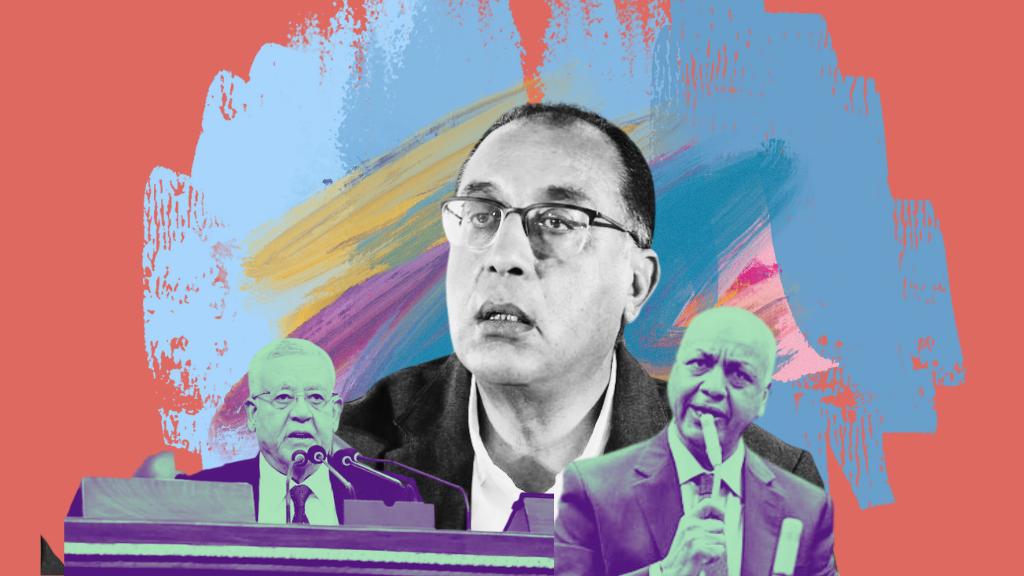


The Civil Movement has issued a detailed report responding to the Egyptian government’s statement “Together We Build a Sustainable Future 2024/2027”, delivered by Prime Minister Mostafa Madbouly before the House of Representatives in the New Administrative Capital last July.
The government’s programme, a copy of which Zawia3 has seen, runs to 286 pages and revolves around four governing principles represented in the programme’s main pillars: the first main pillar deals with protecting national security and Egypt’s foreign policy; the second talks about building the Egyptian person and enhancing their well-being; the third, taking up more than a hundred pages of the report, talks about building a competitive economy attractive to investment; and a fourth pillar, whose pages do not exceed fifteen, deals with achieving political stability and national cohesion.
Following that, a committee was formed by decision of the Civil Movement’s board of trustees at its meeting on 9 July, composed of Elhamy El-Merghany, economic researcher and deputy head of the Socialist Popular Alliance Party; Mostafa Kamel El-Sayed, professor of political science and member of the movement’s board of trustees; Talaat Khalil, the Civil Movement’s general coordinator; and Mohamed Hassan Khalil, a member of the movement’s general secretariat, to respond to the government’s statement, which the movement rejected.
The Government Ignores
In its introduction, the Civil Movement’s report, a copy of which Zawia3 has seen, criticised the Egyptian government’s failure to present a study and critique of its economic and political policies over past years, and blamed the state of the economy on the government’s policies, which, according to the report, “led to a huge deficit in the general budget and the balance of payments, and to an unprecedented level of debt, which recently fell to USD 154 billion after reaching USD 168 billion in previous months”.
The Civil Movement’s report also held the Egyptian government’s policies responsible for the poverty rate rising to almost a third of the population, and for having to sign an agreement with the International Monetary Fund that obliges it to a number of measures including “liquidating state property”, as stated in the staff report approving the loan in December 2022, of which the current loan, in March 2024, is an amendment.
The movement explained in its report that the government’s economic policies have led to Egypt’s dependence on its creditors, foremost among them Gulf states, as Egypt gave up its productive assets and opened the door to giving up the Egyptian state’s historic assets in order to implement those measures.
Commenting, Walid El-Amary, spokesperson of the Civil Democratic Movement, says the report has not yet been submitted to the Egyptian Parliament, and that the movement was keen to present it first to public opinion before submitting it to the House of Representatives.
He explains to Zawia3 that the committee formed by the Civil Movement’s board of trustees prepared the report in cooperation with representatives of the parties within the movement, except for the Justice and Egyptian Social Democratic parties, because their membership has been frozen since the presidential election.
Civil Movement member and Cairo University political science professor Mostafa Kamel El-Sayed points out that the movement was keen to respond to the government’s statement because it is almost the only opposition in Egypt, cares about what the government does, and wants to express to public opinion its position on the government’s programme and its policies.
The political science professor stresses that the new government submitted a programme to the House of Representatives that he described as “inappropriate and inconsistent with the importance of the pillars the government put forward, which is why the movement saw it as its duty to present its position on the government’s programme to public opinion, which differs from the way the House dealt with the programme”.
National Security
National security and Egypt’s foreign policy were among the main pillars the Egyptian government addressed in its report. The pillar included two main programmes, the first of which comprised six main sub-programmes: protecting the security and stability of the borders, supporting the army’s military capabilities in facing external threats, strengthening the security of the Red Sea and the Suez Canal, strengthening counter-terrorism efforts, combating cross-border crime and human trafficking, and protecting internal security and supporting the security system.
The second main programme dealt with Egypt’s foreign policy and included four sub-pillars: first, protecting Egypt’s regional security and preventing interference in its internal affairs; second, strengthening Egypt’s role in its African surroundings and supporting African stability and development; third, strengthening Egypt’s international role; and finally, strengthening Egypt’s participation in global organisations and leadership on important global issues.
The government presented a detailed proposal on this main pillar for the next three years, including its directions for strengthening its national security and foreign policies according to these sub-pillars. However, those directions did not find acceptance with the Civil Movement, which presented a number of observations and recommendations on this pillar.
The Civil Movement’s most prominent observation was that Egyptian foreign policy lacks any effectiveness in confronting threats to Egypt’s security, whether resulting from the civil war in Sudan, the divisions in Libya or the handling of the Grand Ethiopian Renaissance Dam issue. The report criticised the government plan’s complete disregard for dealing with the dam crisis and Egyptian diplomacy’s mere demand that Ethiopia sign a binding agreement guaranteeing Egypt’s rights, which the Ethiopian government has so far refused.
The report also criticised the performance of foreign policy in dealing with the war of genocide being waged on the Palestinian people by the occupation forces. It also criticised the decline in Egypt’s performance in strengthening Arab and Islamic ties, as the government is hesitating to establish diplomatic relations at the embassy level with Syria and Iran, a position the Civil Movement called for reversing to strengthen Egypt’s diplomatic standing, even though the movement condemns human rights violations in both countries.
The movement warned in its report that borrowing leads to the weakness of the debtor and the creditor’s ability to impose its political and economic conditions, referring to Egypt’s economic situation and its reliance on the International Monetary Fund, of which it has become the second-largest debtor country.
It recommended that the armed forces devote themselves to confronting threats to Egypt’s national security on all its borders and abandon the many activities they have taken on beyond their constitutionally stipulated role. The movement considered the government’s failure to evaluate the past experience of relying on the Israeli enemy to secure the country’s natural gas needs a strategic mistake for which the country is now paying.
Energy and Food Security
Energy and food security came under the first pillar, and the Civil Movement criticised the vagueness of the government’s programme and the absence of a clear plan for self-reliance in providing basic food commodities, as well as the absence of clear features of support for Egyptian farmers, and the disregard of greenhouse farming despite the billions spent on the 100,000 greenhouses project.
The movement pointed to the shortcomings of the government’s programme in the energy sector and the failure to set a sound plan to provide gas to power plants to avoid the load-shedding crisis the country suffered in recent months, in addition to the lack of data on natural gas development plans, including the previous government’s plan to convert more than three million housing units to natural gas and replace 61 million butane gas cylinders. In this regard, the movement warned against the government abandoning the programme to connect natural gas to homes and called for a clear plan to complete it.
In this pillar, the movement turned to shedding light on seven sub-goals in the government’s programme, including a health system that covers everyone, better education that helps provide jobs for the future, integrated and sustainable urban development, providing decent work for all, young people, whom the programme called “partners today and leaders tomorrow”, guaranteeing a decent life for all Egyptians, and empowering women and promoting equal opportunities in all fields.
The movement criticised the government’s programme in its report for ignoring health spending, even though government spending does not exceed 32% of total health spending while Egyptian citizens spend 67% of total health spending out of their own pockets; for the decline in health spending as a share of total government spending and GDP in the 2024/2025 budget compared with 2010/2011; for the number of government hospitals falling by almost half between 2000 and 2022 while the share rose in the private sector; and for issuing a law offering public hospitals to the private sector and investors, which helps strip Egyptians of the right to health and turn it into a commodity.
The report pointed out that the government’s programme ignored addressing the shortage of doctors and nurses, which has grown in recent years, as well as the crisis of medicine supply, which has come to depend heavily on the private sector, and the impact of European and American companies’ monopoly on raw materials on medicine prices.
On education, the movement explained in its report that the core of Egypt’s education crisis is the state’s attempt to withdraw from education in favour of the private sector, which constitutes an attack on the right to education, as it will cause a major deterioration of the educational process, which suffers from an acute shortage of teachers and deficiencies in curricula and assessment methods.
The movement called for an implementable plan within three to five years to address the crisis of class density and cover the shortage of teachers, which exceeds 350,000. It also called for supporting national universities and focusing on supporting and developing public universities, which are being turned into semi-private universities, in addition to dual education systems that are destroying university education in Egypt, as Egypt now has 27 public universities, 25 private universities and 21 national universities.
The movement’s report pointed out that increasing private sector investment in education amounts to a translation of the state’s retreat and withdrawal, the waste of the right to education and its transformation into a commodity for those who can pay its price.
On the government’s programme for integrated and sustainable urban development, the report pointed to the government’s focus on fourth-generation cities at the expense of old cities; these cities are unattractive to members of the middle class because of the high cost of housing units and services. The report also criticised the government’s planning of new cities, as it ignored establishing economic activities in them, which made them unattractive.
The government’s work programme stated that it will build 54,000 social housing units without clarifying the distribution map of the targeted social housing or its cost, and it ignored the latest developments on the housing units it had previously promised to build, such as Nasser City west of Assiut and West Qena City.
On employment policies, the movement considered in its report that the government has adopted an unrealistic approach to linking education and training policies to the real needs of the labour market by focusing on technical education and vocational training, pointing out that officially announced unemployment rates do not match the actual number of unemployed people, and the government’s programme did not include an ambitious plan to attract direct investment for labour-intensive industrial and agricultural projects.
On a decent life, the movement said there is a contradiction between the declared goal and reality, as was clear from raising the price of a subsidised loaf of bread from five piasters to 20 piasters, preceded by reducing the loaf’s weight many times. The movement called for reconsidering the allocations for medicine and infant milk subsidies, which are insufficient, demanding that they be increased. The movement’s report also pointed to the inadequacy of the allocations for social security assistance, the Takaful and Karama programme and the child pension in light of successive price rises and high inflation rates.
Meanwhile, Walid El-Amary, the Civil Movement’s official spokesperson, believes some issues were absent from the government’s programme, including public peace and social security; despite social crises that have erupted in recent years, including the growing violence against women and child labour and violence against children, there was no talk of the causes of the crisis or ways to solve it.
Economic Plans Without Acknowledging the Crisis
The pillar in the government’s programme included four strategic goals, starting with consolidating the foundations of economic recovery and ending with Egypt as a strategic hub for transport, logistics and transit trade, passing through empowering the private sector, boosting local and foreign investment, and controlling prices and curbing inflation.
The movement considered that what this pillar lacks most is an acknowledgement of the failure of the economic model followed over the past ten years, which resulted in a decline in the share of productive sectors, foremost among them manufacturing, in GDP in terms of output and employment. This was accompanied by the growth of external and domestic debt and the government having to resort to the International Monetary Fund in search of a rescue deal for the Egyptian economy, after it came close to being unable to pay its international obligations, in addition to this model’s focus on infrastructure projects that did not add to the country’s productive capacity. The movement believes in the importance of moving away from this model and the need to benefit from the diversity of Egypt’s human, material and geographic resources by focusing on developing industry, agriculture and productive services under the leadership of the developmental state, with the combined efforts of civil state institutions and the public and private sectors. Moreover, the government’s statement did not put forward specific and realistic policies for the Egyptian economy to emerge from its crises.
The movement sharply criticised the state ownership policy, describing it as “adopting an approach that strips Egypt of its productive assets in favour of Arab funds, and the pricing lacks transparency”.
Political Stability Without Causes or Solutions
The Civil Movement’s report pointed out that the pillar on political stability and national cohesion was the smallest of the four main pillars in size, as it does not exceed 12 pages, limited to two main programmes and eight sub-programmes.
The movement considered in its report that, according to the government, political stability and national cohesion are achieved through two main programmes: first, strengthening political participation and good governance, and second, strengthening citizens’ trust in the government.
On political participation, the report pointed to the need to strengthen the role of local councils, human rights and basic freedoms, guarantee academic freedom and scientific research, achieve a strong civil society and activate the role of labour and professional unions.
According to the movement’s report, the government’s statement did not address the real reasons behind weak political participation, which result from the state’s policies towards independent political participation. The movement described such participation as a risk that leads those who dare to undertake it into the depths of prisons.
The government’s programme made no reference to any intention to change the election law, which adopted the absolute list system in the previous parliamentary elections and led to the exclusion of the opposition, according to the report, which also pointed to the opposition being deprived of holding its activities even inside its headquarters, as well as the restrictions imposed on the press and media, which led to Egypt’s low ranking in the World Press Freedom Index, and the same applies to civil associations and academic freedoms.
Political science professor Mostafa Kamel El-Sayed sums up for us the reasons for the shortcomings of the government’s programme in several points, the first being the government’s failure to study the previous experience and the policies that led to the current crisis, pointing out that the statement should have been realistic and respectful of public opinion.
The political science professor believes that the shortcomings that resulted in structural imbalances in the economic part stem from the current government’s lack of an economic mind, as well as a methodological and political error in the government’s programme: “It did not study past mistakes because it wants to continue the same policies in the coming years,” as he put it.
In the same context, Elham Eidarous, representative of the founders of the Bread and Freedom Party (under formation), values the Civil Movement’s attempt to enrich this tradition by responding to the government’s statement, after it was excluded from Parliament in many ways, whether through adopting an electoral system based on the absolute list or by imprisoning those who try, as happened in the Hope Coalition case, pointing to the positive aspect of engaging with the government’s statement, given the message it carries to public opinion that the opposition also has a vision.
On the other hand, Eidarous, in her statements to Zawia3, criticised the Civil Movement’s statement for ignoring the issue of citizenship in the face of state arbitrariness and reactionary sectarian religious currents and others. She believes what was presented on citizenship in the Civil Movement’s statement is very limited and does not match the ideas and proposals the movement put forward in the national dialogue sessions and documented in the book “Horizon of Dialogue”.
She points to the movement’s report not engaging with the government’s vision of the women’s empowerment programme, as to whether it is sufficient or not, and also not engaging sufficiently with the “Anti-Discrimination Commission”, despite the opposition’s demand for it in implementation of the Constitution’s articles.
The representative of the founders of the Bread and Freedom Party (under formation) explains that the government’s programme talked about renewing religious discourse, which is a limited and superficial slogan; the crisis does not lie in the state’s religious discourse, but in defending citizenship for all groups of society without discrimination, bias or hatred, which requires more complex and deeper mechanisms than the slogan of renewing the religious discourse of religious institutions alone.
She stresses the movement’s shortcomings on the issue of citizenship, which is evident, as she describes it, regarding women, Christians and the intellectual and cultural diversity in Egypt, in addition to not addressing the issue of people with special needs and their integration into society under the law issued in 2018; the movement should have offered a reading of the law’s positive and negative aspects.
According to what the Civil Movement stated in its report, it announced its rejection of the government’s statement submitted to the House of Representatives last July at a press conference held on Sunday evening, attended by a number of representatives of the Civil Movement’s parties and some public figures.