

On 3 September, Marwa Okasha was packing for a cycling trip from Cairo to Fayoum. Clothes, snacks and camping supplies would see her through three days away. It was her fifth ride to the governorate, and she was looking forward to it. Instead, a serious crash would leave her in intensive care for two weeks and facing a recovery expected to take three months.
Marwa cannot remember the impact. She remembers coming round at Fayoum General Hospital and calling for her mother, who had died. “I was screaming: Where is Mum? Bring me Mum.” She had fractures in her right foot, a crack in her left knee, bruising to her abdomen and back, and a deep scalp wound with a haematoma. Fluid around her lung and other injuries meant she needed oxygen for more than a week.
Her sister Hala, founder of Cairo Bike Forever, told Zawia3 that Marwa had narrowly escaped death. Nineteen-year-old Mohamed Mansour did not survive his own crash. In November 2024, he was killed on the Ring Road while travelling to a cycling competition for universities and institutes.
Death on the road
Mohamed’s father, Mansour Mohamed, first learned of the crash on Facebook. “They said Mohamed had been in an accident on the Ring Road and posted his photograph.” He rushed to Warraq Central Hospital and found his son dead.
Having helped wash his son’s body for burial, Mansour said the impact had struck the front wheel of the bicycle, rather than coming from behind. The wheel spokes were damaged and the helmet broken. His son had suffered fractures to his hand and head and died at the scene, he told Zawia3.
“He loved his bicycle so much that he kept it on the bed beside him. He worried about it more than himself. I would joke, ‘Mohamed, let’s sell the bike.’ He would say, ‘I might sell myself, but not the bike.’”
Mohamed had been anxious the night before the race, due to take place in Mostaqbal City, and left at around five in the morning. He hoped to come first, having previously placed second among institutes and seventh nationally. His father filed a police report and obtained the death certificate, still struggling to accept the loss. “Mohamed was kind, dependable and loved by everyone. That is what helps us endure.”
When Zawia3 examined the Egyptian Cycling Federation’s website during the reporting, it had not been updated since June 2024. A message from former president Wagih Azzam still led its homepage, alongside old news. The site was slow to load and did not provide accessible governing regulations. Pages on the Arab Cycling Federation’s website also displayed maintenance notices. We could not obtain published regulations from either site for use as a source.
The International Cycling Union’s Code of Ethics places the physical and psychological welfare of participants within cycling’s ethical responsibilities. Protecting riders requires more than organising competitions: it involves safeguarding them against neglect, intimidation and harmful practices, with particular care for minors.
For Egypt’s cycling community, photographs of injured or dead riders have become a source of recurring fear. Marwa and Hala had been travelling with a group of around 40 cyclists in an activity organised by the Mashwar team. Riders collected points to enter a draw for an Umrah pilgrimage under an initiative called the “Holy Mosque Marathon”. Marwa’s anticipated journey ended in hospital.
Hisham Bakri, who was riding beside her at around two in the morning on 4 September, described what happened: “We were riding together, following safety precautions, with rear lights and helmets. Suddenly I was on the ground, while a car threw Dr Marwa onto its windscreen and then onto the road.” He called Hala, who was further ahead, and summoned an ambulance after Marwa lost consciousness.
“I like to ride calmly. Even when I drive my car, I do not like speeding,” Marwa said. Her helmet split in two and her bicycle was destroyed. Hisham escaped with minor bruising.
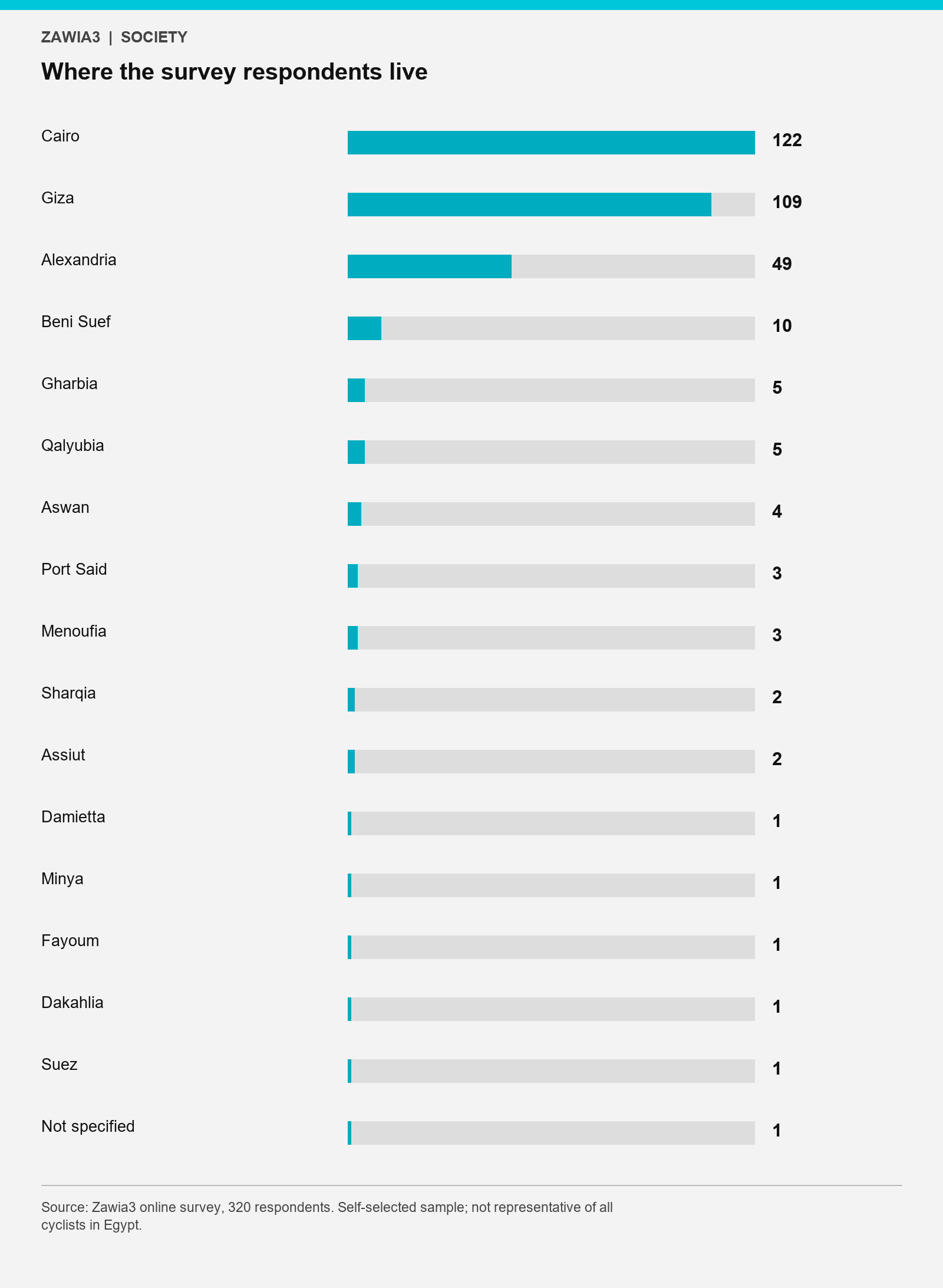
Zawia3 conducted an online survey of 320 male and female cyclists about the risks and difficulties they encounter. The figures below describe this self-selected group of respondents; they should not be treated as estimates for all cyclists in Egypt. Cairo, Giza and Alexandria accounted for most responses.
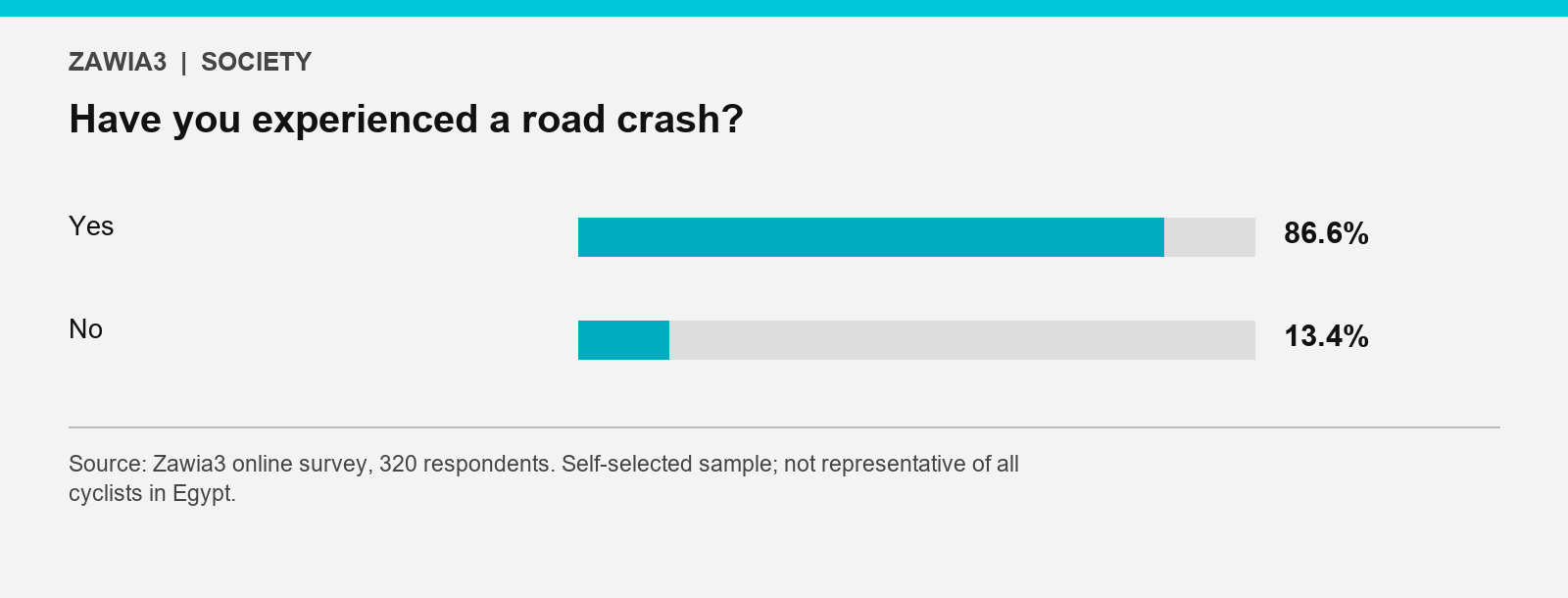
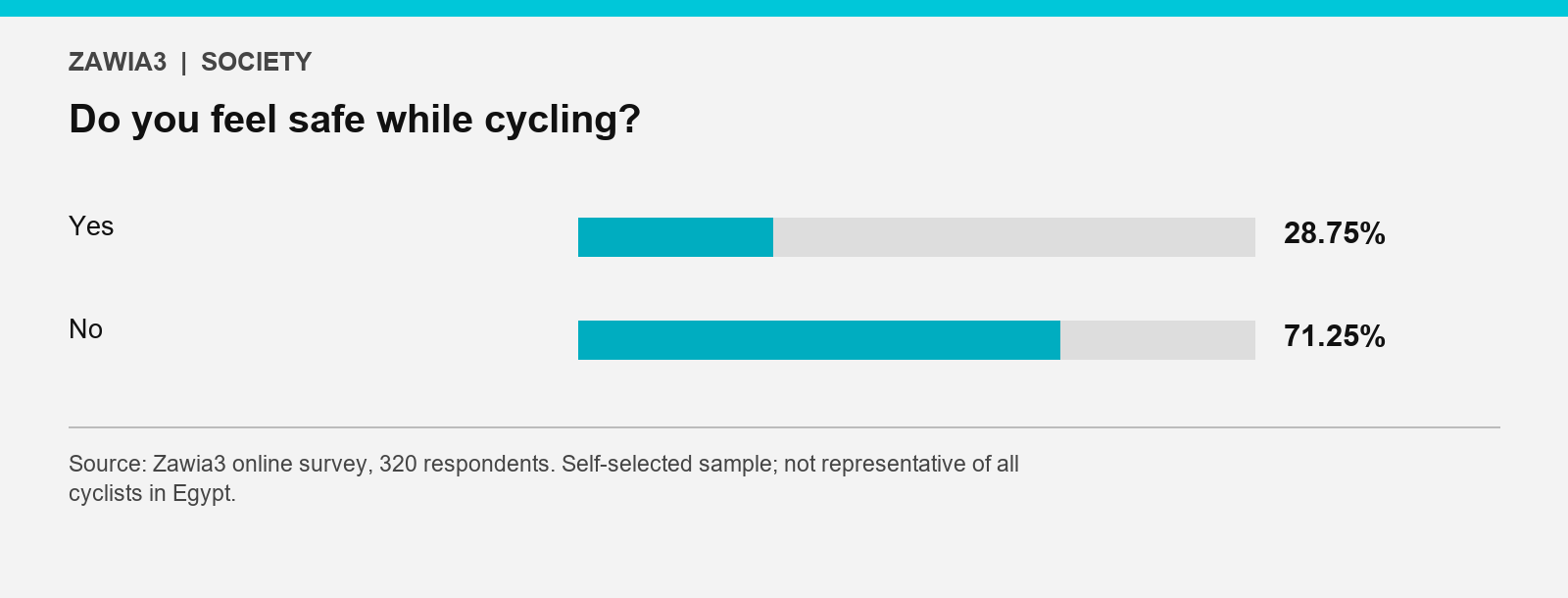
The original chart records that 86.6% of respondents had experienced a road crash while cycling. Separately, 71.25% said they did not feel safe when riding.
Who is responsible for protecting cyclists?
Ayman Salem, executive director of the Egyptian Cycling Federation, said changes to its regulations required cyclists to register under the federation’s umbrella, with amateur groups enrolled through the “Cycling for All” initiative. Each group would appoint a leader with an official card and notify the federation before activities so that it could coordinate with traffic authorities. Unregistered participants would be barred from future participation, he said, describing this as a safety measure.
Salem said the 2025 sports legislation and the federation’s governing regulations made the federation responsible for organising cycling activities, and that it should be notified of trips. He added that medical and precautionary instructions from the Ministry of Youth and Sports applied across sporting federations: riders should undergo medical examinations and be physically fit. Before races, security and traffic authorities would be notified so that roads could be secured or closed and designated routes provided.
Cycle lanes, however, were part of state planning rather than a decision the federation could take alone, Salem said. Budgets and implementation required coordination with the relevant authorities. He acknowledged cycling’s risks and said the federation sought to reduce them through safety measures, awareness programmes and educational courses with the ministry.
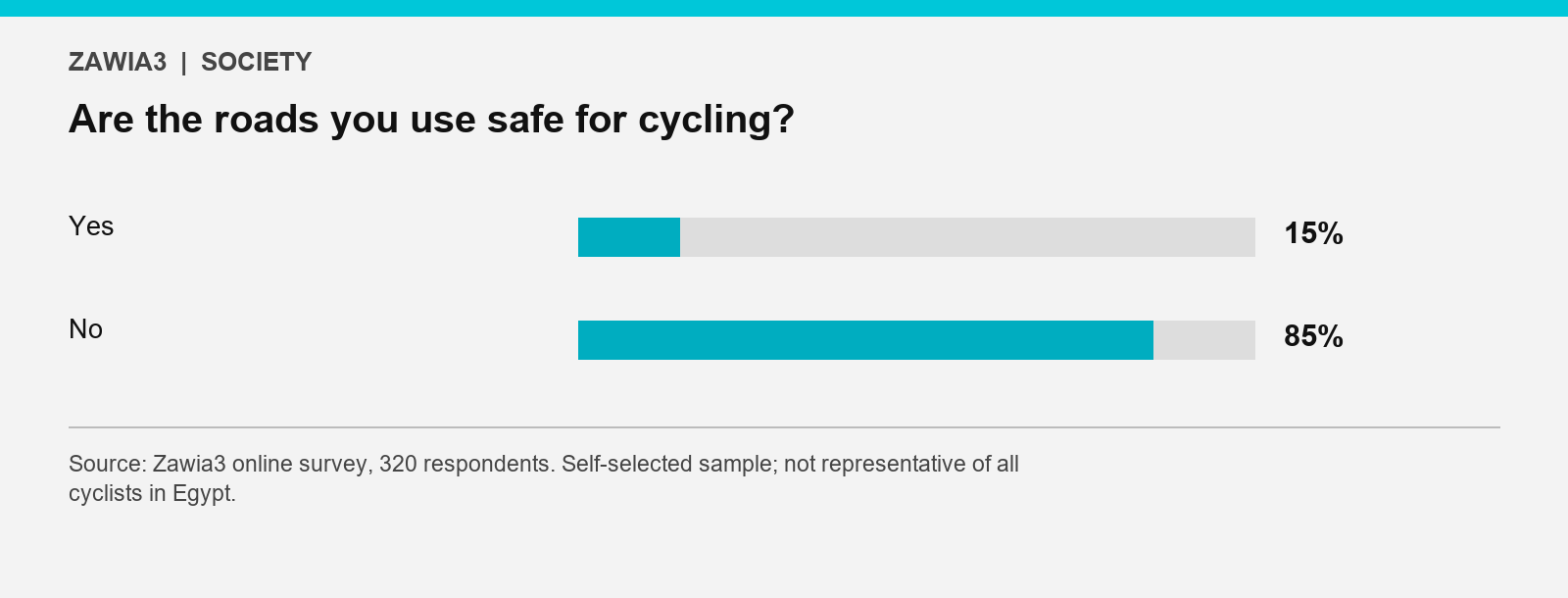
Among the survey respondents, 85% considered the roads they used unsafe.
Hamza Osama, a former member of Egypt’s national cycling and triathlon teams, described experiencing an incident roughly every two weeks. A driver might suddenly open a car door or a speeding minibus’s mirror might strike him. Usually the driver continued without stopping. Those who stopped often blamed the cyclist for being on the road.
In 2019, Hamza, now 25, suffered a much more serious collision near Cairo’s Citadel. A speeding car hit him, breaking his helmet and causing severe head and bodily injuries. The crash disrupted his life for around a year and a half.
He described about 15 months of treatment and five operations, including neurosurgery. A tube was fitted to drain excess fluid from his brain and later lengthened. He said infections led to further procedures, including removal of his appendix and eventually the drainage tube. “After the tube was removed, I went into a short coma and suffered temporary memory loss. I remember nothing about the accident until I woke up in hospital.” He later contracted a severe case of Covid-19 and spent another two weeks in hospital.
In the survey, 154 respondents said crashes had forced them to stop cycling for an extended period—from weeks to months or more than a year. Yet 84.8% of the 320 participants reported using protective equipment such as helmets.
Marwa, too, endured a painful chest tube. As the fluid was drained and her breathing improved, her oxygen support was withdrawn. But restricted movement and pain in her rib cage persisted. “Sometimes painkillers do not help. I have started to appreciate so many things—being able to perform ablution by myself, for example.”
Injuries and financial losses
Beigad Sherif, 21, remembers his first crash in late 2019 on the road down from Mokattam, before it was renovated. As he rode onto the Sayeda Zeinab bridge at around 50 kilometres an hour, his narrow tyre became caught in a gap in the bridge’s metalwork. Cars were behind him. He suffered a crack in his shoulder and bruising down his right side, but chose not to go to hospital.
He had cycled as a child before stopping because his family feared for his safety. Encouraged by friends, he bought another bicycle, developed his skills and began cycling professionally in 2019. His first competition followed in 2020, and he went on to win honours in international, Arab and local events.
Crashes continued. In 2022, near Al-Nasr Club in Heliopolis, a car abruptly changed direction and knocked him and his friends down. He was the only one injured, with multiple bruises. In Suez that year, a large bump on a fast road sent him falling, damaging his bicycle and shoes—which had cost EGP 12,000—and smashing his phone.
Returning from the Ain Sokhna road through Maadi, he collided with a taxi at a speed bump near a shopping centre and suffered scratches. In another Maadi crash, he injured his knee and sustained cuts after falling on a broken section of road as buses and a motorcycle passed. Around six weeks before his interview, he hit a brick while training alone on the Badya road in 6 October City. The bicycle overturned, leaving him bruised and his equipment damaged.
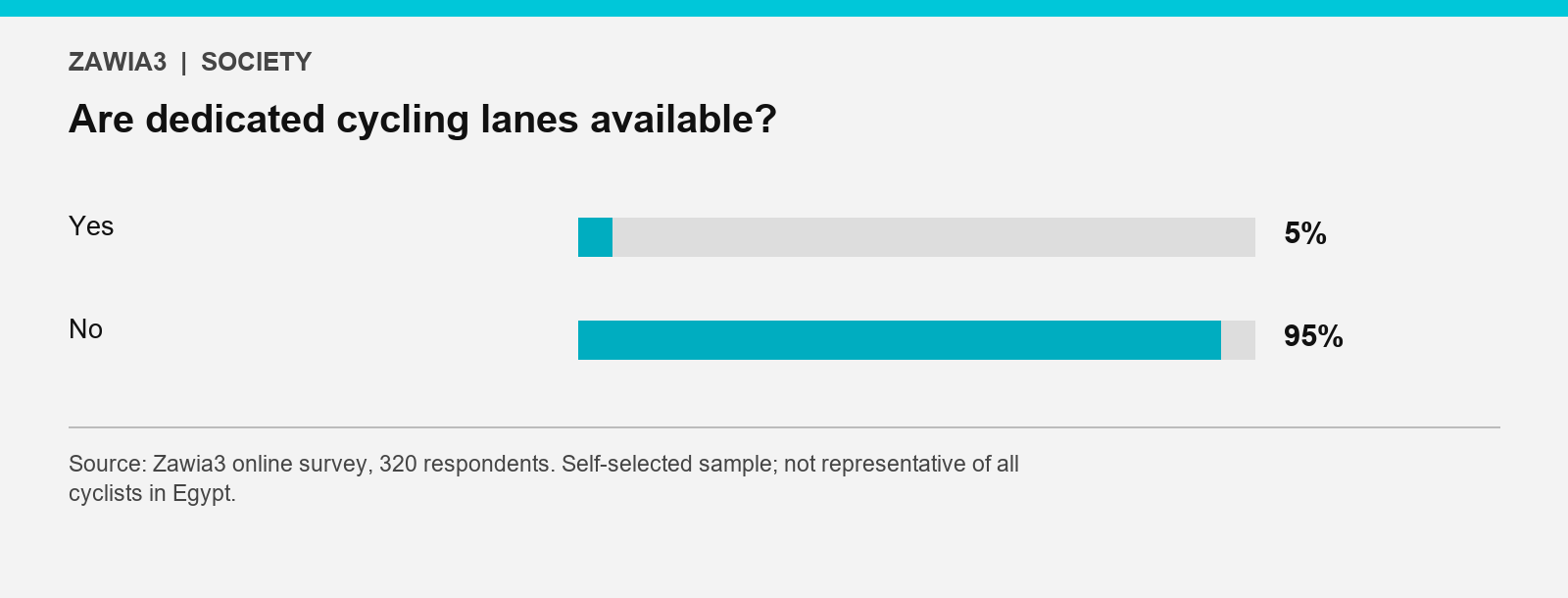
Ninety-five per cent of survey respondents said dedicated cycling lanes were not available on the roads they used.
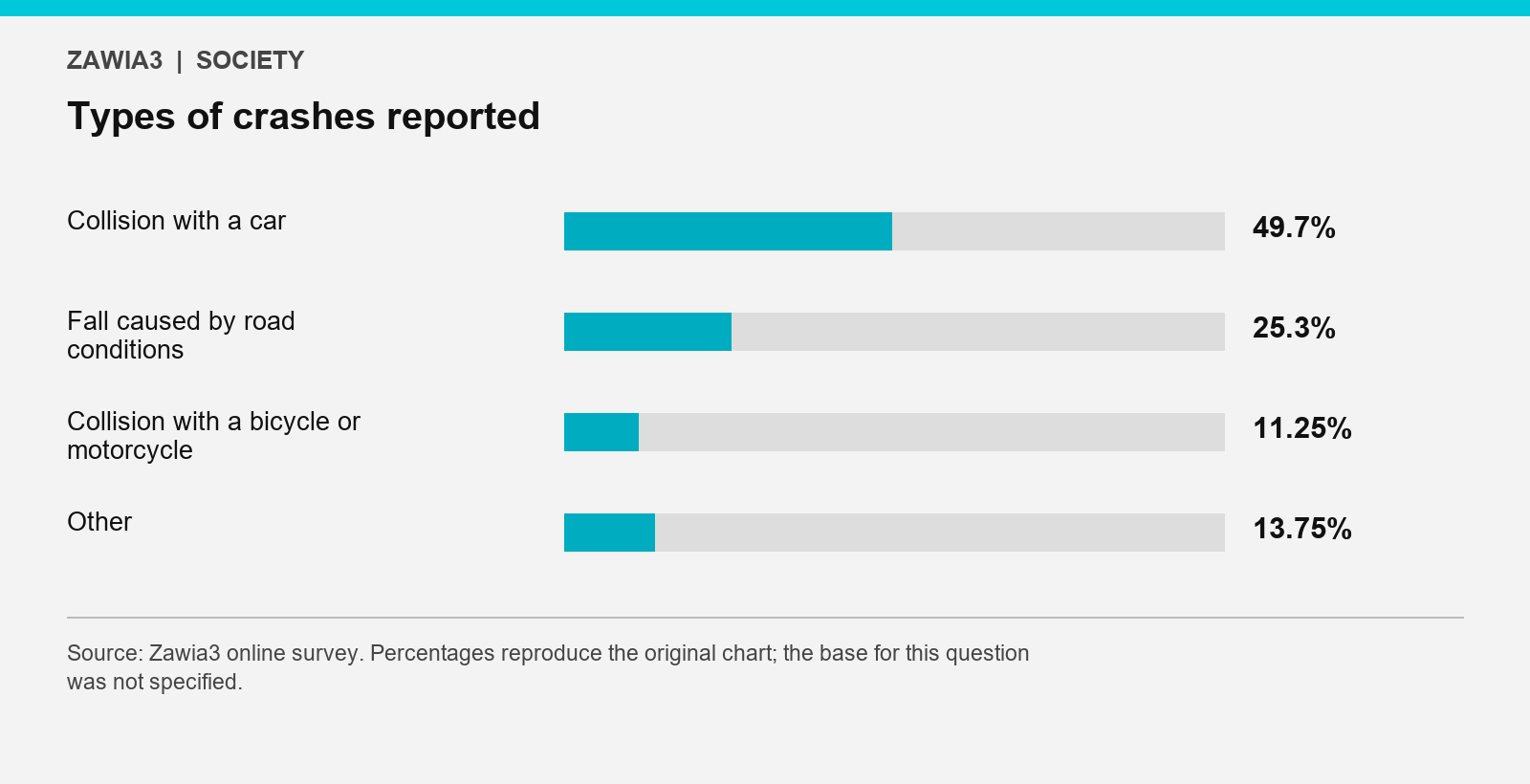
Collisions with cars were the largest category in the survey’s crash-type chart, followed by falls caused by road conditions. Other categories included collisions with bicycles or motorcycles. The published chart does not specify the response base for this particular question.
Nourhan Nagy, 28, remains attached to cycling despite two serious crashes. In autumn 2023, she was at the rear of a group of six riders on the Suez road when a car emerged from a side road and clipped the back of her bicycle. “It was a small impact, but enough to send me flying.” Bruising and inflammation in her knee kept her away for two weeks.
Her second crash exposed a different danger. She was riding from her home in Ramses to work in 6 October City on the Mehwar road. “I was going at about 55 kilometres an hour when suddenly there was a deep pothole I could not avoid. I could either go into it, swerve towards speeding cars or hit a car parked on the right.” She went into the pothole, fell heavily and suffered a deep knee wound that required stitches and left a permanent scar.
Hamza sees responsibility on several sides: reckless drivers, little recognition of cyclists’ right to share the road and inadequate infrastructure. He acknowledged that professional cyclists sometimes train on unsuitable routes, including the Ring Road, because they lack viable alternatives. Existing lanes, where available, may cater to recreational riding rather than the space and speeds required for professional training.
He also described a crash involving an October cycling team which, he said, was caused by a drunk driver. Several riders were seriously injured. One, Maram, was still receiving treatment for paralysis. “Some of them are athletes I coach. Their physical and psychological condition is poor,” he said.
Beigad lost a friend in a crash on the Suez road; another was seriously injured there. He said a Suzuki driver had also struck him in a designated downtown cycling lane, then argued with him for using a space the motorist had treated as a parking area.
“Sometimes people tell me to ride on the pavement, even when I am wearing the national team’s kit and training officially. Some drivers deliberately harass us,” Beigad said.
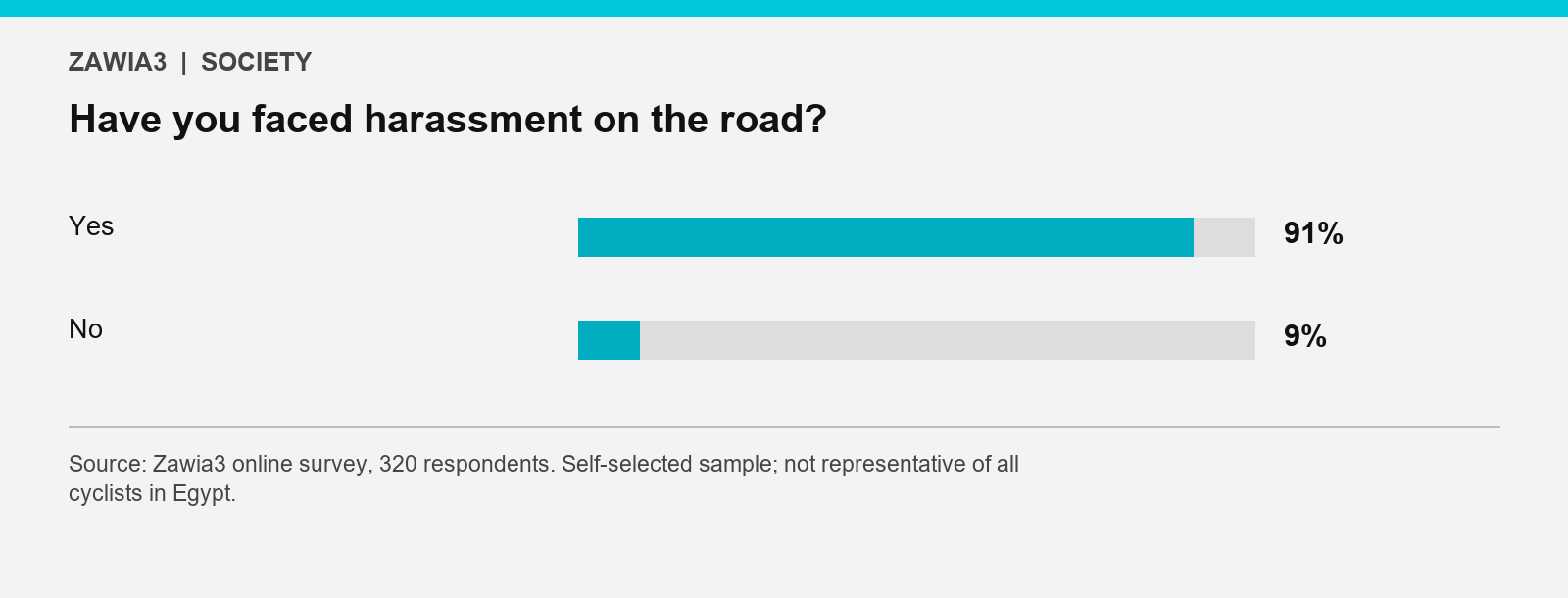
He estimated that repeated crashes had cost him around EGP 300,000 in equipment, including wheels, tyres and torn sportswear. “In just one month, I broke five bicycles.” In the survey, 91% of respondents said they had experienced harassment on the road.
Ehab Hafez, founder of the Mashwar team, described accidents as a recurring risk in a demanding sport, whether on touring rides or in professional cycling. “I do not say that with any pleasure,” he stressed. After roughly ten years organising trips, he believed drivers still lacked awareness of cyclists and frequently ignored them.
“The problem is not that we are on the road. It is about public awareness. Accidents happen and will continue to happen, but we reduce them as much as possible,” he said. Sometimes, he added, a driver looking directly at him through a mirror would still stop in his path.
Hafez called for wider provision of cycling lanes, particularly on major roads. He cited the dedicated route in Ain Sokhna as an improvement over earlier conditions: drivers had come to recognise that the space belonged to cyclists. Riders should take every available precaution, he said, but authorities also needed to provide lanes, educate drivers and enforce rules through cameras and penalties for violations.
He has seen riders killed and others badly hurt. Still, many return. “People who really love the sport cannot stop. They get broken, recover and get back on the bike.” He recalled a rider named Anas who, years earlier, collided with a car while trying to shelter from the wind and fell into a large open drain. He narrowly survived. For Hafez, the incident illustrated the additional dangers posed by infrastructure.
Standards exist; implementation is missing
Road engineering professor Magdi Salah Eldin, a member of the advisory committee for the Egyptian road code, said technical standards for safe, segregated bicycle lanes already existed. They were not being implemented, he argued, because road planning prioritised cars. Much of the existing network was poorly configured to accommodate bicycles safely; separate routes were the solution.
The problem was therefore not simply a lack of plans, but failure to put recognised standards into practice. He cited the Netherlands and Dubai as examples of stronger provision and respect for traffic rules, and called for Egyptian standards to be implemented, including in new cities.
Survey responses identified weak enforcement of laws, limited driver awareness and respect for cycling, inadequate urban planning and poor road conditions among the causes of crashes.
Zawia3 contacted Transport Ministry spokesperson Mohamed Ezz for a response. He directed us to the State Information Service because he considered Zawia3 a foreign outlet. Repeated calls and WhatsApp messages to Diaa Rashwan had received no response by publication.
Cyclists demand safe lanes and protection
The experiences described by the 320 survey participants point to repeated dangers: reckless cars, tuk-tuks and motorcycles; damaged surfaces; poor lighting; and the absence of safe routes. Respondents spoke of friends killed or seriously injured, including members of the October team and Marwa Okasha.
For them, cycling had become an activity that could end in death. Their demands were consistent: protected lanes, stronger traffic enforcement, laws that safeguard cyclists and a road culture in which all users are respected.