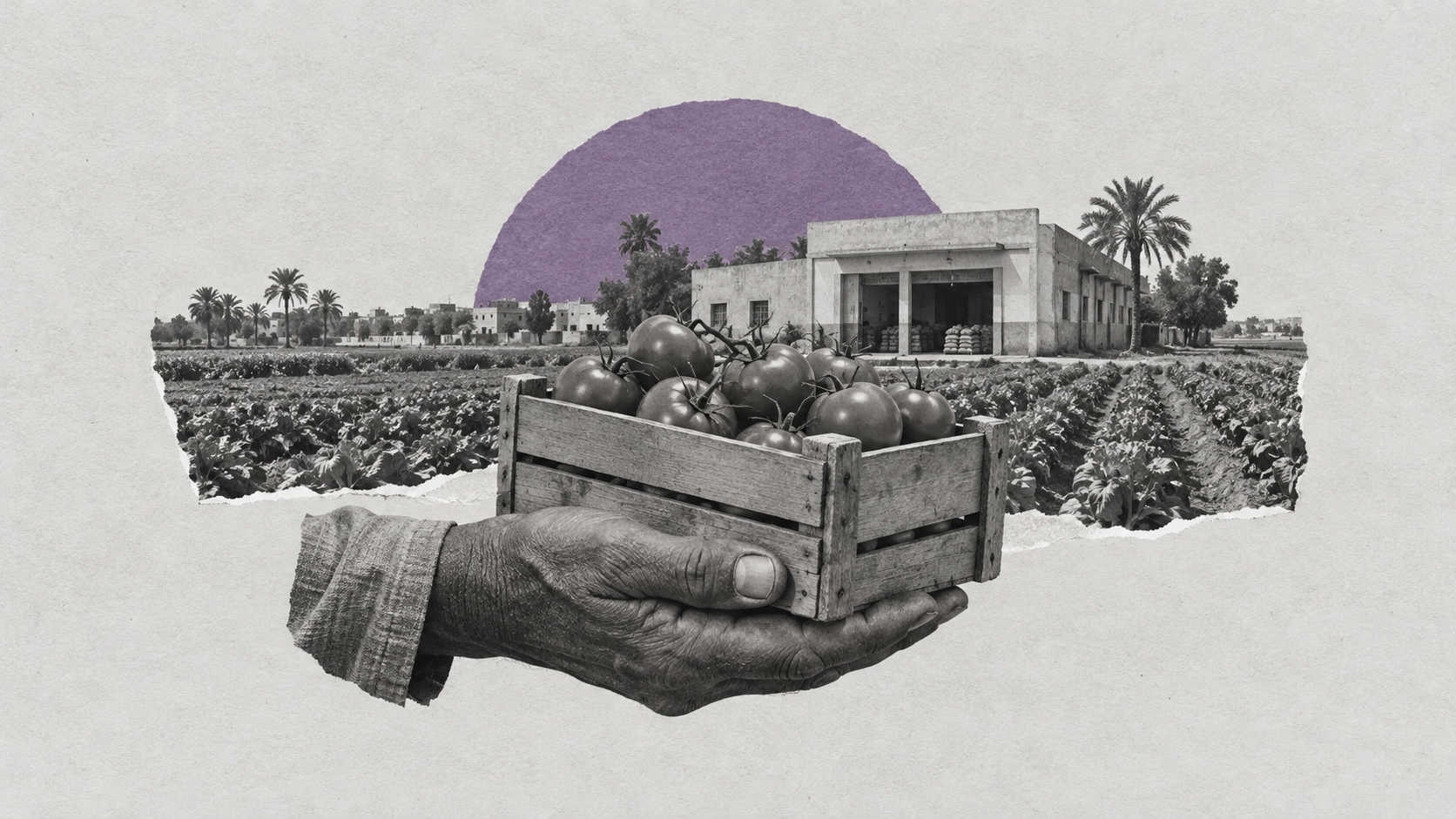


Mohamed Sheiba’s family once lived comfortably in a spacious home in Awlad Khalaf, a village in Dar El Salam district, Sohag. His father built it in 2011 on four qirats of land, with a two-qirat garden, at a cost exceeding EGP 3.7 million. Two years before this investigation, it was among approximately twenty houses demolished for the Dr Mohamed Sayed Tantawi Corridor, also known as the Dar El Salam Axis, a national road project linking Sohag and Qena.
The 28-kilometre route includes a 1.3-kilometre Nile bridge. Its stated objectives are to reduce the distance between Nile crossings and support urban development, investment and trade between the river’s banks.
Although the government paid compensation, twenty families—including Mohamed’s parents, six sons and a daughter—faced acute hardship after losing their homes. Replacement properties in the village, whether to buy or rent, were scarce and priced above their compensation. Much of the housing and land passes between generations of the same families.
After temporarily staying with relatives, Mohamed’s family had to leave. They built a reed hut on agricultural land they purchased outside the village’s designated built-up boundary. They now live without water, electricity or sewerage. Winter rain passes through the reed roof and dusty winds enter the shelter. Two young men in the family have been unable to marry because they lack suitable housing.
Mohamed says a qirat in his village costs approximately EGP 750,000, while compensation did not exceed EGP 200,000 per qirat. Buying replacement land at EGP 720,000 per qirat imposed a heavy burden on the family.
Residents, he says, were promised permits to build elsewhere by then-Sohag governor Major General Tarek El Fiki, which encouraged them to demolish their homes voluntarily. Those promises remained unfulfilled two years after removals began on 1 September 2023, leaving families in makeshift reed shelters.
Sheiba says repeated approaches to MPs brought no solution despite their knowledge of residents’ circumstances. He says official papers, maps and inspection-committee reports record promises to provide alternative sites.
According to him, the governor sent more than six requests to the agriculture minister for exemptions allowing construction on replacement land outside the built-up boundary. The Agriculture Ministry continued to hold up permits, although the Transport Ministry implemented the removals.
“Families include doctors, pharmacists, university and secondary-school students, yet they have lived in inhumane conditions since demolition,” he says. “We need urgent intervention and an official construction exemption. Officials’ promises have not been fulfilled.” He warns that the continuing crisis threatens many families’ stability in Dar El Salam.

His son Osama Mohamed, a university student, says residents were initially told they would receive permits for replacement homes. Demolition followed the next day with army participation, he says, but no subsequent promise was implemented.
Osama says the family home occupied four qirats plus a two-qirat garden, while his father’s and uncle’s demolished properties together covered approximately 33 qirats and included two villas. His own family received no more than EGP 850,000, he says—far below the EGP 3.7 million construction cost in 2011.
“Property prices are extremely high and houses for sale are hard to find. A house can cost EGP 4 million,” he says. “The expropriated land had formal ownership contracts. We were not fairly compensated for it or for crops; compensation covered buildings only.”
He accuses the local council and Agriculture Ministry of obstructing rebuilding, saying any attempt to lay new foundations is removed even though families offer to finance construction themselves. Approaches to constituency MPs, he says, failed.

Compensation without a replacement home
Ashour Mohamed’s family in Nag El Aqula, part of Awlad Touq Gharb village, faced similar hardship when their home on agricultural land was demolished for the corridor’s expansion. They accepted compensation they considered inadequate because officials promised a permit to build on agricultural land.
Ashour began permit procedures two years earlier, obtaining approval stamps on maps and plans from the relevant bodies. Only the agriculture directorate’s approval remained outstanding. His family then lost its home while corridor construction proceeded.
He says residents were told their homes fell within the expansion area and were promised replacement-building arrangements as well as financial compensation for construction, provided they submitted ownership papers, land contracts and maps.
They prepared the documents and secured approvals from surveying, drainage, irrigation, veterinary and electricity authorities before the files went to the Agriculture Ministry in Cairo. Families spent substantial amounts completing the process, only to encounter a ministerial decision stopping their permits.
Ashour identifies seventeen affected households: fourteen in Awlad Khalaf and three in El Aqula, including his own, Khaled Kolaib Mohamed Radwan’s and Younes Fawzi Moussa Mohamed’s. This is his count; the investigation and MPs elsewhere describe approximately seventeen to twenty families.
“We are staying with relatives while waiting for alternatives,” he says. “There is almost no rental housing in villages and hamlets, while rents in district towns are high.”

Ashour recalls an Agriculture Ministry expert valuing land according to location without residents’ involvement. His home stood on one qirat; he says he expected permission for a replacement building of 90 square metres but received only EGP 60,000 for the demolished mud-brick structure.
Authorities also expropriated two qirats and thirteen sahms of his agricultural land. He says a qirat then cost approximately EGP 120,000. He considered the agricultural-land compensation relatively acceptable, but the central issue was the failure to provide the promised free building permit.
“A house on half a qirat inside the village boundary can cost EGP 400,000. Replacing my old house would cost around EGP 800,000,” he says. Appeals to the governor, town councils, government complaints platform and Agriculture Ministry citizens’ service produced no practical response. Complaints to the governor were referred to Dar El Salam’s town council, which he considered the wrong body to resolve the issue.
He contacted the ministry’s citizens’ service in March 2025 and was told by an engineer named Hanan that the maps remained with the legal-opinion and legislation body. Later, she told him the ministry had approved them and an agriculture engineer would visit Sohag within two weeks to meet the land-protection director. She advised following up after twenty days.
Ashour believes political or parliamentary intervention is now necessary and asks why MPs have not defended residents’ ability to replace homes lost for a state project.
While approximately twenty families in Dar El Salam still faced the consequences, residents of Qena learned in summer 2025 of another expropriation decision for the same corridor.
Transport Minister and Deputy Prime Minister Kamel Abdel Hadi El Wazir’s Decision 423/2025 ordered acquisition of 194 properties and land plots in El Amra, Abu Shusha and El Bahri Samhoud within Qena’s surveying jurisdiction, after agreement with owners could not be reached.
It implements Prime Ministerial Decision 3873/2022 designating the project as a public-utility undertaking. The order required publication in Al-Waqa’i al-Misriyya, deposit with the relevant real-estate registry, and effect from its issue date, 16 July 2025.
A compensation crisis—or a permit crisis?
MP Ahmed Abdel Salam Qoura takes a different view of compensation. He says the state paid generous amounts, twice the market value of expropriated land. Some residents bought replacements and, he claims, were so satisfied they wished more of their property had been acquired.
Regarding Awlad Khalaf’s demolished homes, Qoura confirms that approximately seventeen to twenty owners received money and promises to rebuild on agricultural land equivalent in area to what they lost. He says the issue remained under discussion among the Agriculture Ministry, Cabinet and other bodies.
“Residents sacrificed their homes for a national project. They have a right to suitable housing among their families and in their villages,” Qoura says, promising renewed parliamentary briefing requests when the next session begins.
The corridor was not yet complete, he adds. A second phase would involve further acquisitions, with compensation under the same mechanism, in line with what he describes as presidential instructions, particularly concerning Upper Egypt.
MP Abla El Hawary says she knows the situation in Awlad Khalaf and Awlad Touq. She says the plots residents want to build on lie outside the relevant land and built-up boundaries, making permits unlawful. Construction within the residential block on land allocated for housing, she says, could be licensed.
“There are no government housing projects in Awlad Khalaf from which units can be allocated,” she tells Zawia3. “Anyone compensated can buy land inside the boundary and build, rather than seek construction on agricultural land or outside the urban area.” She considers the land’s lack of residential designation the core problem.
El Hawary rejects claims that some residents received no compensation and disputes descriptions of demolished villas. “There are no villas in Awlad Khalaf,” she says. These remarks conflict with the Sheiba family’s account above.
On the new Qena acquisitions, she says the ongoing national project proceeds under Expropriation Law 10/1990, with specialised committees setting compensation. Its purpose, she says, is completing the corridor, rather than taking land without a reason.
Dar El Salam Axis: project and affected areas
| Feature | Detail |
|---|---|
| Official project name | Dr Mohamed Sayed Tantawi Corridor (Dar El Salam Axis) |
| Governorates connected | Sohag and Qena |
| Total route length | 28 km |
| Nile bridge | 1.3 km |
| Villages discussed in residents’ accounts | Awlad Khalaf; Awlad Touq Gharb / Nag El Aqula |
| Qena areas in Decision 423/2025 | El Amra; Abu Shusha; El Bahri Samhoud |
Further road-related acquisitions
The Qena decision was preceded by another expropriation order, Decision 393/2025, covering approximately 85 properties and plots in Dakahlia for development of the Mansoura–Gamasa road, which passes through Dakahlia and Damietta.
The order concerned El Manial, Mit Antar, Orman Talkha, Talkha city, Abu Madi, Kafr Demalash, Mit Zanqar and El Rawda, after owners or interested parties did not sign ownership-transfer forms. Dated 10 July 2025, it required publication in Al-Waqa’i al-Misriyya, registry deposit and immediate effect.
It implements Prime Ministerial Decision 3877/2022 designating the project as a public utility. The scheme includes four overpasses at Gamasa, Ammar, Damira and El Rawda, and two security-control and toll gates at Zayan and Sharnaqash.
Ibrahim Ezz El Din, senior researcher and co-founder of Diwan Al Omran for Urban Studies, says expropriation has accelerated since 2014 and become a systematic means of acquiring private land under the public-benefit justification. He argues that investment and road projects proceed without a sufficiently precise definition of public benefit, leaving owners vulnerable.
“Public benefit is used as a legal pretext while the state controls the whole process—from issuing the decision to setting its conditions, implementation and compensation,” Ezz El Din says. “That closed structure erodes trust and the remaining social contract between citizens and government.”
He highlights economic consequences, citing acquisition of 31 feddans in El Salam II district for the Ahalina 6 project. He says compensation was set at EGP 7,700 per square metre while homes in the project were offered at up to EGP 20,000 per square metre. At that gap, he argues, residents could not buy a unit on the same land taken from them.
The researcher criticises extensive construction of roads and overpasses as socially isolating neighbourhoods and proceeding without adequate planning or environmental assessment. He alleges that some bridges collapsed within their first year, raising questions about feasibility and durability.
He advocates alternatives he believes have been neglected: stronger public transport, pedestrian and cycling infrastructure, and integrated communities providing employment and services instead of rapid solutions based on extensive demolition.
In legal terms, he considers the practices inconsistent with Egypt’s Constitution and international instruments such as the International Covenant on Economic, Social and Cultural Rights. He says affected people are not involved in decisions and learn of them only afterwards.
At the time of the investigation, Ezz El Din described legal avenues as including objection within fifteen days of publication of maps and lists, and challenges to compensation before the court of first instance within four months. He argues that these protections become ineffective when compensation is inadequate and the executive controls the process.
He calls for reconsidering urban policy as a whole, warning that roads and bridges used as quick solutions have long-term consequences for cities and infrastructure.
Separately, an order by Local Development Minister Manal Awad acquired properties for development of the Heliopolis entrance, including Building 85 on El Horreya Street in Almaza, a building and restaurant at Moheib and Hussein Kamel streets, and Plot 2 repeated, Block 435 repeated, on Fanatis El Miyah Street.
Diwan Al Omran again points to the EGP 7,700 versus EGP 20,000 per-square-metre comparison in El Salam as evidence of a wide gap between compensation and sale prices in state projects.
Expropriation only when strictly necessary?
Dr Abbas El Zafarany, former dean of Cairo University’s Faculty of Regional and Urban Planning, says expropriation should be reserved for cases of utmost necessity. Compensation, he argues, should be more than merely fair: it should include relocation, broken social ties and greater distance from work, as well as property value. Higher compensation would force authorities to consider acquisitions more carefully.
He acknowledges benefits from some recent projects, including the Jehan Sadat Axis, which shortened journeys between Nasr City and areas beyond it. But he criticises other bridges he considers of little practical use.
“I see no justification for demolishing existing homes to create new housing projects,” El Zafarany says. “Acquisition is acceptable only for a genuine public benefit, such as a transport corridor. Removing workers’ housing in the Sixth District or established, non-informal residential areas is not the right approach.”
He describes such cases as replacing poorer residents’ homes with units aimed at wealthier groups. Egypt, he argues, already faces property saturation and large numbers of unsold units, while investment should prioritise productive sectors—agriculture, industry, mining and energy.
He advocates solar-energy development to reduce dependence on imports and sees agricultural reclamation and cultivation as providing greater food and economic benefits than static real-estate investments.
For him, sustainable food and energy development should take precedence over further housing schemes or unjustified road and bridge construction in crowded areas such as Nasr City.
Engineer Mohamed Abdel Rahman, secretary-general of the Association of Real Estate Valuation Experts, says recent ministerial acquisitions continue a process rooted in Law 10/1990. He identifies amendments under Law 187/2020 as a significant change in how such decisions are issued and implemented.
Among the changes he describes are deposit of preliminary compensation in a government bank account within one month of the public-benefit decision, with the full sum deposited within three months in an interest-bearing account and owners entitled to late-payment interest. He says validity was extended from two years to three, after which the decision lapses for properties where the required procedures were not completed.
Abdel Rahman argues that expanded executive powers and broader use of “public benefit” sometimes serve ministries’ financial objectives more than residents. This is his assessment of the amended process.
He criticises insufficient notice before implementation and inadequate compensation. In his account, market-value compensation plus a 20% supplement is often not applied in practice because authorities rely on internal staff rather than independent valuers registered with the Financial Regulatory Authority.
He says professional valuation standards adopted since 2015 align with international standards and require registered experts to ensure neutrality and transparency.
He also raises concerns about owners lacking registered title deeds. He claims that compensation and challenges are restricted to registered owners, while only approximately 10% of Egyptian properties are registered, leaving many outside legal protection. These legal and registration claims are attributed to the interviewee.
Paying fair market value and the additional supplement, he argues, would give residents a real chance of obtaining replacement homes in the same area or nearby. He calls for rigorous implementation and broad public dialogue before acquisitions that affect lives or reshape historic areas, with specialists helping balance development, residents’ rights and urban heritage.
The Dar El Salam Axis exposes a conflict between the state’s development objectives and families who lost homes without workable replacement arrangements. Officials defend the legality of acquisition and the generosity of compensation; residents describe money that cannot buy an alternative, promises unfulfilled after two years and shelters without water or electricity.
Between official explanations, legislation and expert assessments, “public benefit” remains contested. Families waiting in villages and makeshift huts want development to protect their housing, dignity and right to fair treatment as well.