As Egypt accelerates the rollout of natural gas to millions of homes, presenting it as one of the past decade’s most important infrastructure projects, deaths and injuries from residential gas incidents are also mounting. The contrast raises urgent questions about expansion without effective inspection and maintenance. A service promoted as reducing dependence on gas cylinders is accompanied by repeated incidents exposing safety failures.
The government began its nationwide household gas connection plan in 2014 to reduce reliance on cylinders. Official figures cited in this investigation record about 572,000 homes connected in 2025 and a cumulative total of roughly 15.5 million residential units. The expansion raises questions about protection against gas emissions and leaks, frequently described in the media as a “silent killer” that takes lives without warning.
Zawia3 documented 113 residential natural-gas incidents resulting in 349 deaths and injuries between January 2024 and January 2026. These are published incidents, generally because they involved human or material losses. Other incidents may have gone unrecorded or unpublished when no tangible harm was reported.
Data came from news archives and official statements by prosecutors investigating the incidents. The reporter searched three news websites using the Arabic terms for “gas leak” and “gas leakage,” excluded cylinder-related incidents and retained only natural-gas incidents inside homes. Leaks in commercial premises or streets caused by excavation or other factors were also excluded.
With no official incident count available, the investigation examines repeated residential incidents during this period, their causes, weaknesses in oversight and maintenance, and the responsibilities of state bodies and gas companies to protect residents in the absence of a comprehensive safety plan.
Recorded outcomes included asphyxiation causing injuries, deaths or both; fires; and partial or complete building damage after gas-pipe explosions. The investigation also identified unauthorized work by some gas company employees, who connected appliances or removed and installed pipes without their employers’ knowledge after assuring residents they would notify the company on their behalf.
The reporting draws on affected residents’ accounts, recordings of some workers and recorded statements from customer service staff who said this procedure was invalid and violated company rules.
The silent killer inside homes
Between January 2024 and January 2026, Zawia3 recorded 113 incidents across several governorates. January 2026 alone accounted for 17, compared with 11 in January 2024 and 11 in January 2025. The winter months of January and December accounted for the largest shares over the preceding two years.
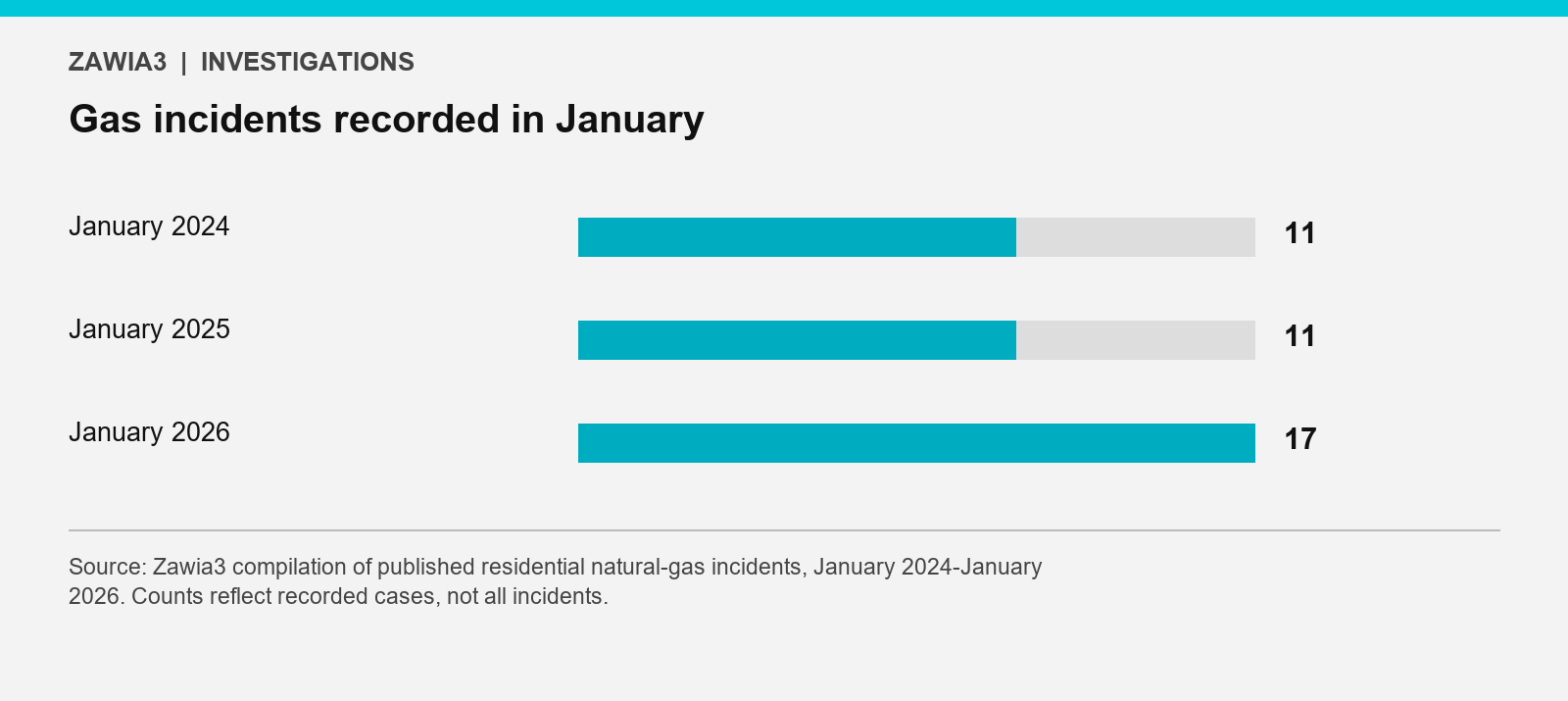
There were 55 incidents in 2025 compared with 41 in 2024, indicating a rising recorded count alongside expansion of connections, without indications of regular company maintenance to limit accidents.
Giza had the largest count, with 31 incidents, followed by Cairo with 20 and Beni Suef with 14. The report describes Aswan, Asyut, Damietta and Qena as having the lowest counts, in areas where gas connections and related services were being expanded or planned.
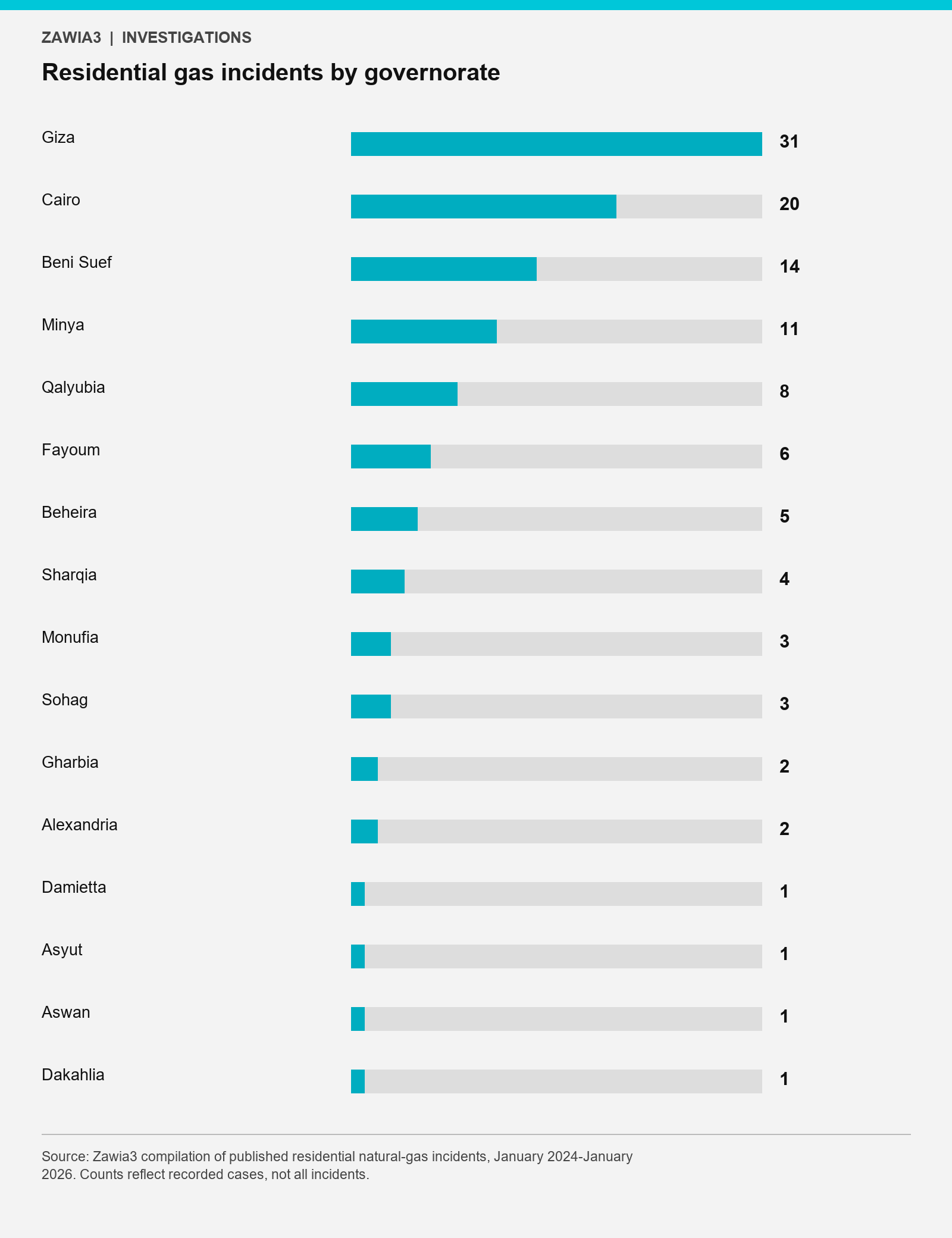
Some locations experienced striking recurrence. New Beni Suef, where residential gas expansion began in 2016, accounted for 13 of the governorate’s 14 incidents. No official intervention was announced to study why incidents recurred or how to control and prevent them.
Asphyxiation was the most frequent harm: 98 incidents caused deaths, injuries or both. Fires, explosions and property damage accounted for 13 incidents. Only two recorded leaks produced no reported human or material damage.
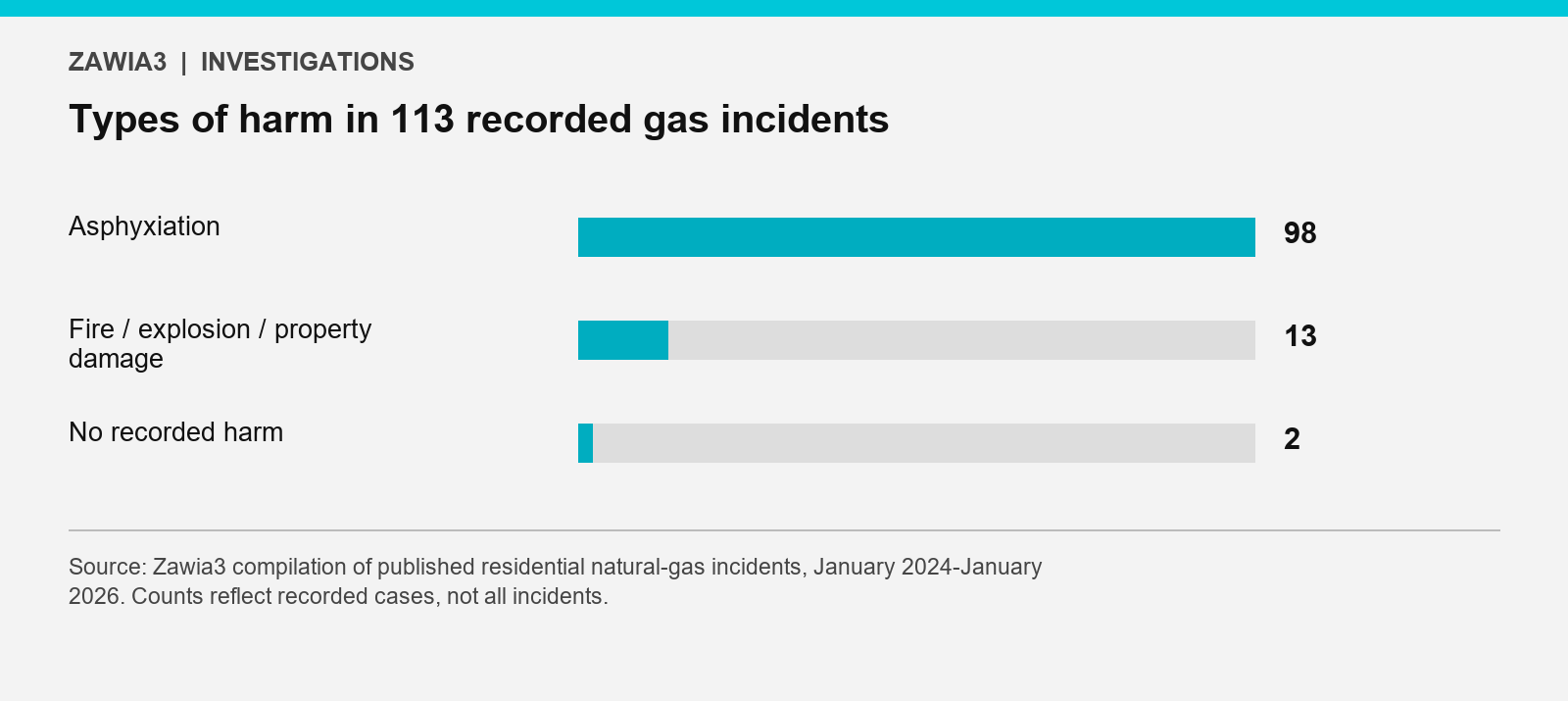
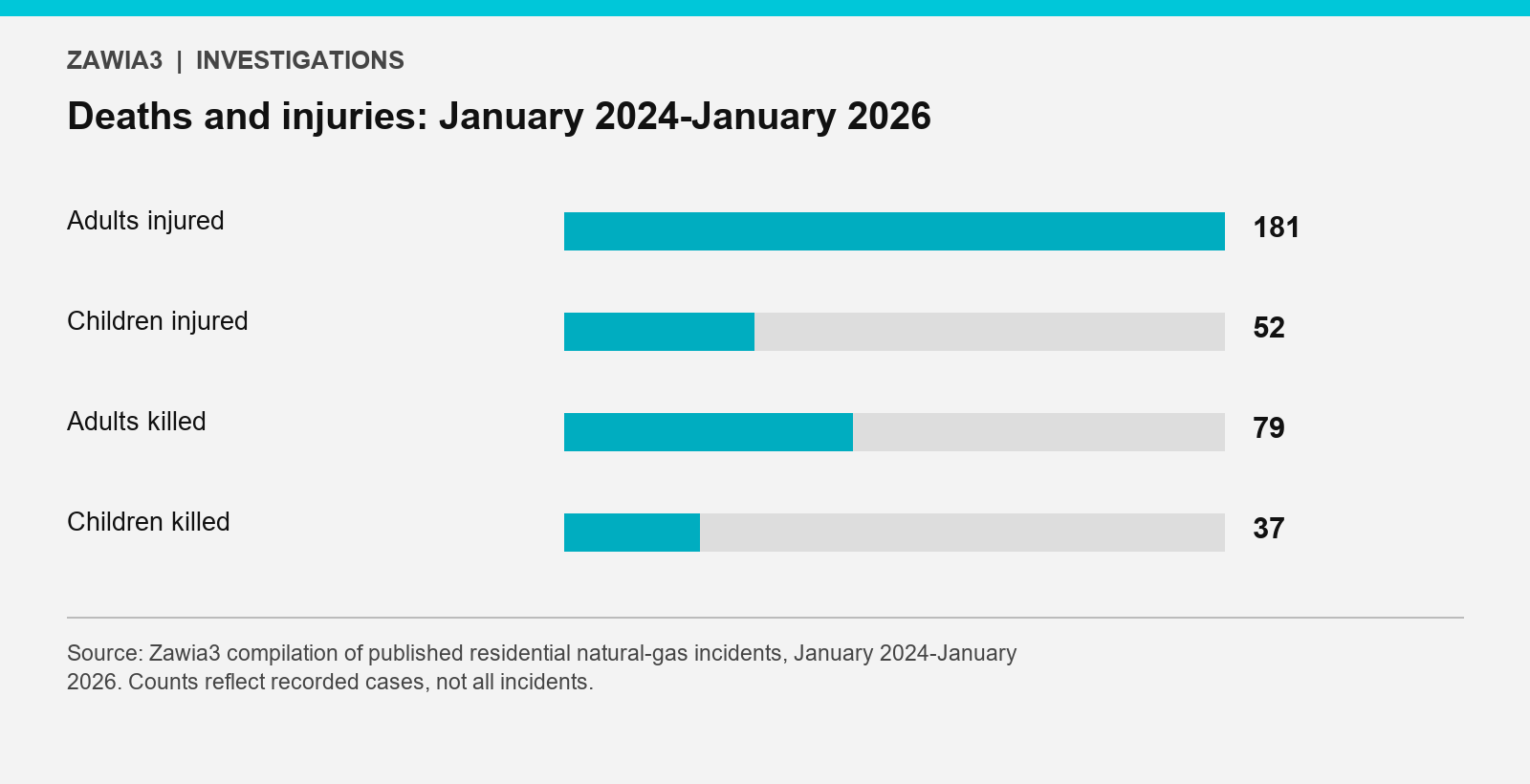
Asphyxiation and fires during the investigation period caused 116 deaths, including 37 children, and 233 injuries, including 52 children, according to the compiled records.
In January, MP Dr. Sara El Nahhas, a member of parliament’s Health Committee, submitted a briefing request directed to the prime minister and petroleum minister about repeated household incidents. She said carbon monoxide from inadequately ventilated appliances and engines, especially in enclosed spaces, was responsible. The colorless, odorless gas can cause serious harm and death within minutes.
She attributed recurrence to insufficient company oversight and periodic maintenance of household supply networks and the absence of early-warning mechanisms for leaks and faults. These measures are essential to prevent further tragedies, she said.
MP Amr Darwish, a member of the Coordination Committee of Party Youth Leaders and Politicians, also submitted a briefing request. In a Facebook post, he praised state connection efforts while stressing the danger when the service becomes a threat to life. Automatic shut-off devices triggered by danger detection had become necessary and should be considered by gas companies, he said.
Periodic maintenance
Alongside analysis of incident records, a Zawia3 questionnaire explored potential causes. Respondents described an absence of regular company maintenance, reinforcing concerns about neglected maintenance and oversight amid rapid expansion.
The survey involved 110 volunteers recruited through posts on social media. It included men and women of varied ages, backgrounds, occupations and residential locations to broaden geographic diversity.
Respondents came from 15 governorates: Ismailia, Aswan, Alexandria, Giza, Dakahlia, Suez, Sharqia, Gharbia, Fayoum, Cairo, Qalyubia, Monufia, Minya, Port Said and Damietta. Ninety-four had subscribed for more than three years, 12 for one to three years and four for less than a year. Ninety-eight said they had never received periodic maintenance during their contracts.
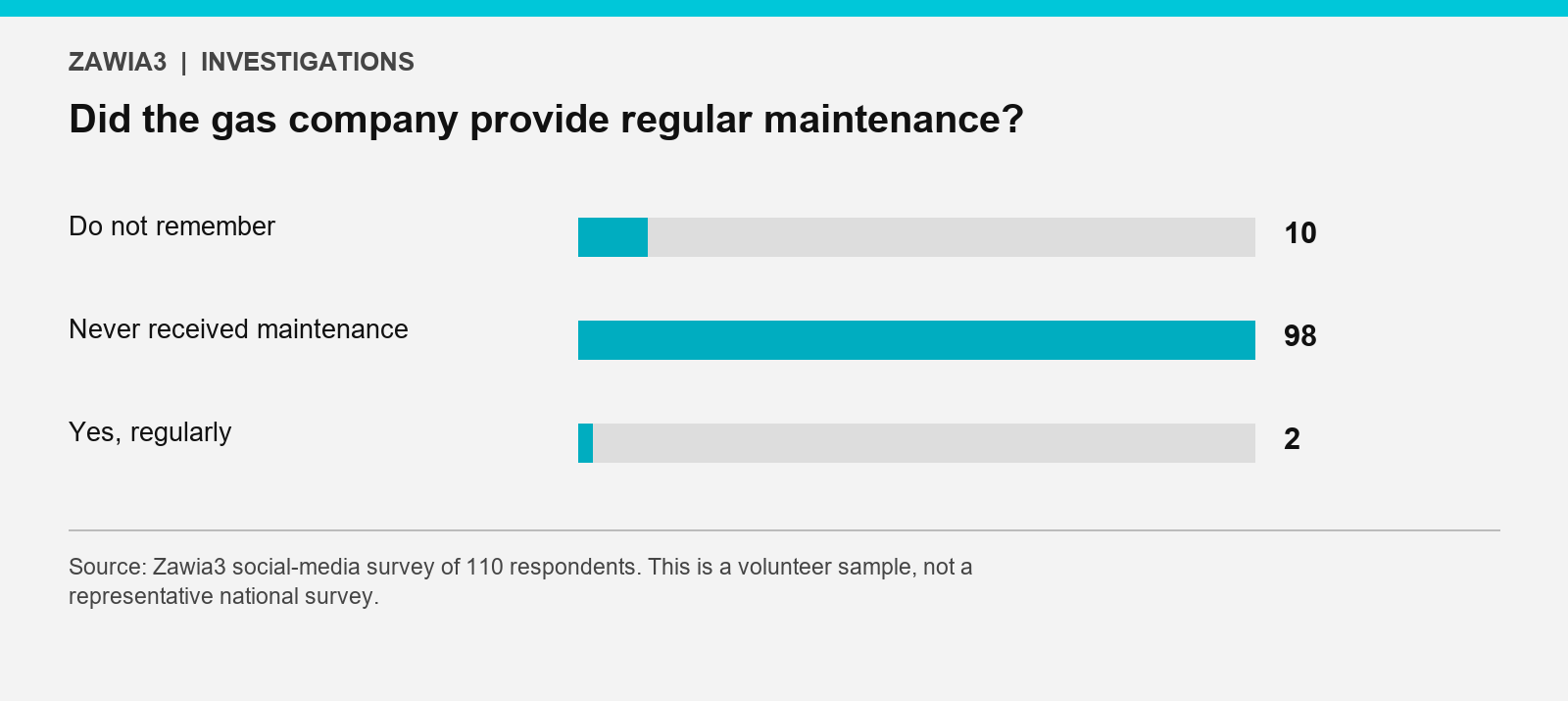
These responses contrast with a February 10, 2022 Cabinet post asserting implementation of all safety measures under the household gas expansion plan.
The stated standards include giving customers operating and emergency instructions permanently displayed on meters, schedules for periodic maintenance of every network component under Egyptian Natural Gas Holding Company (EGAS) supervision, 24-hour emergency service throughout the week, and full occupational health and safety compliance. The survey indicates a gap between these policies and respondents’ experiences of maintenance.
One hundred respondents stressed the importance of company-installed gas detectors alongside maintenance and regular technical inspection of networks and appliances to identify faults early and prevent deaths and injuries.
Commenting on the findings, El Nahhas, a Mostaqbal Watan MP, told Zawia3 that gas companies bear clear responsibility: rising incidents reflect a failure of maintenance and follow-up rather than isolated events.
The responses of 98 residents reporting no maintenance since installation provide strong evidence of shortcomings for which companies are directly responsible, she said.
Housing rights researcher Ibrahim Ezz El Din told Zawia3 that established international standards regard safe household gas utilities as a legal and rights obligation for housing and construction companies and bodies managing buildings, rather than a secondary technical issue.
Article 11 of the International Covenant on Economic, Social and Cultural Rights and the relevant UN committee’s General Comment No. 4 recognize adequate housing, he said. It must protect occupants from structural and environmental risks threatening health and life, including leaks, explosions and carbon monoxide asphyxiation.
He cites the UK, Canada and several EU countries as examples where mandatory, often annual, inspections of gas systems and appliances are performed by certified technicians under clear standards, documented and followed by required repairs before continued occupancy.
Technical standards such as the National Fire Protection Association’s gas code and International Organization for Standardization standards emphasize safe engineering, materials resistant to corrosion and pressure, adequate ventilation and separation from other vital building utilities, he says.
Regular preventive maintenance, replacing worn components before failure, and household gas and carbon monoxide detectors are recognized requirements for reducing risks, according to Ezz El Din.
The obligations also concern transparency: informing residents of inspection results and unsafe-use risks and providing clear emergency instructions so individuals can protect themselves.
Ezz El Din says failing these duties through missing inspections, weak oversight or intervening only after accidents is more than an administrative shortcoming. It undermines the right to adequate housing and the duties of companies and the state to protect health and life at home.
Ahmed Yehia, an occupational health, safety and environmental management consultant, says international safety frameworks identify hazards and prevention through risk analysis and assessment, with legal responsibility resting on producing and implementing companies.
He says companies and contractors connecting homes must provide awareness material and conduct regular follow-up visits even after installation to check compliance and residents’ understanding. He describes this as both a legal and ethical obligation.
Another face of absent oversight
Problems extend beyond absent periodic maintenance to sometimes slow responses. Residents seeking alternatives have created informal, personal reporting channels outside official oversight.
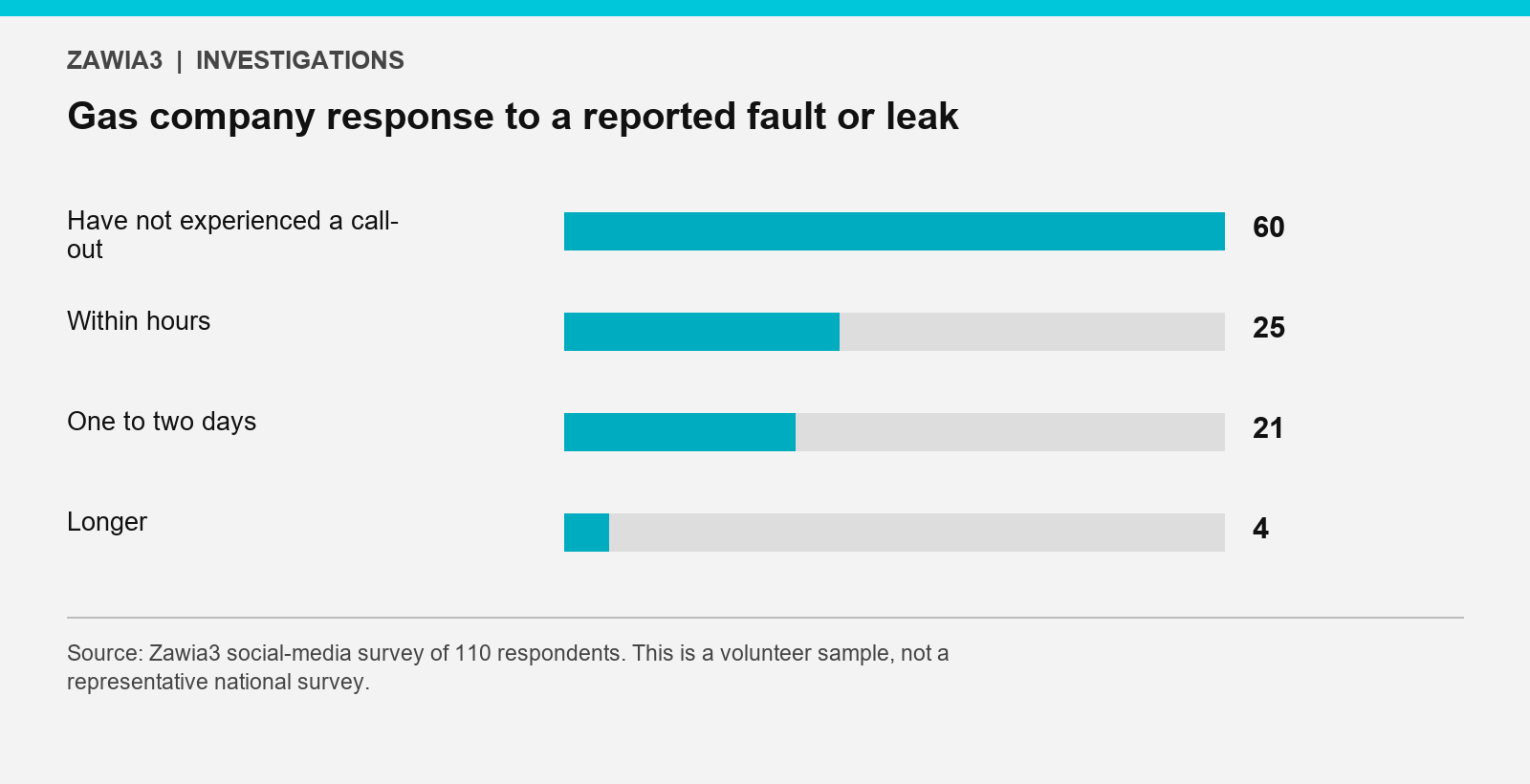
Sixty survey participants had not experienced a company response to a complaint; 25 said responses came within hours; 21 reported waits of one to two days; and four said longer.
Fatma Abdel Razek, a pseudonym for a Qalyubia resident, says she contacts a gas company worker recommended by neighbors because he responds quickly.
He introduces himself as the intermediary between residents and the company, she told Zawia3. He receives their reports directly and says he will notify the company, removing the need to contact customer service.
“The worker first visits after a customer calls the company, then gives the customer his number so future requests go directly to him,” she said.
To verify the claim, the reporter contacted the worker posing as a resident in Qalyubia who needed pipes removed for bathroom and kitchen wall repairs. He said he could attend without a call to the company: contacting him was enough, and he would report the work himself.
Zawia3 contacted customer service at three companies. All said pipe removal and installation—including work needed for renovations—and technical fault reports must be arranged directly through the company. Workers’ claims to act as intermediaries were “incorrect” and fell within attempted fraud, they said.
El Nahhas describes unofficial employee installation or removal as illegal and dangerous, requiring stricter company oversight and accountability and prohibition of interventions outside approved channels. She advises residents to verify technicians’ identities and duties and obtain official company authorization before admitting them.
Hamdi Khalaf, a lawyer with the Egyptian Initiative for Personal Rights, says responsibility cannot be assigned using one cause or uniform assumptions. Each incident must be examined to distinguish misuse by the customer from company negligence.
The more than 90 respondents reporting no regular maintenance indicate a clear breach of contract conditions, he says, potentially establishing civil liability where customers suffer harm.
Khalaf distinguishes civil responsibility, requiring those responsible to compensate material losses, from criminal responsibility in cases involving deaths or injuries.
Every fatal incident is investigated by prosecutors, he says, including forensic examination and technical experts’ reports assessing suspected criminal conduct or negligence. Whether a company is accused depends on the technical findings and whether victims or relatives explicitly implicated it in their statements.
Civil compensation is not automatic: claimants must bring a case, Khalaf says. Families should also raise company responsibility during criminal investigations where the customer was not negligent. Lack of legal awareness and treating incidents as “fate” can lead victims to lose rights despite possible legal and criminal accountability.
The compiled incidents, residents’ accounts, survey and specialist interviews indicate that rapid expansion of household gas has not been matched by adequate oversight and maintenance. Informal employee practices, slow responses and weak consumer protection expose residents to serious risks. International standards frame safe utilities as a legal and ethical obligation. Will the state address rising incidents and missing maintenance, or will the “silent killer” remain inside homes without safety becoming a priority?