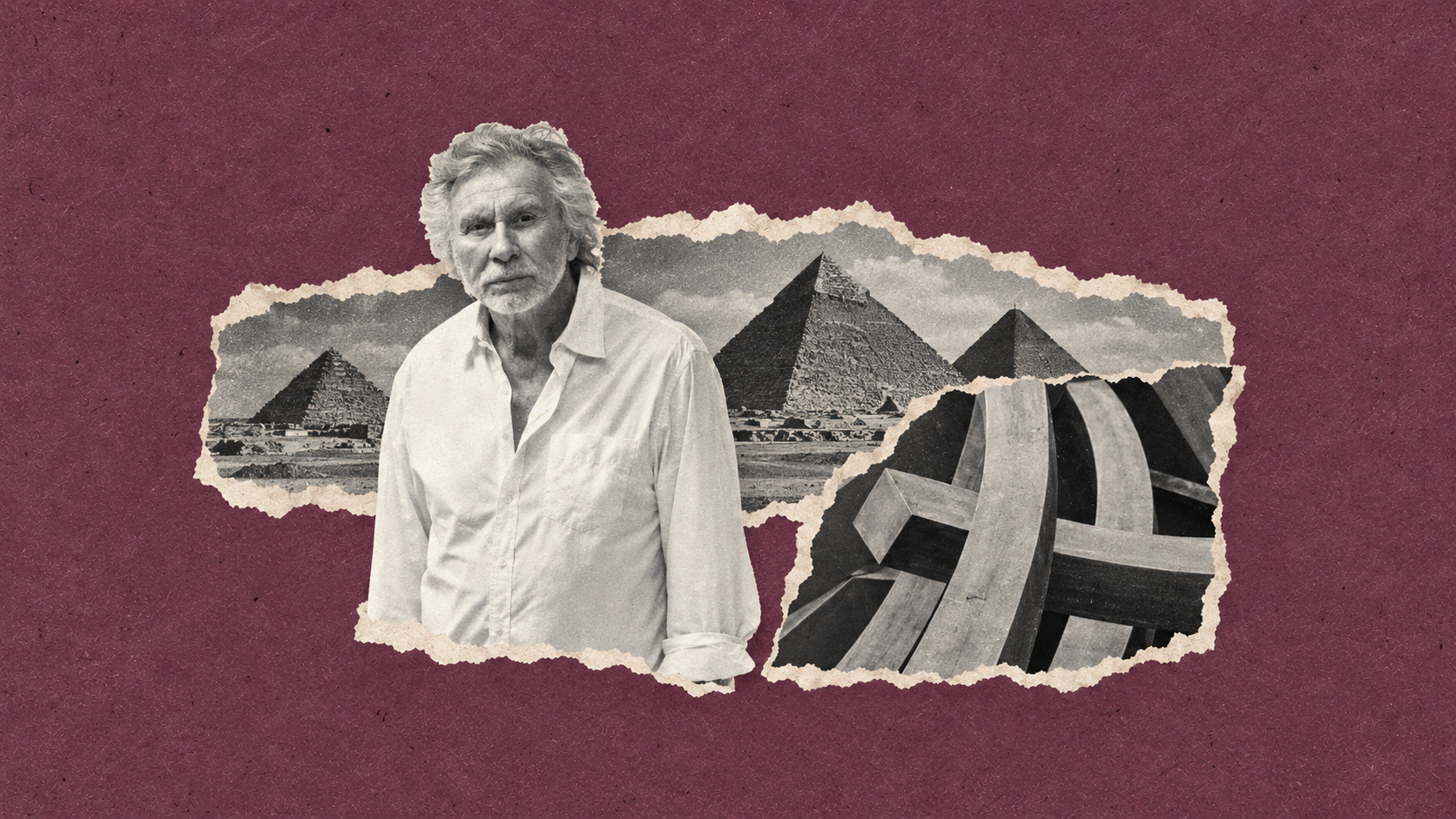
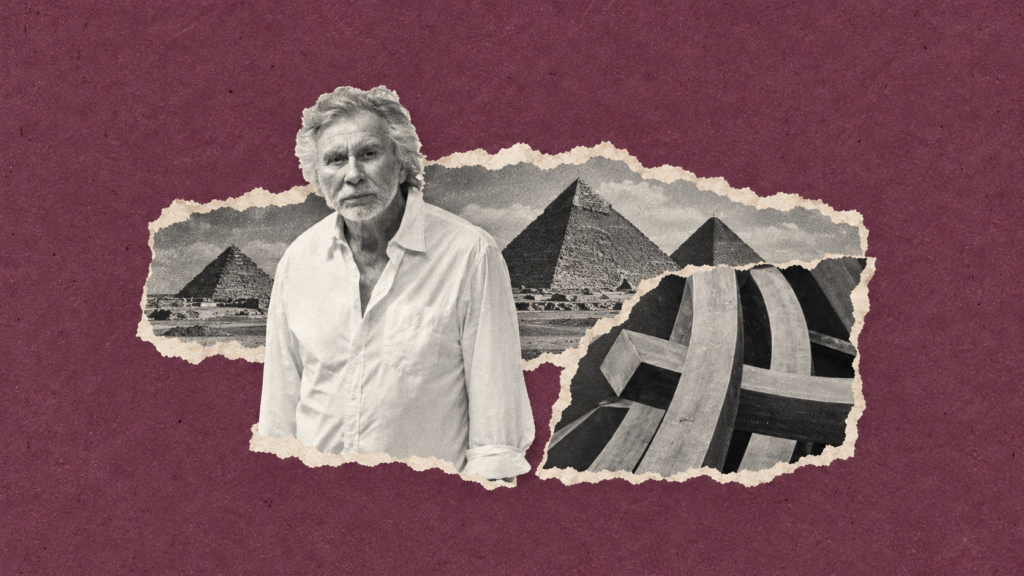

The invitation extended to French artist and sculptor Bernar Venet to take part in the next edition of Forever Is Now, organised by Art D’Egypte from 4 to 28 November 2026, did not pass quietly through Egypt’s artistic and cultural scene. A group of artists and intellectuals launched an initiative opposing his participation, gathering more than 500 signatures in less than 48 hours over the artist’s connections to institutions in Tel Aviv.
According to a statement obtained by Zawia3, the signatories cited Venet’s receipt of the American Friends of Museums in Israel’s 2022 Artist of the Year in Israel award, alongside his formal representation by Har-El Gallery in Tel Aviv.
The petition attracted prominent names from academic, artistic and cultural circles, including Egyptologist Monica Hanna. Meanwhile, artists Alaa Abdel Hamid, Omar Sanada, Pansée Ahmed and others formally announced their withdrawal from the exhibition in protest at the invitation to Venet.
The petition called on Art D’Egypte to withdraw its invitation to the French artist and take a clear position against any form of cultural or artistic normalisation. It argued that hosting him at this moment was provocative to Egypt’s cultural scene, particularly with the event taking place around one of the country’s most prominent archaeological sites.
In comments to Zawia3, Alaa Abdel Hamid explains that Venet received the 2022 Artist of the Year in Israel award from the American Friends of Museums in Israel and is formally represented by Har-El Gallery in Tel Aviv. He notes that the award also involved producing and selling limited editions of small-scale versions of the artist’s sculptures, with the proceeds directed towards supporting Israeli museums.
He says his decision to withdraw from the Cairo International Art District exhibition followed lengthy reflection. He considered his contractual commitments to Art D’Egypte, to which he had delivered his work about three weeks earlier, as well as his concerns about the possible consequences of withdrawing and the possibility of embarrassing other artists or pressuring them to take the same position.
He stresses that he did not want his withdrawal to become an individual gesture whose impact would disappear as public engagement subsided, or a moral contest between himself and his colleagues, casting him as the person taking the right stand and those continuing to participate as less committed.
Abdel Hamid says he had not been following his Facebook and Instagram accounts during the preceding two weeks because he was busy. He only learned of artists’ objections to the invitation to Venet about two days before announcing his withdrawal.
After learning about the issue, he preferred to take time before deciding, particularly because several of those objecting had no participation agreements with the institution, unlike him. He also did not know all the participating artists or have enough time to coordinate with them, especially as some lived in Alexandria and other governorates.
Abdel Hamid says he went to the exhibition venue the next day, when work began at noon, and informed a member of the institution’s staff of his decision to withdraw and retrieve his work. During their discussions, attempts were made to persuade him to wait. He was told the institution was preparing a statement, with the suggestion that he wait until the evening to read it before making a final decision.
He was not convinced, however, by the institution’s explanation that it had not known about the French artist’s connections. In his view, the statement subsequently issued focused on Venet’s artistic career and work without clearly acknowledging that the institution had been unaware of those connections.
He adds that, in his assessment, it is difficult to separate the artist’s career from the institutions that awarded him the prize or his representation by a gallery in Tel Aviv. He stresses that his objection concerns the connections raised by the invitation, rather than an assessment of the artist’s work.
Abdel Hamid notes that other artists announced similar positions after he declared his withdrawal. He stresses that withdrawing is intended to pressure Art D’Egypte to review its decisions and policies, rather than to abandon the artistic space or leave it to others.
He explains that the Cairo International Art District exhibition had not yet opened, and that the artists’ withdrawal was an objection to the organiser’s decision, not a surrender of their right to participate in the artistic scene.
He argues that treating withdrawal as an abandonment of artistic space overlooks its central aim: pushing the institution to reconsider its decision to invite an artist connected to institutions that support Israel.
Abdel Hamid recalls earlier objections to the selection of Pepsi as a sponsor of one of the institution’s events last year, saying the criticism ultimately led to the sponsorship being cancelled. He also refers to an incident two or three years ago involving an American artist who, he says, posted content supporting Israeli military personnel on her social media accounts. He argues that the recurrence of such incidents calls for a review of how artists are selected, rather than treating each case as an isolated event.
The Institution Backs Down Under Pressure
Under pressure over the participation of French artist Bernar Venet, Art D’Egypte announced that it was halting his participation. In an official statement issued at midday on Friday, it said the decision reflected its commitment to its principles and values and its respect for all parties within and beyond the artistic and cultural scene. It affirmed its support for the Egyptian position on the issue and its commitment to humanitarian values and principles, noting that institutional credibility rests not only on recognising mistakes but also on the ability to correct them and uphold the principles on which the institution was founded.
Founded by Nadine Abdel Ghaffar, Art D’Egypte describes itself as a multidisciplinary platform supporting Egyptian art and cultural heritage and seeking to place Egypt at the heart of the international contemporary art scene. It began operating in October 2017 with an exhibition at the Egyptian Museum featuring 16 Egyptian artists alongside antiquities, under the patronage of the Ministry of Antiquities. It later expanded into exhibitions and events connecting contemporary art with heritage sites.
Since 2019, the institution has expanded its presence beyond Egypt by presenting Egyptian artists at international exhibitions and organising artistic events abroad. It has also received UNESCO patronage and participated in international art events, including Abu Dhabi Art and Art Genève. Forever Is Now, staged around the Giza pyramids, is Art D’Egypte’s flagship project, as the Cabinet’s media centre has also announced.
The institution is preparing to hold the sixth edition of Forever Is Now with eight artists, comprising five women and three men, according to announcements at a press conference attended by Egyptian government bodies, including the ministries of Foreign Affairs and Tourism and Antiquities and the Egyptian Tourism Authority, alongside UNESCO’s patronage. A cooperation protocol was signed between Art D’Egypte and the Ministry of Foreign Affairs in May 2026.
Art D’Egypte has faced criticism over the model it presents. Some aspects of the experience have been described as involving an element of ‘artwashing’, referring to the prioritisation of visual spectacle and the display associated with the archaeological setting over the nature of the artworks themselves.
A Wider Debate About the Institution’s Activities
The crisis extends beyond the artists’ petition. Artist Islam Shabana, one of the first signatories opposing the French artist’s participation in the exhibition, says Art D’Egypte hosted American sculptor Carole Feuerman in October 2023. She is also represented by Zemack Gallery in Tel Aviv. For Shabana, this raises questions about how participants in the institution’s events are selected and how thoroughly their backgrounds and professional relationships are examined before they are invited to Egypt.
Sculptor Carole Feuerman is known for supporting the genocide in Gaza and for openly endorsing, on social media, the massacres carried out by the Israeli army under the banner of fighting terrorism in occupied Palestine. She has adopted the Zionist narrative of Al-Aqsa Flood since 7 October 2023.
Speaking to Zawia3, Shabana says Feuerman participated in an exhibition in Israel from 21 September to 27 October 2023, then travelled directly from Tel Aviv to Cairo after it ended to attend Art D’Egypte’s event, held from 26 October to 18 November, at the height of the war in Gaza. He says several people working at the event confronted the institution with this information and that it was aware of these circumstances, according to his account. In Egypt, the artist displayed a work depicting the ancient Egyptian goddess Hathor wearing a black evening dress, with the pyramids in the background. This prompted objections within artistic circles, Shabana recounts.
The petition’s growing body of signatories called on Art D’Egypte to clarify its position and formally answer questions about the criteria for selecting the French artist, the nature of his relationship with the institutions representing him in Israel, and whether the institution had reviewed this information before inviting him.
Forever Is Now, held around the pyramids, differs from the forthcoming event in downtown Cairo, Shabana adds. He explains that the French artist’s works are large sculptures, making the pyramids area suitable for displaying work of that kind. He says the petition’s signatories tried to contact the organiser for a response about the artist’s participation but received none.
On Thursday, the institution had announced what it described as a ‘comprehensive review of the information and circumstances surrounding his participation, in coordination with the relevant authorities’. It said it would announce its final position later, without either cancelling Venet’s participation or confirming that it would go ahead.
In Shabana’s view, Art D’Egypte’s statement reflects ‘the mentality of those running cultural work’, revealing a condescending approach towards local artists discussing issues connected to the reality around them. He adds that the institution’s emphasis on Venet’s international career and honours, without addressing his professional relationships with artistic institutions in Israel or the award he received there, ignores the substance of the objections, in his assessment.
Shabana criticises the presentation of Venet as a prominent conceptual artist. In his view, this type of art has become a commodity within the global art market, and invoking the artist’s international history does not justify ignoring the questions surrounding his participation in Egypt. His criticism extended to describing the institution’s discourse as ‘belittling the Egyptian artistic and cultural scene’, and saying those running it lacked sufficient knowledge of the types of work and artists they present.
The French artist’s works remain on sale through the gallery in Israel, Shabana says. He explains that the main event in which Venet was due to participate at the pyramids is scheduled for 4 November, while another Art D’Egypte event in downtown Cairo in the coming days had included a smaller work by the artist. The plan to display that work was reversed amid the campaign sparked by the controversy over his participation.
Shabana recounts that the institution began following a different course in 2021, relying more heavily on foreign artists and directing a greater share of resources towards them than towards Egyptian artists. He says Egyptian artists believe the institution provides foreign artists with greater financial and organisational resources while Egyptians receive less. This was noticeable from the institution’s earliest years, he says, but has become more pronounced recently.
According to Shabana, the institution initially held events at heritage and cultural sites that were relatively accessible to the public, including Manial Palace, the old Egyptian Museum and Al-Muizz Street. He believes the nature of its events has changed in recent years, with a shift towards a major event at the pyramids alongside other events aimed at Egyptian artists in downtown Cairo alone.
He adds that events at the pyramids are also linked to a number of private-sector sponsors and partners. He points to Arab businesspeople and investors appearing in photographs associated with the events and their organisers, noting the presence of Gulf nationals at the events.
In one edition of the exhibition, Saudi artist Rashed AlShashai appeared on the list of participating artists, while Emirati artist Azza Al Qubaisi also took part in an edition. Gulf involvement extended to the sponsors’ list, with Saudi Hamza Serafi named among the ‘gold sponsors’ of the fifth edition in 2025.
Shabana says that he and several other petition signatories contacted BDS Egypt about the incident. He explains that the movement followed a procedure beginning with a formal approach to the institution, asking it to remove the artist or end its cooperation with him, before moving towards boycott campaigning if it did not respond.
The crisis reopens questions about the boundaries of the cultural boycott of Israel and organisers’ responsibility to scrutinise the connections of artists participating in their international events. In this context, an informed source argues that accountability should extend beyond Art D’Egypte as an institution to those responsible for managing it and making its decisions, foremost among them its founder and manager, Nadine Abdel Ghaffar. The source says her responsibility for the selections that provoked artists’ objections needs to be clarified.
The source stresses the need to move beyond objections to one artist’s participation towards a broader discussion of the criteria for selecting artists and sponsors of cultural events, and how consistent those choices are with the stated positions of artists and audiences towards institutions linked to Israel.
The source says the coming period requires collective coordination among the objecting artists, rather than individual initiatives alone, to sustain pressure on the institution and turn the objections into organised action that will not end when engagement with the crisis subsides.