
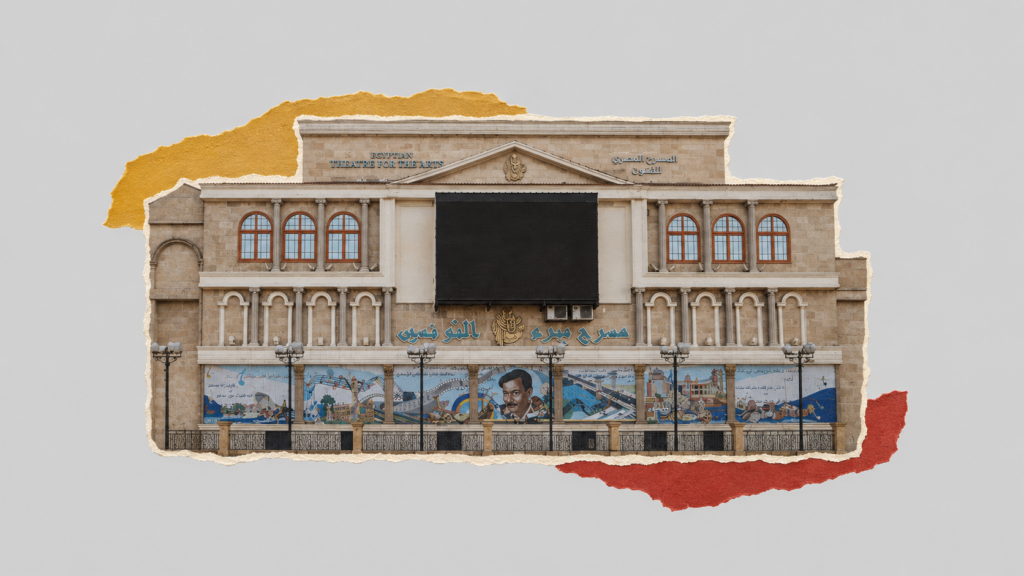

Twenty months have passed since the board of the General Authority for Cultural Palaces decided to vacate rented cultural houses and libraries in 24 governorates, without a published ruling in the lawsuit challenging it and without the ministry announcing the fate of these venues. Meanwhile, March 2027 is approaching, the deadline for the expiry of old-rent contracts signed in the names of government bodies and public authorities.
Most of these venues are small apartments in villages and small towns. Many measure between 40 and 60 square metres, according to the then culture minister, Ahmed Fouad Hanno. For decades, they have hosted literary clubs, theatre troupes, women’s clubs and drawing workshops in places beyond the reach of the larger cultural palaces. Their fate lies at the intersection of three unresolved processes: an administrative decision that Hanno denied was a closure order, a lawsuit in which the State Commissioners Authority recommended overturning it, and a tenancy law that sets an eviction deadline which waits for neither the court’s word nor the ministry’s decision.
120 apartments in 24 governorates
On 5 March 2025, at its 324th meeting, the board of the General Authority for Cultural Palaces approved vacating a number of rented cultural houses and libraries. The culture minister endorsed the meeting’s minutes on 13 March. The authority then instructed the heads of its cultural regions to take the legal steps needed to redeploy employees at these venues by 29 May 2025. A list obtained by Al-Dostor newspaper revealed that the decision covered 120 cultural houses and libraries in 24 governorates across the authority’s six regions. Menoufia topped the list with thirteen venues, followed by Sharqia and Gharbia with eleven each, Daqahlia with ten, Minya with six, and Assiut and Ismailia with five each. In Aswan, South Sinai, North Sinai, Cairo, Fayoum and Matrouh, the decision covered only one venue in each governorate.
The decision followed a prolonged contraction in the network of cultural venues. According to Central Agency for Public Mobilization and Statistics data cited by the same newspaper, the number of cultural palaces and houses fell from 432 in 2009 to 347 in 2021, a loss of 85 venues over twelve years before the issue of rented apartments arose.
The ministry justified the decision by citing the weaknesses of these venues, not just the need for money. The authority’s then chairman, Major General Khaled El-Labban, said their employees were unqualified to provide cultural activities, that Egypt had an abundance of venues, numbering 619, and that closing around a hundred houses would leave roughly 500 venues, enough for cultural activities. Hanno described most of the venues concerned as having no visitors, with some turned into storerooms, and said around 1,200 employees working there would move to palaces that needed them. Before MPs, he said a technical committee had identified 120 rented apartments and assessed their actual impact, that some had been closed for years “with locks and chains,” and that developing the authority required between 7 and 8 billion Egyptian pounds ($126 million to $144 million), while its debts exceeded 2 billion pounds ($36 million).
The official figures themselves reveal that the decision did not cover every property the authority rents. At a meeting of the House of Representatives’ Media Committee, the minister estimated the number of rented premises at around 160 apartments, of which the committee was examining 120. That means around forty other apartments, by Zawia3’s calculation, remained off the list, although they too are rented.
A decision the minister denied and the documents recorded
When implementation began in May 2025, the dispute moved out of offices and into the circles of theatre practitioners and writers in the regions. In a survey of their views published by Al-Dostor on 11 May, stage designer Nahla Morsi said these houses were the only outlet for talented people in villages and hamlets, and that “literary clubs have always been a breeding ground for authors, writers and poets throughout Egypt.” She suggested that the state buy the rented units rather than vacate them. Theatre director Ahmed El-Banhawy said theatres in Fayoum, Beni Suef and many other places had remained closed for years on the pretext of restoration, and that closing the houses was another step along the same path. Writer and critic Karima El-Hefnawy argued that the ministry’s policies were turning cultural services into a commodity. Director Islam Farghaly proposed a practical alternative: using school premises and youth centres in the evenings, stressing that no one had consulted the venues’ managers before the decision.
The same survey also included a dissenting voice. Director Osama Mahmoud said some venues were not fulfilling their role, citing the Ihnasia Cultural House in Beni Suef, which had not taken part in the theatrical season for years. He called for a comprehensive assessment on which to base a decision on whether to close them. This criterion, evaluating venues individually, was the same one the minister later invoked when he stepped back.
In parliament, MPs including Esmat Zayed, Maha Abdel Nasser, Mohamed Hamdy Moussa, Fatma Selim, Hisham El-Gahel, Doha Assi and Dorreya Sharaf El-Din submitted briefing requests. MP Ehab Mansour put a question to the prime minister and culture minister about plans to turn some venues into function halls or nurseries in cooperation with the Ministry of Social Solidarity. At a meeting of the Media, Culture and Antiquities Committee chaired by Dorreya Sharaf El-Din, Hanno said that “no decision has been issued to close” cultural houses. The committee’s deputy chair, MP Nader Mostafa of the Coordination of Youth Parties and Politicians, responded by reading out the administrative decision providing for the venues to be vacated.
Days later, the minister appeared in a video released by the cabinet’s Information and Decision Support Center, saying the ministry was still studying and examining the issue and had issued no decision to close either the palaces or the rented apartments. The authority formed a committee drawn from its cultural affairs, artistic affairs and studies departments to review around forty houses and libraries, each smaller than a hundred square metres. MP Doha Assi said parliament had halted the decision after discussing it in the Culture Committee.
But the official denial did not cancel the signed document. The decision the minister said had not been issued remained in place, with its meeting number and endorsement date. It was the very same decision that reached the State Council months later.
Removing the staff instead of closing the doors
In May 2025, lawyer Ali Ayoub filed a lawsuit before the State Council’s Administrative Court against the culture minister and the chairman of the General Authority for Cultural Palaces in their official capacities, seeking an urgent stay of implementation followed by annulment of the decision. The claim argued that the venues’ rents were modest and that closing them would leave a vacuum in villages and small towns and deprive young people of spaces to develop their talents. The court has heard the case in successive sessions since then, adjourning it from one hearing to the next.
On 2 February 2026, in its report on Case No. 58055 of Judicial Year 79, the State Commissioners Authority recommended annulling the authority board’s decision, issued at its 324th meeting, “insofar as it provided for the removal of employees” from the rented houses and libraries designated to be vacated, with all resulting consequences, foremost the return of employees to their previous workplaces. The report described cultural houses as centres of cultural enlightenment, treated culture as an inherent constitutional right, and held that the ministry’s role was to preserve and develop that right, not close its outlets. Article 48 of the 2014 Constitution states that culture is a right of every citizen guaranteed by the state, which must make it available without discrimination on grounds of financial means or geographical location.
The report’s wording reveals how the decision actually worked. It did not explicitly order the venues’ closure, but rather their clearance of staff and the employees’ redeployment elsewhere. A cultural house whose employees have left has no one to open its door for the literary club or the troupe’s rehearsals. This wording allowed the minister to deny that a closure order existed, while the State Council examined a decision whose actual effect, the claimant says, was closure.
The commissioners’ report is an advisory opinion and is not binding on the court. After it was issued, the court scheduled a hearing for 2 May 2026, and the hearing took place as scheduled. Published coverage since then reveals no ruling on either the urgent application or the merits. This means the decision remained legally effective throughout the months of litigation, unless the authority reversed it through an unannounced written decision.
March 2027: a deadline beyond the ministry’s control
Outside the corridors of the ministry and the State Council, another deadline is approaching, independent of either institution. Following a Supreme Constitutional Court ruling that removed protection against eviction for tenants with legal personality, Law No. 10 of 2022 was enacted and published in the Official Gazette on 6 March 2022 to regulate the vacating of premises rented to legal persons for non-residential purposes. The law gave these tenants a five-year transitional period, raising rent fivefold at its outset and then adding an annual increase of 15%. The old contracts are due to expire in early March 2027, after which the tenant must return the property to its owner unless the two parties agree on a new contract.
The legal persons covered by the law, according to its commonly cited definition, include the state, directorates, departments and public establishments granted legal personality by law, including public authorities such as the Cultural Palaces Authority. The authority has not yet announced how many of its estimated 160 rented apartments are held under old-rent contracts. However, Ali Ayoub’s claim described their rents as “modest,” a description consistent with old contracts rather than market rates.
If these contracts fall under the law, the rent for each apartment rose between March 2022 and March 2026 to almost nine times its pre-law level, by Zawia3’s calculation. This was the same period during which the authority took the decision to vacate them. Four months after this report is written, the question raised by that decision will be reversed: it will no longer be whether the ministry will close the houses, but whether it will negotiate new contracts at market rates with owners entitled to reclaim their apartments. The ministry has announced no plan for that deadline, beyond what the authority’s May 2025 statement said about seeking to establish alternative houses in cooperation with governorates.
From the “People’s University” to an apartment
The network to which these houses belong began in 1945 as the “People’s University,” then became “Mass Culture” in 1965, before a presidential decree in 1989 transformed it into the General Authority for Cultural Palaces. Its stated mission was to spread cinema, theatre, music, literature and libraries across the governorates. The network relied on a dual structure: large palaces in governorate capitals and major cities, and small houses and libraries extending into district towns and villages, some operating from rented apartments in residential buildings.
Entire generations of writers emerged from this network. Short-story writer Saeed El-Kafrawy, a recipient of the State Appreciation Award, started at the Mahalla Cultural Palace in 1964, as part of a literary group that included Nasr Hamid Abu Zayd, Gaber Asfour, Mohamed El-Mansi Qandil, Mohamed Farid Abu Seada, Gar El-Nabi El-Helw and Mohamed Saleh, according to his biography published on the Supreme Council of Culture’s website. One member of that group, Gaber Asfour, later served twice as culture minister. Mahalla Palace itself was among the venues the authority announced in May 2025 that it was preparing to open soon, meaning it had not yet reopened when the decision concerning the houses was issued.
A house’s function is not limited to its literary club. According to Nahla Morsi’s remarks in Al-Dostor’s survey, a single house brings together a women’s club that trains women in handicrafts, drawing workshops for children and adults, folk arts and choral activities, as well as theatre troupes, some of which have represented Egypt at festivals abroad. In the same survey, artist Ibrahim Ali recalled taking part in seminars without pay because there was no budget, and how the cultural house’s director bought tea for attendees out of his own pocket, before everyone met at the café at the end of the day. He believed that an official issuing a closure order had never visited a cultural house and did not know how its amateurs and employees worked.
Between the ministry’s account of apartments closed “with locks” and the artists’ account of houses sustained by volunteering and tea, there are still no published data on each house’s activity: its visitor numbers, the number of activities it holds and its rent. These are the data the minister said his technical committee relied on, yet its findings have not been published.
600 venues and five million for maintenance
Budget figures place the rented houses within a wider crisis. During discussion of the Culture Ministry’s budget before the House of Representatives’ Media, Culture and Antiquities Committee on 12 May 2026, the authority’s chairman, Hisham Atwa, said a previous request for 250 million pounds ($4.5 million) for palace maintenance had received an allocation of only 5 million pounds ($90,000). Committee chair Soraya El-Badawy said the authority’s maintenance allocation the previous year had been 33 million pounds ($595,000). According to Atwa, the authority has around 600 cultural venues, meaning that if the five million were shared equally, each venue would receive around 8,300 pounds ($150), by Zawia3’s calculation.
At the same session, Atwa said an instructor’s payment for activities run by the authority did not exceed 100 pounds ($1.8), and called for activities funding to rise to 42 million pounds ($757,000). The committee’s secretary, MP Doha Assi, pointed to seven cultural palaces that had been built but were still not operating. In June, the committee recommended increasing the authority’s budget by around 500 million pounds ($9 million) for construction, restoration and civil protection requirements. Published official information contains no confirmation that this recommendation was approved.
This shortfall was the backdrop against which Hanno presented his decision in 2025, when he said the ministry would not spend on upgrading dilapidated rented premises. In March 2026, the ministry announced a plan to develop 30 cultural venues within twelve months. Yet the same figures raise the reverse question, one the ministry has not publicly answered: how much does the authority actually pay in rent for the 160 apartments, and what share of its budget does that represent?
Caravans travel while houses wait
Almost everything at the ministry has changed since May 2025 except the issue of the houses. Hanno left in February 2026. His successor, Gihan Zaki, appointed director Hisham Atwa as the authority’s chairman in April, then resigned in July, leaving Higher Education Minister Abdel Aziz Konsowa to run the ministry in an acting capacity. When Atwa took office, the press listed reviewing rented houses and drawing up a clear plan for them among his priorities, but that plan has yet to be announced.
Meanwhile, mobile programmes are expanding. The “Confrontation and Touring” project brings theatrical performances to 250 villages, with its seventh phase running from September 2026 to June 2027. Mobile theatres carried out activities in 19 governorates in 2025, alongside the authority’s participation in the “You Are Life” initiative with the Decent Life Foundation. At his first meeting with ministry leaders, Konsowa directed them to intensify cultural caravans to the governorates in cooperation with universities.
The difference in the impact of the two models lies in their timing: a caravan visits a village for a set number of days, while a literary club meets weekly, a theatre troupe needs a permanent rehearsal space, and a women’s club works throughout the year, not just during a season.
The latest development in this direction was a recommendation. In October 2026, the recommendations of “Egypt Forum 2026” tasked the Culture Ministry with developing a phased plan for cultural palaces and houses in the governorates, focusing on discovering talent and encouraging volunteering and community participation. The houses thus remain part of the state’s discourse, but the plan determining which will stay, which will be vacated, and on what criteria, has yet to appear.
Four months before March
Four months remain before old-rent contracts for legal persons expire. During this period, no single body holds complete control over the houses’ fate: a court has been hearing a lawsuit since May 2025 without a published ruling; a State Commissioners Authority report recommends annulling the decision without binding anyone; an authority has not announced the results of its review of the houses; a ministry has been run by an acting minister since July; and an “Egypt Forum 2026” recommendation calls for a phased plan with no deadline.
The same list includes thirteen venues in Menoufia alone and eleven each in Sharqia and Gharbia. In Mahalla, where Saeed El-Kafrawy, Gaber Asfour and Nasr Hamid Abu Zayd came together in a single literary group more than sixty years ago, the large palace itself was awaiting reopening when the decision concerning the small houses was issued. The question remains suspended until March: who will decide the fate of the 160 apartments, a court that has yet to rule, a ministry without a minister, or owners awaiting the end of the grace period?