

Giza, Egypt
After more than two decades of anticipation, Egypt is preparing to unveil one of the most ambitious cultural projects in modern history: the Grand Egyptian Museum (GEM). Standing just two kilometres from the Giza pyramids, the vast new complex—covering nearly 500,000 square metres, about twice the size of the Louvre—is the world’s largest museum dedicated to a single civilization. With more than 100,000 artefacts spanning Egypt’s pre-dynastic origins to the later pharaonic eras, its opening marks a defining moment in how humanity engages with the ancient world.
“This is a gift from Egypt to the whole world,” declared former antiquities minister Khaled El-Enany, summing up the project’s significance. The museum’s completion represents not just the culmination of a monumental architectural vision, but a statement of national pride and cultural continuity—an act of modern Egypt claiming stewardship over its own ancient narrative.


A Dream Delayed, Then Delivered
The idea of a “mega-museum” first emerged in the 1990s, as the celebrated Egyptian Museum in Tahrir Square grew overcrowded. The project officially began in 2002, when then-President Hosni Mubarak laid its foundation stone. The international design competition attracted 1,500 entries from 82 countries, with the winning proposal by Róisín Heneghan and Shi-Fu Peng of Dublin’s Heneghan Peng Architects—a minimalist structure conceived as a bridge between antiquity and innovation.
Construction began in 2005, but Egypt’s shifting political landscape, the 2011 revolution, and recurring funding shortages repeatedly halted progress. The museum’s original 2013 opening date slipped to 2015, then 2018, then 2020. The COVID-19 pandemic brought further delays. “The $1bn museum has been plagued by delays since it was first scheduled to open in 2015,” observed The Guardian.
At one point, even the nickname “the museum that never opens” began circulating among Egyptians. Yet each postponement allowed refinement: stronger conservation systems, improved accessibility, and a carefully choreographed opening designed for international attention. After a limited trial opening in late 2024, which allowed 4,000 visitors to preview twelve galleries, the museum is finally set for its grand inauguration on November 1, 2025.
Officials say the timing—following regional turbulence—is deliberate. “It had to open when Egypt and the world could celebrate together,” one planner remarked.

Geometry of the Desert
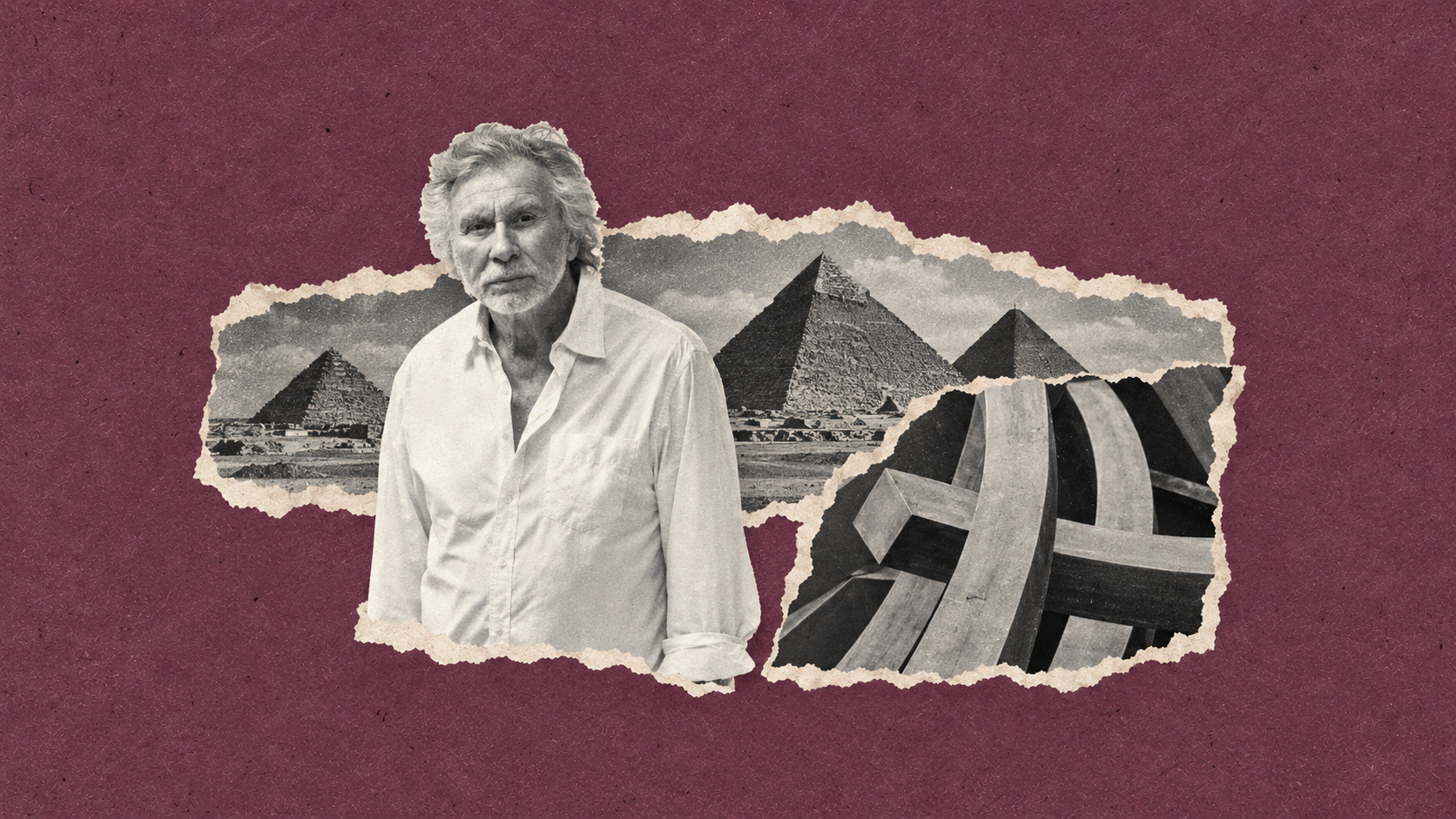
The Grand Egyptian Museum’s architecture commands the desert edge like a modern companion to the pyramids. Its chamfered triangular profile and translucent alabaster façade echo the geometry of the Great Pyramid of Khufu, while its orientation—north and south walls perfectly aligned with Khufu and Menkaure—creates an intentional dialogue between past and present.
“Designing a museum of this calibre so close to the pyramids is a once-in-a-lifetime opportunity,” architect Róisín Heneghan explained. “Our design strengthens that connection to history and place.”
The complex covers 168,000 square metres of built space within a 50-hectare site, its height carefully limited to avoid overshadowing the ancient skyline. Visitors enter through a grand plaza shaded by palms, dominated by the 11-metre, 83-ton statue of Ramses II—moved in 2018 from downtown Cairo in a parade-like spectacle. Inside, a monumental Grand Hall introduces 20–30 large artefacts from different eras, leading to the museum’s centrepiece: the Grand Staircase, a six-storey, 50-metre ascent lined with over 60 statues, columns, and sarcophagi that trace the evolution of Egyptian art and kingship.
At the summit, a panoramic window—aptly named the Window of Eternity—frames the three pyramids in perfect perspective. The effect is theatrical yet reverent: ancient stones seen through a modern lens.
The structure’s environmental engineering is equally impressive. Its insulated concrete keeps interior galleries at 23°C, even when desert temperatures soar to 70°C on the roof. Natural light filters through alabaster and glass to illuminate durable stone artefacts while shielding fragile ones from UV rays.
Behind the scenes, the design was realized through an extraordinary international collaboration. Heneghan Peng worked with structural engineers Arup and Buro Happold; the construction was executed by Orascom Construction and Belgium’s BESIX Group; West 8 designed gardens inspired by the Nile Valley, and Atelier Brückner of Germany led exhibition design. Japan, through JICA, provided over $390 million in loans, technical assistance, and conservation materials.

A Billion-Dollar Vision
Few projects have tested Egypt’s patience and finances like the GEM. When proposed in 2003, costs were estimated at $500 million; by completion, they had surpassed $1 billion (EGP 30 billion). The Egyptian government contributed around $100 million, while Japan’s support—financial, technical, and educational—eventually totalled nearly $800 million.
Fundraising extended beyond state channels. Exhibitions of Tutankhamun’s treasures, organized by Zahi Hawass, toured internationally, raising $120 million earmarked for conservation labs.
“This is not just a museum,” Hawass insisted. “It’s an investment in humanity’s heritage.”
Japan’s ambassador called it “a success story in Egyptian-Japanese relations”, while European partners like Italy’s Goppion supplied the museum’s state-of-the-art display cases—airtight, vibration-free, and climate-controlled.
Despite its cost, Egyptian officials defend the expenditure as visionary. “Allocating billions reflects Egypt’s commitment to preserving antiquities as world heritage,” Hawass said. For a country where tourism contributes nearly 9% of GDP, the GEM is also a calculated bet on the future economy.

The Heart of the Collection
The museum houses the most comprehensive assemblage of Egyptian antiquities ever under one roof—over 100,000 artefacts, including at least 20,000 never displayed before. These span Egypt’s entire historical arc: from Pre-Dynastic flint tools to Ptolemaic mosaics.
Visitors will find monumental granite statues alongside delicate jewellery, papyri, textiles, and wooden coffins. Highlights include the complete collection of Queen Hetepheres, mother of Khufu, and the funerary goods of Yuya and Thuya, grandparents of Tutankhamun.
The Grand Staircase alone is a gallery of giants: ten statues of King Senusret I, a red granite sarcophagus of Merenptah, and colossal busts of Akhenaten. Nearby, newly restored sarcophagi from the 2019 Luxor discovery—30 sealed coffins—are shown together for the first time.
To replace the overcrowded Tahrir museum, the GEM reorganizes Egypt’s heritage into twelve thematic halls (covering 32,000 square metres), exploring Kingship, Daily Life, and the Afterlife. “Every artefact follows a unique curatorial story,” said archaeologist Magdi Shakir, emphasizing how pieces from different dynasties are displayed side by side to tell one continuous narrative.
Researcher Omar Hadri called the GEM “a symbol that retells Egypt’s cultural heritage to the world.” The design’s immersive scale, he said, ensures that visitors “don’t just look at history—they walk through it.”

Tutankhamun’s World Reborn
The undisputed crown jewel of the GEM is the complete treasure of Tutankhamun—more than 5,000 objects displayed together for the first time since their discovery in 1922. From the golden funerary mask and nested coffins to chariots, beds, jewellery, and clothing, the Boy King’s world has been meticulously reconstructed in two vast galleries spanning 7,500 square metres.
Visitors trace the path archaeologist Howard Carter walked: from the antechamber to the burial chamber, surrounded by items as Carter found them—ritual figures, food offerings, even linen garments preserved for 3,300 years.
Among the most remarkable pieces is the ostrich-feather fan, displayed in a sealed, oxygen-free case designed by Goppion to prevent oxidation. The five gilded wooden chariots are presented in a 12-metre custom display, allowing close inspection of the craftsmanship that defined royal Egypt.
“More than five thousand artefacts belonging to Pharaoh Tutankhamun will be exhibited in two halls covering over 7,000 square metres,” said Magdi Shakir. Egyptian media have dubbed it the “King Tut Hall,” revealing “the most intimate details of the child king’s life.”
Zahi Hawass called Tutankhamun’s trove “the unrivaled champion” of the museum, predicting its debut will be “a celebration for all museums in the world.”
For scholars, the comprehensive display offers new opportunities for study; for tourists, it promises the kind of spectacle that has made Tutankhamun the enduring symbol of Egypt’s golden age.

Science Behind the Spectacle
Behind the public grandeur lies one of the most advanced conservation operations in the world. Beneath the museum runs a 17-laboratory complex, linked to the main building by a subterranean tunnel, where Egyptian and international teams have spent years restoring delicate artefacts—from mummies and papyrus scrolls to wood and textiles.
Among their greatest challenges was the Khufu Solar Boat, a 4,600-year-old cedar vessel transported in 2021 from its old pyramid-side museum to a new climate-controlled hall at GEM. The move, costing over $5 million, was achieved via a remote-controlled transporter, underscoring Egypt’s new blend of archaeology and engineering.
The museum’s display technology rivals its architectural ambition. Its vitrines—crafted by Italy’s Goppion—use airtight seals, microclimate regulation, and inert gas systems to stabilize humidity, temperature, and oxygen. This allows organic artefacts—feathers, sandals, even food—to survive exposure. LED lighting prevents UV damage while accentuating fine details.
Security, too, is state-of-the-art. CCTV networks, X-ray scanners, anti-seismic foundations, and vibration-proof pedestals protect both visitors and artefacts. Egyptian Minister of Tourism and Antiquities Sherif Fathy assured that “the museum’s security systems are top-notch… such thefts cannot happen here.”
For visitors, the GEM blends heritage with high technology: immersive VR tours of Tutankhamun’s tomb, interactive touchscreens, a 3D cinema, and a 5,000-square-metre Children’s Museum where digital games teach pyramid building. Online ticketing, mobile apps, and multilingual audio guides make it Egypt’s most technologically integrated cultural site to date.

Grand Egyptian Museum Ticket Prices and Opening Schedule
Egypt will officially open the Grand Egyptian Museum (GEM) to the public on Tuesday, November 4, 2025, following a three-day inaugural celebration beginning Saturday, November 1. The Ministry of Tourism and Antiquities has temporarily closed the museum from October 15 until the official opening to finalize preparations, logistics, and security arrangements.
Entrance Tickets
- Egyptian adults: 200 pounds ($4.17)
- Egyptian students, children, and senior citizens: 100 pounds ($2.08)
- Arab and foreign visitors – adults: 1,200 pounds ($25)
- Arab and foreign visitors – students/children: 600 pounds ($12.50)
- Arab and foreign residents in Egypt – adults: 600 pounds ($12.50)
- Arab and foreign residents in Egypt – students/children: 300 pounds ($6.25)
Guided Tour Packages
Special guided-tour tickets—covering highlights inside and outside the museum—are also available at the following rates:
- Egyptian adults: 350 pounds ($7.29)
- Egyptian students/children/seniors: 175 pounds ($3.65)
- Arab and foreign visitors – adults: 1,700 pounds ($35.42)
- Arab and foreign visitors – students/children: 850 pounds ($17.71)
- Arab and foreign residents – adults: 850 pounds ($17.71)
- Arab and foreign residents – students/children: 425 pounds ($8.85)
Public Holiday for the Opening
The Egyptian government has declared Saturday, November 1, 2025, a paid public holiday for all employees in ministries, state institutions, and local administrations, as well as workers in public and business-sector companies, in celebration of the Grand Egyptian Museum’s inauguration.
Minister of Labour Mohamed Gibran confirmed that the same day will also be a fully paid holiday for private-sector employees, in accordance with Labour Law No. 14 of 2025.

Tourism, Diplomacy, and National Image
Egypt sees the Grand Egyptian Museum not only as a monument but as an economic engine and diplomatic stage. Tourism authorities aim for 18 million visitors in 2025, up from 15.7 million the previous year, crediting the GEM as a catalyst.
Analysts compare its potential impact to the Guggenheim in Bilbao or the Louvre Abu Dhabi. “It adds a new dimension to Egypt’s historic landscape,” said Omar Hadri, noting how it complements other institutions such as the Coptic and Islamic Museums.
President Abdel Fattah el-Sisi has cast the GEM as both a cultural and developmental milestone—“a reflection of Egypt’s global stature and leadership in museum development.”
Over 60 heads of state are expected at the opening, including leaders from France, Italy, and Jordan. International museums like the Louvre and Smithsonian have offered partnerships and consultation, while early exhibitions will include recently repatriated artefacts, reinforcing the theme of Egypt bringing its heritage home.
For Egypt’s allies—particularly Japan and European nations—the project also represents a triumph of international cooperation. As one Japanese official put it, “The GEM is not only Egypt’s pride; it is the world’s achievement.”

Reviving Giza
The museum’s opening coincides with a broader transformation of the Giza Plateau. The area surrounding the pyramids has undergone its first comprehensive redevelopment in decades: a new visitor centre, eco-friendly electric shuttles, and a reorganized bazaar zone have replaced the once-chaotic traffic of taxis and touts.
Private firm Orascom Pyramids Entertainment invested EGP 1.5 billion ($50 million) in site upgrades, while new roads, lighting, and landscaping have improved access. The long-awaited Cairo Metro Line 4, with a station near GEM, is under construction.
The nearby Sphinx Airport now allows tourists to fly directly to Giza rather than Cairo’s main airport—an upgrade expected to reshape travel itineraries and extend stays. Local business owners and guides already anticipate a boom. “Giza is no longer just a half-day pyramid trip,” one tourism executive said. “It’s becoming a multi-day experience in its own right.”

A Project Tested by Time
The Grand Egyptian Museum’s story is one of perseverance as much as vision. Its timeline mirrors Egypt’s modern history: political upheavals, revolutions, economic crises, and recoveries. It endured the 2011 revolution, the pandemic, and countless budget revisions. Critics like archaeologist Monica Hanna once dismissed it as “a vanity project from the Mubarak regime,” questioning whether such mega-projects served Egypt’s broader archaeological fieldwork.
Yet as the doors open, many of those critics acknowledge the achievement. The GEM, they concede, may renew public and global attention to Egypt’s heritage.
The museum’s completion also resolves delicate curatorial politics. The royal mummies, once expected to move here, were instead relocated to the National Museum of Egyptian Civilization (NMEC) in 2021 during the televised Pharaohs’ Golden Parade. Officials maintain that the two museums complement each other: NMEC focuses on civilization as a whole, while GEM celebrates the grandeur of Pharaonic art.
A Symbol of Continuity
The Grand Egyptian Museum is more than architecture, artefacts, or tourism—it is Egypt’s dialogue with time. For a nation that has endured colonization, revolution, and reform, reclaiming its narrative through such a monumental act of curation is deeply symbolic.
As Zahi Hawass observed, “The opening day will be a celebration for all museums in the world.” For Egyptians, it is also a statement of resilience: that amid turmoil and change, the guardians of the world’s oldest civilization can still build something new to preserve the past.
When fireworks illuminate the Giza Plateau on November 1, the sight will be more than ceremonial. It will mark the long-awaited union of Egypt’s ancient wonders with its modern aspirations—a story written in stone, glass, and light.
For visitors, the museum offers a once-in-a-lifetime encounter: to stand beneath the colossal Ramses II, gaze upon Tutankhamun’s golden mask, and feel history breathe once more under the same desert sky that watched the pharaohs rise.