
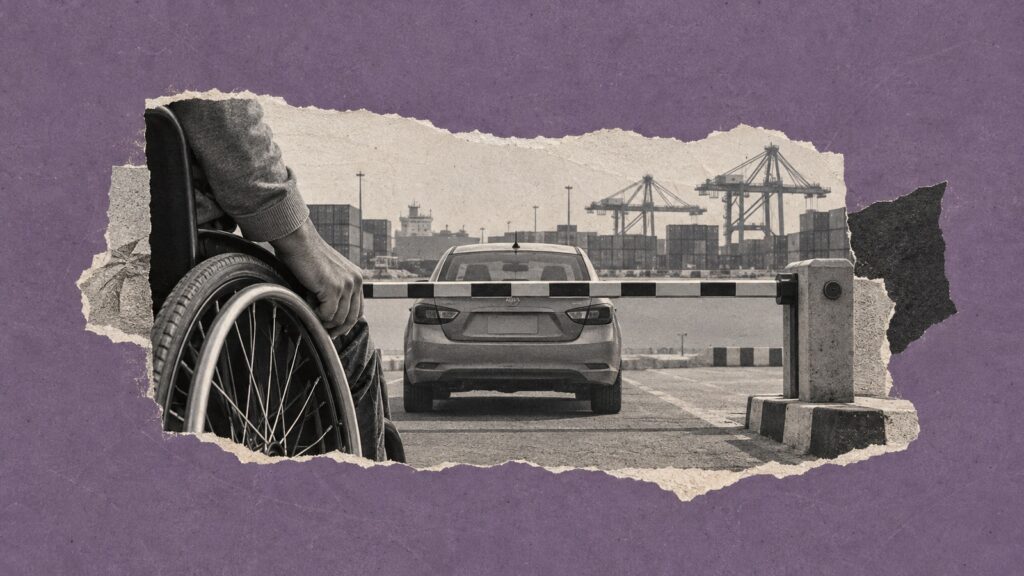

In September 2026, families of people with disabilities renewed their appeals on social media, more than two years after their cars were detained at ports. During the preceding year, customs had released around 9,000 vehicles while retaining thousands more, whose accumulating storage charges have, in some cases, exceeded the price of the cars themselves.
The crisis began in May and June 2024, when the Customs Authority stopped releasing cars imported in the names of people with disabilities. On 24 July 2024, Prime Minister Mostafa Madbouly announced a suspension of imports pending new rules, citing vehicles imported in their names and then sold to ineligible buyers. The rules were issued in October 2024 and releases resumed in January 2025. However, those who did not meet the new requirements, including people who had at some point received Takaful and Karama benefits, saw their vehicles remain at the ports as charges mounted. Two families tell Zawia3 what that means in everyday life, while customs officials, parliamentarians and dealers offer conflicting figures for the remaining vehicles: around 12,000, fewer than 3,000, or ‘tens of thousands’.
A car at Port Said
Zeinab Khalifa, 55, Yara’s mother, tells Zawia3 that she and her husband had to buy a disability-exempt car two years ago so they could transport their daughter around Hurghada, where the family lives. Their old car had begun breaking down, reached the end of its useful life and become a financial burden.
Since Yara became ill at the age of 12, the family had never used her ‘car letter’, the exemption document allowing a person with a disability to import a vehicle free of customs duty. They relied on their old car until someone offered to buy the letter from the couple, precisely the circumvention the government says it is fighting. They refused. They sold their old car and borrowed additional money. Yara’s father paid EGP 550,000, approximately $11,400, for the new vehicle, only to discover that it had been detained in May 2024.
‘After the car was shipped from Korea and arrived at Port Said, we were surprised by the customs detention decision,’ Zeinab says. Since then, the couple have tried every means of securing its release, without success.
Their ordeal did not end with detention. The family was also required to pay storage fees, charged by ports for goods remaining in their yards and described by car owners and parliamentarians as fines. According to Zeinab, these reached around EGP 110,000, approximately $2,280, during 2025, as a condition of collecting the car. The couple travelled to Port Said last year and paid the amount, hoping to receive it. Customs officials nevertheless refused to hand it over because Yara had received Takaful and Karama benefits.
Zeinab says her daughter received those benefits for only two years. The Social Solidarity Ministry stopped them four years ago, before the car was bought, after determining that the family’s income was high. ‘Although that is recorded on their website, they are holding us accountable for benefits that stopped years ago.’ The family has still not received the car despite paying the charge, and a further year and a half of charges has accumulated. ‘We wish we had bought it with full duty paid, rather than being worn down all these years until the car turned into scrap,’ Zeinab says. A ‘free’ car, in this usage, means one imported with all duties paid.
The detention has compounded the family’s transport difficulties. Zeinab explains that the paved road is some distance from their home. Getting Yara and her wheelchair there requires her father to carry her down the stairs from the third floor because there is no lift, while her mother goes to find a taxi. Taxi drivers frequently refuse them because accommodating the wheelchair requires opening the boot and getting out of the car.
The family needs to travel with Yara continually for physiotherapy sessions and medical follow-ups. She cannot go out in Hurghada without transport. With her mother retired and her pension insufficient for her daughter’s needs, taxis add to the costs. Yara has recently stopped attending physiotherapy and now sees the street only at long intervals. ‘My daughter is confined at home. Punish the person who actually did something wrong,’ Zeinab says.
A discontinued benefit holds up a car
Customs’ refusal to release the vehicle because of Takaful benefits is not an individual employee’s interpretation. According to a letter seen by Al Arabiya Business, on 12 January 2025 the Customs Authority’s head issued a decision implementing a meeting chaired by Madbouly on 12 December 2024. It required remaining disability-exempt cars at ports to be re-exported, classified as abandoned goods or auctioned, and applied to recipients of cash support under Takaful and Karama. On 23 February 2025, Sherif al-Kilani, deputy finance minister for tax policy and supervisor of the Customs Authority, halted those procedures. Instructions to Red Sea and Southern Region customs prohibited ‘any procedures, whether re-export, referral to abandoned goods or sale by auction’, without first referring the matter to the authority’s head and then the finance minister. ‘Anyone who violates this shall be referred immediately for investigation.’ The vehicles therefore remained at the ports, neither released, returned nor sold. (Source)
The published letter does not specify whether the decision covers people whose benefits stopped before importation, as in Yara’s case. In the same report, Osama Abul Magd, head of the Egyptian Automobile Dealers Association, said beneficiaries had filed lawsuits arguing that the conditions were not in force when their vehicles were imported and could not be applied retroactively.
From dollar liquidity to ‘abuse’
A month before Madbouly’s announcement, customs had already detained thousands of imported cars. On 26 June 2024, Cairo24 reported cases of vehicles held at ports, including those belonging to Mokhtar Salem and Saad Ahmed Zaki. Iman Karim, general supervisor of the National Council for Persons with Disabilities, commented that the detention was temporary, intended to collect dollar liquidity, and that the cars would subsequently be released. (Source)
The official explanation a month later was different. On 24 July 2024, Madbouly announced a halt to disability-car imports, saying vehicles were imported in beneficiaries’ names but sold to other, ineligible people. He said the aim was to regulate the disability-car system and ensure the cars reached those genuinely entitled to them, without setting a duration for the suspension. Khaled Saad, secretary-general of the Egyptian Automobile Manufacturers Association, estimated to Zawia3 at the time that 90% of these vehicles were driven by beneficiaries’ relatives. Abul Magd put the number detained at ports at around 13,000. (Source 1; Source 2; Source 3)
On 9 October 2024, the Cabinet approved an amendment to Article 75 of the executive regulations of Law No. 10 of 2018 on the Rights of Persons with Disabilities, issued under Prime Ministerial Decision No. 2733 of 2018. The amendment was enacted through Decision No. 3500 of 2024, published on 21 October 2024. To qualify for exemption from customs duty and value-added tax, applicants must hold a disability identification and integrated services card issued by the Social Solidarity Ministry, as well as a medical report containing their details and assessing whether they can drive themselves or require another driver. Applicants must declare that they have not received a customs exemption for a car during the five years preceding the application and that they will not combine this exemption with others provided under different laws. The applicant or a first-degree relative must hold an account at Nasser Social Bank or another bank approved by the Central Bank, opened at least a year before the application, with a deposit no smaller than the vehicle’s price when the exemption is granted. The Real Estate Registration Authority must also refuse to execute powers of attorney to manage a car or individual means of transport registered in the name of a person with a disability. (Source 1; Source 2; Source 3)
The amendment limited imported vehicles to a maximum age of three years, including the year of manufacture, with engine capacity capped at 1,200 cc for petrol, diesel and hybrid cars and 200 kilowatts for electric vehicles. It excluded cars located in free zones. Customs Law provisions apply if a vehicle is seized and its owner with a disability is found to have sold it or handed it to someone not entitled to drive it.
A year of partial releases
After a six-month suspension, on 8 January 2025 the Customs Authority opened a one-month window for submitting release documents. Within a month of applying, the person with a disability had to prove that all or part of the car’s price had been paid at the time of importation from their own account or that of a first-degree relative. The car could be used only by the beneficiary, their insured personal driver, or a first-degree relative if the beneficiary was a minor or unable to drive. Selling or otherwise disposing of it during the statutory restriction period remained prohibited under Customs Law. Abul Magd said at the time that the release fine would not exceed EGP 10,000, approximately $207. (Source 1; Source 2)
That figure did not hold. On 25 December 2025, Al Arabiya Business quoted sources in the Automobile Division saying that customs had gradually released around 9,000 of approximately 13,000 cars, that around 2,800 remained detained at ports after almost two years, and that fines ranged from EGP 150,000 to EGP 700,000, approximately $3,100 to $14,500. Abul Magd said some fines had reached twice the vehicle’s value, prompting importers to file lawsuits to halt sales or auctions. Montasser Zeitoun, a member of the Federation of Chambers of Commerce’s Automobile Division, attributed the crisis to the retroactive application of new conditions. He said the fines resulted from prolonged detention and complicated procedures, rather than beneficiaries’ violations: those who could pay recovered their cars, while those whose fines exceeded the vehicles’ value abandoned them. The outlet also quoted an import-company official saying importers had been told that exemptions would not apply, especially to luxury cars, and given a deadline to regularise their status. Otherwise, the cars would be re-exported at their expense or auctioned. (Source)
Families of people with disabilities thus incurred thousands of pounds each month in port storage charges despite having paid for their cars and completed their paperwork. Appeals continued, alongside parliamentary demands for customs release, while families faced daily difficulties taking their children to medical and educational services amid rising transport costs. (Source 1; Source 2)
Three incompatible figures
On 8 February 2026, the head of the Customs Authority told the House of Representatives’ Planning and Budget Committee, during discussion of the authority’s final accounts for fiscal year 2024/2025, that the number of disability-exempt cars detained was ‘approximately around 12,000’. He did not clarify whether this was the current figure or the cumulative number detained, and promised the committee a comprehensive report. Ahmed Amoui Robin Youssef, a former diplomat, had taken over the authority in March 2025, succeeding al-Shahat Ghatouri. (Source 1; Source 2; Source 3)
At the same meeting, committee deputy chair Mostafa Salem said the government had handled the issue through closure rather than ‘reform, governance and closing loopholes’. He said ‘tens of thousands’ of vehicles were detained at ports, with owners charged storage penalties ‘through no fault of their own’. He demanded a report on the numbers, charges and details of the new law, describing the reduction in engine capacity from 1,600 to 1,200 cc and the extension of the sale ban from five to 15 years as harsh conditions requiring review.
Between 2,800 cars in December 2025, 12,000 in February 2026 and ‘tens of thousands’ in the committee deputy chair’s account, there is no published official figure for the number still at ports as of October 2026.
Bullying on the metro
In September 2026, appeals reappeared on social media demanding the return of vehicles to facilitate everyday journeys to rehabilitation centres, schools and services. They said the suspension had multiplied daily burdens. (Source)
In a video posted on Facebook, the mother of Retaj and Mazen, two children on the autism spectrum, described her difficulties using transport while taking them to the medical councils to complete their paperwork. The family lives in Sadat City, Menoufia. They face persistent bullying on public transport when symptoms of autism suddenly appear, including screaming and intense crying. Passengers address them with deeply hurtful remarks, creating an additional burden she does not know how to confront.
She said this happens throughout the week as she takes her children to medical centres for rehabilitation sessions and weekly exercises, and to school. Her circumstances do not allow her to use taxis regularly. Her difficulties extend beyond ordinary transport: the metro’s extreme crowding causes panic and demands constant vigilance over Retaj for fear of losing her in the crowd. Imagining that situation, she said, ‘crushes my heart’. (Source)
According to her account, the consequences extend beyond difficult journeys to the children’s consultations with specialist doctors. Their experiences on public transport make communication harder and obstruct appropriate care. Retaj cannot answer the doctor’s questions, making it difficult to identify her needs and devise a treatment plan. Between the hardship of the journey and her children’s needs, the mother summed up her demand in an appeal to the president: ‘We want something with four wheels. Let my battle be with autism alone, Mr President. Give us our cars back.’
An inheritance, but no car
Another Mazen, aged 20 and living with an intellectual disability, lives with his mother in Nasr City, Cairo. Her journeys with him extend beyond school: she takes him to clubs for exercise, doctors’ appointments and rehabilitation sessions. When she decided to sell her inheritance to buy a car and ease the transport burden, she hoped to end years of hardship, particularly because she has no one to help care for her son.
She tells Zawia3 that she had raised the purchase price and was ready to buy, but the import suspension, which she says lasted a year, changed her plans. Unable to obtain the car, she had to rely on various forms of transport, sometimes Uber, after becoming exhausted by public transport and the repeated bullying from conductors and passengers.
She says the school journey requires a tuk-tuk followed by a public bus, costing up to EGP 150 a day, approximately $3. That excludes other journeys to dermatologists and for medical tests between Nasr City and Ain Shams, as well as weekly rehabilitation sessions. The hardship is not limited to distance and cost. Her son sometimes experiences episodes of screaming and crying accompanied by intense impulsivity, and cannot tolerate high temperatures while travelling. As she grows older, managing these situations becomes increasingly difficult. Caring for him and transporting him has become more than she can bear.
Manufacturers’ account, dealers’ account
Khaled Saad, secretary-general of the Egyptian Automobile Manufacturers Association, which represents local manufacturing and assembly companies, attributes the continuing crisis and failure to release vehicles to the misuse of customs exemptions to import cars illegally for people without disabilities, taking advantage of the privileges the state grants to people with disabilities.
Speaking to Zawia3, Saad says the authorities identified a large number of cars benefiting ineligible people, without giving a specific figure. He says the state seeks to regulate the system, which led it to tighten import procedures during 2025 and introduce new rules to limit misuse of customs exemptions. As for cars remaining detained despite payment of the required fines, Saad attributes this to their failure to meet the new requirements. He believes they must satisfy the new rules before release.
This account conflicts with that of dealers, who describe conditions applied retroactively to vehicles shipped before the rules were issued. It also conflicts with Yara’s family’s account: they say they met the requirements and paid the fine but have still not received their car.
Two bills in Parliament
On 13 August 2025, the Cabinet approved a bill amending four articles of Law No. 10 of 2018 on the Rights of Persons with Disabilities: Articles 2, 31, 49 and 51. The bill provides for one exempt car every 15 years rather than every five; excludes social security beneficiaries; requires payment from the beneficiary’s account or that of a first-degree relative; prohibits disposal before five years have elapsed from customs release; and requires heirs to pay half the customs duty and value-added tax if the beneficiary dies during the restricted period. It also introduces a new definition of disability covering ‘anyone suffering from a long-term infirmity’. Under Article 49, it raises the penalty for forging a disability identification or integrated services card to imprisonment of up to 10 years and a fine of EGP 10,000 to EGP 100,000, approximately $207 to $2,070. Under Article 51, anyone obtaining an exemption unlawfully faces at least six months’ imprisonment and a fine of EGP 50,000 to EGP 200,000, approximately $1,035 to $4,140. (Source 1; Source 2; Source 3; Source 4)
On 25 August 2025, EIPR criticised the bill in a statement titled ‘A step backwards that would exclude people entitled to government services’. It described a retreat from constitutional and legal commitments to protect disability rights. The rules governing customs and VAT exemptions for cars and individual means of transport, it said, failed to balance facilitating access for people with disabilities and their families against safeguarding the state’s financial rights. It argued that the amendments return to viewing disability ‘solely through the lens of medical incapacity’, contrary to the international Convention on the Rights of Persons with Disabilities, ratified by Egypt in 2008. It said the term ‘infirmity’ has a negative psychological impact and reduces the number eligible for services, that 15 years is too long and replacement should instead be linked to a vehicle’s deterioration, and that the changes threaten these groups’ right to full equality. (Source)
EIPR also said the government ‘did not seek the opinion of the government body with the relevant competence’, the National Council for Persons with Disabilities. In a statement on 17 August 2025, the council described the reported changes as ‘nothing more than a draft amendment to some provisions of the law’, which could not take effect before constitutional and legislative steps were completed. It said it would study the amendments under its mandate in Law No. 11 of 2019. It welcomed tougher penalties for obtaining services unlawfully as a deterrent, while insisting on retaining the law’s term ‘impairment’ rather than ‘infirmity’. (Source)
Ishak Ibrahim, EIPR’s officer responsible for freedom of religion and belief, tells Zawia3 there is a pressing need for disability-exempt cars. He says amendments imposed by the government to prevent ineligible people from exploiting customs exemptions were disproportionate to the problem. Rather than establishing effective controls against abuse, they imposed additional restrictions and complicated access to cars without considering beneficiaries’ needs.
He adds that the government’s measures contradict official rhetoric promoting concern for people with disabilities and efforts to make their lives easier. In practice, they face more difficulties. Facilitating access to cars is neither a luxury nor an additional perk, but a necessity arising from everyday needs, given the hardship of relying on public transport that does not provide accessible travel.
Ibrahim believes the government’s proposed new definition of disability would narrow eligibility for government support and services by excluding people covered under the previous definition, depriving them of benefits intended for them. He criticises extending the car-replacement interval to 15 years from the previous five, arguing that it ignores both disabled people’s needs and vehicles’ deterioration through use. It restricts beneficiaries’ ability to replace cars in line with their needs instead of facilitating access to safe transport. He also criticises excluding social security beneficiaries, whose benefits are small.
‘Does the state see the rights of people with disabilities, or does it see them as a burden on society?’ Ibrahim asks. Treating disability rights as a state handout rather than an entitlement, he argues, is reflected in government decisions. Cases of abuse of car exemptions should not lead to restrictions that prevent eligible people from benefiting, or make obtaining, disposing of and replacing cars more difficult. Abuse must be addressed through safeguards that neither make people with disabilities bear its consequences nor diminish their rights.
The government’s bill was referred to the House of Representatives and discussed by the Social Solidarity Committee, chaired by Randa Mostafa, on 16 February 2026. Deputy chair Ahmed Fathy asked: ‘Do amendments to the disability law serve the public interest and actually reach those entitled to support?’ He said some proposed changes raised questions about their direct effects on eligible groups and required a review that strengthened social protection without harming beneficiaries. Final passage of the bill has not been announced to date. (Source)
In early October 2026, Saeed Reda al-Wasimi, a Congress Party MP and member of the Coordination of Youth Parties and Politicians, joined 60 parliamentarians in submitting a parallel bill to amend Article 31 of Law No. 10 of 2018. It would allow beneficiaries to buy locally assembled cars and adapt them to each person’s needs while receiving the tax and duty exemptions available for disability vehicles. It would also permit Egyptians with disabilities living abroad, or their relatives up to the second degree, to import cars or assistive tools and devices alone under legal rules. It strengthens oversight of exemptions to ensure they reach eligible people and limit abuse. The House referred the proposal to a joint committee drawn from the Social Solidarity, Family and Persons with Disabilities; Planning and Budget; Health Affairs; and Constitutional and Legislative Affairs committees. Al-Wasimi said the proposal ‘aims to support the right of people with disabilities to an adapted car without complications or exploitation’, and that the proposed amendments would provide greater facilitation and expand their benefits. (Source)
Law No. 10 of 2018 on the Rights of Persons with Disabilities requires the state and ministries to provide accessibility, facilitate the movement of people with disabilities and reserve places for them in all means of transport across all classes. (Source)
Between a government bill that has not passed and a parliamentary proposal referred to committees, thousands of cars remain at ports. Their owners paid substantial sums to ease life’s burdens and access services. Yara’s car is stuck in Port Said as its storage charges grow with time. Mazen’s mother has stopped bringing her son to exercise sessions because of what she faces on public transport. She has no other inheritance to sell to buy a car.