
The medical liability law, recently passed by the Egyptian Senate, has sparked a broad wave of debate and controversy, not only in the corridors of the medical professions but also in legal, social and human rights circles, since the law represents a fundamental shift in how cases of medical negligence and errors are handled. While the government describes it as “balanced”, and supporters consider it a qualitative leap towards strengthening transparency and accountability in the health sector, others, especially doctors, see in it a threat to the stability of medical practice, in light of the adoption of a legal provision for imprisoning doctors in cases of medical negligence or errors, which may push them to shy away from taking decisive decisions in dealing with emergency cases for fear of penalties.
The Senate gave final approval to the law on 24 December of last year, 2024, in preparation for referring it to the House of Representatives (the second chamber of parliament) to discuss it and pass it in its final form. The draft consists of 30 articles, the most prominent of which are two articles that sparked wide controversy: Article 27 permitted imprisonment for no less than six months for a doctor in the event of a medical error leading to a patient’s death, while Article 29 gave investigating authorities the power to issue pretrial detention orders against doctors if they commit crimes while providing medical services.
The law also provided for the establishment of the (Supreme Committee for Medical Liability and Patient Protection), which reports to the Prime Minister and is an advisory body concerned with examining medical errors. The committee is tasked with (examining complaints, creating a database, and issuing guidance manuals to raise awareness of patients’ rights in cooperation with the syndicates and relevant bodies). In addition, the draft law includes the establishment of a compulsory insurance system covering medical facilities and service providers working in the medical professions, through the establishment of a government insurance fund. The fund contributes to paying the compensation due for medical errors, as well as possibly covering other damages that may occur during or because of the provision of medical services, even if they are not linked to medical errors.
The government says the law is “balanced”. Taking part in the plenary session the Senate held to discuss the law, Deputy Prime Minister and Minister of Health Khaled Abdel Ghaffar explained that “the philosophy of the law aims to achieve balance and integration between doctor and patient, pointing out that the legislation grants criminal protection to doctors and provides a safe working environment for medical teams, after incidents of assault on doctors recurred”. Likewise, Egypt’s Minister of Parliamentary and Legal Affairs and Political Communication, Mahmoud Fawzi, stated that the new law aims to strengthen mutual trust between doctor and patient and to achieve higher quality in the provision of treatment services, and explained that the legislation includes guarantees for doctors, most notably a precise definition of medical error and the specification of the cases in which the doctor and medical service providers are exempted from liability.
In contrast, the Doctors’ Syndicate broadly objects to the law, and it called for an emergency general assembly, which had been scheduled for tomorrow, Friday, to discuss how to confront it. The head of the Doctors’ Syndicate, Osama Abdel Hay, said in press statements that “the new law does not serve the interests of doctor and patient. Despite the importance of legislation to regulate the relationship between the provider and the recipient of medical services, the current wording does not achieve the purpose of issuing the law”. The head of the Journalists Syndicate, Khaled El-Balshy, also affirmed his solidarity with the demands of the Doctors’ Syndicate, calling for fundamental amendments to the law before it is put to the House of Representatives, so as to ensure a balance between patients’ rights and the protection of doctors.
After the pressure, the House of Representatives’ Health Committee announced the removal of the pretrial detention article from the law, and said the decision came in response to doctors’ demands, while the Doctors’ Syndicate affirmed that it was holding to its demands and renewed its call for the general assembly on Friday. Dr Gamal Omeira, deputy head of the Doctors’ Syndicate, said in television statements that cancelling the pretrial detention article in the draft law on medical liability and patient protection is a response to one of five articles the syndicate had asked to be changed, and added that “the meeting of the House of Representatives’ Health Committee on Tuesday did not discuss fundamental matters”, pointing out that “the draft law still provides for imprisoning doctors for professional errors, which does not exist anywhere in the world”, as he put it.
Commenting on the decision, Mona Mina, former secretary-general of the Doctors’ Syndicate, expresses to Zawia3 her astonishment at the House of Representatives’ Health Committee approving legal amendments and claiming that they came in response to the demands of the Doctors’ Syndicate, noting that “some are cheering these amendments despite the heavy burdens they place on doctors.”
She explains that the amended Article 27 provides for a fine of between EGP 100,000 and EGP 1 million for medical errors that cause actual harm, while the penalty reaches imprisonment for between one and five years and a fine of between EGP 500,000 and EGP 1 million if the error is gross, pointing out that the fine is considered a criminal penalty borne by the doctor personally and is not covered by insurance companies, whose liability is limited to civil compensation.
Mona adds that the legal definitions relating to medical errors remain loose and allow multiple interpretations, which increases the risk of doctors being held criminally liable in the absence of sufficient clarity, noting that Article 23 of the law has not been repealed, as it allows harsher penalties to be imposed where they exist, even though the current penalties are already among the harshest. She stresses the need to review these amendments to avoid tightening the restrictions on doctors amid the challenges they face.
Postponing the general assembly deepens the crisis
The Doctors’ Syndicate issued a statement on Thursday afternoon in which it announced the postponement of the general assembly for a month, with efforts continuing with the House of Representatives to achieve all of the doctors’ just demands, and pending the issuing of the final version of the draft law.
The syndicate said that the House of Representatives’ Health Committee, chaired by Ashraf Hatem, held a meeting yesterday, Wednesday, to discuss the draft medical liability law, attended by the head of the Doctors’ Syndicate, Osama Abdel Hay, and that the committee listened to a thorough explanation of the Doctors’ Syndicate’s demands and its proposed amendments to the draft law.
It added that the Doctors’ Syndicate succeeded in securing the cancellation of the penalty of imprisonment for doctors over professional errors, and of their pretrial detention, as agreement was reached to amend some articles of the draft medical liability law, to cancel the penalty of imprisonment for doctors over professional errors, along with cancelling pretrial detention, and to add a clear definition of medical error and distinguish between it and gross medical error.
The decision provoked anger among a large number of doctors, especially as it came suddenly and without their opinions being sought. A medical source who attended the meetings at the syndicate that preceded the announcement of the decision at midday on Thursday tells Zawia3 that the head of the syndicate and the members of the syndicate council were subjected to great pressure, but he did not explain the nature of the pressure, affirming that until Thursday morning the syndicate council’s decision was to hold the emergency general assembly, and after meetings that lasted more than three hours and saw heated discussions between supporters and opponents, it was decided to cancel the assembly or postpone it, as was announced.
In a swift reaction to the crisis, Dr Ibrahim El-Zayat, secretary-general of the Doctors’ Syndicate council, announced his resignation on his Facebook page, writing: “As I promised you all, if I fail I leave, after our failure to hold an emergency general assembly in the interest of doctors and in their defence.”
For her part, Mona Mina, former secretary-general of the Doctors’ Syndicate, said: “The syndicate, most regrettably, is cancelling the general assembly, happy with a law that provides for penalties higher than the Penal Code that was a source of distress for all of us, five years in prison and an EGP 1 million fine in the case of a lack of caution, and the head of the syndicate welcomes it”. She added: “Gross disregard for the will of doctors… and a severe stab to the profession.” And Dr Khaled Samir, professor of cardiac surgery at Ain Shams University’s Faculty of Medicine and former treasurer of the syndicate, wrote: “The Doctors’ Syndicate council made a mistake in postponing the general assembly, and it has no legal right to do so.”
Five demands of the doctors
During the discussions at the Senate in which the head of the Doctors’ Syndicate, Osama Abdel Hay, and the head of the Dentists Syndicate, Ihab Heikal, took part, the syndicate affirmed that it holds to a set of basic and just demands, among them rejecting the imprisonment of doctors in professional cases, confining criminal liability to acts that violate state laws or to practices outside medical specialisation, and replacing imprisonment with compensation in the case of unintentional errors, stressing that pretrial detention is impermissible in professional cases and that the Supreme Committee for Medical Liability must be the body competent to assess medical errors and rule on them.
The syndicate added, according to a statement, that the draft law in its current form did not respond to its demands regarding the establishment of a compensation fund that bears the full value of compensation without the doctor taking part in its financing, noting the importance of the Supreme Committee for Medical Liability playing a central role in investigation and litigation, so as to ensure neutrality and justice, while providing legal protection for doctors as they practise their profession, in a way that achieves a balance between the rights of patients and those of health service providers.
As Mona Mina says, more than ten years ago the syndicate was the first body to call for the issuing of a medical liability law, with the aim of establishing a scientific and professional method of accountability for any accusation of medical negligence or medical error; it submitted a law earlier, which was ignored, and after that the current (controversial) law was passed. She adds: “We do not deny the existence of medical errors, or of some cases of negligence, a number of which may amount to gross negligence. These things exist, as in any other profession, but the problem lies in the need for a law that distinguishes between the natural complications of any medical intervention, medical errors and gross negligence.”
Ahmed Hussein, a former member of the syndicate council, agrees with her, affirming in his conversation with Zawia3 that Egypt’s doctors do not reject the law outright, and that for years they have been calling for a fair and objective medical liability law. He adds: “Such laws exist in most countries that apply stable, respectable health systems that take patients’ interests into account. These countries have succeeded in achieving a state of satisfaction among patients with their health systems. I always give the example of the UAE and Jordan, as the closest to us in the region, and I see the law applied in the UAE as a good model that could be followed.”
For his part, Osama Hamdy, professor of internal medicine and diabetes at Harvard University, describes the law as “the last nail in the coffin of medicine in Egypt”. Hamdy says in a post on his official page on (Facebook): “After nearly half of Egypt’s doctors have emigrated abroad, most of the rest will certainly emigrate, or refrain from working, if the law is passed that allows doctors to be punished with pretrial detention or prison sentences for professional errors, so that Egypt may perhaps become the first country in the world without doctors! I cannot imagine that the people’s representatives still do not realise what they are heading into with this aberrant law, the only one of its kind in the world, and that with this shameful law they are putting Egypt’s national security on the edge of the abyss. I hope, full of sorrow, that some sensible person will stop this farce and put an end to it!”
Confusing error with crime
Ahmed Hussein says, speaking to us, that “there is a state of incomprehension, or perhaps misunderstanding, among people about the reasons for doctors’ rejection of the proposed law.”
He adds: “Our rejection is not because we oppose the principle of imprisoning doctors outright, as is being presented to people; rather, the purpose of our rejection is to confine imprisonment to acts classified as crimes, such as (female genital mutilation, abortion without medical justification, or a doctor practising a specialty outside his studies and specialisation). What we object to is replacing compensation with imprisonment in the case of unintended medical errors that may be committed by a qualified doctor who practises his work according to his specialisation and in a licensed place, but some error occurs during his work. This is possible in any profession, and it cannot be considered a crime as long as it is not intentional.”
He notes that “the problem with the law submitted by the government is that it equates a qualified doctor who practises his work legally and committed an unintentional error with a doctor who committed a criminal act. This equation is completely unacceptable, because it does not reflect justice.”
In the same context, Mona Mina explains, speaking to us, that medical complications are an integral part of treatment, saying that “any medical intervention, however simple, may result in a proportion of complications or failure. For example, a tonsillectomy may lead to medically known complications, so what about more complex medical interventions? If the doctor followed the correct scientific procedures and did his utmost, he should not be held responsible for the complications; rather, what is required is that he follow up the case and treat these complications in accordance with scientific principles.”
She points out that “medical errors may occur during a medical intervention, since this intervention is human work prone to error. If the doctor commits a medical error without intent or gross negligence, the patient or his family must be compensated; but if the error results from dangerous conduct, such as a doctor working outside the scope of his specialisation, using an unrecognised technique, working under the influence of drugs or alcohol, or performing an operation in an inadequately equipped place, this is considered gross negligence requiring criminal accountability.”
The doctor and syndicate leader affirms that there is a need to define accountability mechanisms: medical errors resulting from minor shortcomings in performance should be met with civil penalties, such as financial compensation and obliging the doctor to take training courses to improve his skills, while gross negligence and unprofessional conduct deserve criminal accountability, as she puts it.
Regarding the draft law the syndicate previously submitted, Mona Mina explains that it includes a clear division between medical complications, minor errors and gross negligence. The draft also provides for the establishment of a committee to determine medical liability, which would be the main body for receiving and examining medical complaints, with the committee made up of representatives of the various medical syndicates and members of civil society. This committee is responsible for determining whether a case represents natural complications, a medical error deserving civil compensation, or gross negligence requiring criminal accountability.
She continues: “The problem with the law currently proposed by the government is that it allows complaints to be filed with multiple bodies, such as the prosecution, the Ministry of Health, or the universities in the case of university hospitals, and this leads to conflicting and duplicated procedures.”
She explains that among the most prominent problems in the new law is that it grants the patient and his relatives the right to file complaints against the doctor with the newly formed committee, under the law, and with the prosecution as well, “which means double accountability, in the sense that the doctor can be held accountable before the committee and the prosecution at the same time, and the doctor is punished according to the penalties set out in the medical liability law or any law that provides for harsher penalties, while the committee’s opinion ultimately remains advisory, and the prosecution or the judge has the right not to adopt it”. She affirms that the syndicate aims to unify the accountability body in order to ensure justice for patients, improve the level of medical competence, and protect doctors from becoming embroiled in criminal cases for unjust reasons.
For its part, the government says the law addresses the difference between error and crime or deliberate negligence. In a statement issued by the Council, the Minister of Parliamentary and Legal Affairs and Political Communication, Counsellor Mahmoud Fawzi, explains that a medical error is a procedure that does not conform to established scientific principles or to the ethics and traditions of the profession and causes harm to the patient, while the doctor’s liability is negated in cases of scientifically known medical complications, or if the doctor followed a method consistent with scientific principles, or if the harm was caused by the patient’s own action or his failure to follow instructions. He pointed out that the draft law aims to achieve a balance between all parties, and that the Supreme Committee for Medical Liability is an additional guarantee for doctors, as the matter has been entrusted to specialists. He explained that there are two routes for filing a complaint, either through the Supreme Committee or by resorting to the Public Prosecution, with the right to appeal the committee’s decisions guaranteed.
The Egyptian Penal Code contains no article directly devoted to “medical error” or “medical negligence” by name. However, general articles of the law are relied upon to cover cases of medical error or negligence, the most important being Articles 244 and 238 of the Penal Code. (Article 244) stipulates that “whoever causes by error the wounding or injury of a person, as a result of his negligence, recklessness, lack of caution or non-observance of laws, decisions, regulations and rules, shall be punished with imprisonment for a period not exceeding one year and a fine not exceeding EGP 200, or one of these two penalties.” And (Article 238) stipulates that “any person who causes by error the death of another person as a result of his negligence, recklessness, lack of caution or non-observance of laws, decisions, regulations and rules shall be punished with imprisonment for a period of no less than six months and a fine not exceeding EGP 200, or one of these two penalties.”
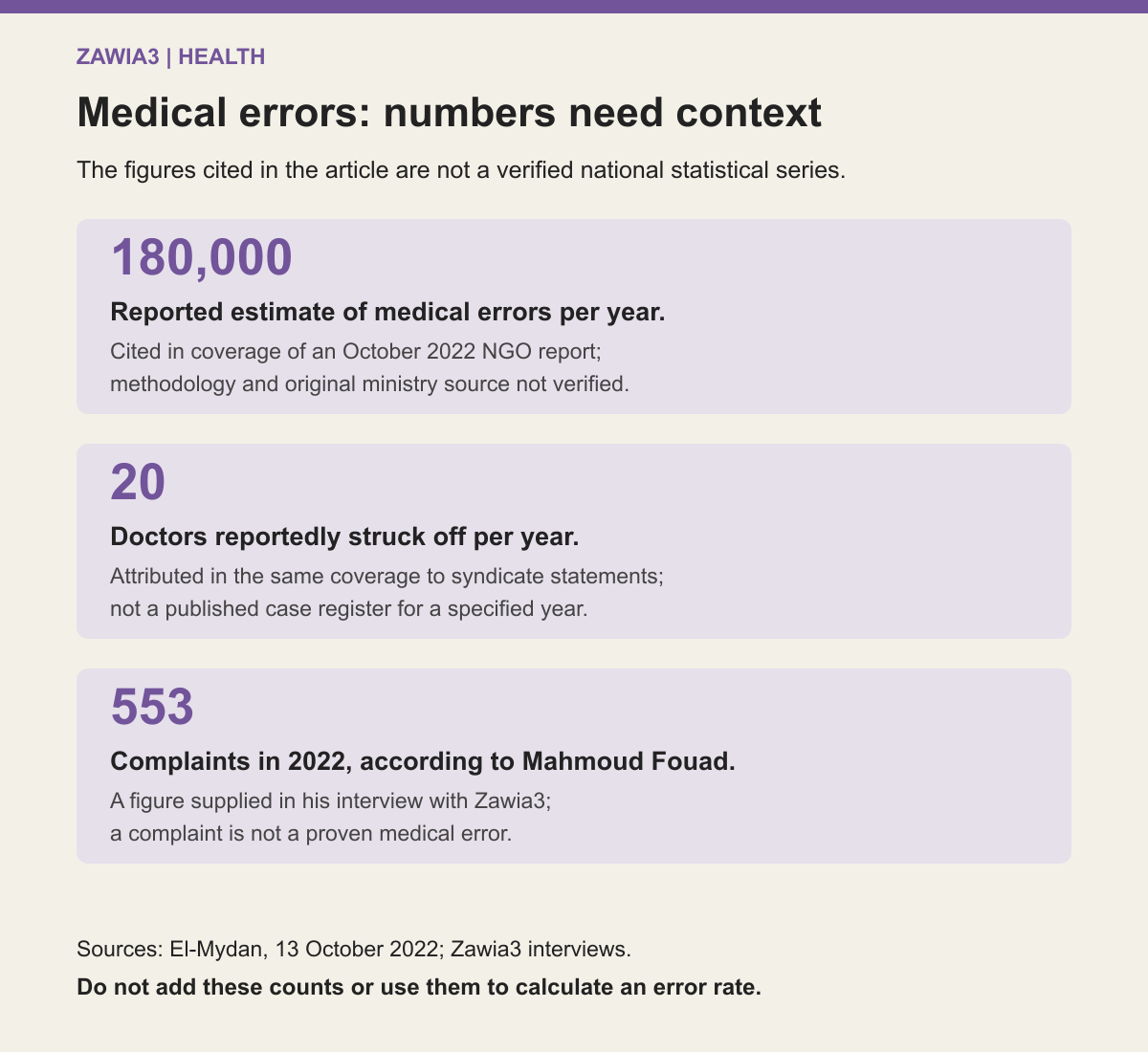
A report issued by the Multaqa El-Hewar Foundation for Development (an Egyptian human rights organisation) in October 2022 indicates that the number of medical errors in Egypt amounts to 180,000 cases a year, and that about 20 doctors are struck off the Doctors’ Syndicate register every year because of medical errors.
Between the rights of doctor and patient
The executive director of the Egyptian Center for the Right to Medicine, Mahmoud Fouad, affirms in a conversation with Zawia3 that there have long been calls to pass a medical liability law, not with the aim of restricting doctors, imprisoning them or even subjecting them to pretrial detention, but with the aim of guaranteeing the rights of both doctor and patient. He explains that with the changes we are witnessing today and the passing of what is already a controversial law, there are new priorities that must be taken into account.
He adds: “The first and most important priority is guaranteeing the rights of the patient, who may become a victim of human errors or of the environment of the hospitals themselves and their equipment. For example, there are many cases in which patients are prepared for surgery according to the waiting list, then the operations are postponed at the last moment because supplies or medicines such as anaesthesia are unavailable, or because doctors are absent. One can refer to the Health Minister’s recent inspection tours, which revealed doctors absent by the hundreds, a clear example of the problem.”
He points out that in 2022 the Administrative Prosecution submitted an official report to the President of the Republic recording 553 complaints against doctors over medical errors. “This figure does not include cases settled through reconciliation, or problems inside private hospitals, which sometimes reach the point of calling the police and ambulance because of medical errors. Some of these errors were serious, the most prominent being the health condition of the brilliant screenwriter Bashir El-Deek, who fell into a coma as a result of a medical error,” as he described it.
He continues: ” The doctor is also a human being, with needs that require large costs, such as postgraduate studies to obtain a master’s or a doctorate, marriage, starting a family, owning a car and so on. Given these needs, is a government salary enough for him? Of course not. So the doctor works in government hospitals to preserve his professional standing, then carries on working in medical centres or private clinics. This system leaves the doctor extremely exhausted, as he works up to about 24 hours a day. Consequently, human errors naturally become likely, and even when negligence occurs, the current law does not distinguish between natural error and gross negligence.”
Ahmed Hussein stresses the importance of providing doctors with the necessary resources so that they can perform their duty as required. He says: “For the doctor to be able to carry out his role as he should, he must have the necessary resources, whether medicines or other medical supplies.”
He adds: “It is also necessary for the doctor to work in humane conditions and for a set period not exceeding eight hours a day. Unfortunately, some doctors currently work 18 and 24 hours inside hospitals without rest and on poor salaries, in addition to the lack of the necessary resources. In light of these difficult conditions, the doctor is asked to deal with emergency and serious cases while he is threatened with prison and punishment should any error occur.”
Does the law protect doctors?
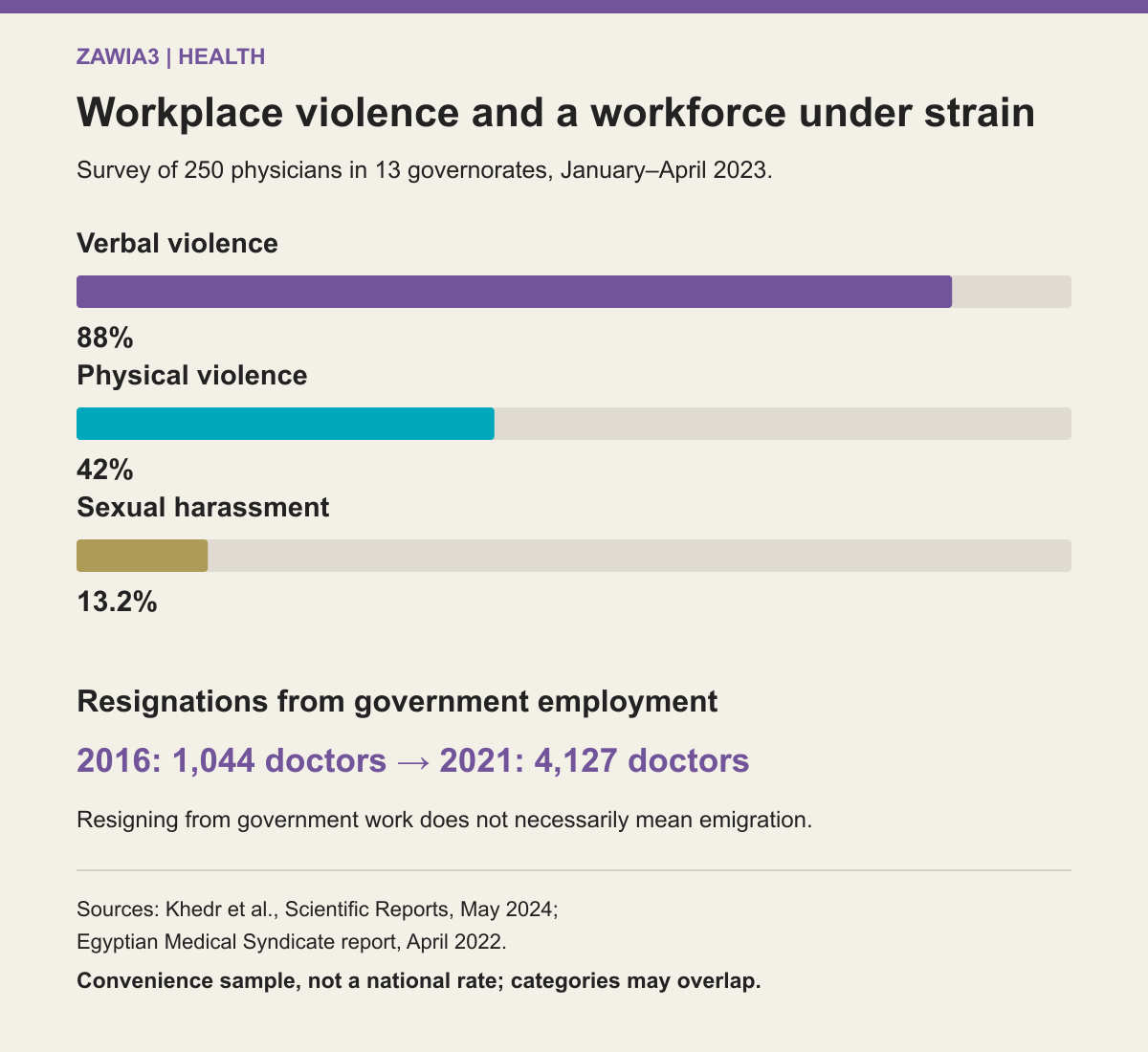
Doctors are also subjected to violence: a study conducted by researchers at Alexandria University revealed high rates of violence against doctors in Egypt, from a forensic medicine perspective. The study, published in the journal “Scientific Reports”, surveyed the opinions of 250 doctors in 13 governorates between January and April 2023 to document their experiences of violence in the workplace. The results showed that 88% of doctors had been subjected to verbal violence, 42% to physical violence and 13.2% to sexual harassment, with 75.2% of the attackers using their bodies, while blunt instruments were used in 29.5% of cases and firearms in 1.9%. The attacks were concentrated in Ministry of Health hospitals and university hospitals, especially during night shifts, because of the shortage of staff and security measures, and the incidents were often due to shortages of medical supplies and long waiting times; nevertheless, only 14.3% of doctors took legal action.
Ahmed Hussein says that “the doctor is punished if he asks the patient to buy some medicines from outside the hospital, while at the same time medicines are not available inside many government hospitals. In such cases, what are doctors to do? The new law offers no solutions or protection for the doctor in these situations.”
He adds: “In the event of assaults on doctors because of a lack of resources or poor conditions, we find that the new law does not provide them with sufficient protection. It is true that there is an article in the law that punishes those who attack medical facilities and obliges them to pay compensation, but it seems to be merely an attempt to make the law look objective; in reality, this article is out of place, because the Code of Criminal Procedure already sets penalties for cases of assault on public facilities.”
He notes: “It cannot be said that all assaults on doctors happen out of thuggery. In most cases, the main reason is the lack of material and human resources, which prevents the doctor from fully performing his role. Sometimes a qualified specialist doctor is not available, and here the word qualified means a doctor with a certain level of competence, not merely a doctor specialised in his field of study. The government must work to provide humane conditions for the doctor so that he can do his work.”
The syndicate leader affirms that “what is required of the government is to adopt a comprehensive health system that guarantees the rights of the health service provider and provides him with the necessary resources, and at the same time ensures that the patient obtains the best possible health care. Even so, there must be clear controls to punish whoever commits a criminal act, and a distinction between this and the unintended medical errors that occur in the course of normal work.”
For his part, Mahmoud Fouad considers that the health system needs a review of the medical education system, especially with universities that accept students with a 70% score and shorten the years of study at the faculty of medicine to five years instead of six, plus the internship year. “Can the competence of a doctor who graduated with 70% be compared with another who obtained 99%? There are experts in the field of medicine warning against these trends, because they threaten the level of doctors’ competence.”
He asks: ” Is the medical environment in government hospitals fit to provide safe health care? Are infection control equipment, essential medical supplies and quality assurance of services available? Have the hospitals obtained the required quality accreditation? Unfortunately, hundreds of government hospitals lack these standards.”
He affirms: “What we want is a fair law that guarantees everyone’s rights: the patient’s right to safe health care, the doctor’s right to work in an environment that guarantees his dignity and safety, and the state’s right to provide an integrated health system. We should not stop at the penalties clause alone, or allow the law to turn into a constant threat to doctors, because that harms the entire health system.”
Egypt faces a major crisis of doctor shortages, as the rate of doctors stands at 8.6 doctors per 10,000 citizens, that is, fewer than one doctor per 500 citizens, while the global rate is about 23 doctors per 10,000 citizens. This shortage raises important questions about how the authorities are dealing with this worsening crisis.
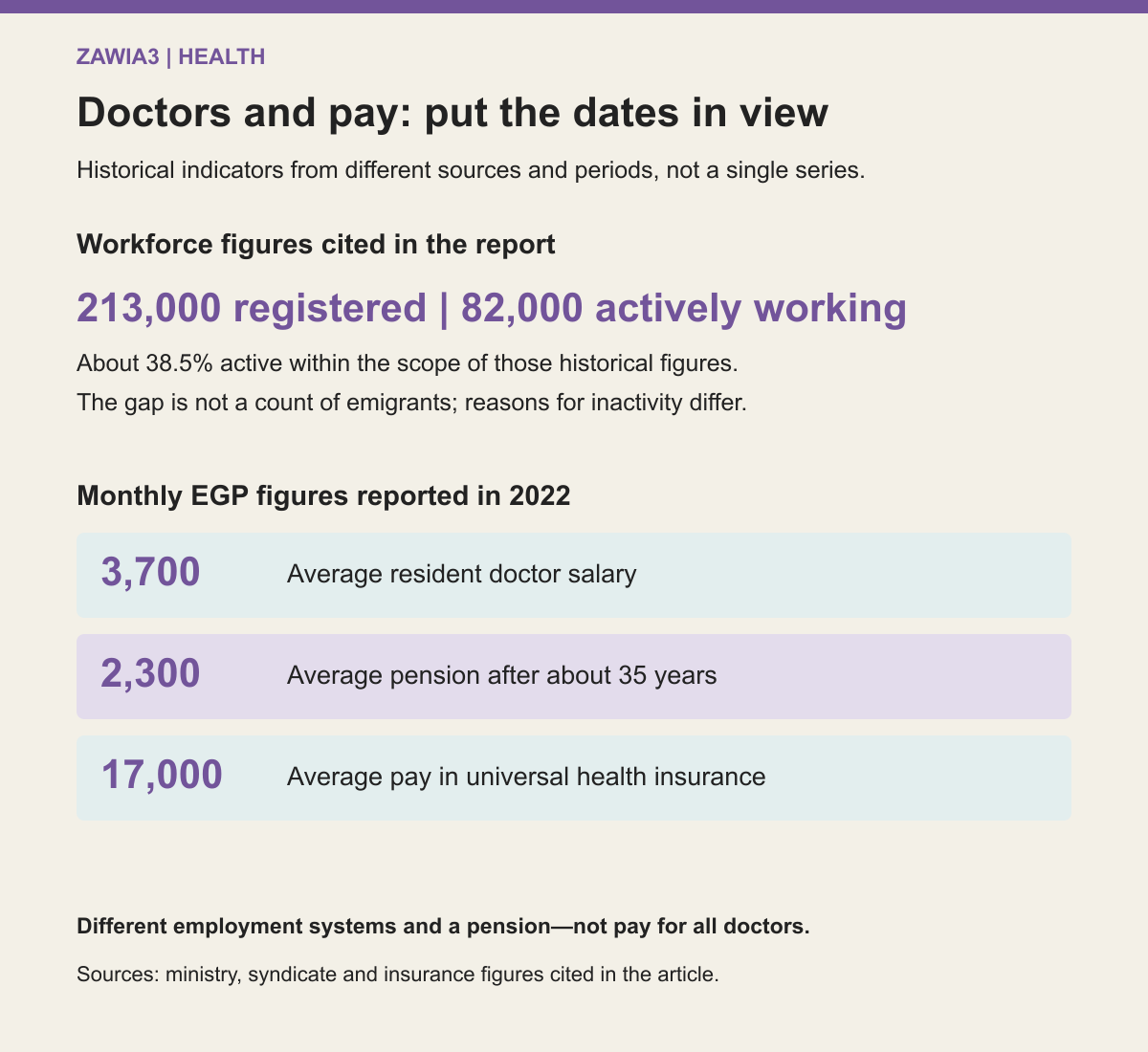
According to Ministry of Health data, about 9,000 doctors graduate every year, but more than 60% of them choose to work outside Egypt. In 2018, a government study warned of a decline in the number of working doctors, showing that of 213,000 doctors licensed to practise the profession, only 82,000 actually work in the various health bodies, representing only 38% of the core workforce. These figures highlight the crisis of doctors emigrating abroad and leaving Egypt’s health system in a state of shortage. The Central Agency for Public Mobilisation and Statistics also reported a decline in the number of doctors to 97,400 in 2022, compared with 100,700 in 2021, a decrease of 3.3%. Meanwhile, Egyptian Doctors’ Syndicate data stated that about 11,536 doctors resigned from government work in just three years, in the period from 2019 until March 2022. According to those data, 2022 saw the resignation of more than 4,300 Egyptian doctors working in government hospitals, the largest number in the past seven years, at a rate of up to 13.5 doctors every day, as the number quadrupled from 1,044 resignations in 2016 to 4,127 resignations in 2021.
According to the Egyptian Doctors’ Syndicate, the average salary of a resident doctor in Egypt in 2022 was about EGP 3,700, and the average pension of a doctor after about 35 years of government work is EGP 2,300, while the Health Insurance Organisation indicated that the average salary of a doctor in the comprehensive health insurance system, which has been applied in some of Egypt’s governorates, reaches EGP 17,000 a month.
In April 2022, the Egyptian Doctors’ Syndicate issued a report entitled “The Doctors’ Syndicate sounds the alarm”, in which it warned of doctors’ continuing reluctance to work in the government sector and their growing efforts to emigrate abroad. But it seems the authorities have not paid attention to the need to put in place laws that strengthen doctors’ ability to practise their profession in Egypt, in a working environment they consider safe economically, in terms of security and psychologically, at a time when the authorities have sought, as described by doctors we spoke to, to impose further restrictions on doctors without regard to their living and professional conditions.
Editorial correction: The first version of the report quoted the text of Article 244 of the Penal Code in its old wording, which punished with imprisonment for a period not exceeding six months or a fine not exceeding EGP 10; in fact, its text in force punishes with imprisonment for a period not exceeding one year and a fine not exceeding EGP 200, or one of these two penalties, according to the text of the article after its amendment.
Editorial correction: The first version of the report stated that the Multaqa El-Hewar Foundation for Development’s report on medical errors was issued in October 2023; in fact, it was issued in October 2022, according to the coverage of it published on 13 October 2022, to which the report refers.
Editorial correction: The first version of the report stated that attackers of doctors used sharp instruments in 29.5% of cases of physical violence; in fact, this percentage relates to blunt instruments, while sharp instruments were used in 7.6% of cases, according to the study published in the journal “Scientific Reports”.