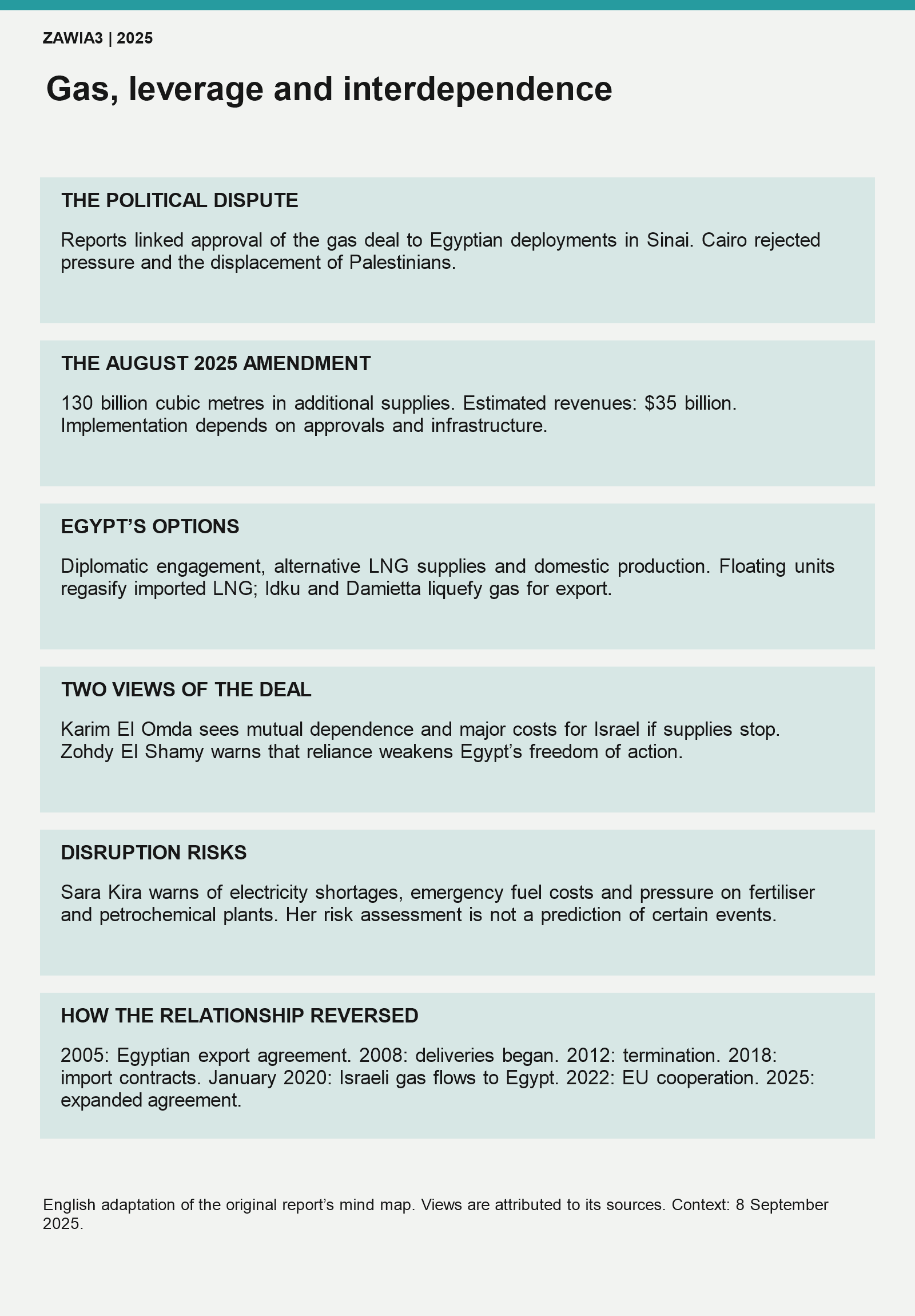


Reports that Benjamin Netanyahu has made implementation of Egypt’s expanded gas agreement conditional on his personal approval have opened another front in the tension between Cairo and Israel. Observers interviewed for this report see an attempt to put pressure on Egypt over its refusal to accept the displacement of Palestinians from Gaza into Sinai.
A report published on 3 September linked the Israeli prime minister’s position to a review of Egyptian military reinforcements in Sinai and allegations of a breach of the peace treaty. The agreement announced a month earlier envisages an additional 130 billion cubic metres of gas, with estimated revenues of $35 billion and a supply period extending to 2040 under its terms.
Cairo rejected the threat. State Information Service chairman Diaa Rashwan said Netanyahu’s position lacked political and economic realism and argued that cancellation would impose a heavy cost on Israel. Egypt also reiterated its opposition to the displacement of Palestinians and said it would not accept pressure on energy, Gaza or border issues.
A diplomatic source and a security source told Zawia3 that Cairo viewed Netanyahu’s remarks primarily as a performance for Israel’s domestic audience. Both described the rejection of Palestinian displacement as a clear Egyptian red line.
The diplomatic source said Egypt would respond to actions rather than statements. In his assessment, alternative energy arrangements and wider regional partnerships gave Cairo room to protect its interests. Both sources described bilateral relations as their most strained in years and said they saw no immediate prospect of restoring normal ambassador-level exchanges. They stressed that diplomacy remained Egypt’s preferred approach, while arguing that other tools remained available to protect national security.
Reports of additional Egyptian tanks and armoured vehicles around Rafah and northeastern Sinai have added to the dispute. Observers interpreted the deployments as a defensive signal against a forced movement of Palestinians across the border, amid Israeli discussion of buffer zones and corridors around Gaza.
One account cited 88 battalions, approximately 42,000 troops, three divisions and more than 1,500 tanks and armoured vehicles, alongside work on airfields, air defences and maritime facilities. These deployment figures have not been independently verified for this report. They cannot, on their own, establish a treaty violation: the treaty’s military annex sets different arrangements for different zones. Its 22,000-troop ceiling applies to Zone A, while Zone B has a separate 4,000-person border-force allowance; mutually agreed activities can also authorise additional deployments.
What does the expanded agreement provide?
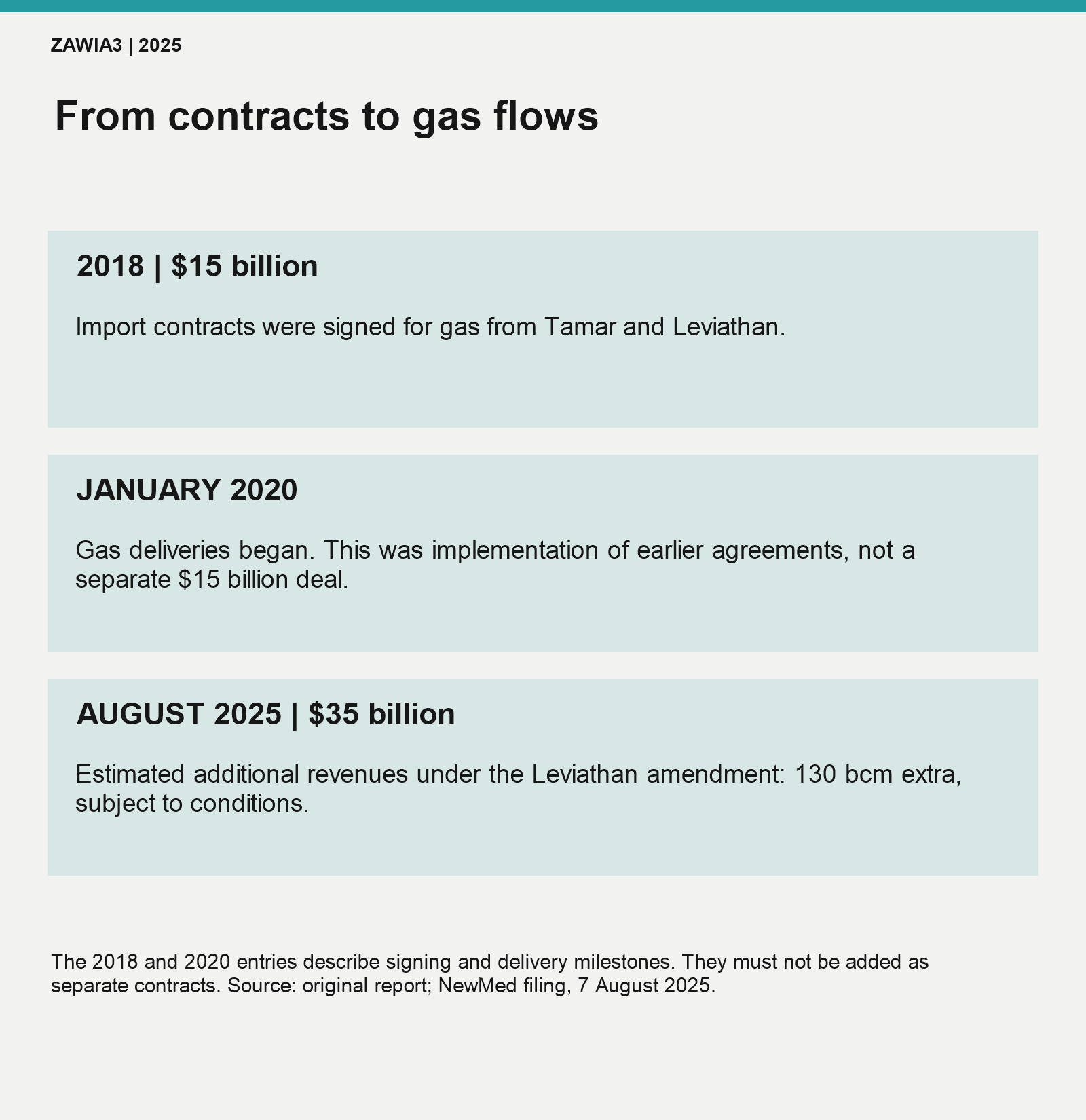
On 7 August 2025, the Leviathan partners announced an amendment to their September 2019 export agreement with Blue Ocean Energy. NewMed Energy’s filing specifies 130 billion cubic metres in additional quantities, divided into increments of approximately 20 billion and 110 billion cubic metres. The larger increment depends on investment and transmission arrangements, and implementation requires regulatory and other approvals.
The amendment adds those volumes to an existing maximum contract quantity of roughly 60 billion cubic metres. The estimated $35 billion represents projected revenues from the additional gas, not an unconditional fixed payment already made. Israeli gas deliveries to Egypt began in January 2020.
Israeli Energy Minister Eli Cohen presented the agreement as significant for security and politics as well as economics, arguing that it would strengthen Israel’s regional energy position, generate revenue and create jobs. The deal therefore raises questions about political leverage as well as commercial interdependence.
Political economy professor Karim El Omda argues that Israel would be the bigger loser if the arrangement were cancelled. He describes it as an expansion of an existing agreement, rather than an entirely separate contract, and points to pipeline connections linking Leviathan to the Egyptian market.
Egypt’s scale and infrastructure make it an important destination, although it is not Israel’s only gas export market: Jordan also receives Israeli supplies. El Omda says Egypt needs imports to bridge the gap between production and consumption, which he expects could persist for two years. He estimates that alternative imported liquefied natural gas could cost $10–15 per million British thermal units.
In his view, the agreement can supply households and factories while any surplus could be liquefied at Idku and Damietta for export. He expects an eventual increase in Egyptian production and connections with Cypriot fields to improve the balance. His suggestion that liquefaction plants could reach full utilisation in 2026 is a forecast made at the time of the interview, not an established outcome.
El Omda also argues that Chevron’s investment creates pressure to keep gas sales flowing. The company holds 39.66% of Leviathan, according to the partners’ August filing. He points to Egypt’s floating storage and regasification capacity and the prospect of a winter surplus as additional flexibility. These vessels turn imported LNG back into gas; they do not liquefy it. His conclusion that commercial interests constrain Israel’s choices remains an assessment, rather than a guarantee against interruption.
How the eastern Mediterranean gas balance changed
The discovery of Zohr in 2015 was hailed as a turning point in Egypt’s energy prospects. Production began in late 2017, and Cairo subsequently promoted its liquefaction plants and export connections as the basis for a regional energy hub. Neighbouring producers, including Israel, could use Egyptian infrastructure to reach overseas buyers.
That promise came under pressure as output weakened and demand grew. By 2023, declining production at major fields, slower development and rising needs from a growing population and energy-intensive industries were reshaping the balance. Israel, meanwhile, expanded development of Leviathan and Tamar.
The 2018 import contracts involving Dolphinus and the Israeli field partners helped lay the commercial foundations for the reversal in trade. Physical imports began in January 2020. Although the arrangement was promoted in terms of liquefaction and re-export, imported gas also supported domestic supply.
The resulting dependence complicates Egypt’s position. A country that once exported gas to Israel increasingly needs Israeli supplies to meet its own requirements. Commercial relations have become entwined with regional power and security calculations.
Trade figures cited in Zawia3’s earlier reporting put Israeli exports in the petroleum-gas category to Egypt at $2.13 billion in 2023, about 95% of Israel’s goods exports to the country. Meanwhile, Egyptian gas production fell from 35.5 billion cubic metres in January–July 2023 to 30.19 billion in the same months of 2024, a decline of approximately 15%.
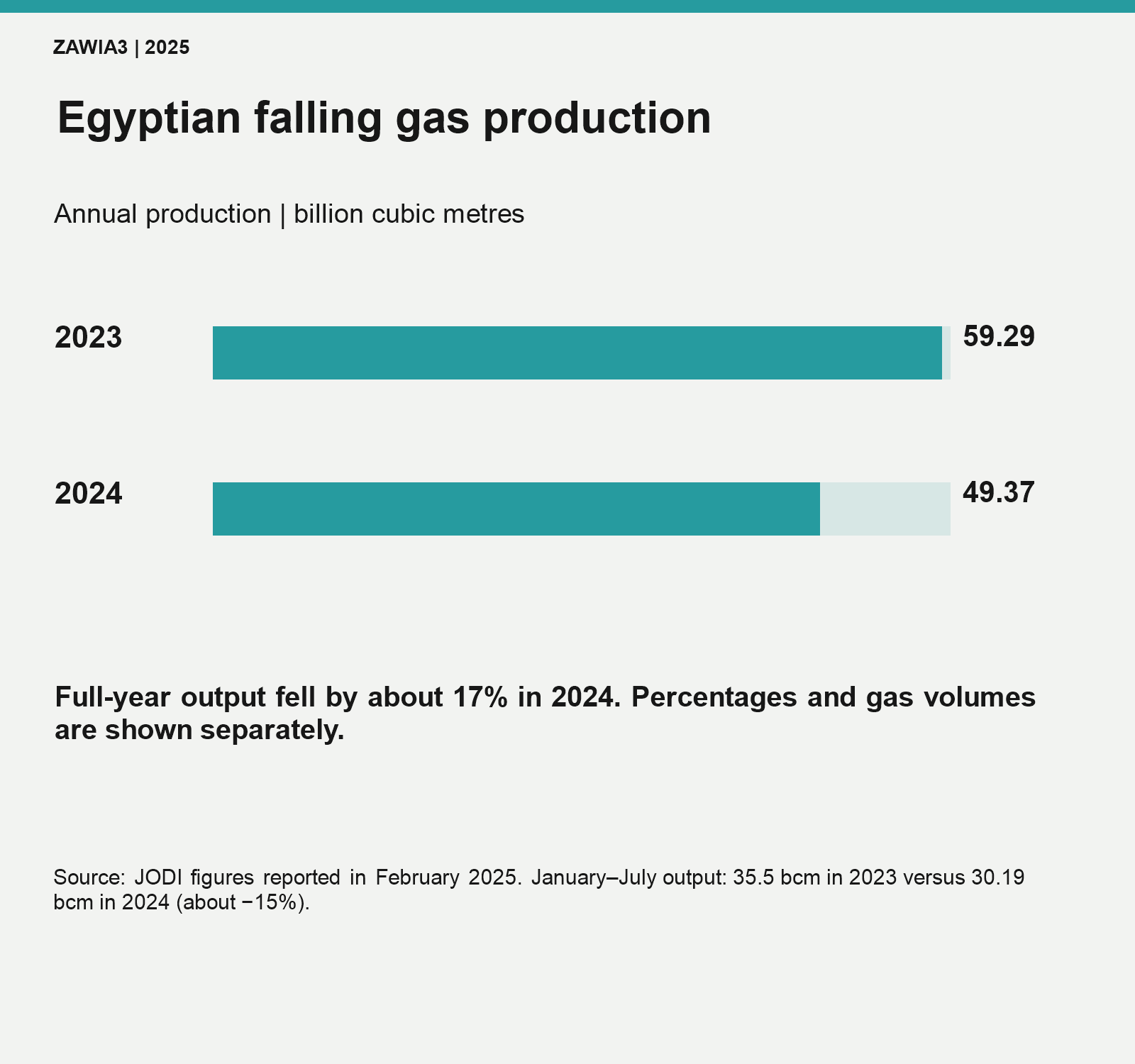
Full-year figures reported in February 2025 show output of 49.37 billion cubic metres in 2024, compared with 59.29 billion in 2023, a fall of about 17%. Different daily estimates cited in contemporary reporting reflect different periods: production of roughly 4.6–5 billion cubic feet was set against domestic requirements of around 6.2–6.8 billion. They should not be treated as a single simultaneous measurement.
The original reporting also described lower Mediterranean production and a return to net LNG imports, with 2.8 million tonnes imported in 2024 and exports down to about 0.54 million tonnes. The central trend is the widening supply gap, increased spending on imports and diminished ability to export surplus gas.
Declining domestic output has left electricity generation and energy-intensive industries more exposed to imported fuel. A commercial supply arrangement can therefore become a strategic vulnerability when deliveries are interrupted.
Development delays cannot be illustrated by treating Raven as a field that had yet to start producing: its initial production began in April 2021, as its partners announced at the time. Subsequent development phases are distinct from that original start-up.
Earlier forecasts cited in the Arabic report anticipated higher Israeli deliveries by January 2025 and continued reliance through 2027. Those were projections from their respective publication dates, rather than new forecasts made in September 2025. The recurrent electricity shortages underline why Cairo has sought to secure both pipeline gas and LNG cargoes.
How far can gas become a pressure tool?
Sara Kira, director of the European North African Center for Research, tells Zawia3 that the relationship began through company-level commercial contracts. She distinguishes those contracts from a direct political commitment, while acknowledging the strategic environment in which they operate.
She argues that the East Mediterranean Gas Forum provides a framework for coordination and can help manage competition over discoveries and export routes. The forum is a cooperation body, however, not the owner or administrator of all regional fields and contracts. Rights to amend or terminate a contract depend on its terms and applicable law, not simply on forum membership.
Kira sees Egypt’s liquefaction infrastructure as a source of bargaining power. Israeli gas can be imported into Egypt for domestic consumption or, where a surplus exists, liquefied for export. She believes a prolonged interruption would also hurt Israel because its export infrastructure limits its options.
She refers to alternative supply arrangements, including Qatar and, she says, Iran. The claimed Iranian arrangements were not officially documented in the material available for this report and should not be read as a confirmed source of Egyptian supplies.
The June 2025 interruption during the conflict with Iran illustrates the exposure. Israel shut production at Leviathan and Karish on security grounds, disrupting exports to Egypt and Jordan. Kira says domestic Israeli demand takes priority, leaving Egypt vulnerable even under long-term commercial arrangements.
Kira warns that interruptions can affect electricity supply, force expensive emergency fuel purchases and put pressure on fertiliser and petrochemical production. The cost extends beyond the gas bill to foreign-currency needs and industrial stability.
She estimates that Egypt’s 2025 LNG purchases involved roughly 60 cargoes costing around $3 billion, alongside fuel-oil purchases. Those are the figures she gave in the interview, rather than a verified full-year total. Falling LNG exports also weaken Egypt’s energy-hub ambitions. Idku and Damietta remain liquefaction facilities; increased LNG imports use regasification infrastructure and do not mean that the export plants have themselves been converted into import terminals.
In Kira’s assessment, permanently ending long-term contracts would be costly for Israel economically and diplomatically and could raise financing and insurance costs for its gas projects. She considers repeated short disruptions a more plausible pressure tactic than permanent cancellation. She argues that careful contract management, diversified supplies and regional coordination can reduce Egypt’s exposure, though none removes the risk entirely.
Does reliance constrain Egypt’s choices?
Economist Zohdy El Shamy, chair of the Socialist Popular Alliance Party’s board of trustees, offers a sharply different assessment. In an earlier interview with Zawia3, he called the expanded agreement a “new strategic disaster” that would constrain Egypt’s energy decisions for years.
He argues that Egypt should have learned from previous import agreements, initially valued at $15 billion and subsequently expanded, and invested more in developing its own fields. He also raised suspicions about the ownership of offshore resources. Those suspicions were not supported in this report by evidence establishing Egyptian ownership: geographical proximity alone does not determine maritime or resource rights.
El Shamy says reliance on Israeli supplies makes it harder for Egypt to take firm positions during regional confrontations. In his view, expanding that reliance to a larger agreement running to 2040 gives Israel additional political and economic leverage.
“Why tie our energy needs to a single source in a country occupying Arab land and fighting a continuing war on our borders?” El Shamy asks. “What logic makes us increase dependence instead of looking for alternatives?”
He describes the arrangement as a reshaping of the balance of power that makes Israel an unavoidable partner in Egypt’s energy equation. He calls the policy a grave mistake against national security, warning that Egyptians could bear its consequences for decades. These are his political and economic judgments, rather than findings about a legal offence.
Two decades of gas agreements
The direction of trade has reversed since the 2005 Egyptian export agreement. Deliveries through the Arish–Ashkelon pipeline began in 2008. Pricing and transparency prompted public controversy and legal challenges in Egypt, while repeated pipeline attacks after the 2011 revolution disrupted supplies.
The Egyptian side terminated the export arrangement in 2012 amid contractual and payment disputes and deteriorating security. The 2018 import agreements involving Tamar, Leviathan and Dolphinus then marked the commercial reversal. Deliveries to Egypt began in January 2020, following amendments to the arrangements in 2019.
Egypt, Israel and the European Union signed a cooperation memorandum in 2022 envisaging supplies to Europe through Egyptian liquefaction infrastructure. The August 2025 amendment further expands the prospective scale of the Leviathan relationship, subject to its implementation conditions.
Egypt’s rejection of Palestinian displacement remains central to the political dispute. Whether the gas relationship strengthens mutual dependence or gives Israel an additional pressure tool is the question dividing the sources interviewed here. The answer depends not only on contract volumes but also on alternative supplies, infrastructure and Cairo’s ability to reduce the gap between domestic production and demand.