Egyptian construction companies are changing the balance of their business, pursuing more work abroad while becoming more selective at home. On 26 March 2025, Orascom Construction chief executive Osama Bishai said the company aimed to reduce Egypt’s share of its overall activity to one-third by 2026 as it expanded regionally and internationally.
Bishai said Orascom preferred Egyptian projects with at least some foreign-currency financing, reducing its exposure to domestic market volatility. Collecting payments from government clients remained a challenge, he said, although the situation had improved in the first quarter of 2025 following efforts to settle arrears.
It was not the first indication of a shift. In November 2024, Bishai said Egypt accounted for 64% of the company’s ongoing work, compared with 14% in other Arab countries and 22% in the United States. At that stage, the plan was to lower Egypt’s share to 50% by the end of 2025 and increase the Arab region’s share to more than 20%.
Orascom is one of the largest names in Egypt’s construction industry. Its roots lie in a contracting business founded by Onsi Sawiris in the 1950s and nationalised in 1961, before he established Orascom in 1976. The Sawiris family and associated holdings accounted for around 54.86% of the company’s shares, divided between Nassef Sawiris and related entities at 42.36%, and Samih Sawiris, family members and related entities at 12.5%.
The company works in infrastructure, industrial and commercial construction, and renewable energy, including major Egyptian projects. Its activities include civil and electrical work for wind-power generation near Ras Ghareb on the Red Sea.
Egyptian contractors look abroad
The shift extends beyond Orascom. Hassan Allam has announced plans to expand its business in Saudi Arabia, the United Arab Emirates, Oman, Libya and Iraq, with contracts worth more than US$2.5 billion.
Arab Contractors has announced two bridge projects in the Libyan cities of Derna and Sousse. Samcrete Egypt is preparing to enter Saudi Arabia for the first time while expanding its African investments towards US$2 billion. Concrete Plus plans five Saudi projects worth close to SAR 2 billion, alongside a commercial project in Oman valued at US$30–40 million.
These are companies’ announced plans and contract figures, rather than a claim that all the projects or investments had already been completed.
At the same time, new alliances continue to target Egypt. An Oragani Group-led consortium, bringing together Sons of Sinai and EGE Group’s INCOME with China State Construction Engineering Corporation, has announced plans for infrastructure and construction work inside and outside Egypt. It targets an initial US$500 million of business in its first year, rising to US$5 billion within three years.
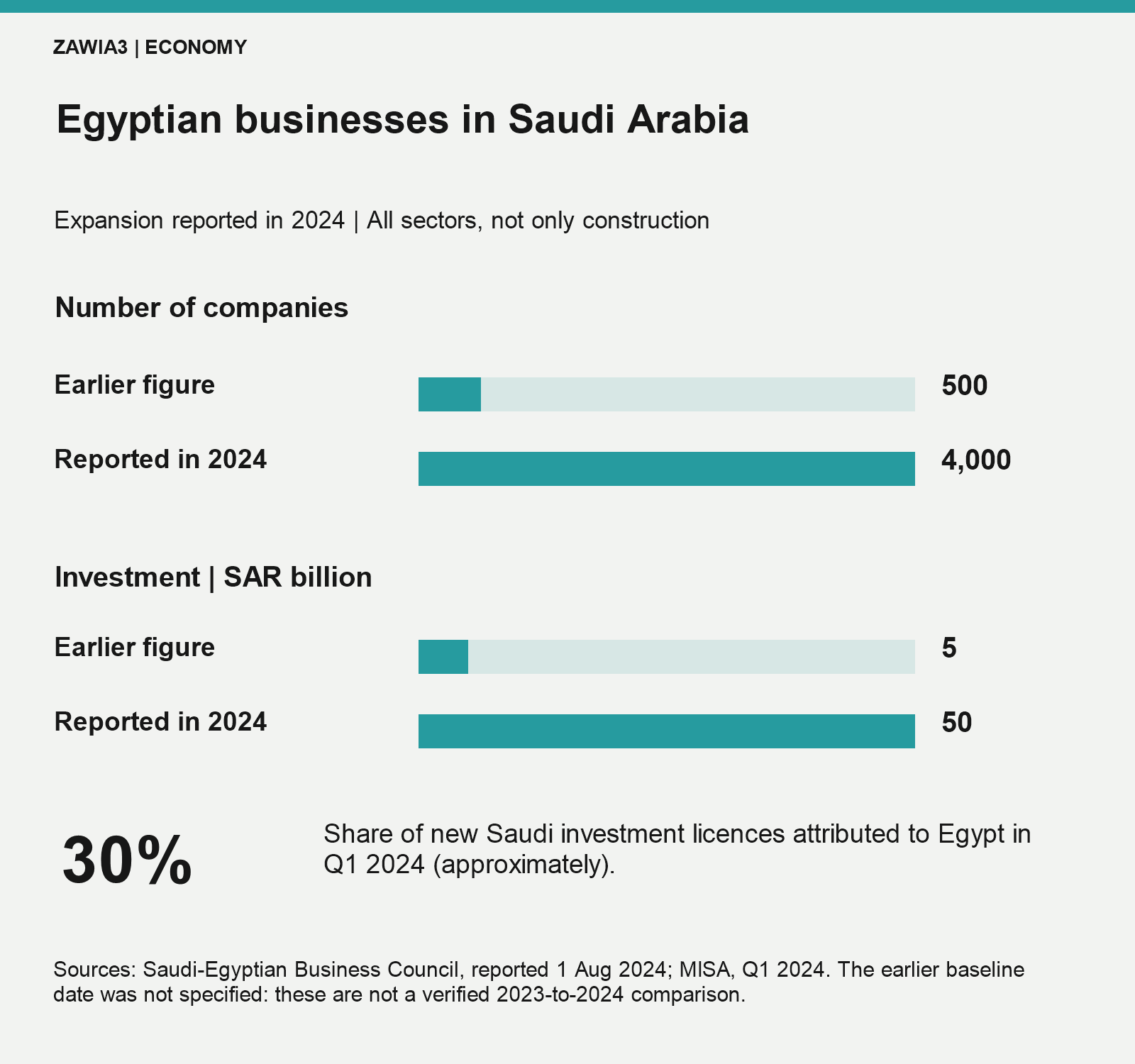
Figures released in 2024 show a broader Egyptian business presence in Gulf markets, across sectors rather than construction alone. In remarks reported on 1 August 2024, Saudi-Egyptian Business Council chair Bandar Al Amiri said the number of Egyptian companies operating in Saudi Arabia had risen from 500 to 4,000 and investment from SAR 5 billion to SAR 50 billion. The published remarks did not specify the date of the earlier baseline.
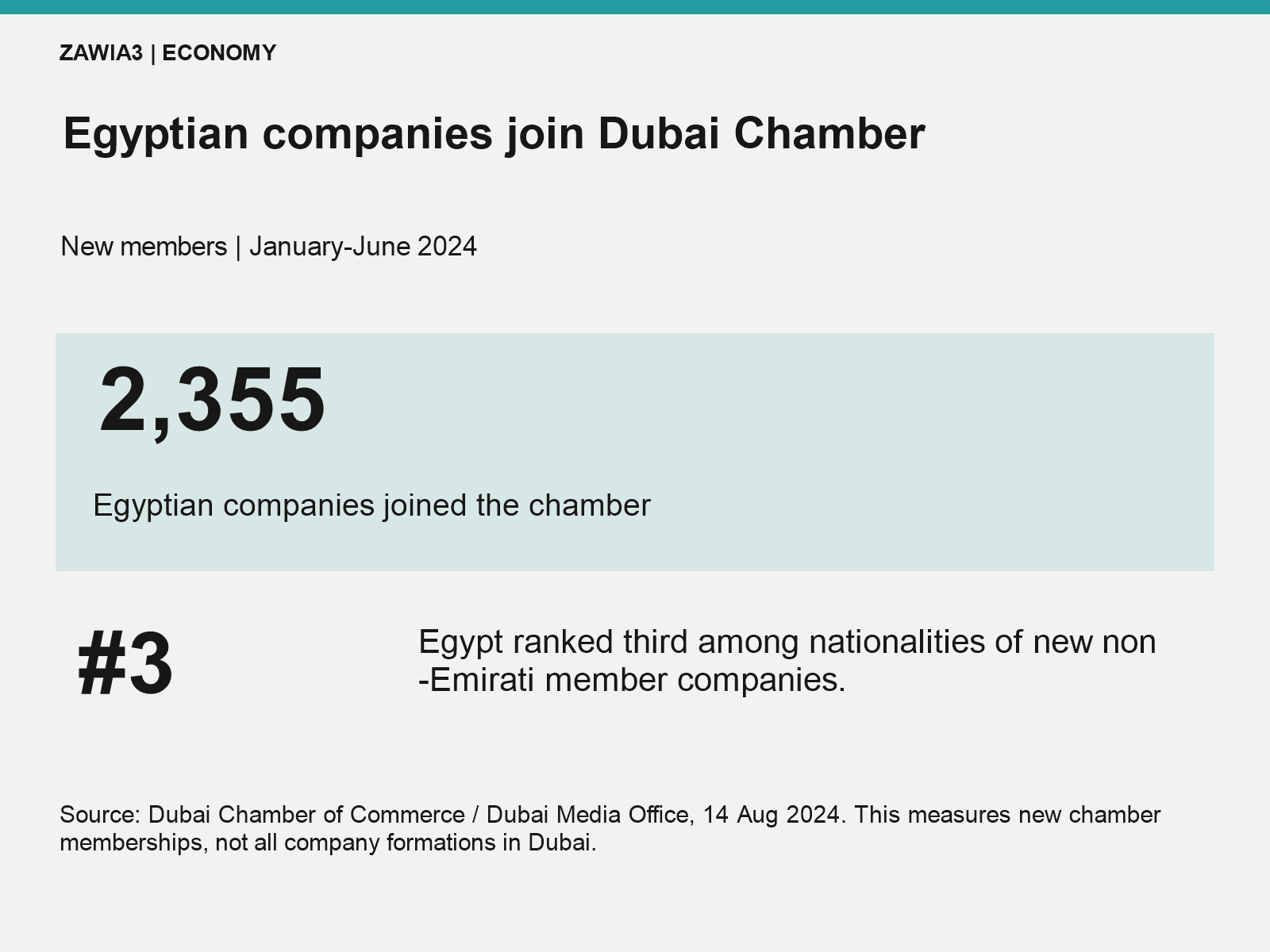
Egypt accounted for approximately 30% of new Saudi investment licences in the first quarter of 2024. In Dubai, 2,355 Egyptian companies joined the Chamber of Commerce in the first half of 2024, placing Egypt third among the nationalities of new non-Emirati member companies. The Dubai measure concerns chamber membership, not every business incorporated in the emirate.
Payment delays and the pressure on cash flow
Akram Ismail, a figure in the Civil Democratic Movement and the Bread and Freedom Party, which is under establishment, links the outward push to difficult domestic working conditions. He says payment arrangements on many projects, particularly those assigned through the Armed Forces Engineering Authority, place severe strain on contractors.
Rather than being paid in full when a project is finished, contractors may see outstanding amounts partly rolled into payments associated with later projects, Ismail tells Zawia3. In his account, companies must take on new work to recover money owed for earlier work, creating continuing liquidity pressure.
For contractors struggling to collect old invoices, taking on another project can become a condition of survival rather than a freely chosen expansion strategy.
Exchange-rate changes add another layer of risk. Ismail says firms can be left absorbing increases in raw-material costs without adequate compensation, threatening their financial stability and the quality of delivery.
Mohamed Sami Saad, chair of the Egyptian Federation for Construction and Building Contractors, has also warned about liquidity shortages and delayed payments. In remarks discussing the sector’s position entering 2024, he said companies that recovered their receivables would be better placed to win new projects, while those without liquidity risked gradually leaving the market.
Saad cited expectations of a contraction in construction activity of as much as 20%, attributing the pressure to inflation, higher building-material costs and delayed government payments. That forecast belongs to the earlier remarks cited here; it should not be mistaken for a measured outcome or automatically treated as a new 2025 projection.
He called for new projects to be linked to realistic financing schedules consistent with delivery timetables. If contractors became reluctant to bid, he warned, the consequences would extend to the government’s infrastructure and development plans.
International growth or domestic retreat?
Other economists caution against treating expansion overseas as evidence of an exodus from Egypt. They see it as a familiar strategy for growth, risk management and diversifying revenue.
Mohamed Ramadan, an economic researcher at the Egyptian Initiative for Personal Rights, says claims of a collective withdrawal by Egyptian contractors are exaggerated. Regional and international expansion by some firms is a normal feature of business development, he tells Zawia3.
Operating in several markets can help companies balance demand, absorb shocks and generate cash from different sources. Ramadan says there is not yet clear evidence that overseas expansion itself has eroded domestic construction activity. He warns against loading individual business decisions with more significance than the available evidence supports.
Political-economy professor Karim El Omda similarly views international expansion as a normal strategy for large companies. A declining domestic share of a firm’s business does not necessarily mean its Egyptian operations are shrinking in absolute terms; overseas activity may simply be growing more quickly.
El Omda tells Zawia3 that regional markets offer attractive opportunities through faster procedures, financing and demand for infrastructure across Arab and African countries. At home, construction activity is closely tied to government policy and the pace of major public projects.
He links the changing balance to efforts to curb state-led investment under the IMF-supported programme and create more room for private activity. Differences in demand and funding between markets therefore help explain why contractors may allocate a greater share of their resources abroad.
A smaller Egyptian share of a company’s portfolio is not, on its own, proof of an absolute retreat from Egypt. The distinction between proportions and actual activity matters.
El Omda also sees potential benefits for both firms and the wider economy: overseas contracts can improve profitability, sustain businesses and generate foreign-currency income. On that reading, international work complements rather than replaces domestic activity.
The government had already announced measures to rationalise spending on major projects in response to foreign-currency shortages. Prime Minister Mostafa Madbouly said projects that had not yet begun would be postponed as part of efforts to reduce financial pressure and impose greater budget discipline.
The emerging picture is therefore mixed. Payment delays, currency risk and changing public investment priorities make the domestic market more difficult for some contractors. At the same time, international opportunities allow established firms to diversify. Distinguishing forced retreat from strategic expansion requires looking at actual contracts, payments and activity, rather than a company’s geographical percentages alone.
Data clarification: The Arabic and English graphics distinguish the Saudi figures reported in 2024 from an unspecified earlier baseline, and identify the Dubai figures as new chamber memberships. All underlying data precede this report’s April 2025 publication.