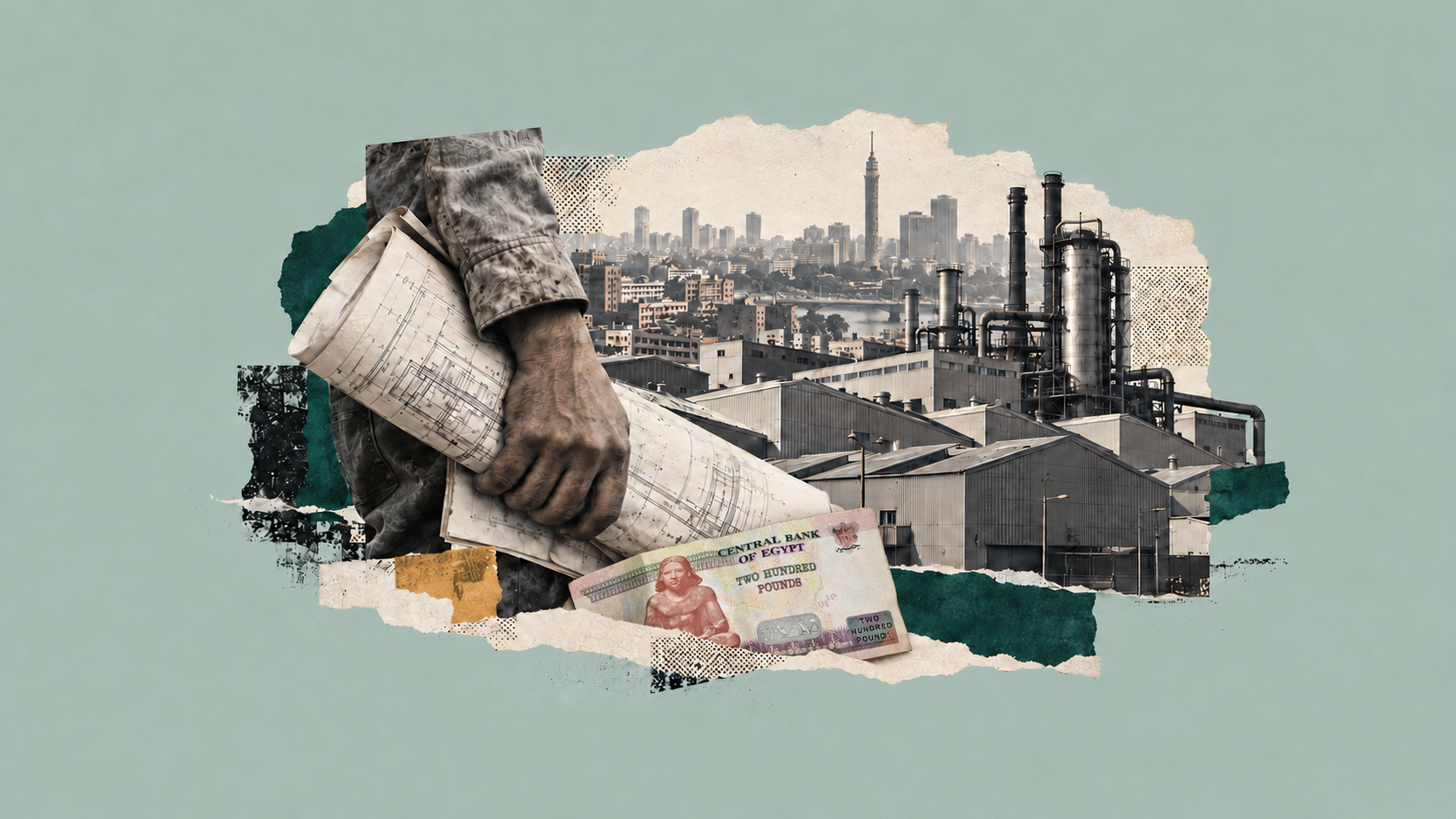


The global agency “Standard & Poor’s” lowered the outlook on Egypt’s credit rating from “positive” to “stable”, amid mounting pressures resulting from rising external and domestic financing requirements. The agency explained that the worsening of financing needs, whether on the external or the domestic level, increases the Egyptian economy’s exposure to the risks of the volatility that global financial markets are currently witnessing. Nevertheless, the agency kept Egypt’s long-term credit rating at “B-” and its short-term rating at “B”, unchanged.
The institution pointed out that raising interest rates to 27.25%, together with the liberalisation of the exchange rate, led to an increase in the yields on local treasury bonds and bond auctions, and to a rise in the costs of servicing government debt, which were already high, especially on domestic debt, which is mostly issued with short maturities.
In the same context, the “Fitch” agency affirmed Egypt’s long-term foreign-currency credit rating (IDR) at “B” with a stable outlook. The agency attributed its decision to the balance between the strengths and weaknesses of the Egyptian economy, as it points to an improvement in foreign currency indicators on the one hand, against an increase in domestic debt risks and its rising cost on the other.
Meanwhile, “Standard & Poor’s” pointed in its report to the Egyptian authorities’ commitment to maintaining a flexible exchange rate and to implementing the economic policies agreed within the International Monetary Fund programme, which supports growth prospects and fiscal consolidation during the fiscal years 2025 to 2028, despite global challenges, among them customs tariffs and financial volatility.
The agency expected the Egyptian economy to see a gradual recovery starting from fiscal year 2025, but at a lower rate than previous estimates, recording average growth of 4.1% during the period from 2025 to 2028. It pointed out that growing confidence in the economy as a result of the liberalisation of the exchange rate contributes to boosting growth, supported by domestic demand, construction and tourism, along with the information technology, trade, agriculture and healthcare sectors.
The agency lowered its growth forecast, estimating it at 3.5% in the current fiscal year, rising to 4% next year, then to 4.3% and 4.6% in the following two years respectively.
As for “Fitch”, it expected the real gross domestic product growth rate to accelerate to 4% in the current fiscal year, after recording 2.4% in 2024, supported by improved economic confidence. It considered it likely that growth would reach 4.7% in 2026, driven by improving real incomes, although it would remain slightly below the potential growth rate.
The agency affirmed the Egyptian government’s commitment to the International Monetary Fund programme, which aims to restore macroeconomic and fiscal balance, but it considered that the pace of structural reforms aimed at boosting competitiveness remains limited, which may keep some existing risks in place.
Although global rating agencies rely on numerical indicators in assessing the performance of economies, these assessments often overlook the direct social impact of the policies associated with them, especially in countries such as Egypt, where decisions linked to rating downgrades translate into more pressure on the poorest groups. In contrast to the stability of financing indicators, the middle and lower classes continue to face mounting burdens in the form of rising interest rates, increasing living costs and shrinking employment opportunities. Independent economic experts believe that the excessive focus on foreign investment indicators, without paying sufficient attention to the impact of policies on citizens, reproduces the crisis of trust between the state and society.
A number of local investors point out that the problem relates not only to the state’s ability to pay its obligations, but to the absence of a stable, long-term regulatory vision. Economic decisions are often taken as a reaction to crises, without a clear institutional framework that reassures the local investor before the foreign one. And in an unstable environment, even the best ratings do not guarantee a sustainable flow of capital.

On the Rating and Its Importance for Investors
According to “Fitch”, the “B” rating falls within the high-risk investment category, meaning that the state is currently able to meet its financial obligations but is exposed to economic or political risks that could affect this ability. The agency does not expect the rating to change in the near future unless radical shifts occur.
As for the “B-” rating at “Standard & Poor’s”, it indicates higher risks of non-payment, amid continuing economic pressures. The lowering of the outlook from “positive” to “stable” reflects the state of uncertainty over the pace of reforms and the extent of the stability of the foreign exchange market.
Mohamed Ramadan, a researcher on economic affairs at the Egyptian Initiative for Personal Rights, believes that credit rating reports are among the essential tools on which foreign investors rely, especially those interested in investing in domestic debt instruments.
Speaking to “Zawia3”, Ramadan explains that these ratings provide a comprehensive picture of the state’s economic situation and the extent of its ability to meet its financial obligations, especially paying periodic payments in dollars and servicing debts.
He adds that rating agencies rely on a set of economic and financial factors, with each factor given an assessment graded (A/B/C) according to each agency’s criteria, and the final rating is derived on the basis of a weighted average of these factors.
He points out that the signs added to the rating, such as the (+) or (−) mark, reflect the outlook: if it is positive, this indicates the possibility of the rating improving in the future, whereas if it is negative, it often reflects the absence of certainty about the state’s ability to pay, especially amid global economic pressures and rising interest rates.
Economic researchers believe that the paradox in the Egyptian situation lies in the fact that most of the reforms that rating agencies reward, such as floating the pound and raising interest rates, multiply the debt crisis rather than solving it, as they increase the cost of domestic borrowing and entrench the state’s dependence on short-term debt instruments, which keeps the economy in a vortex of borrowing to repay loans.
Foreign Currency and Obligations: The Decisive Factors
For his part, Dr Mahmoud El-Garf, a professor of international economics, explains that the difference between a positive and a negative outlook in the rating comes down to the basic economic indicators that the rating agencies monitor.
Speaking to “Zawia3”, El-Garf affirms that these agencies rely in their assessment on main criteria, among them: “the state’s ability to pay its financial obligations on time, the level of the trade balance deficit, the availability of foreign currency, and the extent of the state’s ability to secure financing in dollars and foreign currencies”. On the basis of these factors, the agencies determine the degree of economic risk, which is reflected in the level of the credit rating, which may be raised or lowered according to economic performance indicators.
El-Garf concludes by stressing that a stable credit rating strengthens investor confidence and supports the state’s ability to obtain external financing, whether through loans or bond issuance, and that it also constitutes one of the main incentives for the flow of direct and indirect foreign investment into the state.
In its report, “Fitch” pointed out that the Egyptian economy faces several challenges, most notably the weakness of the government’s fiscal position as a result of the high ratio of interest to revenues, large external financing needs and the volatility of hot money flows, in addition to high inflation rates and geopolitical risks. The agency affirmed that Egypt has managed to maintain its foreign currency reserves after the improvement they saw in the first quarter of 2024, supported by the “Ras El-Hekma” deal and inflows of foreign capital into the domestic debt market.
Recently, Carla Slim, the expert at Standard Chartered Bank for the Middle East, North Africa and Pakistan region, affirmed at a press conference that around USD 3 billion of hot money left Egypt during the second week of April, and said that the dollar is expected to reach EGP 54 by the end of 2026 and EGP 52 by the end of the current year.
For his part, economic analyst Zohdy El-Shamy explains that hot money is short-term capital with which investors move between countries in search of the highest possible return, without a long-term commitment to the local economy. He points out that this money was strongly present in the Egyptian economy in past years, but with the escalation of risks, many investors withdrew their money, which caused a sharp decline in foreign currency reserves and negatively affected market stability.
Speaking to Zawia3, El-Shamy stresses that hot money may help to ease some crises temporarily, but it does not represent a sustainable solution. Therefore, the real bet must be on building a diversified and strong economy, capable of absorbing shocks, rather than one that remains dependent on the fluctuations of short-term capital.
It is worth noting that the period between 2022 and 2024 saw a series of adjustments to Egypt’s credit ratings by the major global rating agencies, Fitch, Moody’s and Standard & Poor’s (S&P). These adjustments came as a result of local and international economic and financial developments, reflected in outlooks that varied between negative, stable and positive. Fitch began in 2022 by lowering the outlook to negative while affirming the rating at “B+” in November 2022, then lowered the rating to “B” in May 2023, owing to rising external financing risks and the increase in public debt. In November 2023, it lowered the rating to “B-” while keeping the outlook stable. But in November 2024, the agency raised the rating again to “B”, citing a clear improvement in the external position and the stability of monetary policies.
As for Standard & Poor’s, it was more conservative in its assessment, as it maintained the rating at “B” with a stable outlook in 2022. In October 2023, it lowered the rating to “B-“, justifying this by the delay in implementing monetary and structural reforms, while keeping the outlook stable. In March 2024, the agency maintained the rating at “B-” and raised the outlook from stable to positive.
Some independent economists raise questions about whether these ratings actually assess the quality of economic performance, or whether they reward compliance with the conditions imposed by international financial institutions, regardless of their effects on social reality. While the liberalisation of the exchange rate and the reduction of energy subsidies are considered ‘structural reforms’, the absence of fair tax reforms or sustainable support programmes for the most vulnerable groups keeps the economy in a cycle of recurring social fragility.
Although the Egyptian government is committed to the policies of the International Monetary Fund, economic experts question the extent of the popular legitimacy of those policies, especially given the absence of public debate about their consequences and the absence of transparency in the details of the negotiations. They affirm that financial reforms cannot be considered complete or effective unless they are coupled with fair social protection policies and a genuine tax reform that addresses the structural inequality in the distribution of burdens.
Editorial correction: The first version of the report stated that Standard & Poor’s kept Egypt’s rating at “B”; the correct position is that it affirmed the long-term rating at “B-” and the short-term rating at “B” in its decision issued in April 2025, as stated later in the report.
Editorial correction: The first version of the report stated that Fitch lowered Egypt’s rating from “B+” to “B” in November 2022; the correct position is that it lowered the outlook to negative while affirming the rating at “B+” in November 2022, then lowered the rating to “B” in May 2023, according to the agency’s data.
Editorial correction: The first version of the report stated that Standard & Poor’s kept the outlook unchanged during 2024; the correct position is that it raised it from stable to positive in March 2024 while affirming the rating at “B-“, before returning it to stable in April 2025.