

As reported in December 2025, an IMF mission had arrived in Cairo for discussions on the delayed fifth and sixth reviews of Egypt’s programme. Finance Ministry sources told Zawia3 that the talks aimed to unlock approximately $2.7 billion in expected financing before the end of the year. They described tensions over the pace of divestment from state-owned businesses, while the government pledged to offer stakes in around 11 companies across several sectors in the first quarter of 2026.
In July 2025, the IMF postponed the fifth review of the $8 billion Extended Fund Facility arrangement and planned to combine it with the sixth, allowing additional time for progress on divestment and the wider reform agenda. The fourth review had already been completed in March; its staff report was published in July. The delayed pair was therefore the fifth and sixth reviews, not the fourth and fifth.
Prime Minister Mostafa Madbouly said on 10 December that he had met the IMF mission and that discussions were progressing well, with positive news expected shortly.
Privatisation sits at the centre of the programme’s effort to reduce the state’s economic footprint and attract investment. But sales require time for valuation, pricing and negotiation, creating a tension between demands for rapid progress and the practical complexity of transactions.
Although programme assessments recognised improvements in inflation and foreign-exchange conditions, limited progress in reducing the role of state-owned companies remained a concern.
The fourth-review report, published in July, discussed the military’s commercial presence. It listed 97 military-owned companies, including 73 in industry, and identified their substantial position in sectors including marble, cement and steel. Its broader concern was the need for competitive conditions that allow private businesses to enter and expand.
Reporting at the time described weaker-than-planned divestment receipts, falling from a $3 billion ambition to approximately $600 million. IMF spokesperson Julie Kozack linked the delay of the fifth review, and its combination with the sixth, to the need for further progress on the state-ownership and divestment agenda. The figures refer to the earlier programme assessment, rather than completed 2026 sales.
Debt and a recurring funding cycle
The original report cited approximately $717.7 million in payments to the IMF due in December 2025, following around $343 million in November. These were contemporary dollar estimates: IMF repayment schedules are denominated in Special Drawing Rights, and their dollar equivalents change with exchange rates. They should not be read as current balances or future payments already completed.
The payment schedule coincided with efforts to complete the fifth and sixth EFF reviews and the first review under the Resilience and Sustainability Facility. The latter supports reforms addressing longer-term vulnerabilities, including climate-related challenges.
Successful reviews were expected to unlock approximately $2.7 billion in further financing, supporting foreign-exchange buffers and the balance of payments amid substantial external obligations in 2025 and 2026. At the date of the original report, this was expected financing, conditional on the relevant agreements and approvals.
The IMF’s May 2025 mission statement emphasised exchange-rate flexibility, faster divestment, a smaller state footprint and stronger private-sector participation. Fiscal reforms sought to contain deficits and debt while protecting vulnerable groups. Social protection, subsidy reform and investment conditions were also important parts of the debate.
The government hoped to improve credit-rating agencies’ assessments, strengthen reserves and create fiscal room to handle shocks such as energy-price movements and changes in global monetary conditions. Completing the reviews was also expected to reassure investors and development partners.
Mahmoud El-Garf, a professor of international economic law, sees a relative recovery after years of pressure. He attributes part of the improvement to exchange-rate stability, increased investment inflows and inflation easing from its earlier peak.
But improvement does not mean that risk has disappeared, El-Garf tells Zawia3. Persistent inflation, population growth and external imbalances still leave the economy fragile, particularly for more vulnerable households.
He points to a current-account deficit projected at around 4.3% of GDP for 2025/26 as a sign of continued reliance on external funding. This is a projection discussed in the interview, not a realised figure for a fiscal year that had not yet ended.
When government spending exceeds revenue, borrowing fills the gap, he explains. Currency depreciation raises the local-currency cost of dollar-denominated principal and interest. The fiscal deficit, current-account deficit and persistent inflation thus reinforce reliance on debt, even when the country makes substantial annual repayments.
New fiscal restraint: what can it achieve?
Reports in November 2025 described a broad set of fiscal-restraint measures intended to contain debt and budget pressures, with concerns about their effect on industrial activity and investment. They included increases in energy, transport and government-service prices, alongside tighter use of sovereign guarantees for major projects in infrastructure, education, health and transport.
The report describes Finance Ministry guidance restricting new sovereign guarantees to projects with clear viability and strong cash-generating capacity. It also describes limits on new assets and imported equipment unless self-financed or supported through private-sector partnerships, including build-operate-transfer arrangements or public-private partnerships.
Such arrangements can change the way projects are financed, but moving financing outside the budget or using a partnership does not automatically remove public risk. Contractual commitments, guarantees and the treatment of assets remain relevant to the state’s exposure.
Budget estimates cited in the original reporting put domestic and external principal repayments at approximately EGP 2.1 trillion in 2025/26, compared with around EGP 1.6 trillion in 2024/25—roughly a 30% increase using rounded figures. These are principal repayments, not total debt service including interest. The comparison concerns the current 2025/26 budget against the preceding year, rather than describing 2024/25 as the current year in December 2025.
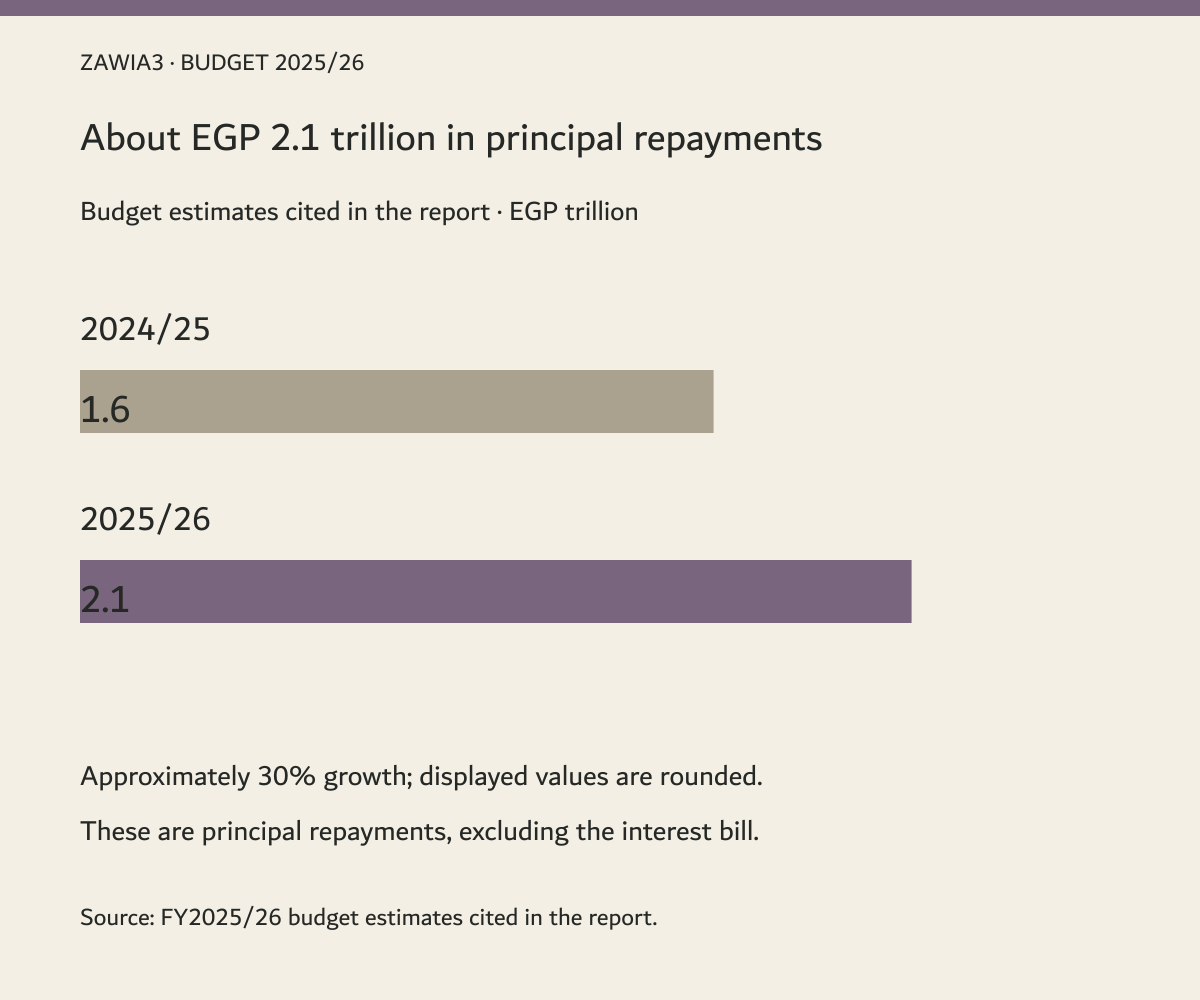
The figures underscore the pressure that repayment obligations place on financing needs. Debt interest, separately included in expenditure, competes with social and investment spending. The distinction matters: external debt stocks, annual repayments and the interest bill measure different things.
The original report also warned of substantial IMF repayments over the following five years, highlighting 2026 and 2027. Its cited schedule did not provide a reproducible Egypt-specific annual series for that claim. The burden is therefore discussed here without presenting an unverified annual peak or a fixed dollar conversion as an established schedule.
Egypt’s external debt rose substantially over the preceding decade. Historical figures quoted in the report include approximately $48 billion in June 2015, $55.8 billion in 2016, $82.8 billion in 2017, $96.6 billion in 2018, $106.2 billion in 2019 and $123.5 billion in 2020, followed by $137.8 billion in 2021, $162.9 billion in 2022 and around $168 billion in 2023. These observations do not all share the same reference date and should not be treated as a uniform year-end series.
For a like-for-like comparison, the Central Bank’s 2024/25 External Position report records $152.9 billion at the end of June 2024 and $161.2 billion at the end of June 2025.
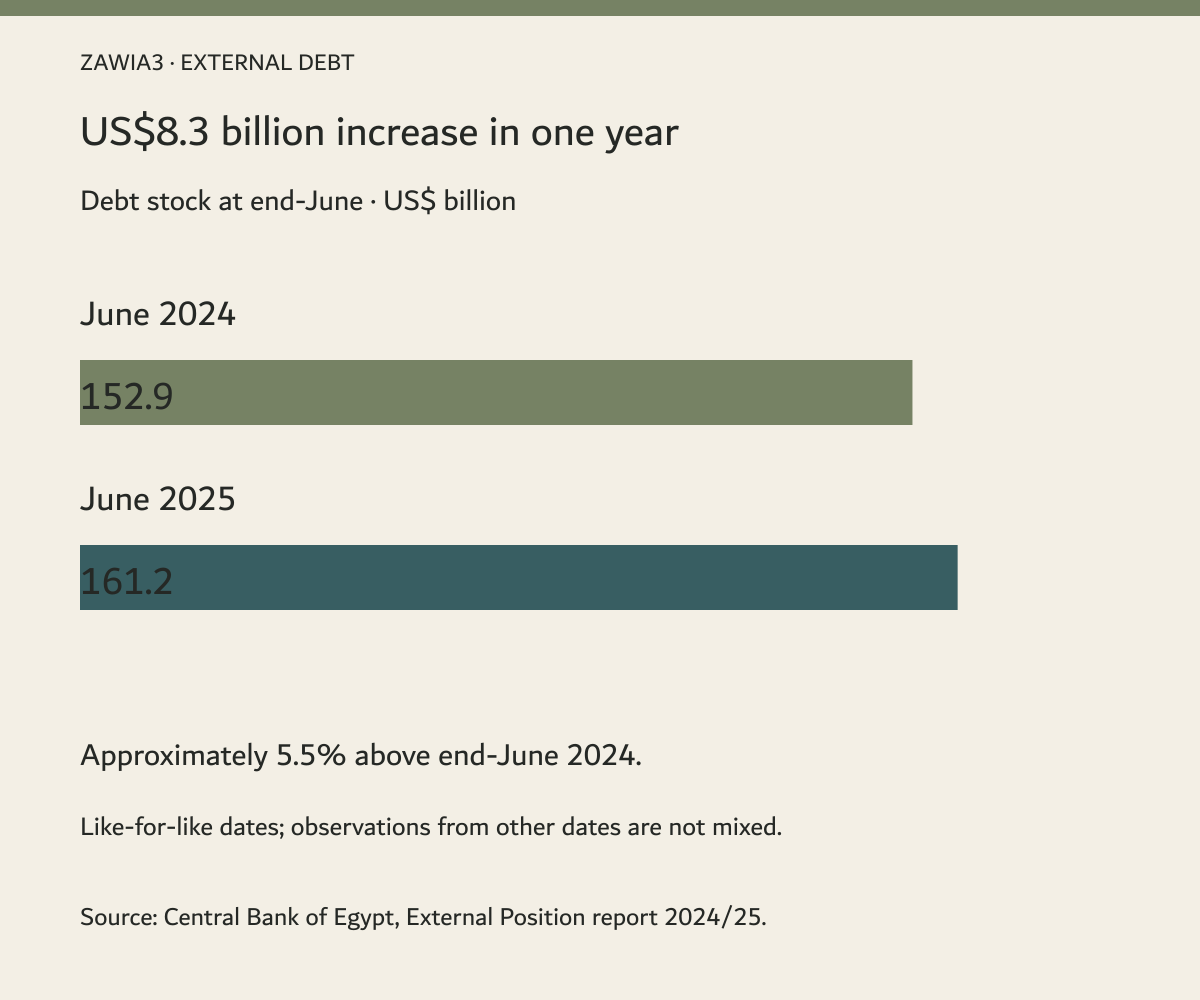
Economist Elhami El-Merghany, a leading member of the Socialist Popular Alliance Party, says external debt rose from $34.9 billion in June 2011 to $46.1 billion in June 2014 and approximately $161.2 billion by the end of 2024/25.
El-Merghany believes the trajectory has left the economy captive to IMF prescriptions, with economic management increasingly directed towards servicing debt. He describes Egypt as one of the Fund’s largest borrowers and stresses the pressure that foreign-currency repayments place on reserves.
He argues that the increase cannot be explained solely by dollar exchange-rate movements. In his assessment, borrowing lacks adequate controls and scrutiny, and often funds projects that could be postponed rather than productive agriculture, industry or import-substituting activities.
He believes this pattern has deepened dependence on IMF conditions, asset sales and a reduced state role while essential services deteriorate and poverty, hunger and malnutrition increase. These are his assessments of the economic and social consequences.
El-Merghany also criticises what he sees as insufficient parliamentary and public oversight of external borrowing. He calculates that principal and interest absorb roughly 65% of total budget uses, leaving little room for development and services. That denominator includes financing uses such as principal repayments; it is not equivalent to 65% of government revenue.
He warns that the economy is entering a danger zone and calls for different spending priorities and sustainable income sources, rather than continuing to rely on borrowing that compounds vulnerability.
Different forecasts, different assumptions
Forecasts available in late 2025 envisaged a gradual recovery in 2026. A Reuters economists’ poll put growth around 4.6% for 2025/26, while the Arab Monetary Fund—not the International Monetary Fund—was cited for a forecast of approximately 4.7% in 2026. Those estimates use different reporting periods and cannot be treated as identical observations.
The Central Bank’s Q2 2025 Monetary Policy Report, published in August, projected real GDP growth of 4.8% in 2025/26 and 5.1% in 2026/27. These are historical forecasts, not the outcomes of either fiscal year.
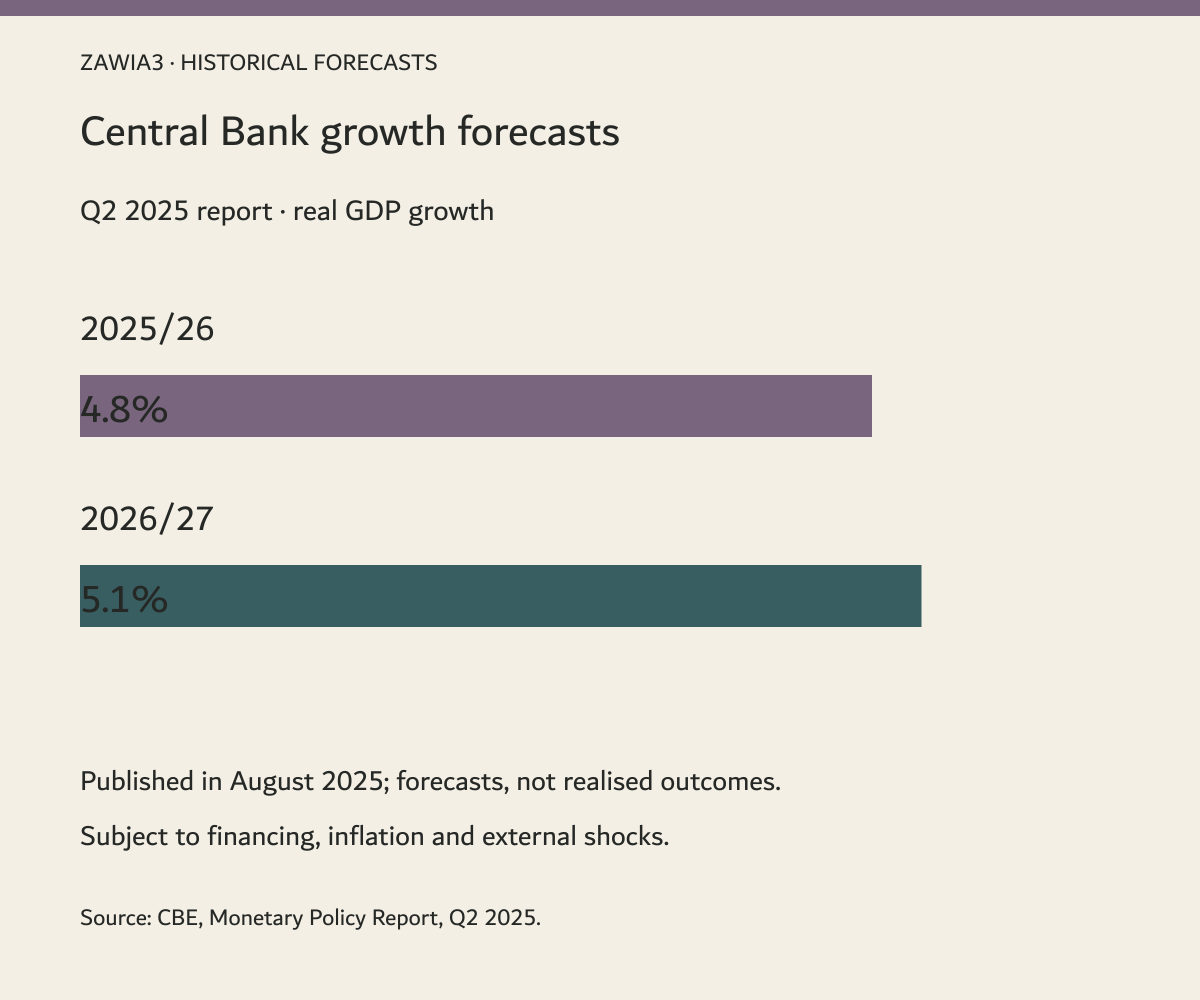
The recovery outlook depended on easing inflation, monetary-policy decisions, exchange-rate conditions, investment and continued access to finance. A fall in the debt-to-GDP ratio is also different from a fall in the nominal debt stock. Measures cited as evidence of progress therefore need to be read with their dates, definitions and assumptions.
In September 2025, the Planning Ministry announced growth of 4.4% in 2024/25, compared with 2.4% a year earlier. Fourth-quarter growth reached approximately 5%, against 2.4% in the corresponding quarter of the previous year. The fiscal year runs from July to June.
Annual growth exceeded the ministry’s 4.2% target. It attributed the improvement to macroeconomic stabilisation, investment-spending governance and stronger private-sector participation under the national structural reform programme.
The government also pointed to asset-sale and foreign-investment inflows and improved credit assessments. But forecasts from different institutions are not directly comparable unless they cover the same period and measure. A general claim that official forecasts exceed all international estimates by 0.5–1 percentage points is therefore too broad.
In August 2025, President Abdel Fattah El-Sisi approved legislation governing the state’s ownership of companies and facilitating transactions under its state-ownership policy. The report describes wider mechanisms for disposing of interests, including sales, market offerings, mergers and divisions.
The framework covers wholly or partly state-owned companies connected with ministries, public authorities and other state bodies, with exceptions for some strategic companies and entities established under international agreements. The existence of a legal mechanism does not itself demonstrate how transparently an individual sale is valued or carried out.
The central disagreement is therefore about what the indicators can establish. Government statements emphasise recent growth and sectoral gains, while analysts warn about debt-service costs, the pace and terms of divestment, and exposure to regional conflict or energy-price shocks.
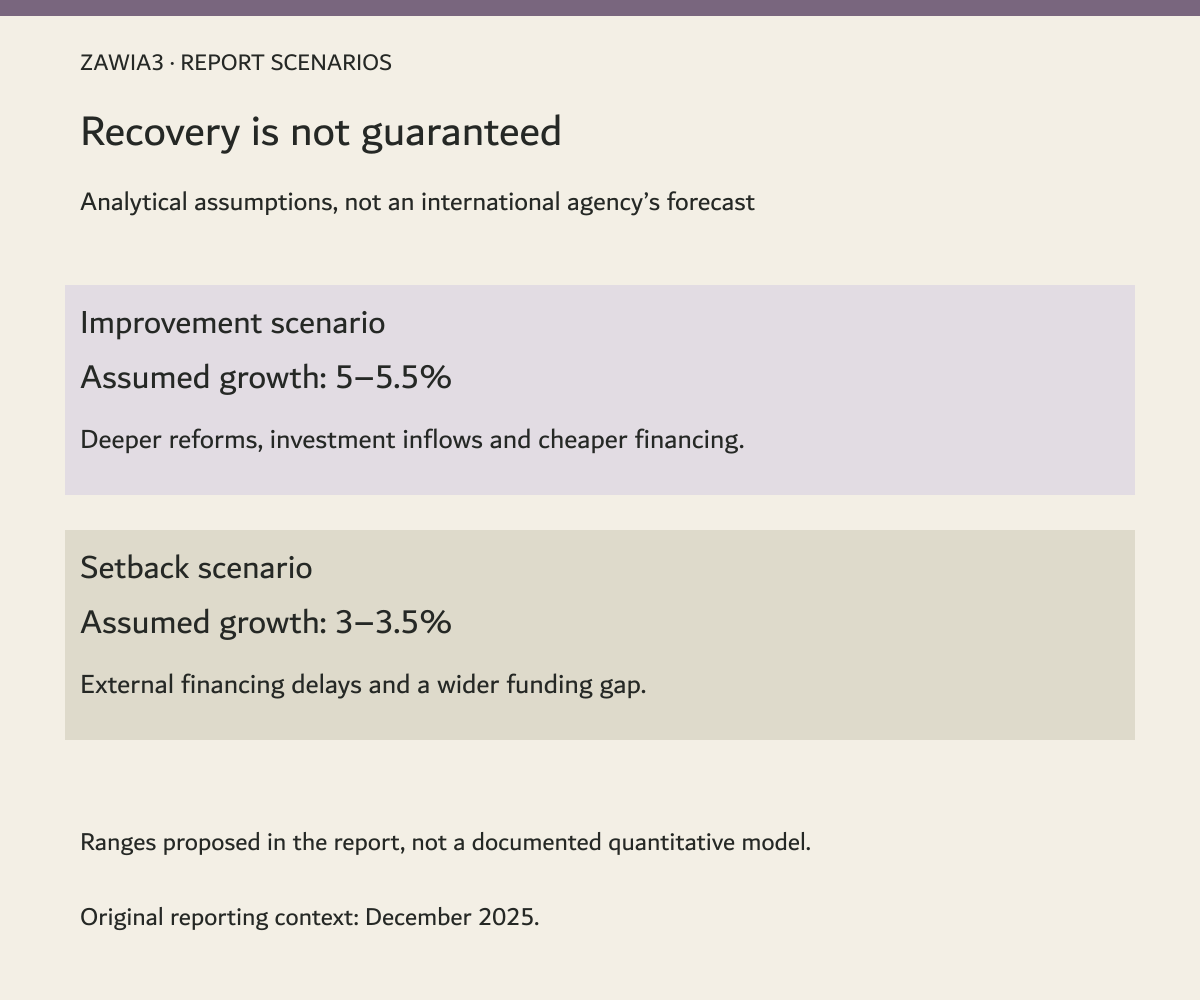
The original report proposes an improvement scenario with growth of 5–5.5%, conditional on larger investment and divestment inflows and cheaper financing. It contrasts that with a setback scenario of 3–3.5% if financing is delayed or the funding gap widens. These are analytical ranges put forward by the report, not documented forecasts from ESCWA or another international institution. No reproducible quantitative model or probability is supplied for them.
Taghreed Badr El-Din, an assistant lecturer in economics at Beni-Suef University’s Faculty of Politics and Economics, calls the situation a “cautious recovery.” Growth and monetary stability have improved, she says, but deeper reform is needed to sustain that improvement.
She cites forecasts she dates to May 2025: IMF growth of 4.3% in 2025 against 3% a year earlier, and World Bank projections of 4.2% for 2025/26 and 4.6% for the following year. These figures are presented as estimates quoted by the interviewee in the original December 2025 reporting context. She attributes the outlook to foreign investment in energy and infrastructure and the IMF-supported $8 billion programme.
Positive indicators do not mean that earlier pressures have ended, she stresses. They reflect relative stabilisation after a difficult period, including improved exchange-rate conditions, returning confidence in domestic debt instruments and stronger reserves.
She notes that the IMF’s July report recognised macroeconomic stabilisation while warning that structural reforms to expand private-sector activity and reduce the state’s footprint had made limited progress. Genuine structural transformation still required considerable work.
The Central Bank’s Q2 2025 report recorded average annual urban headline inflation of 15.2% for the quarter, its lowest quarterly reading since the third quarter of 2022. Badr El-Din links easing inflation to exchange-rate improvements and lower sovereign risk, and anticipates further disinflation towards the then-target of 7%, plus or minus two percentage points, in the fourth quarter of 2026. This was a target and expectation, not a guarantee.
Badr El-Din warns that debt remains a major risk. She calls for stronger non-tax revenues and effective fiscal discipline to reduce pressure on the budget. Her concern is about future vulnerability, rather than treating a projection as an already recorded debt stock.
She also identifies bureaucracy and uncertainty about competitive conditions as obstacles to sustainable investment, despite efforts to promote opportunities and expand private-sector participation.
Regional and global events directly affect the economy, she says. Middle East conflict reduced Suez Canal income, and energy-price volatility added budget pressures. Tourism and services helped absorb some of those shocks. She cites tourist numbers growing by approximately 12% during the part of 2025 then covered by her assessment; this is not a verified full-year total as of 11 December.
For Badr El-Din, recovery is real but uneven, reliant on external capital and unfinished reforms. She describes a delicate transition that could become a stronger recovery with sustained structural reform or falter if measures remain limited and temporary.
The Egyptian Initiative for Personal Rights likewise argues that celebration of a roughly EGP 629 billion primary surplus in 2024/25 cannot be separated from the debt burden. A primary balance measures revenue minus non-interest expenditure; principal repayments sit outside the conventional expenditure calculation.
The organisation argues that the fuller picture must include principal and interest payments, which consume nearly two-thirds of total government uses. Interest alone, it says, was close to three times the primary surplus being celebrated.
As the original report looked towards 2026, Egypt faced a choice between consolidating stabilisation and continuing a cycle of debt-led financing. Growth and inflation offered signs of improvement, while debt costs, incomplete reform and external shocks threatened its durability.
Completing the IMF reviews was expected to support financing and relieve balance-of-payments pressure. But a durable recovery would also require productive investment, clearer competition rules, stronger public oversight and sustainable revenues. Delays and wider financing gaps could instead limit growth and deepen dependence on borrowing.