
Egypt’s House of Representatives approved the state budget for fiscal year 2025/2026 on Tuesday, 17 June, after a debate in which independent and opposition MPs challenged its priorities. Their objections centred on rising debt and borrowing, pressure on social spending and what they described as the absence of a clear economic strategy.
The annual budget sets out the government’s expected revenue and spending priorities, including health, education and defence. Parliamentary approval authorises the government to implement this financial expression of its economic, political and social choices.
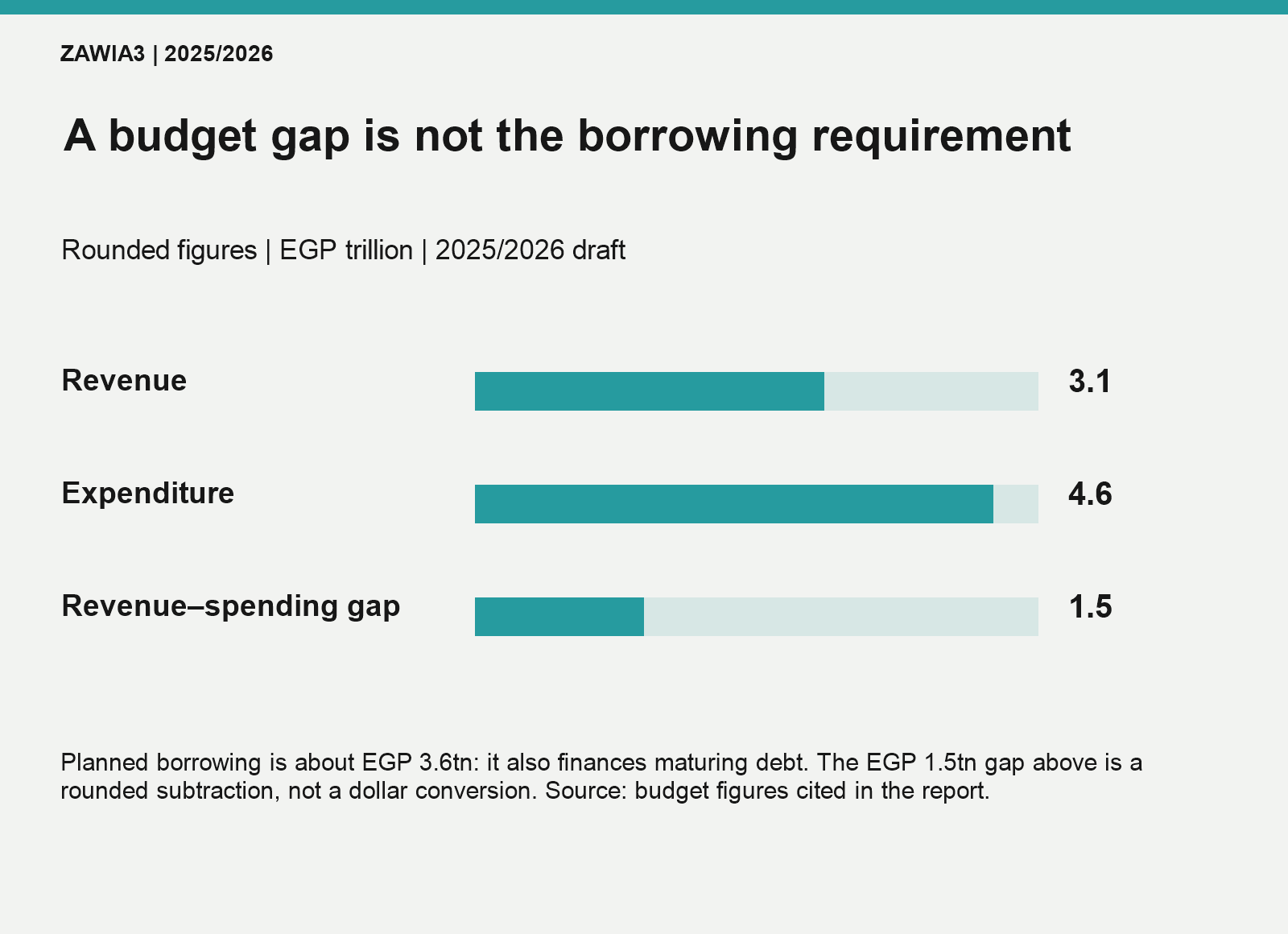
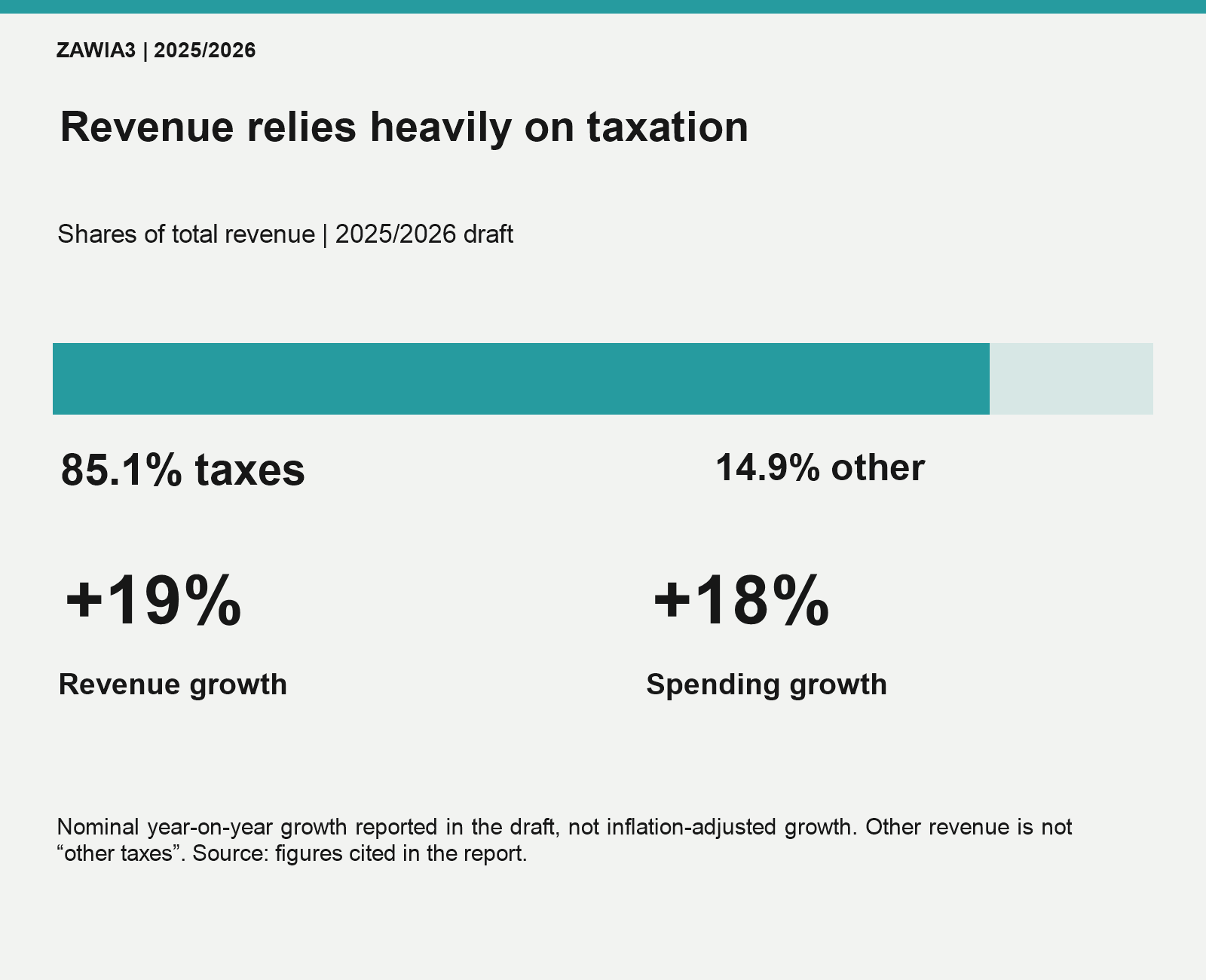
The draft submitted by the government projected revenue of approximately EGP 3.1 trillion, up 19% year on year, and expenditure of about EGP 4.6 trillion, an increase of 18%. These are nominal budget estimates, rather than inflation-adjusted increases or actual spending outcomes.
It allocated EGP 679.1 billion for public-sector wages, an 18.1% increase intended to cover salary rises from July. Medical allocations included EGP 22 billion for medicines, EGP 12.4 billion for raw materials, EGP 11 billion for medical supplies, EGP 2.8 billion for maintaining medical equipment, and EGP 5 billion for subsidised medicines and infant formula. These are separate budget categories and should not all be described as medicine subsidies.
Petroleum-product subsidies, meanwhile, were set to fall by roughly 51%, from EGP 154 billion in the 2024/2025 budget to EGP 75 billion. Electricity subsidies were also allocated EGP 75 billion, alongside EGP 3.5 billion for connecting homes to the natural gas network.
Planned borrowing of approximately EGP 3.6 trillion includes the financing needed to repay maturing debt. It is therefore different from the roughly EGP 1.5 trillion gap obtained by subtracting the rounded revenue figure from expenditure. Confusing the two obscures the scale and composition of the government’s financing needs.
Rising debt and contested social priorities
During the debate, several MPs rejected the budget, warning about the growth of domestic and external debt and the reliance on taxes for approximately 85% of revenue. They argued that social spending was losing priority while chronic structural problems remained unresolved.
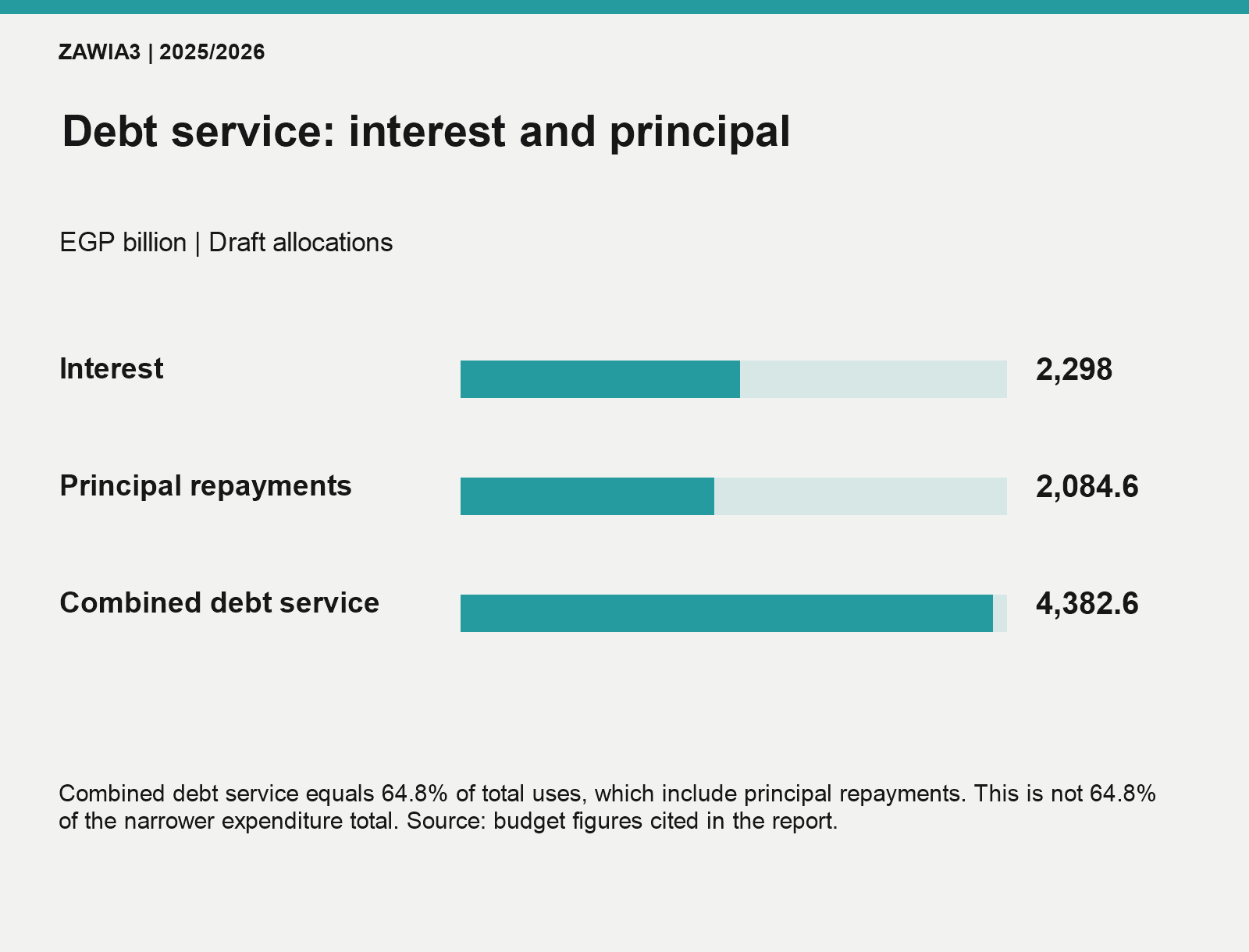
The figures cited in the draft earmarked EGP 2,298 billion for interest and EGP 2,084.6 billion for principal repayments. Together, debt service totalled EGP 4,382.6 billion, or 64.8% of total budget uses. “Uses” is a broader measure than expenditure because it includes principal repayments and other financing transactions. The 64.8% figure should not be applied to the narrower EGP 4.6 trillion expenditure total.
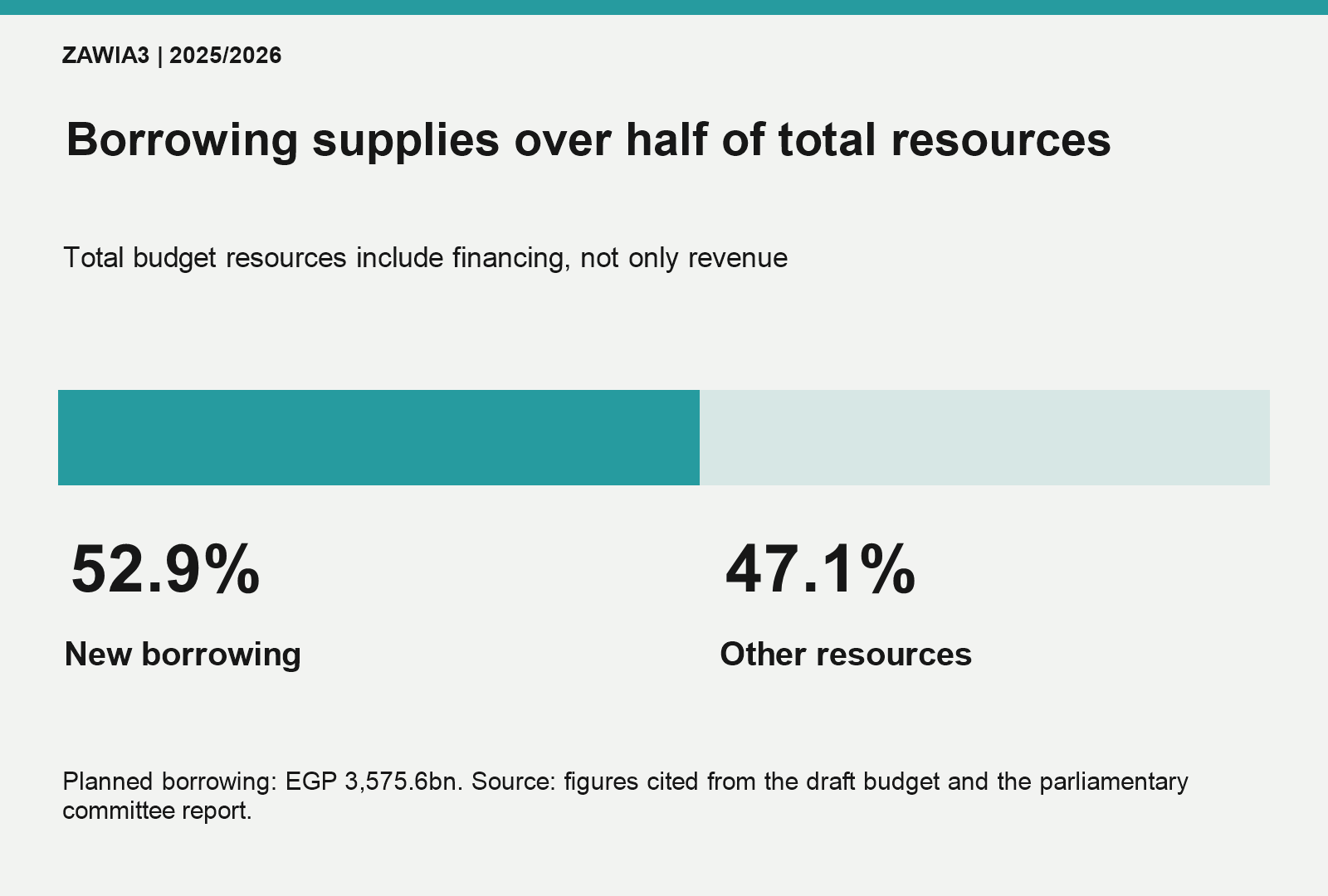
New borrowing was projected at EGP 3,575.6 billion, accounting for 52.9% of total resources, a measure that likewise includes financing as well as revenue.
MP Abdel Moneim Emam, leader of the Justice Party, tells Zawia3 that approval reflected the parliamentary balance between the majority and the minority. The majority, he says, passed the government’s proposal, while the minority set out its reasons for rejecting it.
“We rejected the budget because it extends the unsound economic policies pursued since Mostafa Madbouly became prime minister,” Emam says. He points to shrinking subsidies and expanding debt without what he regards as credible solutions to the underlying crisis.
Emam says he presented a comparison between economic conditions when Madbouly’s government took office and the current position. Excluding taxes and Suez Canal receipts, he put public revenue at no more than EGP 455 billion, contrasting that with a property developer’s announced sales exceeding EGP 1 trillion. This is his illustration of the gap he sees in resource mobilisation; government revenue and a company’s contracted sales are different accounting measures.
For Emam, the contrast signals a fundamental problem in the management of public resources. He says MPs submitted practical proposals to the Planning and Budget Committee to change spending priorities and improve revenue collection, but that those suggestions were not adopted.
He warns that continuing the same policies amid worsening domestic and regional challenges could produce economic conditions harsher than those of recent years. He calls for a comprehensive review of the budget’s structure and a more equitable, effective approach, rather than repeatedly applying the same measures.
Maha Abdel Nasser, an MP from the Egyptian Social Democratic Party, says the objections resemble those raised a year earlier. What has changed, in her view, is the degree of uncertainty and risk.
“I see nothing new in the budget. We reject it every year for the same reasons, but this year is much harder,” she tells Zawia3. The numbers, she argues, could change rapidly as economic conditions shift: legislators are debating figures on paper that may look very different within a month.
Her deeper criticism concerns the absence of a change in direction. Government rhetoric about investing in people, she says, cannot be reconciled with inadequate education, healthcare and cultural services.
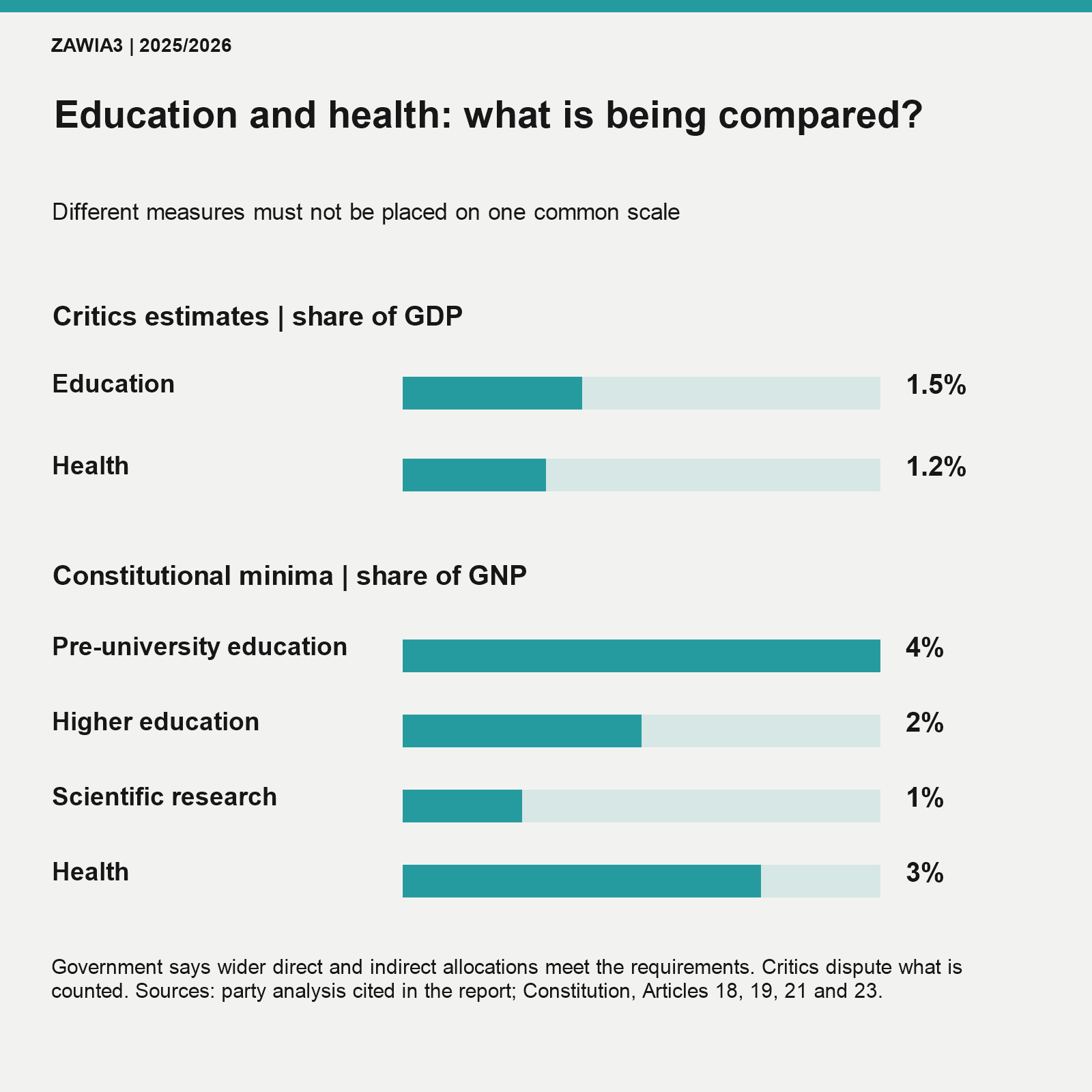
Abdel Nasser points to the closure of cultural centres on grounds of insufficient funding. She cites direct education spending of approximately 1.5% of GDP and argues that it falls far short of the constitutional commitment to education and scientific research. Those constitutional minima are expressed as shares of gross national product, however, and the dispute also concerns which institutions and spending categories should be counted.
A strong research environment requires a sound educational foundation, she says. Individual efforts are insufficient without a clear plan, timetable and coherent policy. Education is a responsibility of the whole state, rather than of one minister alone.
Other MPs similarly challenged the health and education allocations. They saw the disagreement as evidence that human development remained subordinate to other priorities, with consequences for inequality and the erosion of the middle class.
Do health and education allocations meet the Constitution?
Egypt’s Constitution requires minimum government spending equivalent to 4% of gross national product for pre-university education, 2% for higher education, 1% for scientific research and 3% for health. Each sector has its own obligation; the four thresholds together amount to 10%.
The government and its parliamentary supporters say the requirements have been met. The Planning and Budget Committee counted direct and indirect expenditure across the relevant sectors at approximately EGP 1.8 trillion, which it described as 10.7% of the national-output base used in its calculation.
Parliamentary Affairs and Political Communication Minister Mahmoud Fawzi defended that approach during the debate. He argued that social provision was among the government’s priorities and that spending could not be assessed solely through the direct allocations of individual ministries.
Fawzi pointed to university hospitals and institutions associated with Al-Azhar, the police and the armed forces as contributors to healthcare and education. His position was that the services should be assessed across the wider system, including indirect spending, rather than only through hospital counts or a single ministry’s budget.
Abdel Nasser rejects the government’s presentation. In her view, attributing debt-interest costs to health and education helps produce apparent compliance without delivering equivalent services.
“How has the government complied? That needs explaining,” she says. “What is actually spent is far below the required amount.”
She recalls raising the same objection with former finance minister Mohamed Maait during an earlier parliamentary session. Her concern, she says, was the reality of services people receive, rather than an accounting calculation that presents a higher total.
Abdel Nasser warns that deteriorating public education and healthcare force households to pay out of already limited incomes for services the state does not adequately provide. This increases living costs and deepens the sense that the burden is distributed unfairly.
MP Ahmed El-Farghaly describes the proposal as the worst budget in the Egyptian state’s history, a political assessment he links to what he regards as repeated failure in economic management.
“Pensions, health and education are this government’s last priorities,” he tells Zawia3, arguing that citizens bear the consequences of expanding borrowing. He accuses the government of relying on taxes, state-asset sales, subsidy reductions and external loans without a credible development strategy.
El-Farghaly also disputes the government’s claim of constitutional compliance. He argues that Takaful and Karama cash assistance is insufficient for families’ needs. His comparison with less than one dollar a day is a criticism of benefit adequacy, rather than a uniform payment rate for all households: programme entitlements vary by category and household circumstances.
Cosmetic figures—or meaningful social protection?
The Socialist Popular Alliance Party has also published an analysis rejecting the 2025/2026 draft budget. Prepared by economist and party leader Elhami El-Merghani, the paper argues that servicing public debt absorbs resources that should support development and public services.
It highlights the EGP 4.38 trillion combined cost of interest and principal repayments—64.8% of total uses—and planned new borrowing exceeding EGP 3.5 trillion in a single year. For the party, this illustrates a continuing and dangerous dependence on refinancing.
The paper estimates direct education allocations at 1.5% of GDP and health allocations at 1.2%. It contrasts these figures with the constitutional commitments, while the government uses a wider definition that includes indirect spending. The differing denominators and spending scopes must be distinguished when presenting the dispute.
The party argues that debt payments crowd out resources for education, health, housing and meaningful assistance to poorer households. It sees the distribution as a structural imbalance that threatens social stability and entrenches inequality.
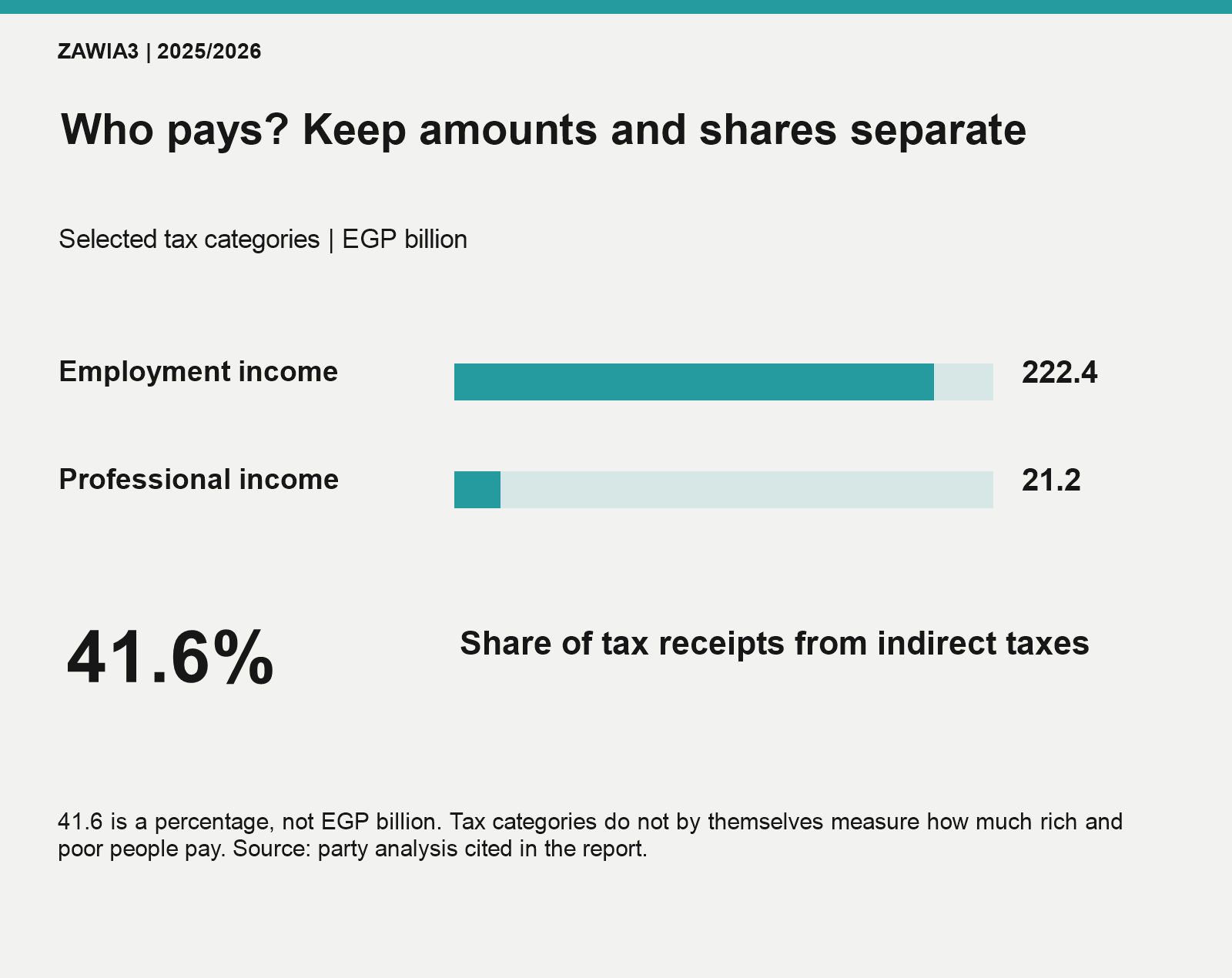
Taxation is another central objection. According to the figures cited in the analysis, taxes provide 85.1% of total revenue, leaving 14.9% from other sources. Indirect taxes—including VAT and taxes on goods and services—account for 41.6% of tax receipts.
The party argues that consumption taxes place a disproportionate burden on lower-income households because essential purchases consume a larger share of their income. This does not mean all households pay the same amount, or the same proportion of their earnings, in tax.
It also contrasts EGP 21.2 billion in expected receipts from professional income with EGP 222.4 billion from employment income. The disparity raises questions about the tax base and collection, but these categories alone cannot establish how much rich and poor people pay overall.
The analysis calls for a more progressive distribution of the burden and stronger taxation of wealth and profits. Egypt already has graduated personal-income-tax brackets, including under Law No. 7 of 2024. The criticism is therefore better understood as a demand for greater progressivity and fairer enforcement, rather than evidence that progressive rates do not exist at all.
The paper further challenges how the approximately EGP 742.6 billion allocated to subsidies, grants and social benefits is presented. It argues that the headline amount combines items that do not all become direct assistance to households.
Among the items it identifies are EGP 153.4 billion relating to obligations to social-insurance and pension funds, and EGP 9.4 billion in awards, decorations and benefits for non-employees. It also questions the presentation of EGP 75 billion in electricity subsidies while consumers continue to face higher tariffs. These are the party’s criticisms of budget classification and distribution; the presence of a transfer within a broad social-spending category does not, by itself, prove accounting manipulation.
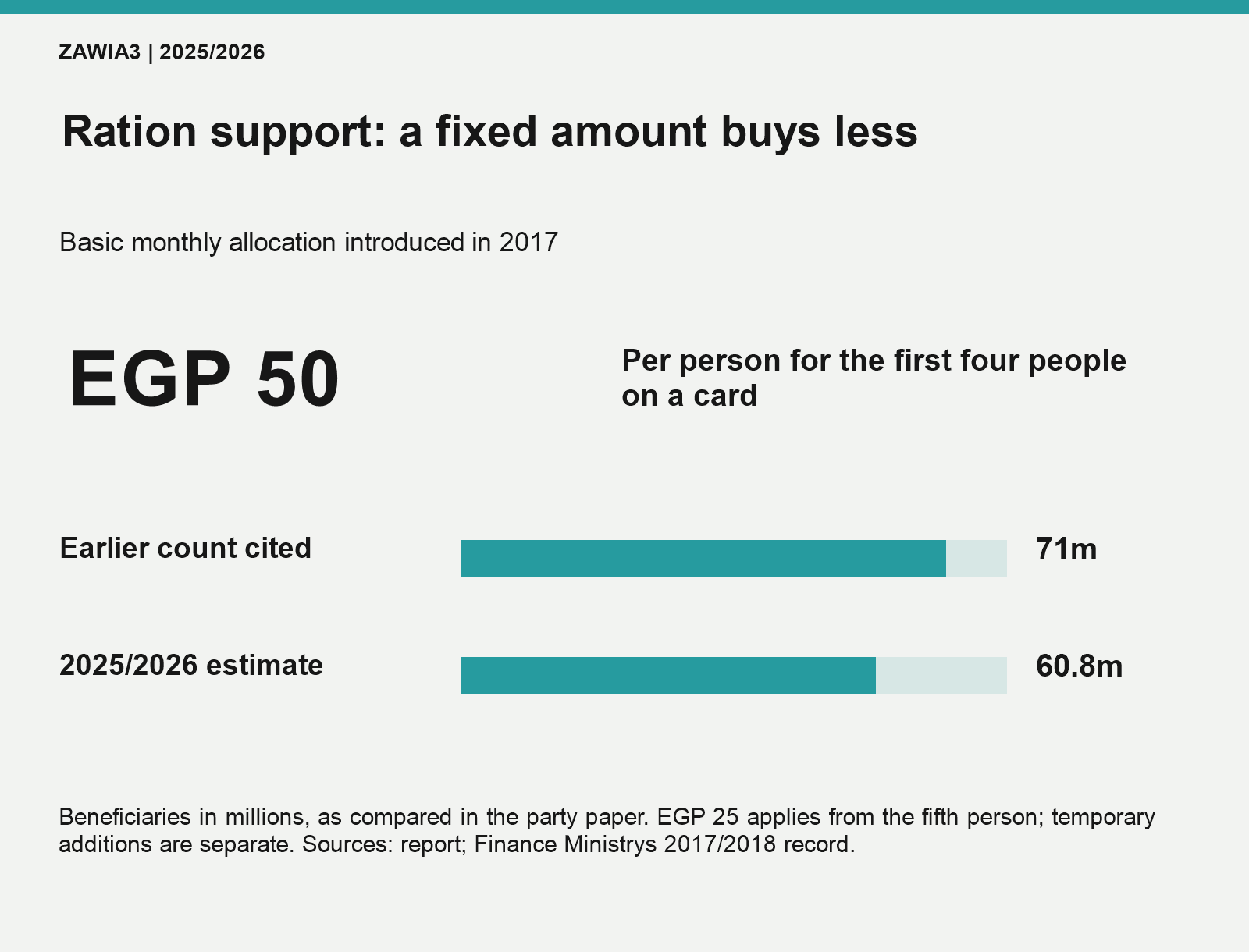
The erosion of ration-card purchasing power is another concern. The basic monthly allocation of EGP 50 for each of the first four people on a card dates to 2017, while EGP 25 applies from the fifth person onwards. Temporary additional support is distinct from this basic entitlement. The Finance Ministry’s record of the 2017/2018 measures records the increase from EGP 21 to EGP 50.
The party compares an earlier beneficiary figure of about 71 million with a budget estimate of 60.8 million. Combined with rising prices, it argues, an unchanged basic allocation means weaker protection, even where the nominal amount has not been cut.
For the party, the central question is not how large the budget appears on paper, but whether it improves the lives of people facing poverty, insecure work and deteriorating public services.
Its conclusion is that the budget favours creditors and owners of capital over poorer households and workers. Continued reliance on borrowing, asset sales and subsidy reductions, it argues, offers temporary responses to a structural crisis without resolving its causes.
The government maintains that its broader allocations meet constitutional and social commitments. The disagreement exposes a deeper contest over fiscal priorities: what counts as social spending, who carries the tax burden, and how much room debt service leaves for public investment in people.