


Mina Salah did not expect his search for a home to become a prolonged battle with contractors. One of them, he says, was a member of parliament who sat on its housing committee. After paying a deposit through a private intermediary, he says he discovered that the property was registered to someone he described as a front, known in the market as “Koheil”. Handover was repeatedly delayed.
“They began asking for more money, and then the pressure turned into indirect threats,” he tells Zawia3. He eventually sold the apartment at a loss.
That experience led him to state housing projects, advertised as a safer alternative. He paid EGP 300 for the application booklet for “Housing for All Egyptians 3”, deposited EGP 22,000 and began assembling the required documents. Two months later, a message told him he was outside the priority list. “It was another shock,” he says, “but I decided to wait for the next announcement.”
When Housing for All Egyptians 5 opened, he started again. He sold gold worth EGP 30,000 to pay the reservation deposit, in addition to the booklet fee. After roughly five months, he received preliminary confirmation that he met the conditions. A further month later, he says, another message placed him outside the priority group and instructed him to await the next round, buy another booklet and bring his deposit up to EGP 50,000.
“Why does the Housing Ministry not wait until successful applicants are announced before collecting booklet fees and reservation deposits? What does it do with all the money collected in advance?” Mina asks.
Over the past decade, housing projects have become a central part of the Egyptian state’s public message. Social and middle-income housing schemes overseen by the Housing Ministry and the New Urban Communities Authority promise greater access to homeownership. But the accounts of applicants such as Mina describe another experience: long delays, uncertainty about payments and rising deposits without clear delivery guarantees.
The cases below concern different programmes, including subsidised social housing and middle-income developments. Their eligibility rules and financing arrangements are not identical. Applicants’ questions about the use of their money are not, by themselves, evidence that funds have been diverted.
Where does applicants’ money go?
People interviewed by Zawia3 describe recurring problems: missed handover dates, non-refundable administrative charges and application booklets costing EGP 700 in the latest round, despite a limited supply of units relative to demand. Their experiences raise questions about how applicants’ payments are managed and what information they receive.
Ahmed Salem, an accountant at a private company in Giza, applied for social housing in 6th of October City in 2020. “I hoped to escape the repeated burden of rent, especially after prices rose so much. I paid the required deposit and kept up with the instalments. The official promise was clear: delivery within a maximum of 36 months.”
The deadline passed without a handover notice. He repeatedly visited the Hadayek October city authority and says he received only vague responses: construction was under way, the project was in its final stages, delivery was approaching.
As mid-2025 approaches, he still has no apartment. “I pay high monthly rent while also paying a bank instalment for an apartment I have not received. I do not have a clear timetable explaining when this ordeal will end,” he says.
Salem asks whether the ministry uses applicants’ money on other projects and why it does not publish a clear financial explanation. “We ask for nothing more than deadlines being honoured, or at least a frank explanation for the delay.”
Mona Abdel Galil, 44, a private-sector employee in Mansoura, received a reservation number for an apartment in the Sakan Misr development in New Mansoura in 2022. She hoped to leave rented accommodation for a home that would offer greater social and financial security. She says she has received no clear handover notification. Calls and emails bring the same response: construction is continuing.
“Money is collected with strict precision, but we do not see the same precision in completion or respect for deadlines,” Abdel Galil says. The home that was supposed to bring stability has instead become a constant source of anxiety.
She questions why the project was offered if its financing or timetable was not secure, and whether money is being used elsewhere without buyers’ knowledge. These are concerns she raises about the lack of information, rather than findings established by an examination of the project’s accounts.
In Alexandria, Khaled Fathy, a 40-year-old public-sector employee, says he has paid instalments for a social housing unit in New Borg El Arab since 2020. The project was presented as a model of urban development, he says, yet the area remains sparsely occupied and essential electricity, water and road infrastructure is incomplete.
He contrasts that experience with announcements of financial surpluses by the New Urban Communities Authority, asking why receipts have not translated into faster delivery. He wants a clear timetable, transparent accounting and compensation for delays. “Some friends believe poor management is the cause. I think the problem goes deeper, to the absence of oversight and accountability,” he says.
The government’s explanation
The Housing Ministry has attributed delivery delays to economic shocks, supply-chain disruption and rising construction-material prices. Former housing minister Assem El-Gazzar said some delays were beyond the ministry’s control and that work was continuing to deliver overdue units.
In an earlier episode, Mustafa Madbouly said in August 2017, while serving as housing minister, that currency flotation and increased materials costs had forced contractors to halt work. The government introduced compensation legislation and allowed roughly nine additional months to complete projects. That statement concerned the 2017 situation; it was not a new explanation issued in 2025.
In October 2024, Mai Abdel Hamid, chief executive of the Social Housing and Mortgage Finance Fund (SHMFF), said delayed apartments were being handed over at a rate of 8,000–10,000 a month. She expected the backlog to be cleared during 2025. That was a forecast, not confirmation that every delayed unit had been delivered.
For projects in New Alamein, Housing Minister Sherif El-Sherbiny acknowledged delays and referred to meetings with contractors and consultants to accelerate work, with phased handovers beginning in mid-August 2024 and extending to mid-2025. Ministry directives to new-city authorities also called for faster execution, precise schedules and continued monitoring of Housing for All Egyptians projects.
Citizens’ savings as a source of finance
Karim El-Omda, a professor of political economy, argues that the state increasingly relies on citizens to absorb financial pressures. In his view, ordinary people’s pockets have become the first option for addressing imbalances in government and public economic bodies.
He points to the expansion of middle-income and more expensive schemes, including Sakan Misr, Dar Misr and Janna. He sees these fully finished developments as closer to a commercial developer’s model than to a social programme directed at those least able to afford housing.
Holding buyers’ money for long periods without paying a return or delivering on time is economically unfair, he argues. A person who pays for an apartment and waits years effectively provides the developer with interest-free finance while continuing to meet other housing costs.
El-Omda places that burden in the context of Egyptian interest rates exceeding 27% during 2024. When borrowing is expensive, access to buyers’ cash is valuable to the implementing body, while the buyer bears the cost of losing access to savings.
He suggests that deferred delivery may enable payments to cover temporary financing gaps. This is his economic interpretation, not an audited finding that a particular project’s receipts were transferred elsewhere. Inflation also erodes the purchasing power of money tied up or later refunded; it does not necessarily mean the apartment itself loses market value.
Rights lawyer Yasser Saad is sharply critical of collection practices, delays and inadequate disclosure. He considers some practices potentially fraudulent and calls for project size, selection rules and delivery schedules to be clear before money is collected.
Speaking to Zawia3, he argues that official bodies should be accountable for failing to honour commitments, and that returning money years later without accounting for its diminished purchasing power does not repair the buyer’s loss. He also disputes the idea that an eventual refund necessarily resolves questions about how the money was initially obtained.
That is the lawyer’s assessment, not a court finding that fraud occurred in the cases described here. Article 336 of the Penal Code requires obtaining property through specified forms of deception. Delay or a refund without compensation does not, on its own, establish every element of the offence. The rules governing housing allocation also need to be distinguished from those governing public procurement; the applicable contract and legal framework matter in each case.
Who finances the projects?
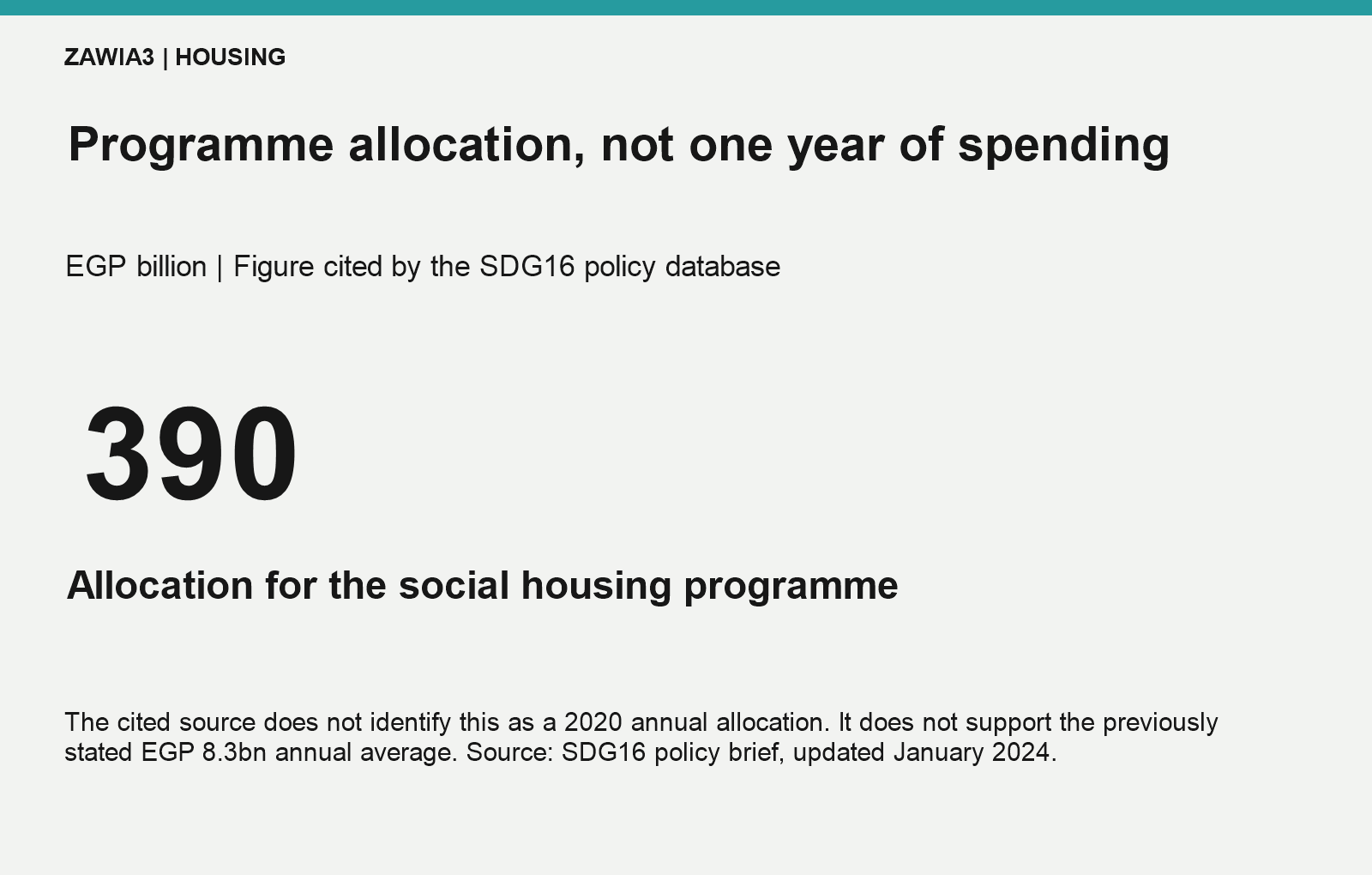
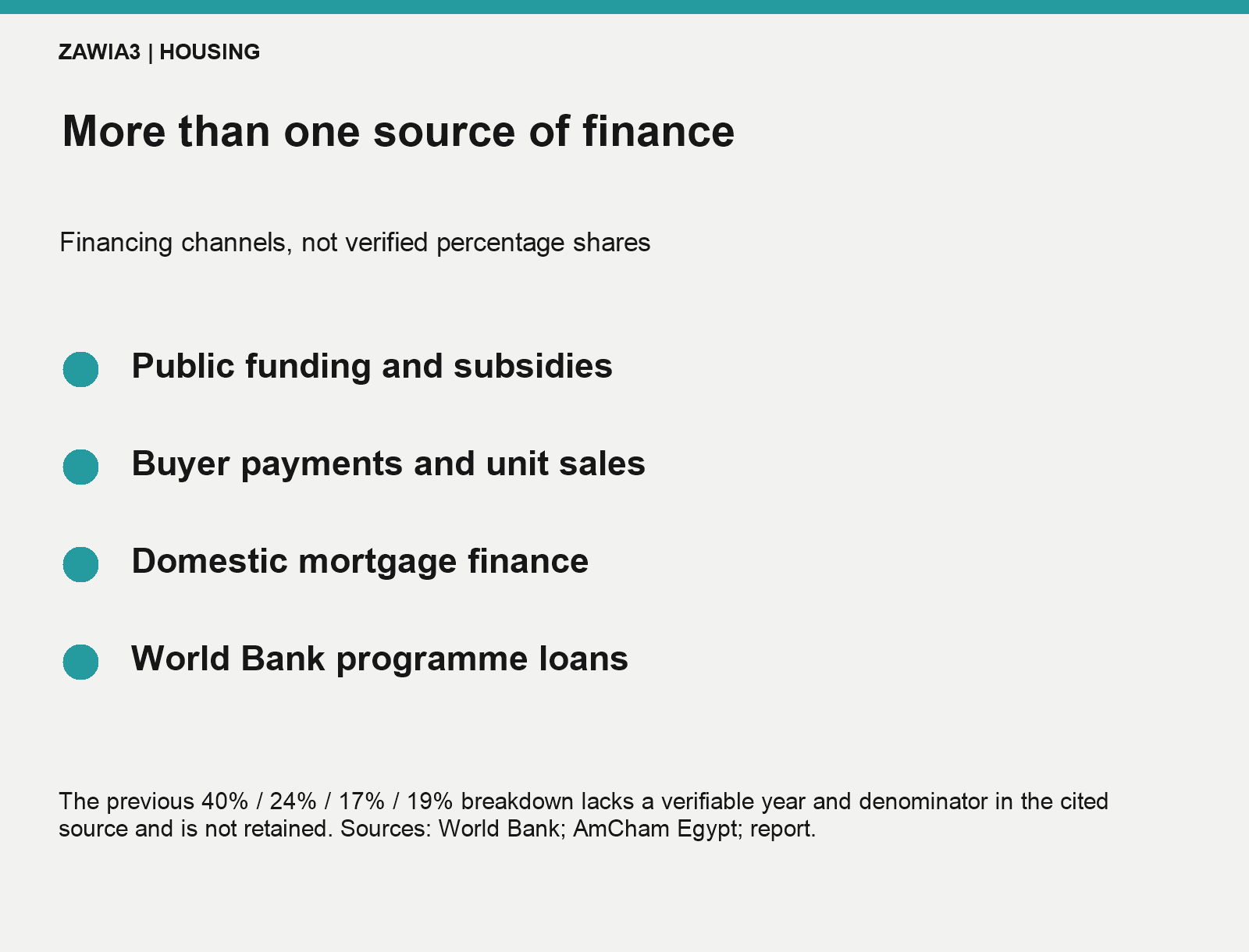
Social housing draws on several sources: public allocations and subsidies, purchasers’ payments and unit sales, domestic mortgage finance and external loans. The SDG16 policy database cites EGP 390 billion allocated to the programme, but does not identify it as a one-year allocation in 2020.
The previously stated annual average of EGP 8.3 billion and the 40%/24%/17%/19% financing split are not retained here because their period and accounting basis could not be established from the cited source. An AmCham Egypt review records EGP 20 billion allocated by the Central Bank to mortgage financing in 2014 and an additional EGP 20 billion in 2019.
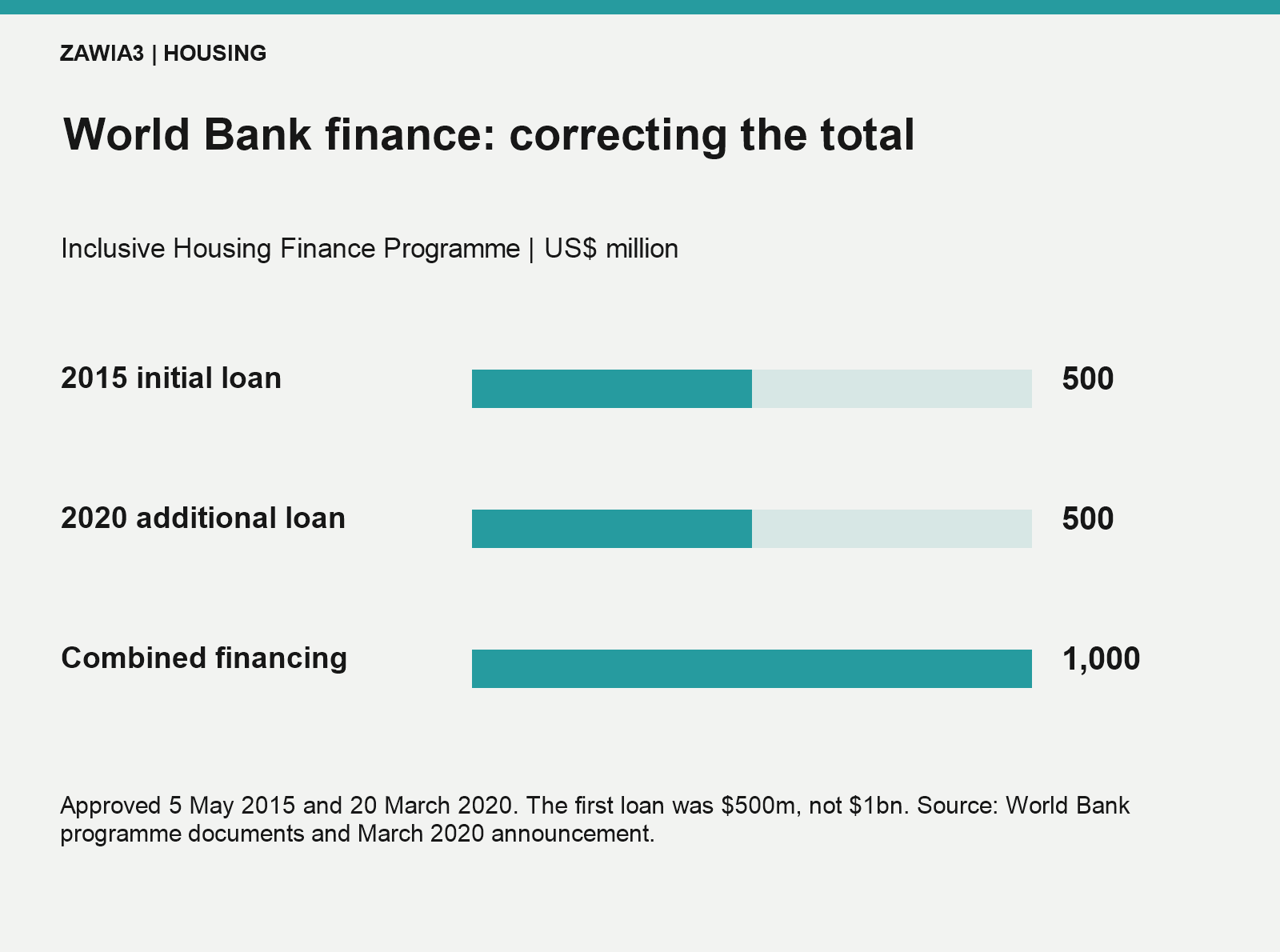
The World Bank approved the original US$500 million Inclusive Housing Finance Programme-for-Results loan on 5 May 2015. It then approved a further US$500 million on 20 March 2020, bringing the two loans to US$1 billion in total. The programme supports low-income households’ access to housing and the Fund’s institutional capacity, with additional work on private-sector participation and green housing.
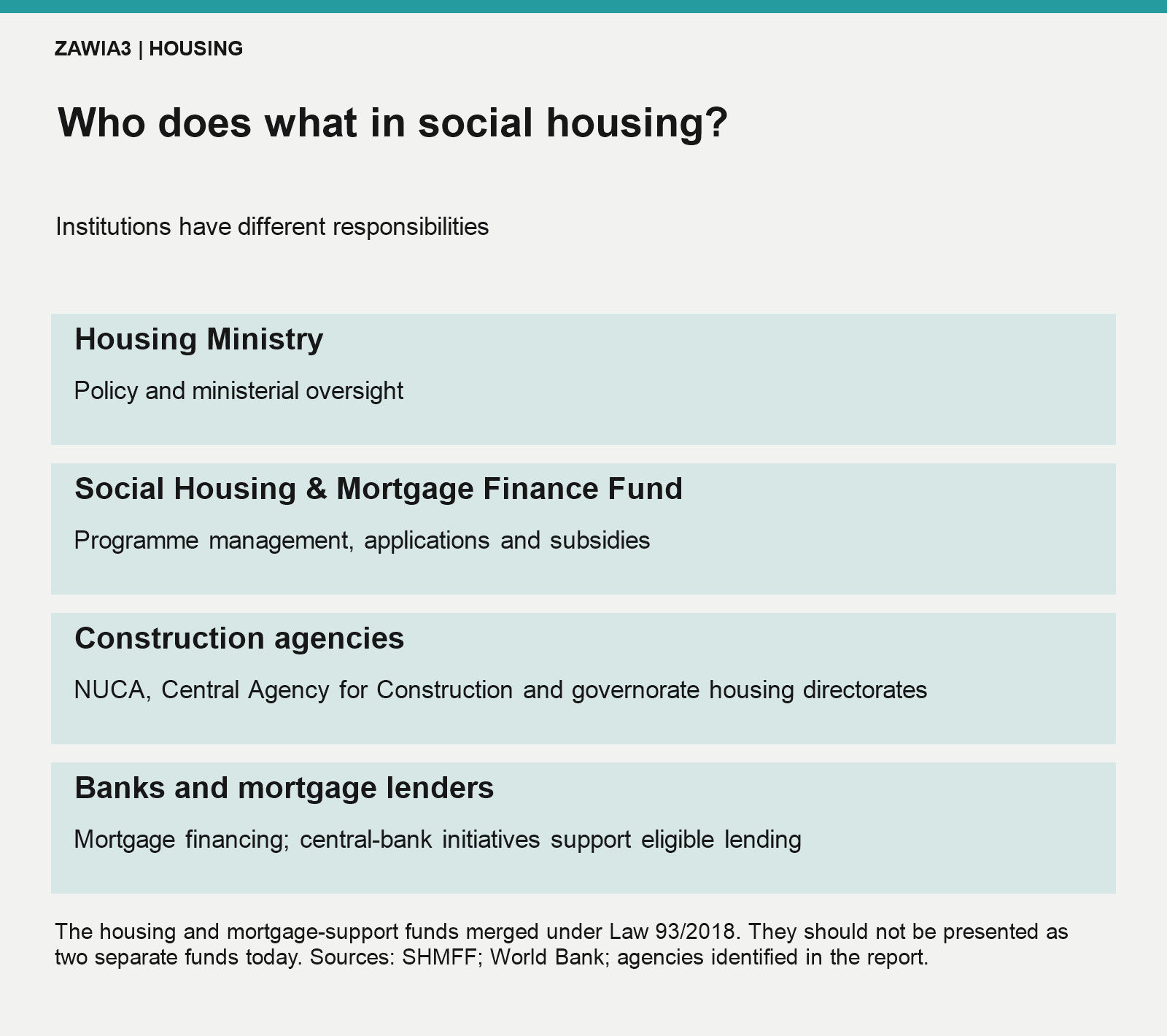
The Housing Ministry oversees SHMFF. Under Law 93 of 2018, the former social housing and mortgage-support funds were merged, so they should not be treated as separate current institutions. Construction involves the New Urban Communities Authority, the Central Agency for Construction and governorate housing directorates. Banks and mortgage-finance companies provide purchase financing under the relevant initiatives and eligibility rules.
A gap between demand and delivery
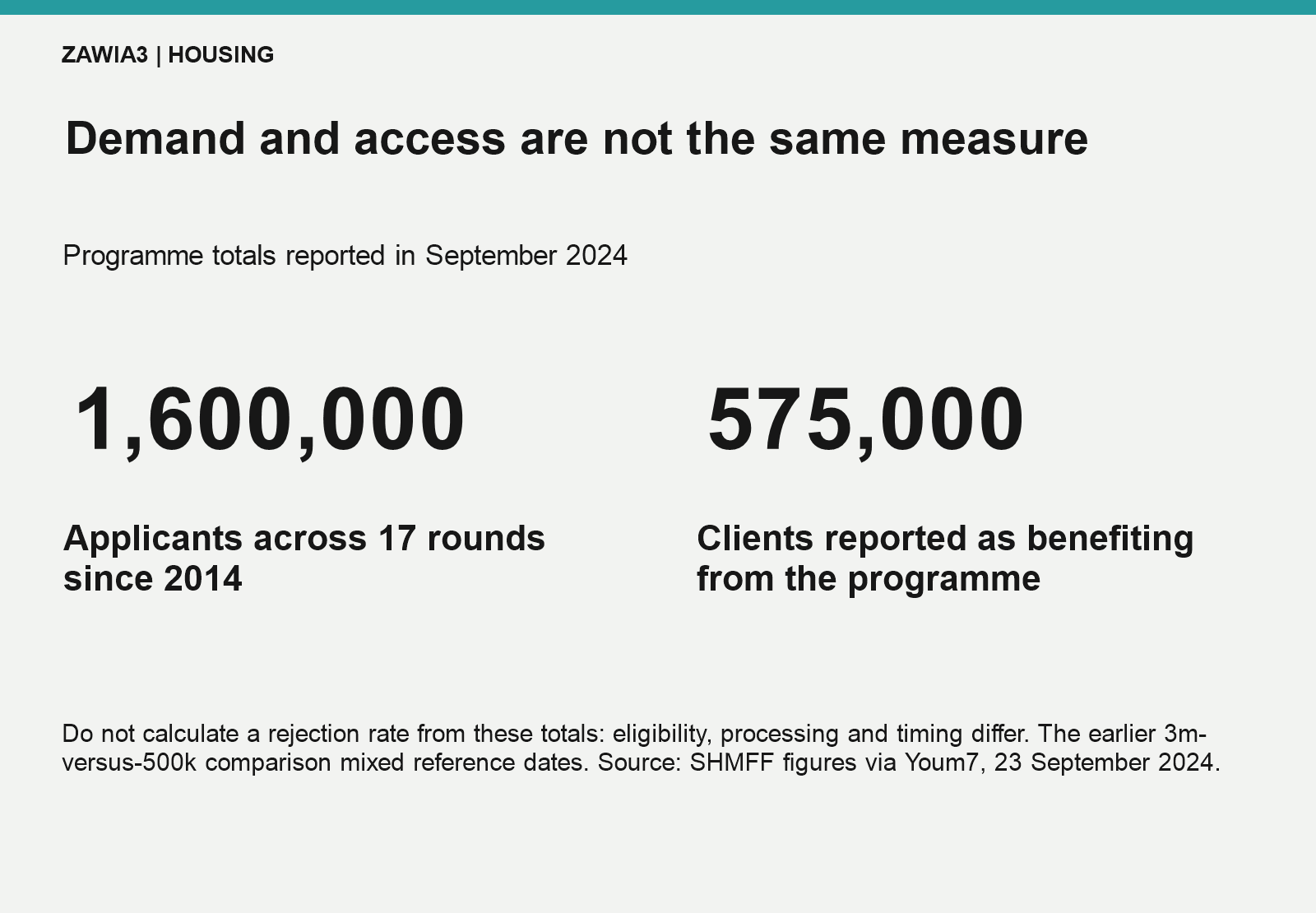
Zawia3 examined statements and published figures on applications, construction and access to housing. These measure different things and must be read with their reference dates. A longer-term estimate of three million applicants cannot be compared directly with roughly half a million beneficiary households in a May 2022 report to calculate refusals or overdue deliveries.
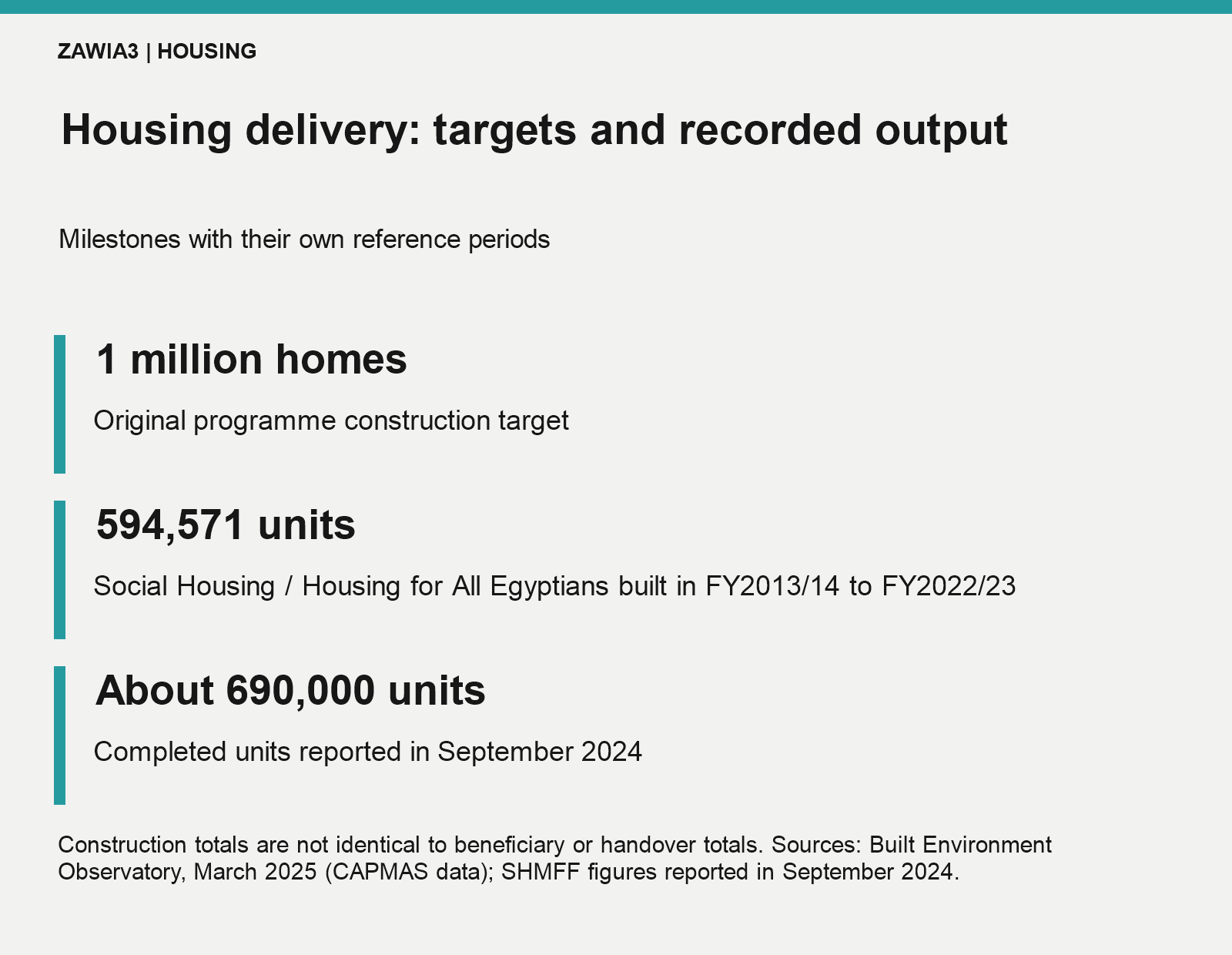
The programme launched in 2011 with a one-million-home objective. A Built Environment Observatory analysis published in March 2025, using CAPMAS data, records 594,571 units built under Social Housing/Housing for All Egyptians during the financial years 2013/14 to 2022/23. That is approximately 60% of the million-unit target, although building, allocating and handing over a home are separate stages.
In one 2014 offering of 63,000 units, about 144,000 people applied. Around 60% were reportedly excluded for reasons relating to documents and eligibility, leaving approximately 57,600 eligible applicants. One round in 2016 reportedly drew about 500,000 applications.
A report published in April 2021 referred to more than 1.5 million applicants across 14 rounds through December 2020 and more than 380,000 allocated units. Another figure of 335,000 in that coverage cannot safely be presented as a later stage of the same series without reconciling its scope.
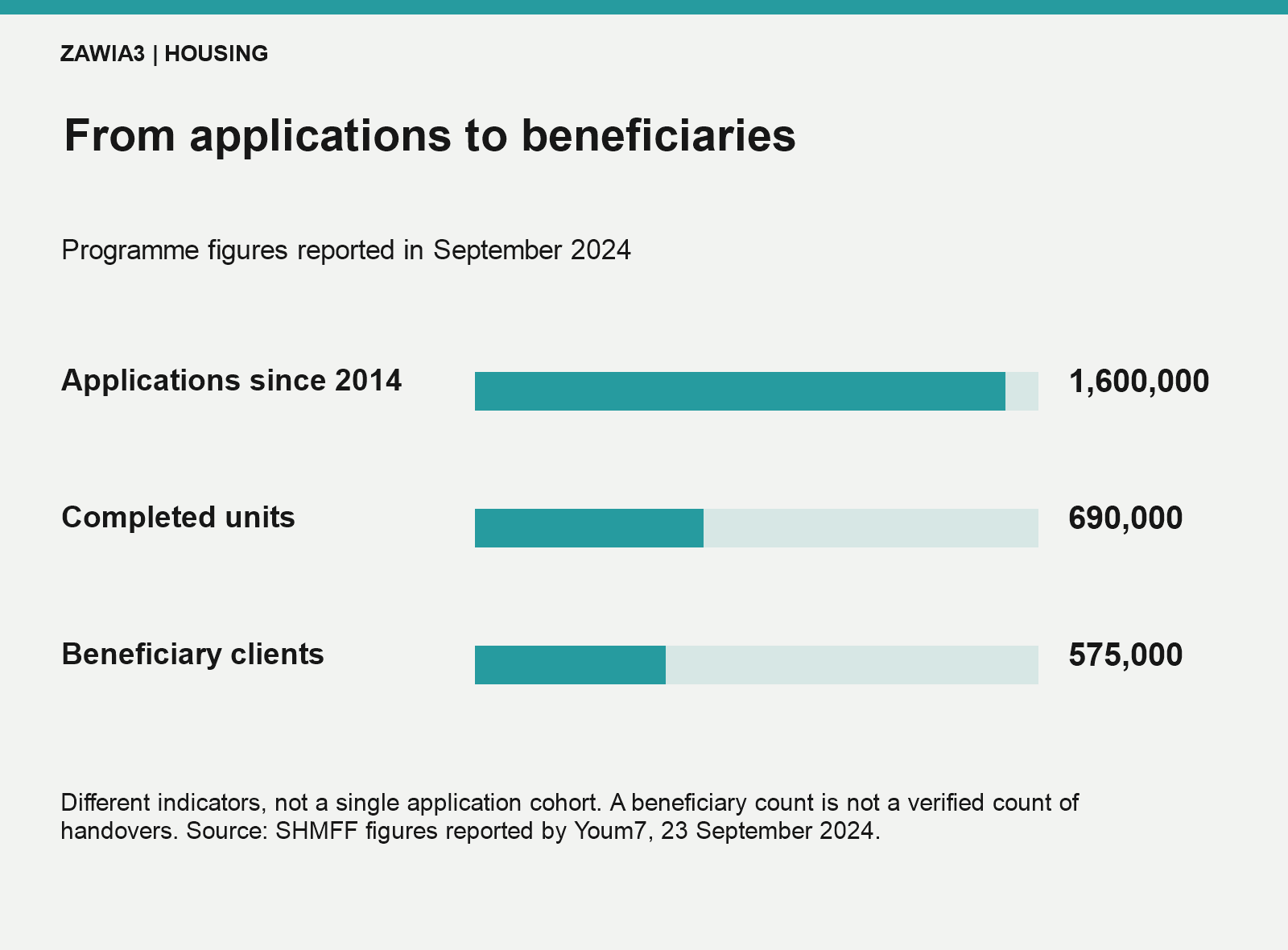
By the figures reported in September 2024, about 1.6 million people had applied across 17 rounds since 2014, roughly 690,000 units had been completed and around 575,000 clients had benefited. These totals are not a single cohort tracked from application through handover, and “beneficiaries” is not automatically a verified count of completed handovers.
Housing-policy researcher Yahya Shawkat, founder of the Built Environment Observatory, argues that homeownership depends on wealth as well as income. A household needs savings for a deposit and enough regular earnings to qualify for mortgage repayments. Together, those conditions exclude some of the poorest people.
He favours rental-based social housing: either publicly offered rental homes or cash support allowing eligible households to rent on the market. He argues that the existing subsidy budget could serve more families more quickly through rental assistance.
Building homes for sale is a supply-led approach, he explains: a set number of units is planned where land is cheap or free, and then offered to applicants. Demand may be high in one location and weak in another. Some households are left waiting for another round because suitable homes are unavailable where they need them, while units elsewhere remain unsold despite the use of social-housing resources.
Reoffering those units later, sometimes to higher-income groups, is an attempt to repair that mismatch, he says. A demand-led approach would begin by examining housing need in each town and village, then allocating resources locally.
Shawkat acknowledges that social housing has benefited many families. The question, he says, is how their number compares with the flow of households that need support each year, particularly in a country with a large stock of closed or unused homes.
He gives an illustrative calculation: if there are roughly 800,000 new marriages a year and 30% of those new households are poor and require housing support, that would imply 240,000 households needing help annually. This is his illustrative assumption, not a statistical count of newly formed households’ housing needs.
Need also changes. Some families become better off and can leave a support programme; others lose income and need assistance. People may travel or emigrate. Rental-based programmes, he argues, can adapt more readily to those shifts.
For applicants who have committed their savings to a promised home, delays affect both daily living and trust in public institutions. Timely delivery matters, but so do clear accounts, realistic schedules and mechanisms that protect buyers when commitments are missed. Their complaints point to the need for housing policy that responds to where people can afford to live, and to what happens to them while they wait.
Editorial clarification: World Bank loan amounts and the dates and definitions of several indicators have been corrected. Unsupported financing percentages have been removed. The reporting and interviews concern circumstances up to 17 June 2025.