


While Prime Minister Mostafa Madbouly was inspecting the Latin Quarter project in the city of New Alamein in mid-July this year, and listening to an explanation from the Minister of Housing about the readiness of thousands of housing units for handover, dozens of owners who had contracted to buy units in the project since 2024 and 2025 were continuing to post their complaints and appeals on social media platforms, calling on the government to intervene to end what they describe as a crisis of delayed handover, the change of specifications of some units, and the continued collection of instalments and maintenance fees even though they have not received their units.
During the tour, Randa El-Menshawy, Minister of Housing, Utilities and Urban Communities, stressed that the Latin Quarter project is being built on an area of 404 feddans and includes 52 residential compounds with a total of 178 buildings containing 10,316 units, while the head of the New Alamein City Authority, Mohamed Khalaf, explained that the project is seeing the handover of 5,368 housing units during this July, after the handover of 1,940 units had previously been completed, with finishing and utilities works continuing in the other areas.
On the other side, however, the testimonies of a number of owners, along with documents reviewed by Zawia3, reveal another account, as those affected by the project say that they paid millions of pounds for units they have not received to date, despite the contractual deadlines having passed, while the company continues to demand that they pay the periodic instalments and maintenance fees.
According to the testimonies of the owners who spoke to Zawia3, the crisis is not limited to the delay in handing over the units, but includes changes to some of the advantages they contracted for, varying levels of finishing and the imposition of new fees and conditions, in addition to complaints relating to the mechanism for dealing with grievances and with requests for refunds or for the cancellation of contracts, which some of them affirm were carried out without following the legal procedures stipulated in the contracts.
Trust in a Government Project
Sherif El-Hadary, one of the affected owners and a lawyer before the Court of Cassation and the Supreme Constitutional Court, says that the governmental nature of the project was one of the most important reasons buyers flocked to it, even though the contracts were concluded through two companies, “City Edge” and the Saudi Egyptian Construction Company.
El-Hadary adds to Zawia3 that the crisis facing buyers extends to what he describes as an “imbalance in the contractual relationship” between the company and the clients, explaining that the Authority entrusted the marketing and contracting work to the two aforementioned companies, but that the owners are ultimately dealing with a government project, which gave them greater confidence when making the decision to buy.
One of the owners (M.E.), who preferred not to be named, agrees with him, saying: “I used to avoid buying property from private companies, and I turned to a government project believing that it offers greater guarantees and protects clients’ rights.”
He explains that the sales team made numerous marketing promises to buyers before contracting, including allocating a private beach for owners and free access to Alamein events, but after signing the contract he was surprised to find that these advantages were not written into its clauses, and that the company considered them mere “non-binding” marketing talk, noting that the contracts include clauses that give the company broad powers without providing corresponding guarantees to buyers.
Since its launch, the Ministry of Housing and the New Urban Communities Authority have promoted the “Latin Quarter” project as one of the most important housing projects in the city of New Alamein, relying on its European architectural style and its distinctive location on the Mediterranean coast, in addition to what the official bodies describe as integrated services and utilities, which made it one of the most attractive projects for buyers looking for housing or investment in the new city.
For his part, El-Hadary criticises the terms of the contracts that give the company the right to withdraw the unit if the client is late in paying two instalments, with 10% of its value deducted as compensation for damage and the rest of the amounts then refunded in instalments extending over several years. He considers this a breach of contractual balance, adding: “If the client is one day late in paying the instalment, a late-payment penalty of 2.5% is imposed on him, while the company bears no similar obligation when it is late in handing over the unit.”
Buyers also face other financial and administrative problems during contracting; (M.E.) explains that he faced difficulties in the calculation of instalments transferred in dollars, as the company applied exchange rates lower than the official rate prevailing at the time of the transfer, which led to him being asked to pay financial differences amounting to tens of thousands of pounds despite his submission of official bank documents.
El-Hadary also criticises the continued collection of assignment fees when units are resold, despite court rulings confirming the owner’s right to dispose of his unit after ownership has passed to him, noting that the value of these fees varies between contracts, reaching 5% in some and 10% in others.
Delayed Handover
Sherif El-Hadary indicates that he contracted to buy his unit in 2024, and it was scheduled to be handed over during August 2025, with the company granted an additional contractual grace period of one year ending in August 2026, but he has not received his unit to date, despite having paid more than half of its value (he paid more than EGP 3 million out of EGP 6.7 million, in addition to maintenance fees).
El-Hadary affirms that he visits the project site constantly, and has not noticed any significant progress in construction works for more than a year and a half, explaining that the finishings, façades and staircases are still as they were, and that building materials and tools have remained in place for many long months, attributing the delay to disputes between the company and the executing contractors in some areas. He adds that the crisis is not a matter of individual cases but involves between seven and eight buildings that are completely delayed.
Owner (M.E.) agrees with him on the delay in handover, explaining that his original date was in August 2025, with a grace period ending in August 2026, but that only a limited percentage has been handed over so far.
El-Hadary criticises the disparity in handover priorities: there are clients who contracted in 2025 and have already received their units, while those who contracted in 2024 are still waiting for handover, without clear criteria justifying this disparity. He points out that when the handover of units was delayed, the “Saudi Egyptian Company” stopped collecting instalments from clients until handover, while “City Edge” merely informed buyers that it would reschedule the instalments under a clause allowing it to extend the payment period.
He believes that this measure does not remedy the harm but could lead to an increase in the value of the instalments due instead of easing the burden, stressing that the company is asking them to accept a new timetable despite its failure to meet the previous dates, and asking: “The contract is based on handover on a specific date, and if the company did not abide by it, what guarantee is there that it will abide by any new date?”
Poor Quality of Finishing
El-Hadary criticises the level of finishing in the units that have been handed over, stressing that unit prices exceeded EGP 50,000 per metre, while the finishing fell below the level expected of a project of this size and value, which prompted a number of owners to submit complaints about the quality of execution.
(M.E.) agrees with him, stating that the limited number of units that were handed over had clear defects in the floors, ceramics and paintwork, and shortcomings in the installation of windows and of kitchen and bathroom fittings, in addition to unprofessional execution, while the company was asking clients to sign handover reports on the promise of fixing the defects later, which the owners have not seen carried out after signing.
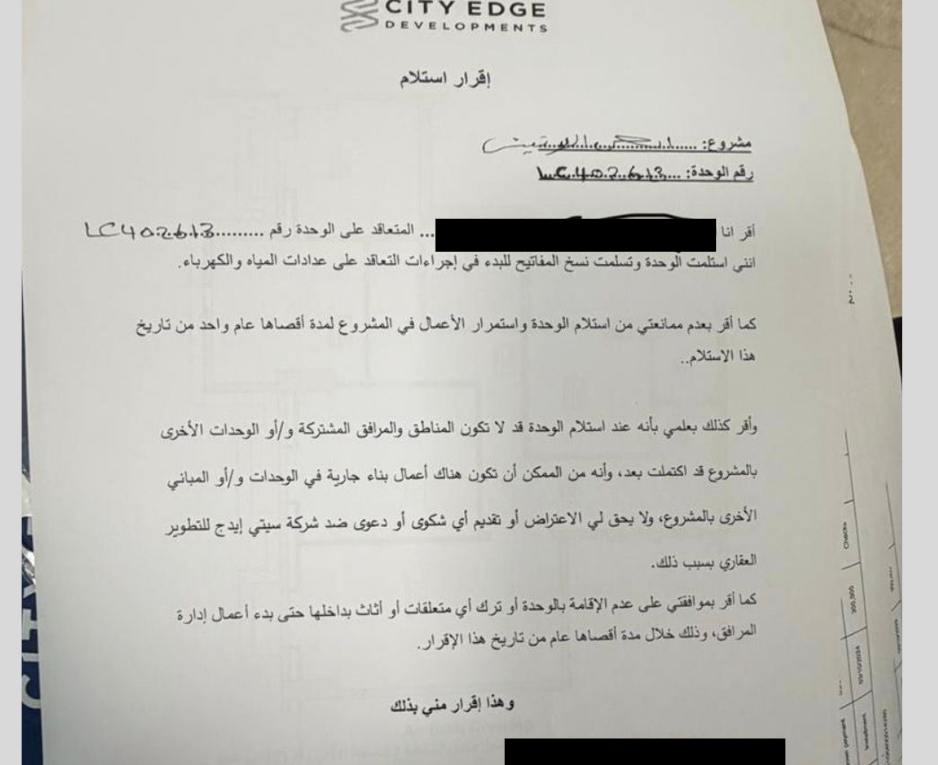
(M.E.) reveals that the company was sending official letters stating that the units were ready and giving them a two-month deadline for taking delivery, after which the unit would be considered “constructively received” even if it was not fit for habitation. He adds that some buyers were asked to sign an undertaking not to reside in the unit or use it for a full year after handover, with the aim of avoiding holding the company responsible for the delay in handover or facing claims for compensation, stressing that he refused to sign and was forced to call the police while trying to take delivery of his unit, whereupon the company withdrew its request.
The “Lagoon” File, the Beach and the Change of the Master Plan
The owners raise the substantial amendments made to the project’s master plan as one of the most prominent aspects of the dispute. (M.E.) tells Zawia3 that the owners bought the units overlooking the “lagoon” (the artificial lake) in the northern zone, which are the most expensive in the project, based on the announced master plan, but they were later surprised by the filling in of nearly a third or a half of the lagoon’s area and its conversion into a private beach that was leased to the Saudi Egyptian Company, with a wall built that blocks the view from the units overlooking it.
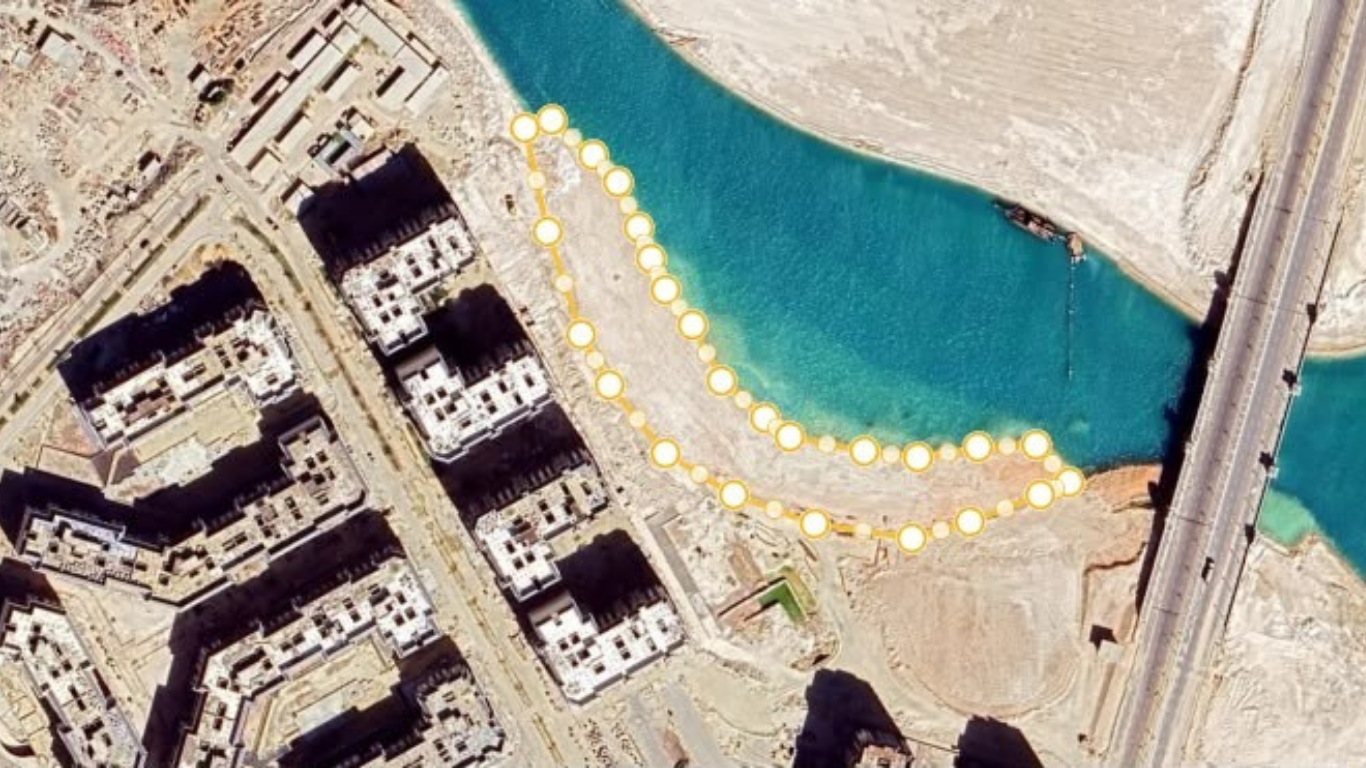
For his part, Sherif El-Hadary points out that this change undermined the advantages on which the purchase decision was based: the units overlooking the sea and the lagoon were the most expensive, with some of them reaching about EGP 6.7 million when contracted in 2024, while units in the southern zone were sold for only about EGP 2 million. Despite this, the owners of the most expensive units were deprived of the use of the lagoon and the new beach, and its use was restricted to clients of the Saudi Egyptian Company, while the cheaper units came to enjoy rights to use it.
Counsellor Hossam Magdy, a lawyer and one of the affected owners, explains to Zawia3 that he faced the same problem after receiving one of his units in the northern zone (which he bought for about EGP 5 million in place of his old unit in the southern zone, worth EGP 2 million, to benefit from the advantage of the view and the beach), as he was surprised to find that the beach opposite the unit is not allocated to the owners of the Latin Quarter but is subject to the management of the Saudi Egyptian Company, while the beaches available through the app are open to the public and not restricted to owners.
Magdy reveals that he learned from officials at the Saudi Egyptian Company that the latter had undertaken to prepare the lagoon area and had spent about EGP 15 million on it, in addition to paying a usufruct fee of about EGP 250 per metre, while “City Edge” refused to contribute to this cost, which resulted in its clients being deprived of the use of the area and in subscriptions being imposed on Latin Quarter owners wishing to use it.
Imposing Additional Costs
(M.E.) points out that upon handover the company required owners to install a central air-conditioning system of the (VRF) type, even though this condition was not included in the contracts, with the cost of installing it ranging between EGP 300,000 and EGP 500,000 depending on the area of the unit, in addition to demanding that they pay the cost of the external air-conditioning connections, even though these were among the company’s announced obligations.
The owners affirm that the project lacks the minimum of basic services: the buildings suffer from power cuts and weak water pressure, and from the absence of landline internet or natural gas connections, with lifts out of order in a number of buildings and a lack of sufficient parking spaces. This comes despite owners having paid large sums to connect utilities (more than EGP 80,000 per unit), in addition to maintenance fees of 10% of the unit’s value collected years before handover (some of them paid more than EGP 1 million in maintenance fees), without any actual maintenance services or facilities operating in the project.
Counsellor Hossam Magdy and the owners also criticise the weakness of the security system: the project lacks an external wall controlling its entrances, and the security personnel present belong to the executing contracting companies and are not responsible for securing the owners’ property. Workers move freely inside the buildings without any mechanism distinguishing the units that have been handed over, which raises owners’ fears about the safety of their property and their privacy. They point to an attempted night-time break-in at a housing unit belonging to one of the female owners, and to the company merely increasing the number of security personnel in a token manner and officially informing owners that it is not responsible for furniture inside the units after handover.
Stalling on Refunds and Arbitrary Cancellation
(M.E.) reveals incidents that were repeated with a number of buyers involving the reservation of housing units and the payment of reservation down payments, before the company later informed them that the units they had chosen had already been sold due to errors by sales staff or updates to the booking system, and they were asked to choose alternative units. If they rejected the alternative and demanded a refund of their money, the company stalls in returning it for periods lasting between six and nine months, which represents a means of holding on to clients’ money and benefiting from it financially. He affirms that some buyers have been forced to resort to the courts, such as Dr Abeer, who filed a lawsuit against the company that is still pending before the courts.
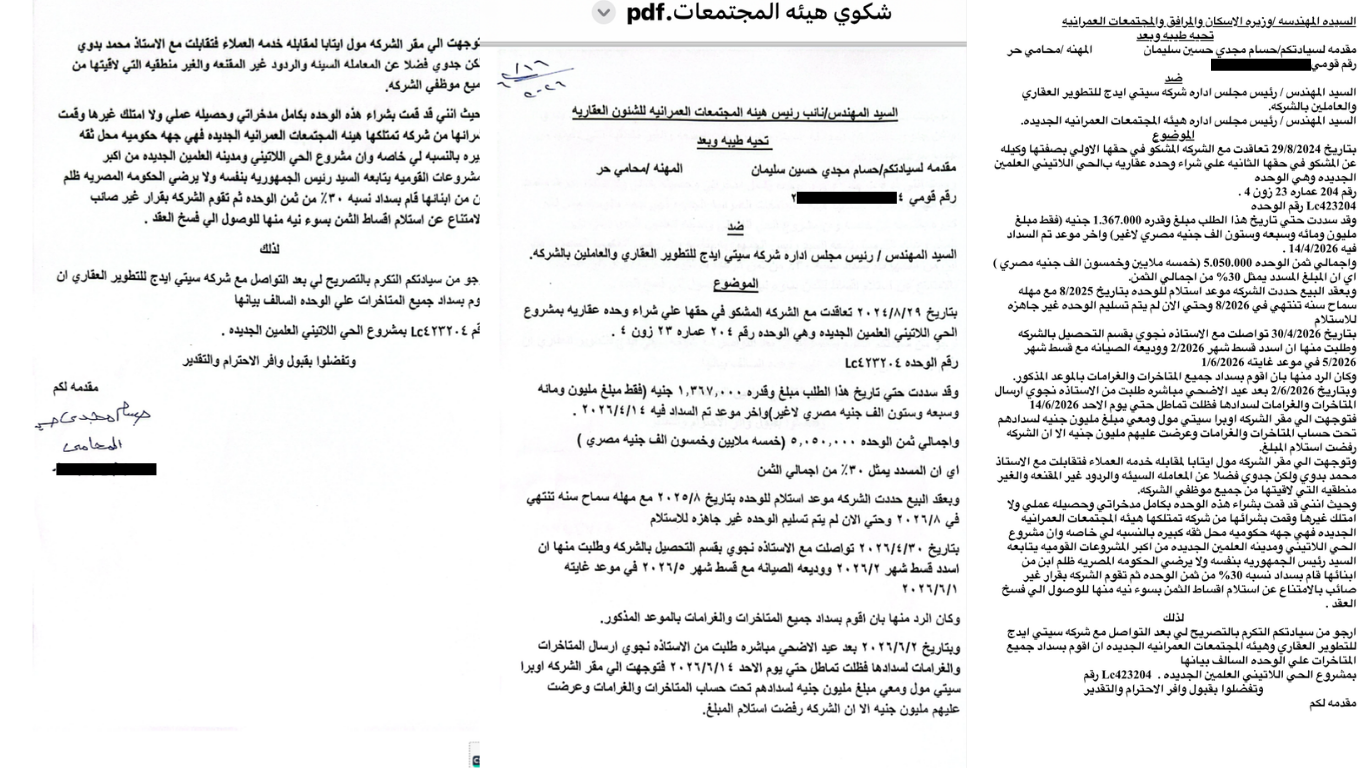
Counsellor Hossam Magdy recounts the unilateral cancellation of his contract for his second unit, whose handover was delayed, explaining that the company, without his consent, directed the instalments he was paying to the maintenance deposit account (amounting to EGP 400,000, which the company insisted on collecting before handover), which led to him being considered late in paying the instalments, only to be surprised by the cancellation of the contract without being notified, sent a formal warning, or the company resorting to the courts to establish the cancellation.
Magdy adds that when he went to pay the overdue instalments, the company refused to accept the money and informed him administratively that the contract had ended, giving him the choice between accepting the cancellation with 10% of the unit’s value deducted (he had paid about EGP 1.5 million, representing 30% of the value of his unit, worth EGP 5 million) or transferring the amounts to another project at its current prices, which he considers unfair, especially as the price of similar units currently reaches EGP 8 million, while the company insists on cancelling the contract.
The owners point out that the complaint submission mechanism itself lacks transparency: the company relies on an electronic application that does not allow clients to keep a copy of the complaint or its tracking number, while the customer service centre refuses to document correspondence by email.
Counsellor Hossam Magdy and lawyer Sherif El-Hadary have submitted numerous complaints and formal warnings to the company, the New Urban Communities Authority, the Ministry of Housing, the Administrative Control Authority and the Prime Minister’s Office, but they have not received any clear responses or measures addressing the crisis to date, and some officials have merely regarded the owners’ grievances as “posts on social media”.
Magdy believes that what is happening not only affects buyers’ rights but also affects the reputation of government projects and citizens’ trust in them, noting that “City Edge” manages major projects in the Administrative Capital, Alamein and New Mansoura, and citing circulating complaints from owners in the “Al Maqsad” project in the New Administrative Capital about delays in implementing some basic services such as electronic gates.
For his part, Sherif El-Hadary stresses that the continuation of the current situation leaves owners facing options that are all costly: either continuing to pay instalments without receiving their units, resorting to terminating the contract with the loss of a percentage of their money and recovering the remaining amounts over years, or entering into long legal disputes. He adds: “If the money we paid had been deposited in banks, it would have generated a large return over the past years; but now we have neither obtained our units, nor recovered our money, nor do we know a clear date for handover.”
Zawia3 made a point of contacting City Edge to obtain a response regarding the incidents contained in the owners’ testimonies relating to the delay in handover, the continued collection of instalments and maintenance fees, and the changes that buyers say have been made to the project, in addition to what has been raised regarding the procedures for cancelling some contracts and the mechanisms for dealing with complaints. Company officials confirmed receipt of the inquiries and informed us that a representative of the legal department would get in touch to respond to what was contained in the investigation, but Zawia3 had not received any response by the time of publication.
Zawia3 also addressed the New Alamein City Authority, affiliated with the New Urban Communities Authority, with an official request to comment on the complaints and incidents contained in the investigation, but no response had been received from the Authority by the time of publication.
Zawia3 affirms its readiness to publish any responses from the company or the relevant bodies as soon as they are received, in keeping with the right of reply and with making all points of view available.
The project, which was promoted as one of the most prominent fourth-generation projects, has become for a number of buyers a model of a conflict between what they were promised at contracting and what they say they found on the ground. While the government affirms that handover works and the completion of the project are continuing, owners continue to demand fair solutions that guarantee their complaints are addressed according to clear and transparent procedures.