
Since the end of December 2020, Rabab al-Sharqawi and her three daughters have lived with the consequences of losing their home in Qaraqes, a village in Beheira governorate. Like other residents interviewed by Zawia3, she says her family was compelled to leave without receiving replacement housing.
Nearly five years before this report’s publication on 30 November 2025, residents of the earthquake housing, Madinat al-Arais and neighbouring estates were told by the Sharnoub local council to vacate buildings classified as unsafe. Rabab recalls a deadline in mid-January 2021. Residents objected because no alternative homes had been provided.
According to her account, water, gas and electricity were cut after the deadline, and people entered the buildings and forcibly removed water pipes, flooding apartments and damaging furniture. Residents then had to leave. She says the council sent refuse-collection trucks to transport their belongings.
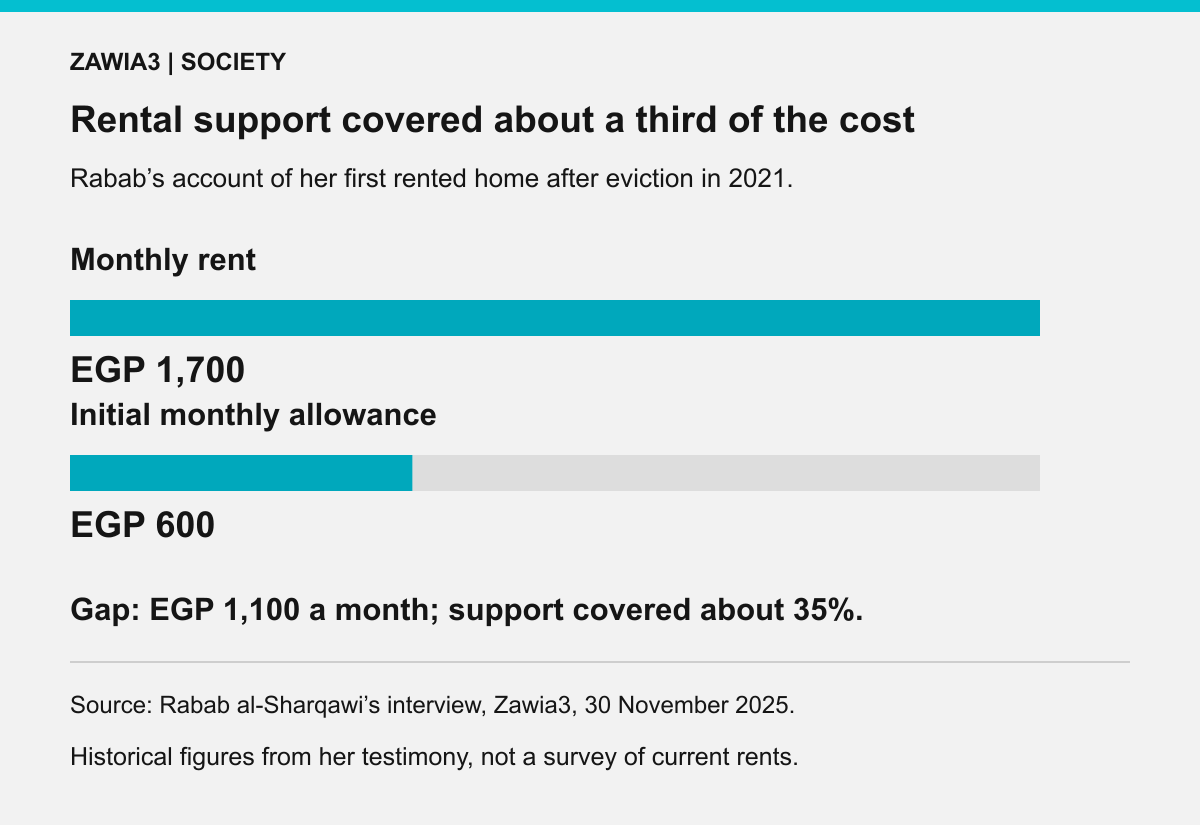
Rabab, a nurse and sole provider for her daughters, did not know where to take them in the winter cold. She says residents were promised new homes within two years and a monthly rental allowance of EGP 600. She initially rented a small apartment with one room, a kitchen and a bathroom for EGP 1,700 a month.
She says the allowance stopped after the first year, while complaints circulated between local bodies without resolution. Officials told residents the governorate lacked the budget to provide replacement housing, she recalls.
Rabab describes repeated unsuccessful attempts to meet officials, despite written requests and documented faxes to the governorate and Housing Ministry. She says residents had paid deposits and monthly instalments for more than two decades, expecting to acquire ownership after a 25-year contractual period, but were removed shortly before the date they expected final title deeds.
She recounts that the original housing programme sold units through the council for EGP 5,000, alongside monthly payments. Apartments were subsequently transferred through successive contracts. In 2008, she bought her earthquake-housing apartment for EGP 50,000. When she approached the council to settle outstanding amounts, she says she was asked to pay another EGP 100,000, which she paid in instalments.
When she requested the final ownership contract, she says she was told to wait until all residents of the building settled their remaining payments. Instead of receiving deeds at the anticipated date, they were evicted.
Rabab says the monthly council payment was EGP 56, described as covering repair, maintenance and rent. Before the eviction, residents were asked for EGP 4,000 per apartment for repairs, later reduced to EGP 1,500. She says they paid, gas was disconnected ostensibly for repair safety, and an eviction decision followed two months later.
She distinguishes the three buildings demolished in 2018, which received press coverage, from subsequent removals affecting other blocks. In her account, hundreds of residents in al-Gababin, Ezbet al-Kom and the earthquake housing experienced a similar outcome. She describes 18 buildings with 24 apartments each, while noting that some units were vacant; those figures therefore do not establish the number of occupied households.
“I am divorced and have three daughters,” Rabab says. She describes widows and sick residents facing the same insecurity, and an allowance that, after protests, resumed at EGP 500 a month rather than EGP 600, paid irregularly in EGP 1,500 batches.
She says her family left in 2021, payments stopped the following year, and contracts for alternative apartments were later signed without the homes being delivered. Another interruption in payments in 2025 led residents to protest outside the Sharnoub council and block the road, she says, but produced more promises.
Payments without secure homes
Mohamed al-Tantawi, another resident affected by the demolition, says families had lived in the housing for approximately 25 years. Some were earthquake survivors; others had acquired units under the Madinat al-Arais programme. They expected ownership documents around January 2021 but instead received instructions to leave without documents guaranteeing their rights, he says.
Al-Tantawi recalls a deadline at the end of December and a warning that anyone who stayed would be removed by force. He says monthly payments included maintenance charges, yet no meaningful maintenance was undertaken while they lived there.
He tells Zawia3 that representatives associated with the Tahya Misr Fund had visited to collect residents’ details and address arrears, but settled debts for only a limited number of poor families. After eviction, the buildings were demolished, with promises that the Decent Life initiative would rebuild them. He says those promises remained unfulfilled when interviewed.
Having lost his work as a cook during the coronavirus pandemic, al-Tantawi describes severe financial hardship. He rented two separate rooms on different floors because he could not afford a suitable apartment. Other families found temporary rentals or stayed with relatives.
He says the EGP 500 monthly allowance repeatedly stopped for months, and EGP 1,500 payments every three months did not cover replacement rent. He argues that residents’ preliminary ownership contracts, monthly purchase instalments and officially registered powers of attorney were inconsistent with the governorate’s later position that the housing had only been occupied under usufruct arrangements. The report records that dispute; it does not establish ownership through an independent legal examination of all contracts.
Al-Tantawi also disputes the buildings’ unsafe classification, pointing to their condition and to reinforcing steel recovered during demolition. Those observations are his testimony, rather than an independent engineering assessment. He accuses the council of collecting repair fees without carrying out the work.
He says a previous attempt to protest at the governorate resulted in security forces dispersing residents, followed by payment of only three months’ allowance. He calls for regular payments or fair replacement housing that allows families to regain stability.
Mustafa Ahmed gives a similar account. He says an earlier repair decision was replaced by demolition, although he believed the buildings did not require complete removal. The promises of compensation and alternative accommodation had not been fulfilled by the time of his interview.
Mustafa says he and others went more than 13 months without receiving an allowance. After repeated visits to officials, their names were restored to the payment lists, but they were told earlier unpaid amounts would not be reimbursed.
He describes an initial EGP 600 monthly allowance, subsequently interrupted and reduced to EGP 1,500 every three months. When residents requested replacement apartments on the basis of their rent-to-own arrangements, he says they were told no units were available.
For Mustafa, the problem is reinforced by responsibility being passed from one local body to the next. He alleges favouritism and says ordinary residents are left without a clear route to securing their rights.
A repair decision that residents say was never implemented
The village’s infrastructure problems predated the removals. A 2016 press report described sewage flooding, rising groundwater and long-standing neglect in Qaraqes, despite its proximity to Damanhour. A 2018 report described around 2,000 residents of Ezbet al-Kom facing deteriorating services, wastewater pooling and complaints that drinking water was contaminated.
Residents interviewed in that earlier coverage said they had paid around EGP 500 per unit for repairs or sewerage connections, but the work had not been completed at the time. They described expensive sewage-emptying vehicles, widespread rubbish, insects and gastrointestinal illness. These are accounts from the earlier reporting, rather than a fresh population count or health survey.
In June 2015, the Housing Ministry announced approval of Qaraqes’s urban boundary, within the Sharnoub local unit in Damanhour district. The announcement concerned the administrative planning boundary; it did not itself settle the subsequent dispute over residents’ housing contracts.
In February 2018, partial collapses affected ceilings and walls in 59 units across three buildings. Then-governor Nadia Abdo announced temporary rentals at the governorate’s expense in Damanhour, for a year subject to renewal until permanent alternatives were arranged, or ready alternative apartments in Badr district for residents who wanted them. Those three buildings later received a demolition decision.
A separate September 2021 report said then-governor Hisham Amna had approved funding for maintenance and upgrading of 20 residential blocks containing 380 housing units and 20 shops in Qaraqes. The listed work included sewerage connections, treatment of columns, beams and ceilings, and improvements to entrances and ground-floor levels. Residents interviewed by Zawia3 say the repair instructions did not lead to the promised rehabilitation, and that housing was instead emptied and demolished.
The different figures in these accounts concern different groups of buildings and reporting periods. The 59 units in three buildings, the 380 units in the announced repair programme and Rabab’s description of 18 blocks should not be combined into a single total of displaced families.
Zawia3 reviewed a residents’ submission to the Beheira governorate’s citizens’ service office, identified in the source report as request No. 1978 dated 28 July 2022. It alleges that residents of housing at the edge of Ezbet al-Kom were forcibly removed on 15 January 2021, after intimidation and utility cuts, and that some vacant apartments were robbed.
The submission describes belongings being transported on council refuse trucks and promises of alternative housing within two years. It says cards were issued for a temporary EGP 500 monthly allowance, that payments ceased after a year, and that subsequent payments covered only 68 people following new social assessments. These are allegations and administrative details recorded in the residents’ complaint, rather than findings issued by the governorate.
The complaint also records approaches to Shubrakhit, Damanhour and Sharnoub officials, a promise of alternative apartments and a signing in February 2022. It describes residents being directed between councils and asked to wait while financial officials referred the matter upwards. The report does not reconcile every stage of that complaint’s chronology with the separate accounts of individual households.
What would adequate housing require?
Urban policy specialist Ibrahim Ezz al-Din, founder and policy director of Diwan al-Omran, says Egypt’s redevelopment policies too often leave basic questions unanswered, beginning with whom planning is intended to serve. Replacing unsafe buildings is not inherently the problem, he argues; the absence of published plans, transparent criteria and residents’ participation creates repeated crises.
He says removal decisions should be based on an assessment of risk, rather than on isolated cracks or a partial ceiling failure being taken as proof that an entire area must be demolished. Egypt’s unsafe-area classification distinguishes threats to life, unsuitable shelter, health risks and insecurity of tenure. Engineering decisions on repair, partial removal or demolition require assessment of the relevant buildings.
Ezz al-Din argues that demolition without adequate legal safeguards, immediate suitable alternatives or sufficient compensation can amount to forced eviction. Redevelopment, he says, does not exempt authorities from international housing-rights standards.
The UN Committee on Economic, Social and Cultural Rights’ General Comment No. 7 addresses forced eviction and the required protections. Its distinction concerns removals without appropriate legal or other protection; it does not mean that every lawful safety-related evacuation is prohibited.
Ezz al-Din considers an irregular EGP 500 allowance inadequate to secure safe accommodation. He argues for either suitable replacement homes or financial assistance that reflects actual housing costs, alongside enforceable arrangements to repair the harm experienced by residents.
The seven elements of adequate housing are security of tenure; availability of services, materials, facilities and infrastructure; affordability; habitability; accessibility; location; and cultural adequacy. He argues that residents’ accounts reveal failures in several of these areas.
He interprets aspects of redevelopment policy as an effort to raise the investment value of poor areas and says delayed projects reveal inadequate planning of finance and implementation. That is his assessment of policy, rather than evidence in this report of a completed investment deal for the Qaraqes site.
His proposed alternative is genuine consultation before removal, clear information on each family’s rights and housing options, residents’ representation on local committees, and recorded agreements guaranteeing return or ownership where applicable. Suitable temporary homes, he argues, would help ensure that redevelopment benefits the community rather than imposing its costs on residents.
The official responses
By late November 2025, the residents interviewed described almost five years of postponed promises, interrupted rental assistance and uncertainty over their future homes. Their accounts raise questions about consultation, accountability and the handling of instalments and repair fees, while the legal status of their housing arrangements remains disputed.
To seek a response, Zawia3 telephoned Mohamed Masoud, head of Damanhour city and district. He said he did not know the details of the case because he had only taken office on 29 October 2025, following a decision by Beheira governor Jacqueline Azar.
Repeated calls to Azar and Damanhour MP Sanaa Barghash, a member of Mostaqbal Watan, went unanswered before the original report’s publication. Zawia3 also contacted Beheira secretary-general Hassan Mowafi about the residents’ complaint. He declined to comment and directed the reporter to the governorate’s media centre.
A media-centre representative said the governorate had been paying residents a monthly rental allowance pending replacement housing, but that he had believed the matter was resolved. He was not aware of the latest developments and promised to consult the relevant officials.
For Rabab, al-Tantawi and Mustafa, the unanswered issue is more immediate: a secure home, regular support and a clear account of when the promises made after their removal will be honoured.