

The transport minister’s decision to bar new appointees from submitting resignation and leave requests for ten years did not come as a shock to “Walid” (a pseudonym), a graduate of the Faculty of Engineering, mechanical division; he had been through something similar seven years ago, when he left his job as a logistics officer at a well-known agency at Port Said port and applied, together with three of his friends, to the recruitment competition announced by the Railway Authority in 2019. After completing several “technical” tests at different bodies, and before the appointment decision was issued, he was surprised to be required to sign a commitment barring him from requesting resignation or leave for five years; his enthusiasm turned into anxiety and hesitation in the face of such restrictions, but after a brief objection he found no way out of signing, especially since he had given up his other job.
Walid tells Zawia3 that signing up to work for five years without requesting leave or submitting a resignation was a mandatory condition for acceptance into the job, even though no one had informed him of it in the application conditions or while preparing the required papers; while he was at the Military Academy to begin training, consisting of physical fitness exercises, horse riding and lectures, he was surprised by an employee who came in with a paper and a pen and asked him to sign the contract, after taking away his phone so that he could not photograph it. When he asked, the employee replied that it was merely a procedure to complete the acceptance papers, and refused to give him a copy of it.
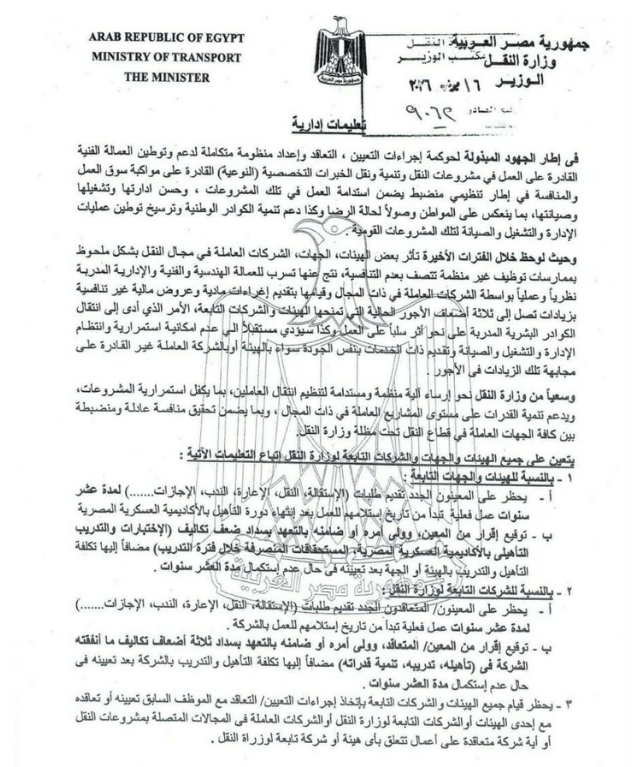
The five years became ten after Lieutenant General Engineer Kamel El-Wazir, the Minister of Transport, issued at the beginning of July new administrative instructions obliging the authorities, companies and bodies affiliated with the Ministry of Transport to bar new appointees from submitting requests for resignation, transfer, secondment, assignment or extended leave for ten years of actual work, starting from the date they take up their posts after completing the (technical and technological) training courses; the ministry also obliged the new appointee and his guardian or guarantor to sign a declaration including an undertaking to pay three times the costs of the tests and qualifying training, in addition to the entitlements paid out during the training period, if the ten-year term is not completed.
The ministry justifies these instructions, in the circular, by saying that they aim to preserve the existing technical workforce, after it observed unregulated employment practices within the transport sector that contributed, according to the circular, to the leakage of trained engineering, technical and administrative workers to other bodies and companies as a result of high financial offers, which had a negative impact on the stability of the work environment.
However, the ministry did not specify the number of workers who have left its bodies, the reasons that pushed them to leave their jobs, or the nature of the high financial offers; it confined itself to imposing penalties in exchange for requesting leave or submitting a resignation, believing that in doing so it would preserve the technical workforce.
Although the testimonies of Walid and a number of workers at the National Railways Authority to whom Zawia3 spoke indicate that they signed undertakings years ago committing them to serve for five years, the Egyptian National Railways Authority did not announce this until last year, in decision No. 6545 of 2025, whose articles oblige anyone appointed to the authority to work for a period of no less than five years starting after the completion of the prescribed training, without being allowed to request special leave or secondments; in the event of leaving work, resigning or being dismissed from service, the employee or his guarantor must repay three times the expenses spent on him while passing the tests, in addition to the wages he received for the qualifying training courses, calculated according to the period of service he spent at the authority.
To verify these testimonies, Zawia3 contacted a trade union member at the Railway Authority, who confirmed that some companies affiliated with the Egyptian National Railways Authority, operating in freight and container transport, require new appointees who have passed their competitions to sign contracts that include a commitment to continue working for five years. He attributed this condition to the cost of qualifying new workers, explaining that “the cost of preparing technical cadres may reach about EGP 300,000, including tests and training programmes, in addition to full accommodation at the Wardan Railway Institute at the employer’s expense, as well as the training courses the appointees receive before taking up their duties”.
If the compensation in the event of leaving work is calculated according to the ministry’s circular, at three times the expenses, it could reach about EGP 1 million based on the amount mentioned by the union member; this raises a question about why the Ministry of Transport has resorted to shocking mechanisms such as imposing huge financial penalties that workers cannot afford to pay if they leave work or submit their resignations, when they originally applied for jobs that would provide them with a stable and secure life.
Zawia3 contacted the media adviser of the Ministry of Transport to clarify the reasons for issuing the decision barring resignations and leave for ten years for new appointees and obliging them, if they do not complete the term, to pay three times the training costs, but he had not responded by the time this report was published.
Like many others, Walid rushed to apply to the Railway Authority’s competition in 2019 to select 150 engineers in the mechanical, electrical, communications, civil, electronics and architecture specialisations, to be employed in the authority’s various regions in Cairo and the governorates at the third grade, on condition that the applicant held a bachelor’s degree in engineering in one of the listed departments; he believed that he would enjoy many privileges if appointed to a permanent government job, but what he encountered was more like a contract of permanent monopoly.
A breach of the advertisement’s conditions
In its 2019 competition, the Railway Authority stipulates that applicants be permanent residents of the regions they apply to, with the region registered on their ID cards; yet it violates this condition, appointing a resident in his own region and then transferring him to another, according to Walid’s account to Zawia3. He says that in 2020, after taking up his post, he was surprised to be appointed as a traffic engineer in the East Delta (Zagazig) instead of Port Said, his place of residence, even though he had applied to work in his own region in compliance with the advertisement’s condition. He repeatedly objected to the transfer decision, demanding that its implementation be halted, because of the financial and physical burdens it imposed; he found that he would spend about five hours on the road between Port Said and Zagazig, there and back, in addition to the long working hours, depriving him of sufficient rest before his next shift. But his objections met no response, and he was told: “Your place is in the East Delta; follow your assignment there.” He spent a whole year moving from one place to another, sometimes working and sometimes receiving additional training, in more than one region, to confirm his fitness to work at the authority, stressing that during this year he did not receive a salary even once, at a time when he was responsible for a wife and two children.
The suffering did not end there; he adds that after the training period ended he was shocked to be assigned to work in the two governorates of Port Said and Suez at the same time, which he described as a heavy decision for a newly appointed engineer who did not know the nature of the work, leaving him to bear job burdens at both sites. He explains that assignment decisions are supposed to fall within a usual job structure comprising a section head, an engineer, a traffic chief and shunting workers, but the shortage of staff pushed the authority to assign him to cover the work in both governorates, even though the distance between them is great, and he found himself facing a fait accompli he could not refuse. His suffering continued in this way throughout the five years, without obtaining leave even once, or on special occasions.
Although the Cabinet issued a decision granting periods of secondment and special unpaid leave for work abroad, after the employee obtains the approval of the competent authority within a period not exceeding fifteen days, and the Minister of Transport issued a decision approving the granting of unpaid leave to workers in the transport sector after banning it in 2021, the authority rejected Walid’s request last year for leave to work abroad, after he had thought it was an opportunity that would open a door for him out of the system that had weighed him down, so that he could move to a job with a higher salary; five years had passed since he signed the decision barring resignations and leave, which allowed him to apply for one year’s leave.
Walid tells Zawia3 that after he obtained the approval signatures on his leave request from all the competent departments, from the department director up to the head of the central administration, his request stalled, along with that of another colleague who had also applied for leave to work abroad, without either of them knowing why; instead of receiving the approval decision, he was surprised by a decision transferring him to work in the infrastructure sector.
Walid explains that the news struck him like a thunderbolt; on the one hand, he lost the opportunity to work abroad after he had built hopes on a salary much higher than what he receives at the authority, which does not reach EGP 10,000 and from which a large part is deducted for comprehensive health insurance, in addition to about a third of it for taxes, according to him. On the other hand, the infrastructure sector changed the nature of his work entirely, as he moved from his specialisation in freight and container transport logistics to monitoring railway lines, ensuring the readiness of switches and blocks and monitoring faults that may affect train traffic, which brought him back to square one and required him to be qualified and trained in another field from the beginning. He was also forced to pay the price of the contract, which amounted to EGP 100,000; after he completed the five years and requested leave and was met with refusal, he decided at that very moment never to return to the Railway Authority.
Walid’s story is a mirror reflecting the reality of work within the transport sector’s authorities; he states that his entire cohort faced this recurring pattern of restrictions, to the point that some of them found no way out other than leaving work, after seeing a number of them referred to the military prosecution over ordinary work errors, and he himself was referred to the prosecution on a charge of embezzling EGP 10. Despite the financial burdens that leaving work entails, he recounts that one of his colleagues had to pay more than EGP 40,000 to obtain a clearance and end his service after three years. Walid believes that requiring five years of service in return for the training period is not sufficient justification for restricting a worker’s right to leave work, saying: “They say this training costs money. Well, what’s that got to do with us? Did anyone tell you to train us? It’s something the employer itself made a condition, so how can the worker be held to account for it?”
A penalty clause
After Kirollos (a pseudonym) learned from the authority’s recruitment management office that anyone who does not complete the service must pay EGP 130,000 as a penalty clause, he was unable to submit his resignation and accept a job offer with a salary much higher than what he currently receives at the Railway Authority, where he gets EGP 6,000, of which EGP 1,500 goes on transport alone.
Kirollos graduated from the Higher Institute of Transport Technology (the Wardan institute belonging to the railways), and he tells Zawia3 that before studying at the institute he signed a set of conditions, most notably agreeing to work for five years at the railways or its affiliated companies without requesting leave or submitting a resignation during this period, explaining that continuous work without interruption was a basic condition for studying at the institute, and that if he violated it he would have to repeat the application steps from the beginning.
After finishing his time at the institute and being appointed to one of the authority’s affiliated companies, after passing a number of tests, he points out that the nature of work at the company differs from work within the authority, explaining that the salaries of the company’s workers are paid late compared with the authority, in addition to part of the salary being deducted for taxes, which has caused him a financial burden. He explains that his biggest problem is that if he wants to end his service before his contract term expires, his resignation will not be accepted until he pays the penalty clause, which he describes as unspecified, since its value is determined case by case.
He also explains that workers’ salaries currently stand between EGP 6,000 and EGP 6,500 including incentives, which does not keep pace with the continuous rise in prices and inflation rates, while bonuses and allowances are added according to the applicable system. Price data support this complaint: the annual inflation rate in Egyptian cities rose to 14.9% in July 2026, and transport prices alone recorded an annual increase of 21.1%, while the salaries of the workers Zawia3 met range between EGP 6,000 and EGP 10,000. Kirollos believes that the continuous shortage of workers, as a result of numbers retiring, may be one of the authority’s motives for keeping as many employees as possible, but he stresses that appointment is supposed to be an opportunity to work, not a commitment that is difficult to back out of.
In March last, Lieutenant General Kamel El-Wazir had said, in a phone-in to the programme “El-Hekaya”, that the number of railway workers today stands at 34,000, compared with about 40,000 in the past and 52,000 in 2012 and 2013, that wages have tripled, and that the average wage at the authority has reached EGP 10,000, noting that the annual wage bill amounts to about EGP 4.8 billion.
From Transport to Wedding Venue: Cairo’s Monorail Struggles to Attract Riders
Staff attrition: an administrative flaw and a threat to the transport sector
Dr Mohamed Ali, former dean of the Faculty of International Transport and Logistics, attributes the Ministry of Transport’s decision to bar resignations and leave for a period of up to ten years to an accumulation of administrative and structural crises within the sector, and says that the freeze on appointments in the government apparatus for more than 15 years led to large numbers of workers retiring without being replaced by new appointments, which caused a marked shortage of qualified technical competencies to manage and operate transport facilities.
He adds, in statements to Zawia3, that the continued rise in the inflation rate, while the wage structure has not kept pace with price increases, has also contributed to the leakage of part of the technical workforce to other sectors inside Egypt or to job opportunities abroad, and he warns that the continuation of this situation will aggravate the shortage of qualified cadres, threatening the transport sector’s ability to manage its facilities efficiently as the number of workers dwindles, leaving in it, in his words, “those who cannot find a better opportunity outside government work”.
Ali believes that solutions based on decisions that support forced labour to prevent workers from accepting tempting offers from other companies will not succeed in addressing the crisis but will aggravate it, warning that the continuation of these policies may accelerate the leakage of competencies from various government sectors such as customs, taxes and the technical sectors of ministries, with a negative impact on the efficiency of public facilities and the quality of their services.
He points to the need for an alternative vision to address the crisis, through a precise study of technical workforce needs and the development of the incentive system in a way that improves incomes and limits resignations, alongside reconsidering the closure of appointment opportunities, attracting outstanding competencies, transferring expertise to new generations, and requalifying and training current workers, ensuring the sustainability of competencies and the ability of public facilities to perform their tasks efficiently.
A condition of adhesion
Aziza El-Tawil, a lawyer at the Egyptian Initiative for Personal Rights, says that the decision barring resignations and leave for ten years is illegal and cannot be imposed on workers, explaining that the Constitution regulated the right to work by referring public sector laws to the Civil Service Law, and the private and business sector to the Labour Law. She adds that the Labour Law contains fixed principles that cannot be waived, that the Labour Law considers the waiver of a worker’s right a legal violation, and that the law recognises all forms of leave, from regular and casual leave to maternity and childcare leave and sick leave, or leave for travel or for performing the Hajj; the idea of abolishing leave, in both the public and private sectors, is illegitimate and falls under forced labour.
The Constitution’s Article 12 stipulates that work is “a right, a duty and an honour guaranteed by the State”, and that “no citizen may be compelled to work except by virtue of a law, for the performance of a public service, for a specified period, and in return for fair remuneration”, while Article 13 obliges the state to preserve workers’ rights and prohibits their arbitrary dismissal. At the international level, International Labour Organization Convention No. 29 of 1930 concerning Forced Labour is one of the fundamental conventions to which Egypt is bound as a member of the organisation.
As for the ban on resignations, she explains that a worker has the right to submit a resignation whenever he wishes under the law, but with controls, as the law requires him to notify the institution before resigning so that his absence does not disrupt the work, stressing that the law has not placed restrictions on submitting a resignation. She points out that these provisions are not new but have existed for years worldwide, and were adopted from many countries to be included in the Labour Law and the Civil Service Law, whether regarding the number of working hours or the permitted leave.
She notes that the new instructions in the transport sector are illegitimate and inconsistent with the law, stressing that they will harm thousands of employees and add burdens beyond their means; anyone who wants unpaid leave or to submit a resignation will not be able to do so because of these instructions, given the restrictions they impose, such as paying the full costs if the ten-year term is not completed, and consequently paying three times the training costs in addition to the training expenses at the institute, describing it as a coercive relationship that strips the employee of rights and flouts constitutional rights.
She adds that the employee has the right to resort to the courts on the basis of the Labour Law and the Civil Service Law, affirming that the court will rule in his favour because these instructions violate the Constitution and the law, that compelling employees to sign them is a condition of adhesion, and that signing it does not mean the employee accepts its terms.
Although the Civil Service Law allows all forms of leave, its Article 56 prohibits the employee from performing work for others, with or without pay, during the leave period without a licence from the competent authority, failing which he is deprived of his wage for the leave period.
In the end, Walid left work at the authority for good, after his request for secondment leave was rejected despite his completing the five years his employer had bound him to; Kirollos, for his part, resigned himself to staying, fearing that he would find himself required to pay the penalty clause the recruitment department had informed him of, and perhaps an even greater amount.
Between the one and the other, the new ten years await a cohort that has not yet signed, set to repeat Walid’s ordeal twofold, in the absence of a clear answer about the fate of the previous cohorts subjected to these restrictions: has any of those affected filed lawsuits challenging these decisions, and if they have not, was fear of fines and financial obligations the reason for their reluctance? The broader question remains: are financial penalties and restrictions on leave and resignation the only way to preserve the technical workforce, or are there alternatives that would ensure the authority keeps its cadres without making the cost of leaving a job so prohibitive that it prevents workers from exercising their rights?