
When human-rights lawyer and former prisoner of conscience Haitham Mohamedeen talks about prison, he returns to memories he would rather leave behind.
“Prisons in Egypt are completely unsuitable for people with illnesses, even minor ones that could be managed outside,” he tells Zawia3. “Overcrowding, the lack of beds and reliance on squat toilets make life extremely difficult for patients.”
People with slipped discs and other musculoskeletal conditions suffer not only from missing treatment, he says, but also from the physical design of detention facilities. He recalls basic movements becoming painful tasks in cramped cells and prisoners sharing limited medicines in an effort to ease their symptoms.
Mohamedeen was released more than three years before the Arabic report’s December 2025 publication, after approximately three years in pretrial detention. The details remain vivid in his account.
A crisis extending beyond missing medicines
His testimony describes several overlapping problems: unsuitable detention conditions, limited equipment, inadequate specialist care and delayed responses to emergencies.
He says prison clinics often provided painkillers regardless of the condition, and obtaining a doctor after cells closed at 6pm could be extremely difficult. He recalls nurses borrowing blood-pressure equipment from prisoners because official devices were not working.
Routine medical visits were largely formalities, in his assessment. At Qanater, he says, a dermatologist was responsible for diagnosing and prescribing treatment for conditions outside that specialty.
Mohamedeen points to Article 55 of Egypt’s Constitution, which requires treatment that preserves detainees’ dignity and prohibits torture, intimidation, coercion and physical or psychological harm. It also requires detention in places suitable on humanitarian and health grounds, with accessibility for people with disabilities.
Article 10 of the International Covenant on Civil and Political Rights requires humane treatment and respect for the inherent dignity of people deprived of their liberty. The Nelson Mandela Rules, adopted by the United Nations in 2015, set out international standards for prisoner treatment, including access to healthcare without discrimination.
Samar El-Husseiny, executive director of the Egyptian Human Rights Forum, describes prison healthcare as one of the most serious rights concerns. She stresses that it affects all detainees, rather than only people held for political reasons.
Appropriate healthcare does not mean taking someone to hospital for emergency treatment and immediately returning them to an unsuitable cell, El-Husseiny says. Recovery and necessary follow-up care must also be provided.
She says returning sick prisoners before they are ready can worsen their condition. Local and international rights groups have also documented allegations of withheld treatment, delayed hospital transfers and harsh detention conditions. These are accounts and findings attributed to the organisations and witnesses, rather than medical diagnoses established independently by this report.
Marwa Arafa and Hoda Abdelmonem
The Egyptian Initiative for Personal Rights reported that translator Marwa Ashraf Mohamed Arafa appeared at a hearing on 18 October 2025 exhausted and struggling to breathe. She told the court she was experiencing complications following a suspected earlier pulmonary embolism, alongside heart problems and high blood pressure, without adequate specialist treatment.
Rights organisations, politicians and public figures subsequently made an urgent appeal to the National Council for Human Rights. Arafa had been detained since April 2020 and was held at the 10th of Ramadan rehabilitation centre, Rehabilitation 4, in connection with Supreme State Security case 570 of 2020.
The appeal said she was referred for trial in December 2024 with 38 other defendants in case 19857 of 2024, First Nasr City Felonies, on charges involving membership of and financing a terrorist group.
Those seeking intervention challenged the length of her detention under Article 143 of the criminal procedure law applicable at the time. By October 2025 she had spent more than five years in detention in total; this does not mean she had exceeded a two-year limit by an additional five years.
The appeal described a serious health episode in August 2025, initially assessed as a possible pulmonary artery clot, after which her mobility deteriorated and she relied on other prisoners for assistance. According to the appeal, she received only one night of medical care before being returned to detention.
Supporters requested transfer to a specialist facility, either through Badr’s medical complex or to an external hospital at her family’s expense. They argued that continued detention without adequate care conflicted with constitutional safeguards and Egypt’s international obligations.
The appeal described Arafa as a 32-year-old translator and mother whose young daughter had been deprived of her care since the arrest. It also referred to the child’s autism and the psychological effect of witnessing her mother’s arrest at the age of two.
El-Husseiny cites Arafa’s case in questioning why a prisoner who needs specialist treatment cannot receive it in a properly equipped hospital. In her view, withholding care can become an additional punishment.
She says rights organisations are asking for basic safeguards, including treatment, access for families to medical information and permission to deliver necessary medicines. She reports accounts of medicines being barred in some prisons or sold at prices 25%–40% higher than outside. Those percentages reflect the testimonies she describes, not a systematic price survey.

Rights groups also reported a deterioration in the health of lawyer Hoda Abdelmonem. Their accounts described a clot in her left leg, serious kidney problems, a cardiac episode and loss of balance associated with a middle-ear condition. They said her family received notification of a diabetes diagnosis in August 2025.
Her daughter, Jihad Khaled, appealed to the president on 12 October 2025 for release on health grounds or through a presidential pardon. In a letter seen by Zawia3, she described her 66-year-old mother’s condition as extremely critical.
Abdelmonem had completed a five-year sentence in October 2023 but remained detained in new cases, according to her family and rights advocates.
A lawyer, rights defender and former member of the National Council for Human Rights, she was arrested in November 2018 and included in Supreme State Security case 1552 of 2018, known as the Egyptian Coordination for Rights and Freedoms case. After more than four years in pretrial detention, an emergency state security court sentenced her to five years on 5 March 2023. Rights organisations described the charges as fabricated.
Despite the end of that sentence on 31 October 2023, she was not released. On 18 November 2024, she appeared again before prosecutors in connection with case 800 of 2019, described in the report as a third case involving the same allegations.

A systemic problem
Mohamedeen recalls confusion during the coronavirus pandemic. He says he received a first vaccination dose, returned 21 days later and asked whether the vaccine was British or Chinese. The doctor told him it was a hepatitis B vaccine, he says, rather than the coronavirus vaccination he believed he was receiving.
This is his recollection of the conversation. The report does not establish the vaccine product or schedule from medical records.
He also describes extraction as the routine response to dental problems. More dangerously, he says, emergency help at night could be delayed while guards opened doors or moved between floors, including at Qanater.
He regards the problem as longstanding and particularly visible after the expansion of pretrial detention following the revolution. In his assessment, individual cases expose the absence of a functioning treatment system.
Prison clinics and hospitals alone are insufficient, he argues, especially when even public hospitals outside detention face shortages. Patients with serious or chronic conditions need access to specialist and university hospitals.
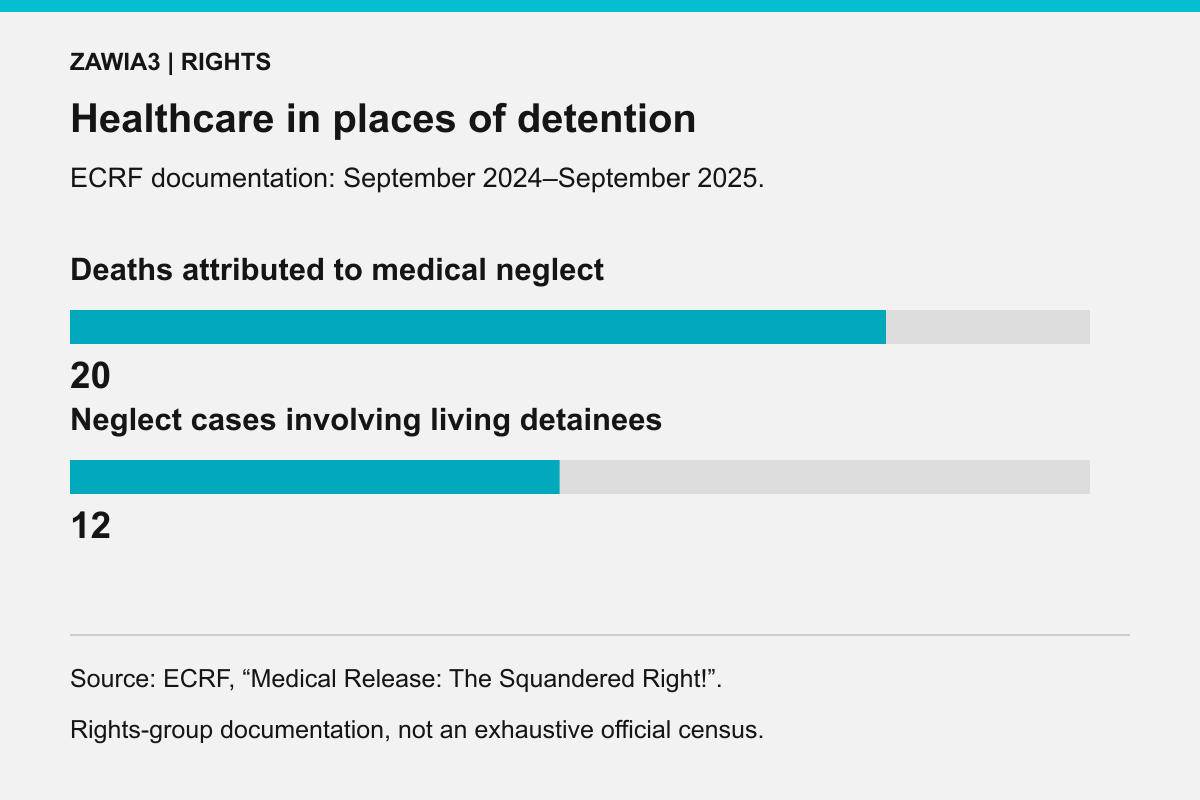
The Egyptian Commission for Rights and Freedoms’ “No Statute of Limitations” campaign issued “Medical Release: The Squandered Right!” on 16 November 2025. Covering September 2024–September 2025, it documented 20 deaths it attributed to medical neglect and 12 alleged deliberate-neglect cases involving living detainees. These are the organisation’s documented cases, not an exhaustive official count.
In a separate July 2025 appeal, EIPR sought urgent healthcare for a 64-year-old pretrial detainee from the Ahmadi Religion of Peace and Light, held in case 2025 of 2025.
EIPR said the 10th of Ramadan 6 prison had responded inadequately, providing catheterisation twice in May for urinary retention while other serious problems remained untreated.
According to the organisation, he had required eye surgery before his arrest and had kidney disease, diabetes and liver-related illness. It reported leg swelling, severe deterioration in his vision and a diabetic coma after he did not receive his medicines.
EIPR also called for the release of at least 16 detainees in that case, including 14 members of the religious group, and for urgent medical care.
Abdel Moneim Aboul Fotouh: a historical warning
A joint statement issued by nine rights organisations on 9 May 2018 raised concerns about the health of former presidential candidate Abdel Moneim Aboul Fotouh. It is an earlier case, not a statement about the year preceding this report’s December 2025 publication.
The groups said he had suffered four episodes of angina in fewer than three months and had not been transferred from Tora’s Mazraa prison to hospital. The age of 67 cited in that statement was his age in 2018.
They described chronic conditions, including diabetes, high blood pressure and an enlarged prostate, and said a particularly severe episode occurred on 5 May 2018. His family had submitted a detailed memorandum to the National Council for Human Rights on 22 April that year.
The statement alleged that requests for specialist assessment and transfer had not been met, and criticised solitary confinement in unsuitable conditions. These allegations describe the circumstances reported in 2018 and should not be mistaken for independently verified clinical information for December 2025.
El Nadeem documents 77 cases
El Nadeem Centre’s January–June 2025 archive recorded 77 medical-neglect cases after removing repeated reports. Its monthly counts were 16 in January, 11 in February, 19 in March, 20 in April, 22 in May and 20 in June. Because cases can be reported in more than one month, these columns must not be added together as separate cases.
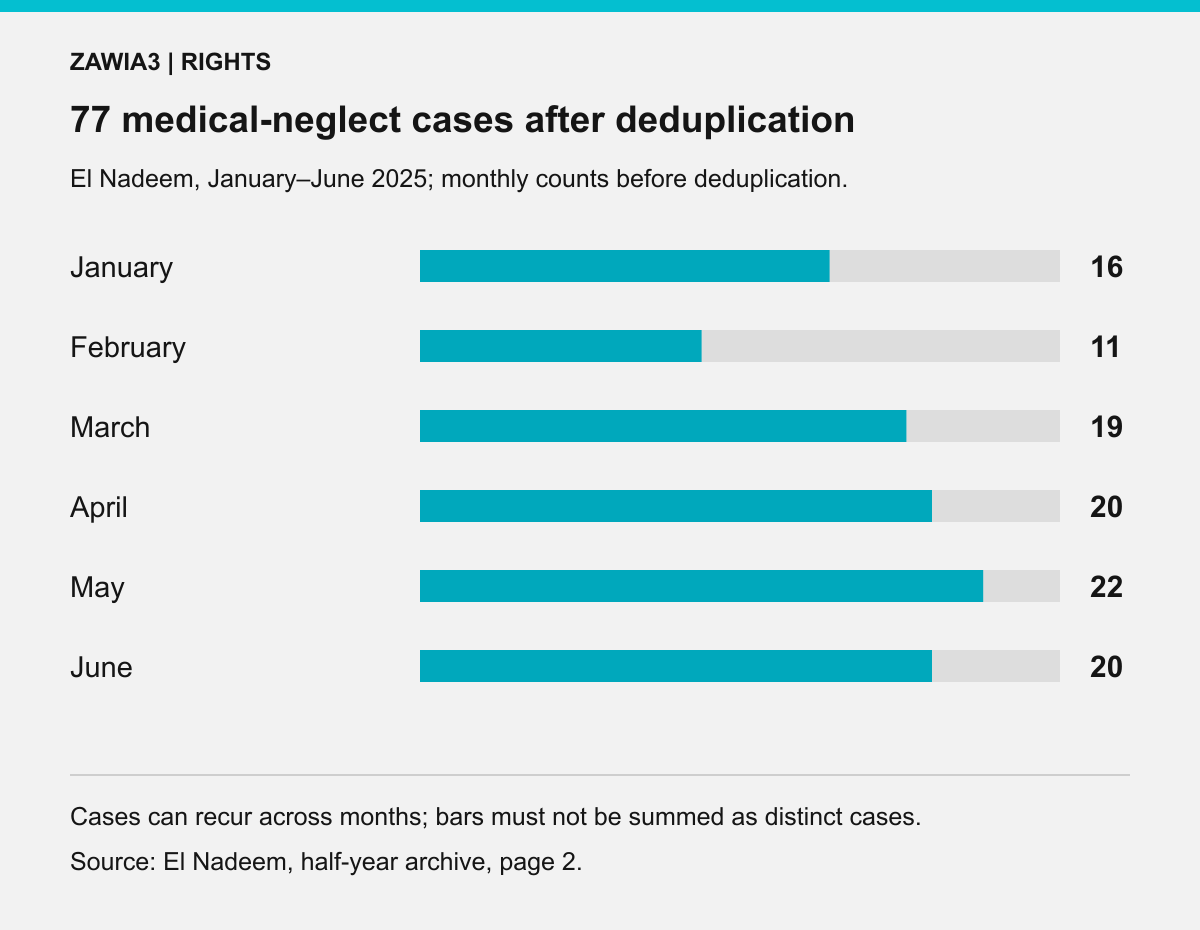
The documentation covers reports accessible to the organisation and may not reflect all detention facilities. Its period and method also differ from the ECRF report, so the two organisations’ totals should not be combined.
Egypt’s constitutional safeguards include the right to health and protections for detainees. Egypt acceded to the Convention against Torture on 25 June 1986; 1986 is the accession year, rather than the year the UN adopted the convention. Deliberate denial of healthcare can raise concerns under prohibitions on torture and ill-treatment, with the legal characterisation depending on the circumstances.
Mohamedeen argues that prosecutors should conduct regular, comprehensive and unannounced inspections, and ensure prisoners can reach equipped hospitals rather than relying on formalities within detention facilities.
El-Husseiny recommends an urgent committee involving independent doctors and rights specialists, access to medical records, transfers when clinically necessary and effective oversight by the National Council for Human Rights.
During preparation of the original report, Zawia3 contacted the National Council for Human Rights through the official channels on its website to seek comment on detention conditions and medical care. No response had been received by the Arabic publication date.
The accounts expose a gap between legal protections and the care witnesses and rights organisations say prisoners receive. Their demands centre on effective inspections, independent medical assessment and timely treatment: healthcare as a right that remains in force behind prison walls.