
Madiha Ibrahim, 46, is fighting two battles: breast cancer and the cost of the supplies she needs for treatment. She says she borrows money each month to buy needles for her implanted chemotherapy port because suitable supplies are not consistently available at the public hospital treating her. The needles she seeks cost EGP 350–500 each at private pharmacies.
Although she receives treatment near her home in Old Cairo, the additional purchases stretch beyond her family’s means. She puts the monthly cost of the needles alone at more than EGP 1,000, before other medicines. With her husband’s limited income, relatives and neighbours have become a source of loans to keep her treatment going. Her concerns about the quality of the hospital’s supplies reflect her experience; they are not a laboratory assessment of those products.
Egypt’s drug-shortage crisis has affected treatments for chronic illnesses ranging from diabetes and hypertension to cancer and kidney disease. Reporting in October 2024 described shortages affecting around 1,000 products. In February 2024, pharmaceutical-industry chamber head Gamal El-Leithy estimated shortages at 30–40%, with some products lacking substitutes. Those earlier estimates should not be read as a fresh count for March 2025.
Irene Saeed, a member of parliament’s health committee, tells Zawia3 that access to medicine is fundamental to healthcare: a diagnosis without treatment leaves the service incomplete. Shortages of medicines and equipment, she says, undermine the work of the entire system.
“What is the point of an examination without treatment?” asks Saeed.
She says supply problems have lengthened waiting lists despite the presidential initiative intended to reduce them. Public hospitals that had made progress faced renewed setbacks as dollar shortages complicated imports. Moving patients between hospitals in search of supplies has become common, she adds, exhausting families. She calls for a review of the Unified Procurement Authority’s policies, better direct-purchasing arrangements and strategic reserves of essential medicines and consumables.
Ali Auf, head of the pharmaceuticals division at the chambers of commerce, offers a different account. He tells Zawia3 that missing medicines were supplied months ago and that government efforts aim to prevent a recurrence. He attributes part of the perceived shortage to doctors prescribing brand names and patients insisting on particular brands despite available alternatives.
Auf maintains that alternatives exist for the missing products and that availability has improved. He says doctors in public hospitals and health-insurance facilities are required to prescribe by scientific name, allowing the available equivalent to be dispensed, and rejects the suggestion that health-insurance medicines are inherently inferior. His assurances contrast with the difficulties described by patients and the medicine-rights advocate interviewed for this report. Decisions about suitable substitutes require professional assessment.
Poverty, illness and the search for treatment
Noha Mahmoud, 52, from Giza, receives chemotherapy for leukaemia at a public hospital. She says rising prices and shortages have left her trapped in a cycle of borrowing. Some necessary medicines and supplies have recently been unavailable through her state-funded treatment, forcing her to search outside the hospital.
She describes needing injections to prevent blood clots, priced at up to EGP 600 each, which she says the hospital does not provide. Gloves, masks and disinfecting supplies have also become purchases she must make herself. Each month brings the same choice: take on more debt or postpone treatment. To her, illness and the economic crisis have become inseparable barriers to recovery.
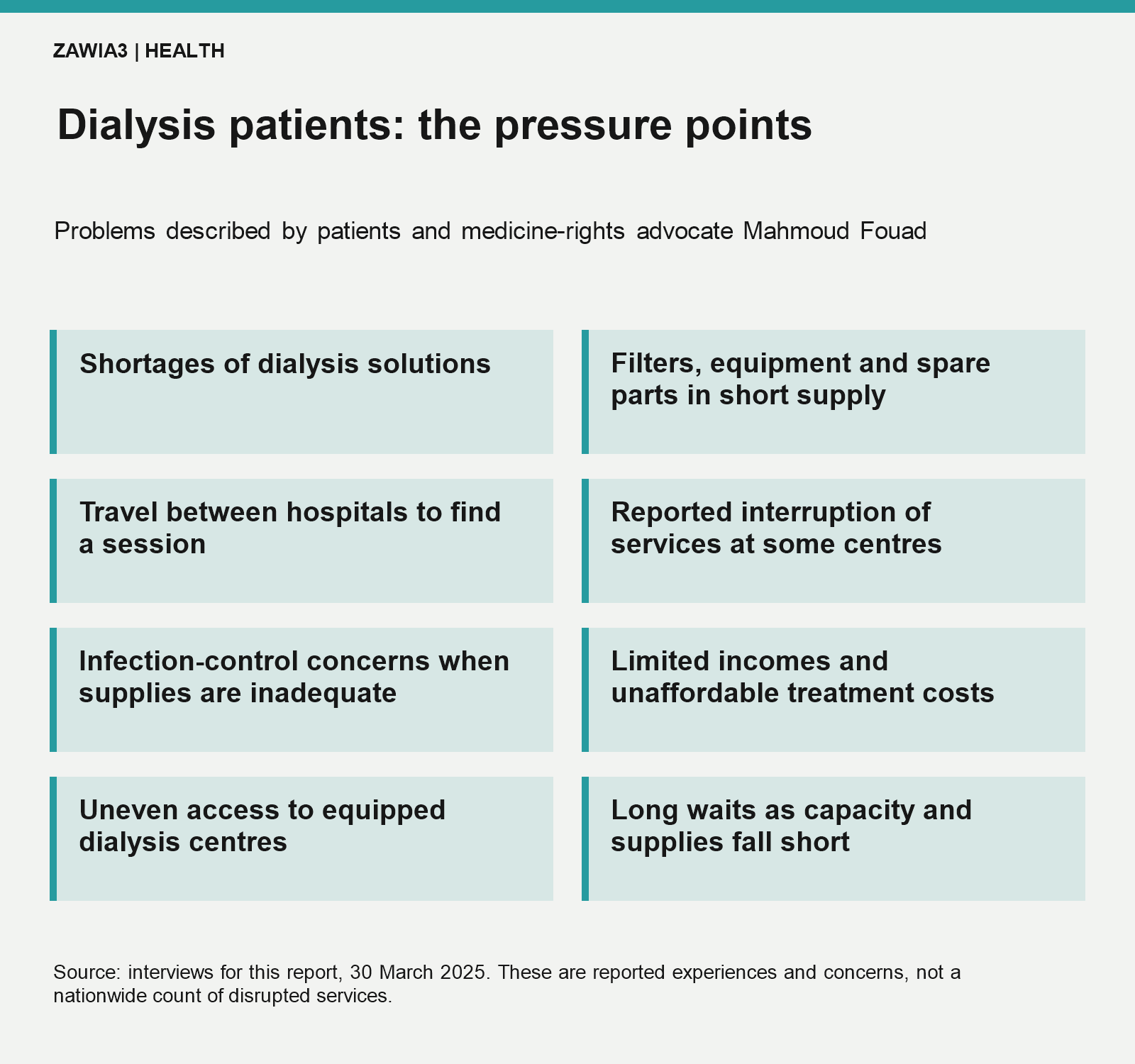
For kidney-failure patients, the search for treatment can mean travelling between facilities. Hassan Abdullah, 52, from Sohag, says he gets up before dawn every few days to find a public hospital with supplies for dialysis. Sometimes he is told shortly before a session that the necessary solutions are unavailable.
That leaves him facing a delay or buying supplies at prices he cannot afford. Formerly a labourer, he now relies on relatives’ help while debts accumulate. He says that on one occasion securing a single session consumed half his monthly income. Waiting in a crowded hospital, he worried that supplies might run out before his turn.
Souad, 42, from Beheira, describes difficulties obtaining medicines that control blood phosphorus and other prescribed treatments. She says products missing from public pharmacies have appeared on the black market at up to five times their official prices. Unable to afford them, she reduced her doses and says her condition deteriorated, making it difficult to leave home.
During a hospital visit, she waited for her doctor while her husband tried to find a way to pay for the medicines. “Can medicine really be harder than the illness itself?” she asks. Her account illustrates the pressure of unaffordable treatment; it is not a recommendation to change prescribed doses.
A video of Health Minister Khaled Abdel Ghaffar responding to a dialysis patient’s complaint about waiting attracted criticism online. The minister said machines needed to be disinfected between patients, but also asked why patients had not first thanked the state for the building and equipment.
“First say thank you for the beautiful building and the available equipment, but we have some requests,” he said, describing this as proper courtesy while acknowledging patients’ right to raise requests. Critics argued that asking for gratitude diverted attention from the complaint itself.
A supply crisis behind the pharmacy counter
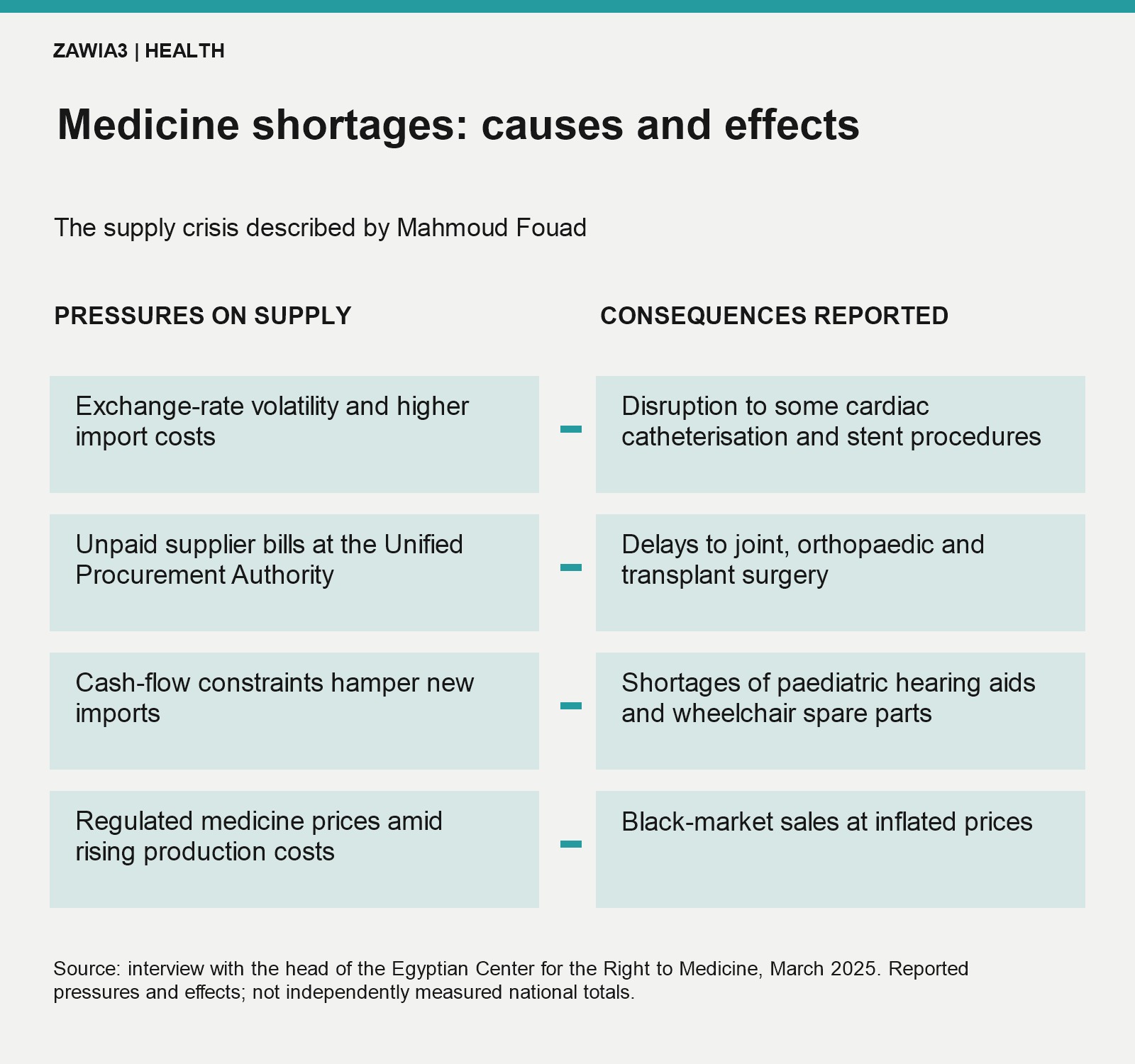
Mahmoud Fouad, head of the Egyptian Center for the Right to Medicine, says the crisis that intensified in 2023 and continued through 2024 has not ended. Exchange-rate instability has strained medicine and medical-supply businesses that depend on imported products or production inputs.
He distinguishes between regulated medicine prices and the more market-driven pricing of supplies. In his account, centralised public purchasing through the Unified Procurement Authority and accumulated debts to suppliers created a cash-flow bottleneck. Companies waiting for payment struggled to finance imports or maintain reserves.
Fouad says the prime minister held two meetings to address the problem and that EGP 5 billion was allocated toward outstanding payments. He adds that another EGP 2 billion was approved around two weeks before this report, following a change in the authority’s leadership. These are figures supplied in his interview; he says critical surgical supplies nevertheless remain difficult to obtain.
Industry estimates cited in reporting put the market at roughly 17,000 pharmaceutical preparations and around 170 factories. Reported price adjustments affected hundreds of products, including increases of 20–30% for some chronic-disease medicines and 30–50% for some seasonal or non-essential products.
The report also cites Auf’s estimate of approximately EGP 215 billion in sales for 2024, compared with EGP 154.7 billion in 2023—an increase of about 39%. This is nominal sales value: higher prices do not by themselves demonstrate that patients bought more medicine or found every prescribed product. The November 2024 source linked in the original article covered the first ten months, not a verified final full-year total.
Large numbers of pharmacies and pharmacists do not necessarily resolve gaps in access. Earlier figures cited in the original put the sector at around 213,000 pharmacists and 80,000 pharmacies, but their reference year was unspecified. They should not be presented as a current census or used to support an unverified universal World Health Organization staffing benchmark.
Operations delayed, equipment out of reach
Fouad says shortages have disrupted some cardiac catheterisation and stent procedures, delayed joint and orthopaedic surgery and affected kidney and liver transplants. His description concerns the impact he has observed or received reports about; the article does not establish that every hospital or every procedure has stopped.
He also points to shortages of children’s hearing aids and spare parts, as well as wheelchair components. Such gaps, he says, interfere with schooling, communication and daily mobility. He claims some children unable to use hearing equipment were allowed to miss school, although no education-ministry circular establishing a general exemption was supplied for this report.
According to Fouad, providing essential medicines at selected 24-hour Al-Esaaf pharmacies is insufficient if patients outside major cities must travel to find them. Someone in Matrouh, Aswan or Fayoum may still face a long and costly journey.
Availability should mean finding treatment where and when a patient needs it—not having to travel to another governorate, Fouad argues.
He sees this as a planning and production problem as well as a distribution issue. With compulsory pricing and higher input costs, he says, manufacturers may hesitate to produce larger quantities for fear of losses.
Black-market prices and interrupted care
Fouad says shortages of chemotherapy medicines have interrupted treatment for many patients. He refers to a government announcement of 180,000 imported injections of an oncology medicine, but questions how long that quantity can meet demand. He also describes shortages of hormonal treatments prescribed in some pregnancy and fertility cases.
As an example, he names an injection referred to as “Genator” in the Arabic interview, quoting an official price of EGP 245 and prices of EGP 800–3,000 at private hospitals. The trade name and the comparability of those quotations were not independently established. His broader allegation is that shortages allow some sellers to charge multiples of official prices, placing treatment beyond poorer patients’ reach.
Dialysis, he adds, has faced shortages of filters, equipment and essential materials that reportedly interrupted services at a number of centres. He says a ministry hotline was introduced to follow the problem, but patients had already endured delays. Regular equipment maintenance and appropriate infection-control supplies remain essential; shortages alone do not establish that a particular patient acquired an infection.
Even when products are available, Fouad says, prices are increasingly unaffordable. He estimates that a basic prescription may cost EGP 250 and some antibiotics more than EGP 300, while consultation and medicine costs can approach EGP 1,000. These are examples he gives, not a standard treatment tariff. Antibiotics are not a treatment for an uncomplicated viral cold, as WHO guidance makes clear.
The contrasting accounts leave patients between official and industry assurances of improved availability and their own repeated searches for treatment. Those living with cancer, kidney failure and other chronic conditions describe how missing supplies and higher prices can turn a scheduled session into a financial emergency.
The report’s interviews point to a need for reliable supplies, affordable access, better purchasing and production planning, and oversight that prevents exploitation. For patients borrowing from relatives or moving between hospitals, the urgency is simpler: receiving the prescribed care before a delay becomes another threat to their health.