
In 2012, Nashat Al-Sheikh purchased a residential unit overlooking the green belt in District Nine of Al-Obour City, in Qalyubia Governorate northeast of Cairo, and moved there with his family away from the congestion of Cairo’s neighborhoods. The presence of gardens and green spaces, along with areas in the process of being planted, encouraged him and other residents to believe the city would retain its environmentally friendly character.
The city has, however, witnessed a marked decline in its green space over the past three years, following the clearance of large areas of trees and grass and their replacement with commercial projects, including malls and fuel stations containing restaurants and cafes, while construction work continues in parts of the green belt, a green or agricultural zone designed to serve as the city’s “lung” and a natural outlet that improves air quality and reduces pollution.
Nashat recounts that one of the large green spaces in District Nine was designated, according to the district’s subdivision plan, for services and gardens, but was converted into plots of land on which residential apartment buildings were erected, resulting in the loss of a large portion of the open spaces within the district.
He confirmed to Zawia3 that the reduction of green spaces contributed to increased air pollution, particularly given the city’s proximity to the Al-Obour Axis, which sees heavy truck and car traffic, explaining that the trees had served as a natural barrier absorbing part of the emissions. Their replacement with commercial facilities increased traffic density and its accompanying exhaust fumes, causing a decline in the city’s quality of life compared to what it was when he moved there more than a decade ago.
The same experience befell Haitham Sabra, who purchased a residential unit in District Seven approximately six years ago. The presence of green spaces was among the most important reasons for his choice of residence, given that the green belt was a fundamental component of the city’s urban planning, particularly with the city’s proximity to the industrial zone.
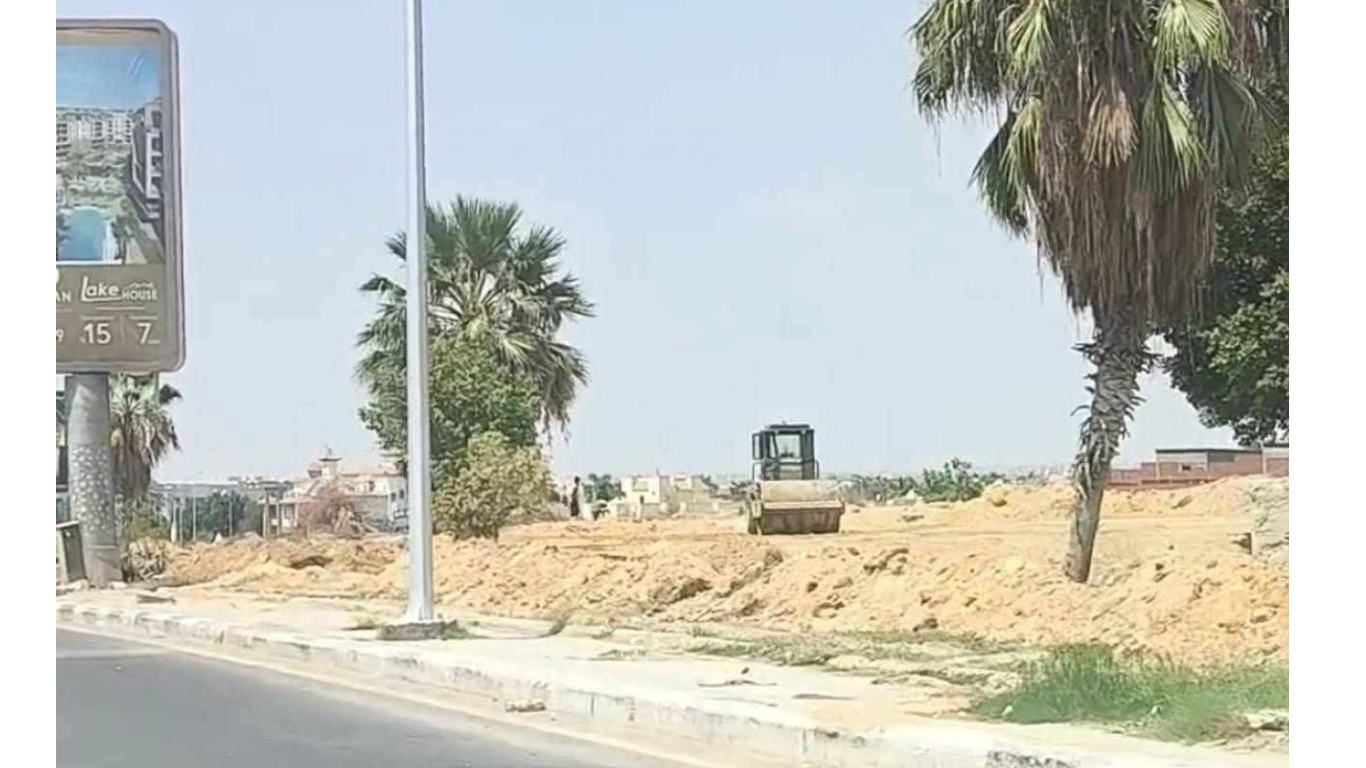
He was shocked to find parts of the green belt along the main road subjected to repeated clearing operations in recent years, noticing from time to time the clearing of large green areas without knowing who was responsible.
He told Zawia3: “The green belt was established primarily to mitigate the effects of emissions from the adjacent industrial zone, and its reduction therefore negatively affects air quality and residents’ health, while the city needs to strengthen its plant cover rather than reduce it, especially given the presence of industrial pollution sources.”
He adds: “The state establishes new urban projects with the aim of improving quality of life, and preserving the green spaces within them is no less important than implementing them. Compromising them threatens an environmental legacy that must be preserved for future generations.” He argues that reducing green spaces not only affects the environment and public health but also impacts quality of life and social behavior, affirming that the city contains other areas that can be used for investment projects without encroaching on parks or the green belt.
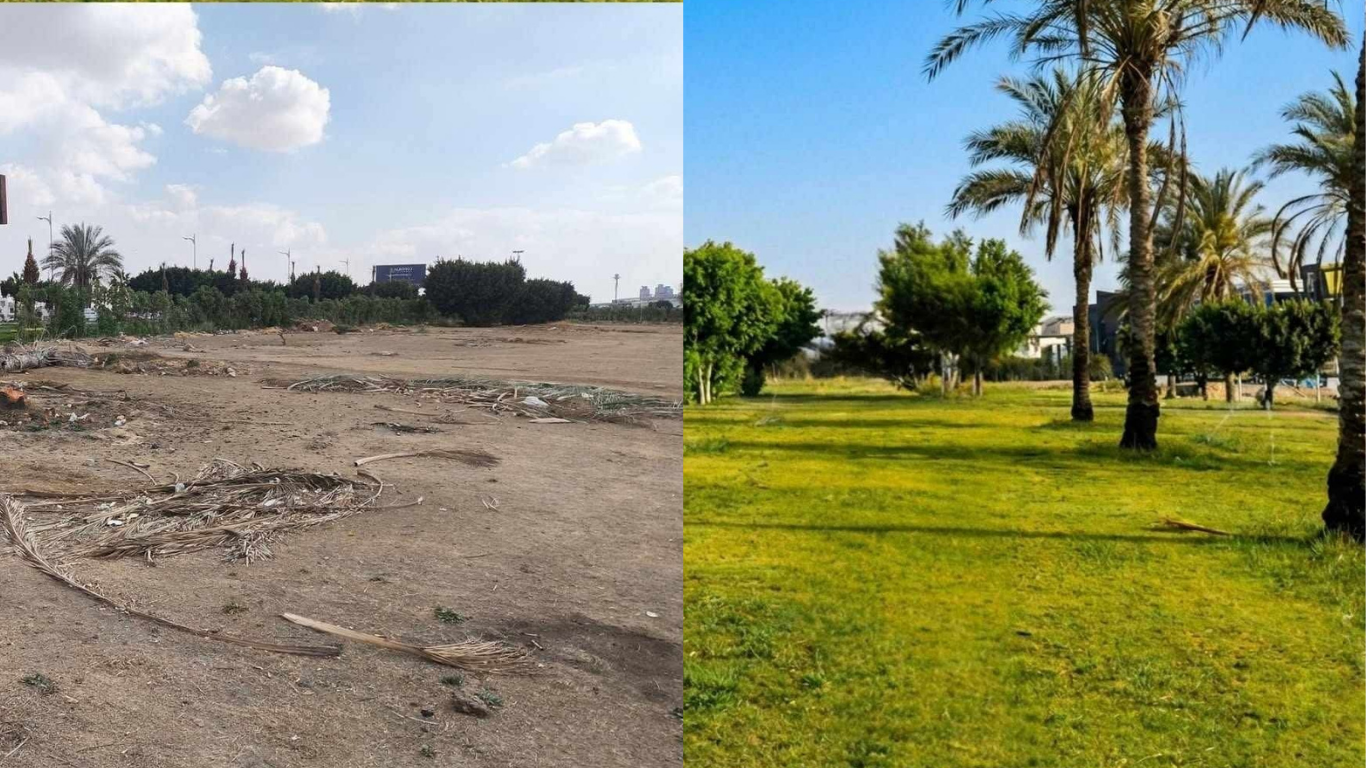
Al-Obour City comprises 11 residential districts and two industrial zones, with a population of approximately 800,000, while estimates from the New Urban Communities Authority indicate that the city’s absorption capacity and target population exceed one million.
In recent weeks, social media platforms witnessed complaints and distress calls from residents affected by the clearance of parts of the green belt and their conversion into construction and commercial projects rather than remaining open green spaces serving as an outlet for residents, with hashtags circulating such as “Save_Al-Obour_City,” “No_to_Destroying_Green_Spaces,” and “Al-Obour_Calls_for_Help.”
A number of the city’s residents also shared a statement addressed to President Abdel Fattah El-Sisi and Prime Minister Mostafa Madbouly, on behalf of approximately 500,000 residents, calling for the city to be saved from what they described as a civilizational catastrophe and an environmental crisis being committed, according to the statement, by the Al-Obour City Authority and the New Urban Communities Authority.
The statement said the city had witnessed over the past three years “a fierce assault and brazen encroachment” on its major parks, with large green spaces cleared for commercial projects “in total disregard for the minimum standards of environmental respect and in contempt of the contracts under which residents paid substantial sums of money,” pointing to the extension of these encroachments from the city’s main axis through the industrial zone to the green belt inside residential areas.
The statement called on the political leadership to intervene immediately to stop the encroachments on green areas, to conduct a comprehensive review of the city authority’s performance and of all decisions issued regarding green land over the past five years, to cancel contracts concluded with companies involved in the clearing operations, and to restore these lands to their original purpose.
Recommended Reading: 11,000 Signatures and a Lawsuit: Zamalek Residents Resist the Development of the Heritage Zahriya Garden
The Residents’ Union: Approximately 30% of the Green Belt Lost
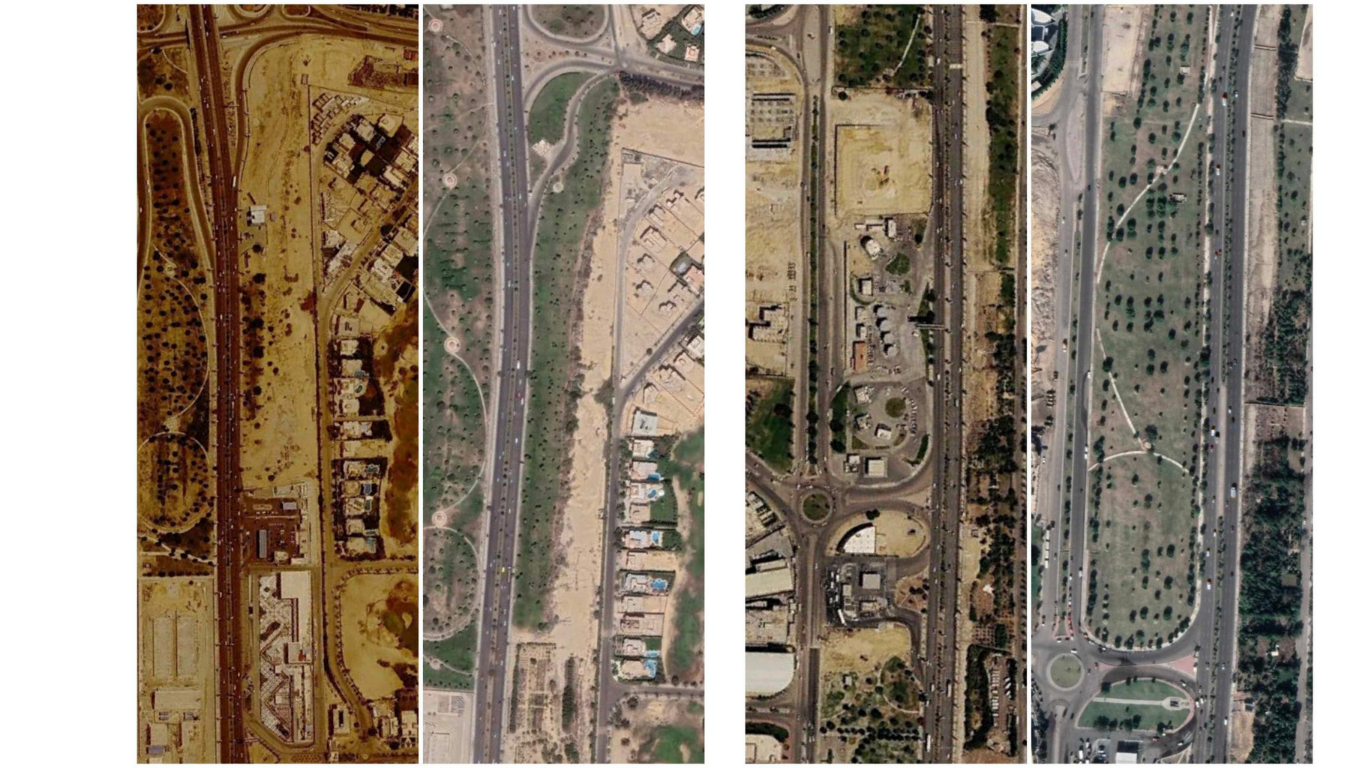
Satellite images via Google Earth and Google Maps show the clearance of a garden adjacent to Hub Mall on the Al-Obour Axis, which residents who spoke to Zawia3 believe the city authority sold for a commercial project. The same occurred with the garden adjacent to Hi City Compound in District Five.
The images also show the beginning of clearance operations encroaching on residential areas in District Nine, and the disappearance of green spaces that formed years ago a large garden in front of Avenue Mall in the industrial zone, as well as the garden that stood beside the Chill Out fuel station on the Al-Obour Axis. The most recent encroachment documented is the garden located on the green belt beside Avenue Mall.
Zawia3 contacted one of the founders of the Residential Districts Union in Al-Obour City, who declined to be named, and he confirmed that the city is witnessing continuous clearance of parts of the green belt, with scarcely a month passing without a green plot being cleared. He estimated what the green belt has lost over the past four years at approximately 30%, explaining that parts of the parks have been removed one after another to make way for commercial projects.
He affirms that the latest development monitored by the Union includes preparations for new clearance work related to a garden near the District Nine underpass, alongside fears of encroachment on another garden of approximately 6,000 square meters, after residents observed sections being marked inside the green belt in District Nine, in areas adjacent to residential neighborhoods, with white chalk markings, while the Union received information about preliminary steps being taken to hand them over to a new owner, which triggered residents’ objections.
He adds: “The green belt represents Al-Obour City’s environmental artery and one of the main reasons citizens chose to live here, given the natural outlet it provides and its role in improving air quality inside a city situated close to an industrial zone. Preserving it was part of the city’s urban identity since its founding.” He notes that Al-Obour contains desert areas that can be used for investment projects without touching the parks or the green belt.
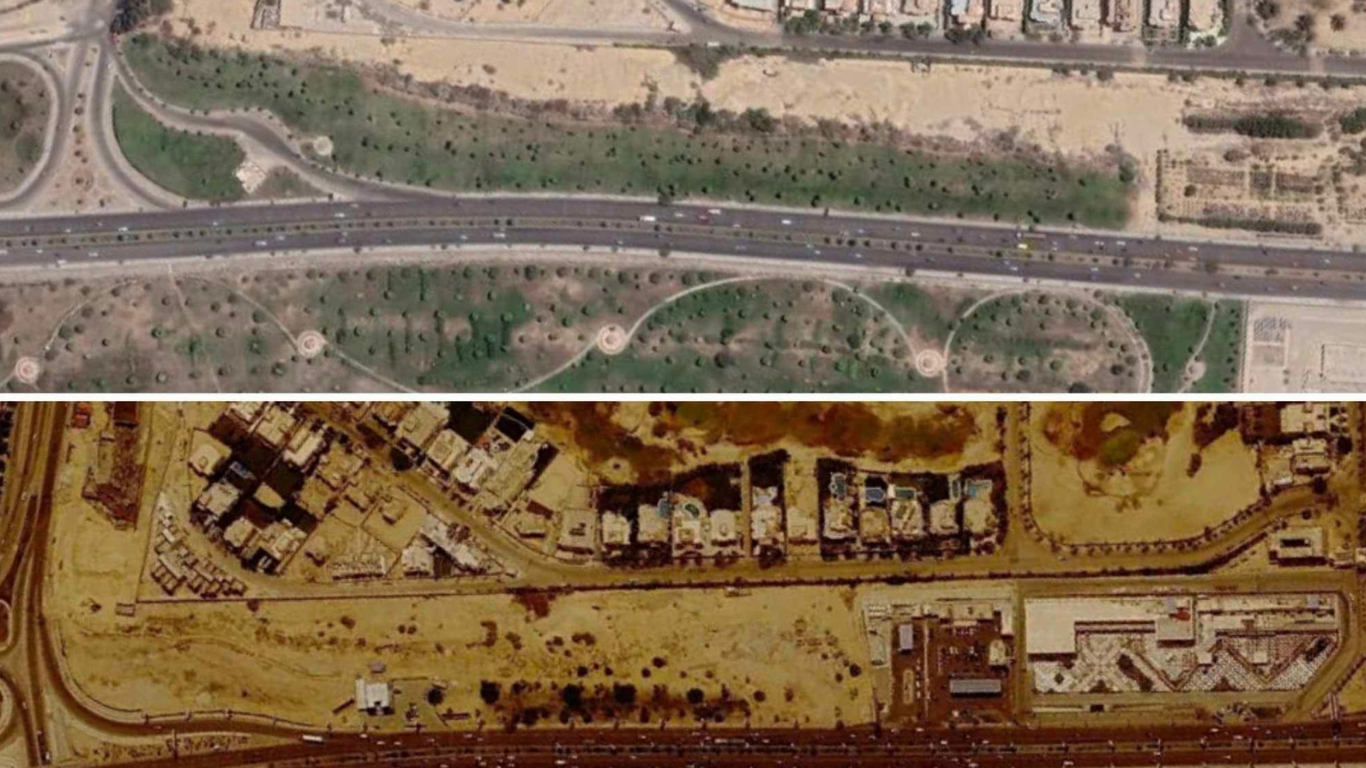
Some residents and the Residential Districts Union, in their testimonies, point the finger at real estate development companies, among them Reflect Developments, owner of the Select Obour Mall project, located directly on the main Al-Obour Axis in District Nine opposite Arkan and Avenue Mall, extending over 5,000 square meters and reportedly set to include a banking zone, entertainment areas, and large parking garages.
The same company owns “Infinity Mall”, a commercial project in District Nine overlooking the Al-Obour Axis and the green belt directly. The company had announced on January 29, 2026 that the mall was approaching handover stage with construction progress exceeding 80%.
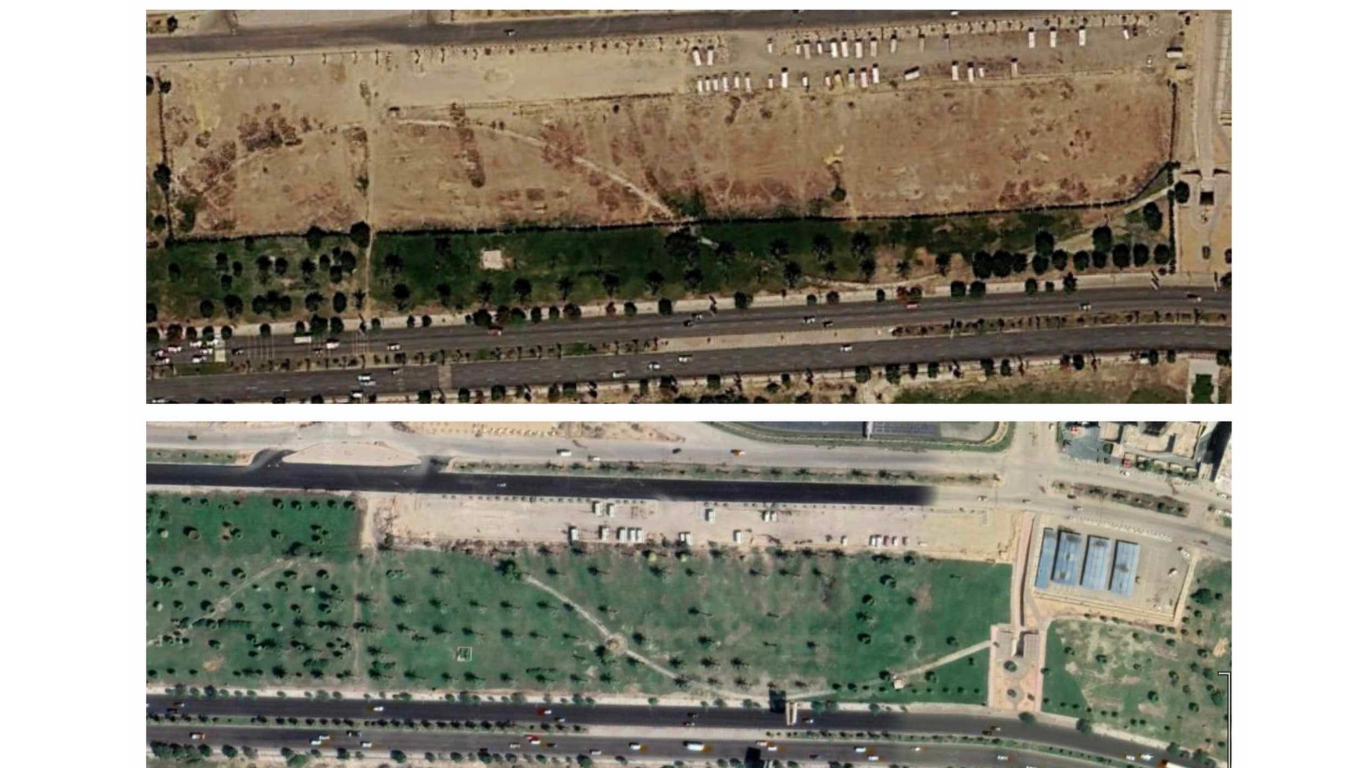
Clearance operations beginning in one of Al-Obour’s largest gardens, which some residents believe are being carried out on behalf of Reflect Developments.
The name of Kuwait Development Group also circulates among angry residents, after the company announced its project “Zone 8 Obour”, reportedly to be located on the city’s main axis and extending over approximately 25,000 square meters. Residents fear it will be built on the ruins of one of the city’s largest gardens. Despite residents’ concerns and accusations, neither company has publicly commented on what has been raised.
Recommended Reading: “Ras Hankorab”: The Conflict Between Capital and Environment in the Wadi Al-Gemal Reserve
Green Space Retreating in Favor of Investment
Lawyer Ahmed Al-Saeedi, Chairman of the Egyptian Foundation for Environmental Rights, argues that what Al-Obour City is witnessing in terms of green space clearance and the conversion of parts of the green belt and parks into investment projects reflects the absence of commitment to environmental rules and legislation. The crisis, he notes, is not confined to Al-Obour but extends to other areas experiencing a continuous decline in green space in favor of urban and investment expansion.
He explains that the green belt was established primarily to enhance green spaces, particularly in industrial cities such as Al-Obour, to limit the effects of pollution and absorb carbon emissions, affirming that the preservation of those spaces should be a priority for new city authorities and the New Urban Communities Authority, rather than converting them to commercial and investment activities.
He told Zawia3: “This orientation contradicts the principles of environmental protection enshrined in the constitution, and ignores the application of environmental laws, foremost among them the requirements for environmental impact assessment of projects. Their absence, alongside the absence of community participation and social impact assessment, renders current development incomplete, focused on economic return without regard for the environmental or social dimension.”
He explains that the expansion of real estate and commercial projects at the expense of green spaces increases the carbon footprint and reduces cities’ capacity to combat pollution, in addition to depriving residents of natural outlets, which negatively affects quality of life and public health.
He calls for a reconsideration of policies for dealing with green spaces, and for the enactment of independent legislation to protect trees and green areas, noting that Egypt previously had a law providing protection for these spaces before it was abolished with the issuance of the current Agricultural Law. He also calls for the establishment of a specialized body to coordinate between different entities, set stricter rules for protecting environmentally sensitive areas, foremost among them green belts, thereby ensuring that their use cannot be changed except under strict environmental controls.
Asmaa Al-Halwagi, Chairwoman of the Tree Lovers Association, affirms that preserving green spaces must be an intrinsic part of the concept of sustainable development, and that any development projects must not come at the expense of natural resources or future generations’ right to a healthy and balanced environment.
She argues that the establishment of commercial centers or investment projects must not come at the expense of parks or green belts, questioning the rationale of removing parks to build malls when they could be built on desert areas or alternative lands that do not serve as an environmental outlet for residents.
She told Zawia3: “Sustainable development means achieving economic development while respecting natural resources and the environmental heritage. The loss of green spaces is a loss that is difficult to compensate for, and the state and society are obligated to adhere to this principle when planning urban and investment projects.”
She stresses that trees are no longer a decorative element or luxury, but an environmental and health necessity in the context of climate change and rising temperatures, contributing to reducing pollution, absorbing emissions, tempering the climate, providing shade, and improving air quality. She notes that industrial cities such as Al-Obour need to increase their tree cover rather than reduce it, and calls on the Ministries of Local Development and Environment to investigate what is being reported about green space clearance in the city and take the necessary measures to preserve what remains.
Recommended Reading: One Kilo of Fish Costs the Sea Ten: The Calculations of Overfishing in the Red Sea
Parliamentary Action
Following residents’ complaints about the reduction of green spaces in Al-Obour City, MP Amira Al-Adly submitted a parliamentary inquiry on July 4 to the Ministers of Housing, Utilities and Urban Communities, and Local Development and Environment, affirming that preserving green spaces is not merely an aesthetic feature but a citizen’s right and one of the most important components of quality of life and environmental balance, consistent with the state’s orientations toward building sustainable cities.
Al-Adly says the “inquiry aims to establish the truth regarding what has been raised about changes in the use of some green spaces, and to clarify the extent to which this is consistent with the city’s master plan, the legal and technical bases on which those procedures relied, the role of the relevant bodies, and what has been done to preserve the green area,” pledging to follow up the matter within the House of Representatives in her supervisory capacity.
MP Bothaina Abu Zeid confirms receiving complaints from city residents about the clearance of parts of the green belt, expressing to Zawia3 her intention to submit a parliamentary inquiry to hold the government accountable and summon the relevant bodies to clarify the circumstances of what is occurring, and to identify those responsible and those benefiting from the change in land use of green areas.
She points to her personal monitoring of what is happening as a resident of Al-Obour, affirming that preserving green spaces is a fundamental demand of residents who chose the city for the less congested environment and cleaner air it provides, and that their reduction threatens one of the city’s most important features.
In the context of the right of reply to residents’ complaints, Zawia3 attempted to contact Engineer Tamer Gabr, Head of Al-Obour City Authority, but he did not respond to any of our phone calls. Zawia3 also contacted Dr. Heba Matouk, Spokesperson of the Ministry of Environment, to ask whether any complaints had been received by the Ministry regarding the clearance of green spaces in the city, and she denied having any information in this regard.
Zawia3 directed questions to the New Urban Communities Authority and to Reflect Developments and Kuwait Development Group, regarding the accusations raised by residents and the Residents’ Union about the clearance of the green belt for their projects.
Despite new cities’ need for service and commercial projects, residents and environmental advocates demand that this not come at the expense of green space. The file of green space clearance in Al-Obour City remains open between residents’ accounts, experts’ warnings, and recent parliamentary moves, pending an official response that clarifies the reasons for changing the use of these spaces and the extent to which this is consistent with the urban plan and environmental requirements.