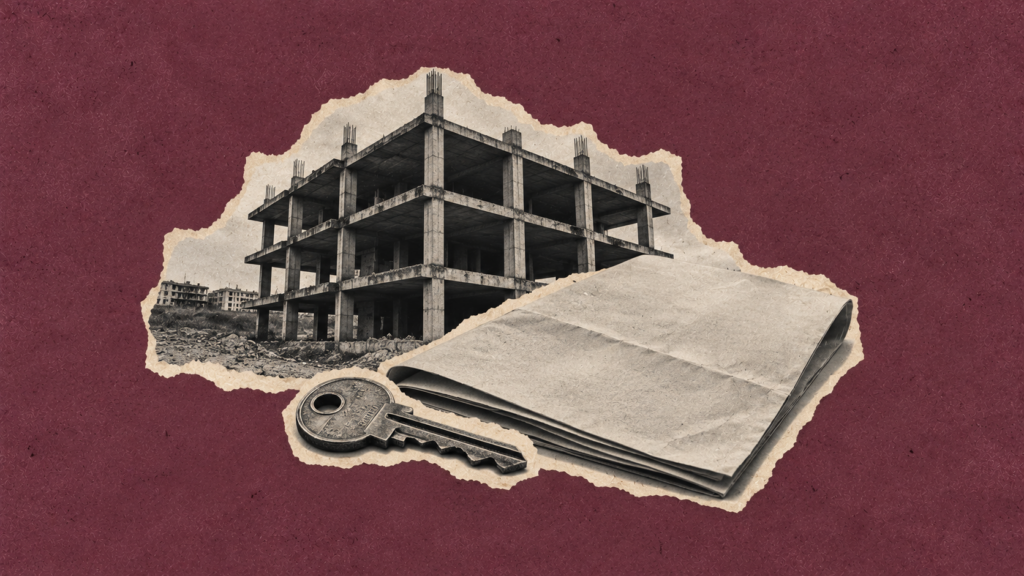

Mamdouh recounts that a large number of residential buildings within the project were never constructed at all, despite contracts with buyers being based on delivery of units between 2016 and 2018. At the same time, there is another group of owners—including himself—whose units have in fact been completed, yet remain without utilities to this day: no electricity, no water, in addition to clear deficiencies in final finishing, including elevators, facades, and entrances. As a result, many owners now find themselves five, six, or even eight years past the agreed delivery dates, without being able to benefit from apartments for which they paid the full price.
Mamdouh confirms that all owners paid the full value of their units, which ranged between 380,000 and 400,000 Egyptian pounds (approximately $7,835 to $8,247) around 2014, with prices varying from one year to another. He explains that installments were paid regularly, and that, in his view, the company has no justification for delaying delivery after full payment was completed. The affected owner suggests that the company appears to enjoy unexplained influence, noting that, according to his account, it is seeking to collect additional amounts from all units in the project estimated at around 100,000 Egyptian pounds ($2,062) per apartment—an amount that, when calculated across an average building, could generate tens of millions of pounds in extra revenue.
Mamdouh also reveals to Zawia3 that the company is demanding that some owners pay sums not stipulated in their contracts, reaching up to 100,000 Egyptian pounds ($2,062) for the connection of utilities and meters. He adds that the company obliges them, according to his account, to sign handover reports that include new clauses imposing “lifetime” maintenance fees. He confirms that a number of buyers were forced to comply with these demands under the pressure of urgent housing needs, despite their being in violation of the law.
In 2013, Sherif Mamdouh dreamed of owning an apartment in Katameya. Real estate agents persuaded him to purchase a unit in the “Makani B Sarayat Katameya” project, located along the Ring Road near the entrance to Ain Sokhna Road. The development is owned by “Cairo Consult for Real Estate Development in Katameya” and the unit was priced at around 400,000 Egyptian pounds ($8,247). He was offered flexible payment terms and, according to the contract, was promised handover in 2018. Yet, with 2025 coming to a close, he has still not received his unit.
Sherif’s dispute with the developer has dragged on for more than seven years, along with around 1,500 other affected owners. They’ve filed complaints with multiple government entities, including the Cairo Governorate, the Cabinet, the Ministry of Electricity, and the Electricity Distribution Company—without any concrete resolution. In October, a number of them staged a protest in front of the Cairo Governorate building, denouncing what they saw as the governorate’s failure to act against the company, which they say violated allocation decree No. 379 of 1998. That decree had granted the company—by direct order—a 32-feddan plot of state-owned land in the Basateen district (Plot No. 11), at a rate of 80 Egyptian pounds ($1.65) per square meter, on the condition that the project be completed and delivered within three years of allocation.
Mamdouh explains that many of the buildings in the project were never even constructed, despite contracts stipulating that units were to be delivered between 2016 and 2018. Others—himself included—saw their units built but without any utilities: no electricity, no water, and clear deficiencies in finishing, including elevators, facades, and entrances. As a result, many owners have missed their handover dates by five, six, or even eight years—and still cannot use properties they’ve fully paid for.
He confirms that all owners paid in full, with unit prices ranging from 380,000 to 400,000 Egyptian pounds ($7,833–$8,247) around 2014, depending on year of purchase. He says installments were paid regularly and sees no legitimate reason for the delays. He suspects the company is exploiting its unexplained influence, alleging that it is now demanding an additional 100,000 Egyptian pounds ($2,062) per unit—amounting to tens of millions in potential extra revenue per building.
Speaking to Zawia3, Mamdouh reveals that the company is asking some owners to pay undocumented fees—up to 100,000 Egyptian pounds ($2,062)—to connect utilities and meters. He adds that the company also forces them to sign new handover reports containing clauses that impose lifelong maintenance fees. He says some buyers had no choice but to comply, pressured by their urgent need for housing—even though the demands were illegal.
He adds that the explanations offered by official bodies for the delays—ranging from the economic crisis to COVID-19 and the state’s support for investors—are “unconvincing,” noting that delivery dates were set years before these factors emerged. Some buyers were supposed to receive their units in 2016, 2017, or 2018—well before the recent waves of inflation.
Mina Fakner Gerges shares a similar ordeal stemming from a developer’s failure to honor contractual deadlines. He purchased a residential unit in a project by “Oriental Weavers” and its real estate arm (O.U.D) in 2020 for 1.7 million Egyptian pounds ($35,064), which included maintenance fees, parking, and a club membership in Egypt’s New Administrative Capital. He was scheduled to receive the unit by the end of 2023. However, construction progress has been extremely slow, and to this day, he has not taken possession of his unit.
Later, he also purchased a unit from the Red Sea Tourism Development Company in its “Oriental Coast” project located in southern Quseir. That unit was scheduled for handover in May 2024—but that too has not materialized.
Mina notes that he signed the contracts when the exchange rate was 15–16 Egyptian pounds to the dollar, while the current market value of the units has since doubled, reaching 3.5 to 4 million Egyptian pounds ($72,155–$82,481). According to him, the O.U.D company now considers itself the losing party, arguing that the original payments are undervalued compared to today’s market rates. Mina says the company’s representatives told owners they got their units for “dirt cheap,” while repeatedly promising to bring in new contractors—though no real progress has been made.
He interprets the delays as a tactic to push owners to withdraw and reclaim their payments from five years ago. In protest, he stopped paying installments and filed a compensation lawsuit.
Speaking to Zawia3, he says: “Clients are in crisis because they fulfilled their financial obligations based on the company’s reputation. Many even took out loans to cover installments. Meanwhile, real progress has stalled. Contractors work for two or three months, then disappear for 20.”
Their stories echo that of Ibrahim Abdel Nasser, who returned to Egypt in 2023 after years abroad, seeking stability through property ownership. After selling part of his assets overseas, a real estate broker advised him to invest in the Egyptian market, directing him to “The Mark” for Real Estate Development—a joint-stock company chaired by Amr Badr. Ibrahim signed contracts to buy both an office and a villa in the “Wonder Mark” project in Mostakbal City and began paying in installments.
Yet, as he puts it, not a single “nail” has been hammered into the ground—now entering the project’s third year—while surrounding residential compounds launched after his have already been delivered.
Ibrahim says he has so far paid nearly 9 million Egyptian pounds ($185,547), but no real construction has begun. Alongside other buyers, he joined a protest against the company, which—he claims—refused to refund the full amount, offering partial refunds with a 15% deduction on unit value. He views this as blatant injustice. After the protest and lawsuits filed by 50–60 buyers, the company dispatched a handful of workers to pour some concrete—a symbolic gesture that falls far short of expectations for a project meant to include 600 villas.
He tells Zawia3: “We discovered that the land used for the project isn’t even registered in the company’s name, and that the contract we signed was effectively a coercive agreement—legally flawed, since the company sold land it doesn’t own. With no visible construction, owners can’t resell their units. There’s nothing tangible to evaluate—no structures, no market value.”
A similar experience is recounted by Shokry Tammam, along with other buyers affected by the “Plage” project in Sidi Abdel Rahman at kilometer 120 on the Alexandria–Marsa Matrouh road. Though some owners were due to receive their units in 2017 and others in 2019, none have taken possession to this day.
Originally developed by “Maxim Real Estate Development”—part of Maxim Holding—the project was later taken over by “Mountain View,” which issued a new timeline promising deliveries in August and September of last year. Shokry says no new construction has taken place, and the buildings remain in the same condition as they were in 2017–2018.
He tells Zawia3: “I filed a lawsuit to suspend my installments after enduring more than two years of delays. Some buyers had paid 80–90% of their unit’s value, yet the project site remains an empty desert.”
He explains that nearly 3,000 buyers have yet to receive their units. The crisis deepened when the company filed lawsuits against clients who had stopped paying installments—despite delays exceeding two years for most. Many had already paid 60–70% of the total unit price with no actual progress.
Several affected owners filed an official report two years ago at Fifth Settlement Police Station under No. 5324, and a lawsuit followed, registered as No. 821 of 2023.
These disputes come in the wake of severe delays in project execution and non-delivery of units, despite a 2021 government decision prohibiting developers from selling units before completing at least 30% of construction—intended to protect buyers’ rights.
In June 2022, Prime Minister Mostafa Madbouly issued a decree mandating that all relevant state bodies include “unit sale regulations to protect buyer rights” in real estate project tender documents and annex them to developer contracts.
The decree set strict conditions: no advertising of unit sales without a ministerial decree approving the master plan and specific project phase, and no launching of a new phase without confirmed adherence to the approved timeline for the previous one. Developers must also deposit financial guarantees into project-specific bank accounts, proportionate to the area offered for sale. These guarantees may be in cash, cheques from past project revenues, special credit facilities, or bank letters of guarantee.
Advertising rules also require proof of sufficient financial coverage for the phase being sold, with funds deposited before receiving marketing approval—and strict adherence to project timelines.
Article 5 stipulates that: “If the developer delays handover beyond the agreed date in the contract—and provided that the state agency fulfilled its role in issuing permits, and the buyer met all contractual and payment obligations—the developer shall be granted a 12-month grace period. If delays exceed 12 months, installment payments are postponed by the same delay period after the original payments end. If the delay exceeds 24 months, the buyer has the right to choose between continuing with postponed installments or requesting a full refund within three months of the request.” This article applies to all ongoing projects. The decision gave developers with delayed projects a one-year window to resolve their legal and contractual status.

Building Violations Leave Homeowners in Legal Limbo
In a related development, several owners of first-row chalets in the “Porto South Beach” resort in Ain Sokhna are locked in a legal dispute with Amer Group. They had purchased their units—comprised of a ground floor and one upper floor—over a decade ago. But in 2025, they were stunned to learn that the company planned to add a second upper floor above their chalets, invoking contract clauses that, according to the company, allow for structural modifications.
The owners rejected the proposed vertical expansion, which would require vacating their units, citing the absence of any guarantees regarding the duration of the evacuation and concerns over potential risks such as ground subsidence or structural cracks. The contracts, they argue, offer no clear protections in such scenarios.
A representative of the homeowners—who asked not to be named—told Zawia3 that the company offered them alternative units, but most declined the relocation, insisting on staying in their prime first-row properties with direct sea views. These are not just weekend getaways for many; some reside in them permanently. The owners subsequently took legal action to halt what they described as an infringement on their private property, after receiving phone calls from the company informing them of its intention to remove their air conditioning units—an act the residents considered a clear violation of private ownership, punishable under Egyptian law.
“The company has the right to build,” she said, “as long as that does not infringe on the rights of existing owners, disrupt electricity or water services, or expose them to risks from demolition or structural changes like pouring new concrete ceilings.” She added that past incidents have only deepened fears: the first phase of the village, which operated under a timeshare system, was entirely demolished, and the company had intended to demolish the current owners’ row in one go. However, the residents refused—most rejecting offers to relocate to other parts of the project.
She explained that the owners have sent internal notices to the village manager and formal legal warnings to the company confirming their refusal to leave. They also turned to the Border Guards Authority, which confirmed that the maximum allowable height for first-row buildings facing the sea is 6 meters—equivalent to a ground and first floor only. While the company is now seeking to obtain approval from the Border Guards, residents are turning to the courts to protect their rights and prevent their forced removal from their homes.
Eroding Trust in Real Estate Investment
For his part, economic expert Dr. Ahmed Shawky believes that the roots of the crisis lie in the business model of real estate development companies. These companies rely on groups of investors who inject large amounts of capital to purchase land and expand projects, while primarily depending on funds collected from buyers—whether down payments or installments—to finance other projects, rather than allocating those funds to the same project. Over time, companies expanded by launching new developments based on continuous cash inflows from the market, without having the actual capacity for self-execution or independent financing.
The economist explains that this model has created a vicious cycle: developers wait for new buyer payments to continue construction, while buyers stop paying due to delayed or stalled execution, leading to further disruption and drawing both sides into financial and legal disputes. He considers this to be the core problem producing the current chaos in Egypt’s real estate market, which necessitates effective government regulation of the sector.
He tells Zawia3: “The absence of strong oversight allows developers to expand without controls and leaves buyers in direct confrontation with companies, without real backing or protection. Regulating the real estate market and imposing clear, effective rules would restore confidence among both investors and buyers, and address the distortions that are now costing the economy and citizens heavy losses.”
Shawky explains that market chaos undermines the investment climate and reduces the attractiveness of real estate investment. Local and foreign investors tend to gravitate toward large, well-established companies, while smaller developers face major difficulties attracting investors and financing projects. He adds that this disorder weakens the market as a whole and affects property values. While declining prices may appear to benefit citizens in the short term, they harm the market in the long run, reduce its investment appeal, and undermine the competitiveness of Egypt’s real estate sector domestically and internationally.
Shawky stresses the need for all real estate development projects to be placed under the supervision of a competent government authority, such as the New Urban Communities Authority, responsible for reviewing projects before launch, monitoring implementation stages, and ensuring buyer protections. He explains that a regulatory body with executive powers would bring real discipline to the market, as it could impose strict penalties on non-compliant developers, or even withdraw land from them and complete the project itself—or resell it to compensate buyers—especially since land values increase over time.
Real estate activities and construction contribute 18.3% of Egypt’s gross domestic product, according to data from the second quarter of 2024. Other reports estimate the real estate sector’s share at around 20% of GDP, including property development, construction, and building.
The sector saw significant growth in 2024, with real estate sales rising to 2.5 trillion Egyptian pounds ($51.55 billion). According to reports by specialized real estate firms in Egypt, sales by the top ten real estate companies reached 290 billion Egyptian pounds ($5.98 billion) in the first quarter of 2025—up from 239 billion Egyptian pounds ($4.93 billion) in 2024.
Meanwhile, Saher El-Saadi—business consultant, member of the World Economics Association, and head of the Association of Egyptians in China—explains that current problems in the real estate market are not new, but have worsened in recent years due to the growing number of development companies entering the market without sufficient expertise. He notes that many investors treat the field as simple contracting work, while real estate development is a complex industry encompassing construction, execution, marketing, engineering consultancy, and post-delivery project management.
El-Saadi explains that marketing companies also mislead inexperienced developers by encouraging them to sell units at unrealistic prices that do not cover actual construction costs, eventually causing developers to stumble and fail to complete projects. In his view, two types of developers then emerge: experienced developers who absorb losses and continue execution, and newer ones who collapse quickly, altering specifications, delaying delivery, and demanding price increases.
He tells Zawia3 that “delivery delays have become a general pattern in the market, affecting both large and small developers.” He adds that part of this delay is due to stalled permits and ministerial approvals from various government bodies. The multiplicity of authorities overseeing real estate has also created chaos and conflicting construction requirements. While new cities operate under clear rules, governorates and older cities suffer from contradictory decisions—such as imposing four-floor height limits and then reversing them—confusing investors and stalling investments.
He adds that the absence of a unified regulatory authority is the primary reason behind the spread of market problems and the damage to Egypt’s real estate investment reputation. Foreign investors prefer markets with ready-built properties and clearer regulatory systems. He points out that off-plan sales in their current form are a major source of imbalance, as they allow developers to use buyers’ funds for other projects, whereas each project should have its own dedicated bank account, with revenues deposited and spent exclusively on that project under strict banking oversight.
The business consultant emphasizes that regulating the real estate market would bring several benefits, most notably restoring trust, preventing recurring delivery delays, and establishing fair pricing by area—limiting manipulation and attracting foreign investors back into the market, whether through purchasing or development, with positive effects on Egypt’s economy.
Across the stories of Sayed, Mina, Ibrahim, and Shokry, and the disputes involving Porto South Beach owners, a clear pattern emerges: the common thread among affected buyers is not merely delayed delivery schedules, but an entire real estate system operating without an effective regulatory umbrella or binding legislation that enforces developers’ obligations to their clients. Despite government decisions issued in recent years to regulate the market, reality points to weak enforcement and the absence of accountability mechanisms—pushing thousands of buyers toward courts and protests instead of into homes they have paid for over many years.
Testimonies from affected owners reveal a prolonged crisis of trust—one that goes beyond construction quality or company commitments, and instead reflects the absence of a neutral authority to turn to, and the lack of an official channel to receive complaints or guarantee minimum transparency. As companies continue to advertise new phases and market incomplete projects, buyers remain the weakest party—trapped between coercive contracts, ignored timelines, and funds frozen in stalled projects or land without foundations.
As disputes continue to grow, calls are intensifying for the establishment of a real estate regulatory authority capable of enforcing binding rules, monitoring the use of down payments, verifying financial coverage before sales, and conducting regular on-the-ground implementation reviews. Such an authority could restore confidence for citizens before investors, and close the door on practices that many believe have moved beyond isolated mistakes to become a recurring pattern—threatening one of Egypt’s most important economic sectors.
Until clear legislation and a solid regulatory framework are put in place, buyers’ suffering will persist, and the questions will remain unanswered: Who protects citizens when they meet their payment obligations but developers break their promises? And how can a sector expected to attract investment grow without firm rules? Between prolonged waiting, mounting lawsuits, and housing dreams suspended in limbo, genuine reform remains dependent on political will to rebalance power between developers and buyers—so that Egypt’s real estate market becomes a safe space, not a high-risk gamble.