
Faten Zaki was still a child when, according to reporting on her case, her mother forced her into an unregistered marriage at the age of 12 in Kafr Yacoub village, Gharbia. Two years of alleged abuse followed. In August 2024, she was killed at just 14.
Reports about the case described a fatal assault after she ate a plate of pasta before her husband returned home. They said his family tried to conceal what had happened before he was arrested.
Yasmin Essam Mohamed, a 28-year-old Arabic teacher, was killed on 8 October 2024 while holding her 18-month-old daughter on a journey between Kafr El-Dawwar and Alexandria. Accounts of the killing described disputes over her husband’s jealousy, his attempts to isolate her from her family and pressure on her to leave her job. Witnesses reportedly restrained him and handed him to police.
Seteira Abdelrahman Sayed, 56, had left an abusive marriage, moved to a separate home and sought a khul‘ divorce. On the morning of 25 November 2024, she set off for her job in the health-insurance sector in Beni Suef. According to reporting on her case, her husband was waiting outside her home and fatally attacked her.
Maram Osama El-Amawy, 32, a mother of two daughters, died on 2 December 2024. Her case was reported as a severe assault by her husband followed by several days without medical care. She underwent six operations after reaching hospital, but could not be saved.
The details differ, but the four cases point to a pattern described by women’s-rights organisations: fatal attacks can be the final stage of prolonged abuse, with few effective routes to safety before violence escalates.
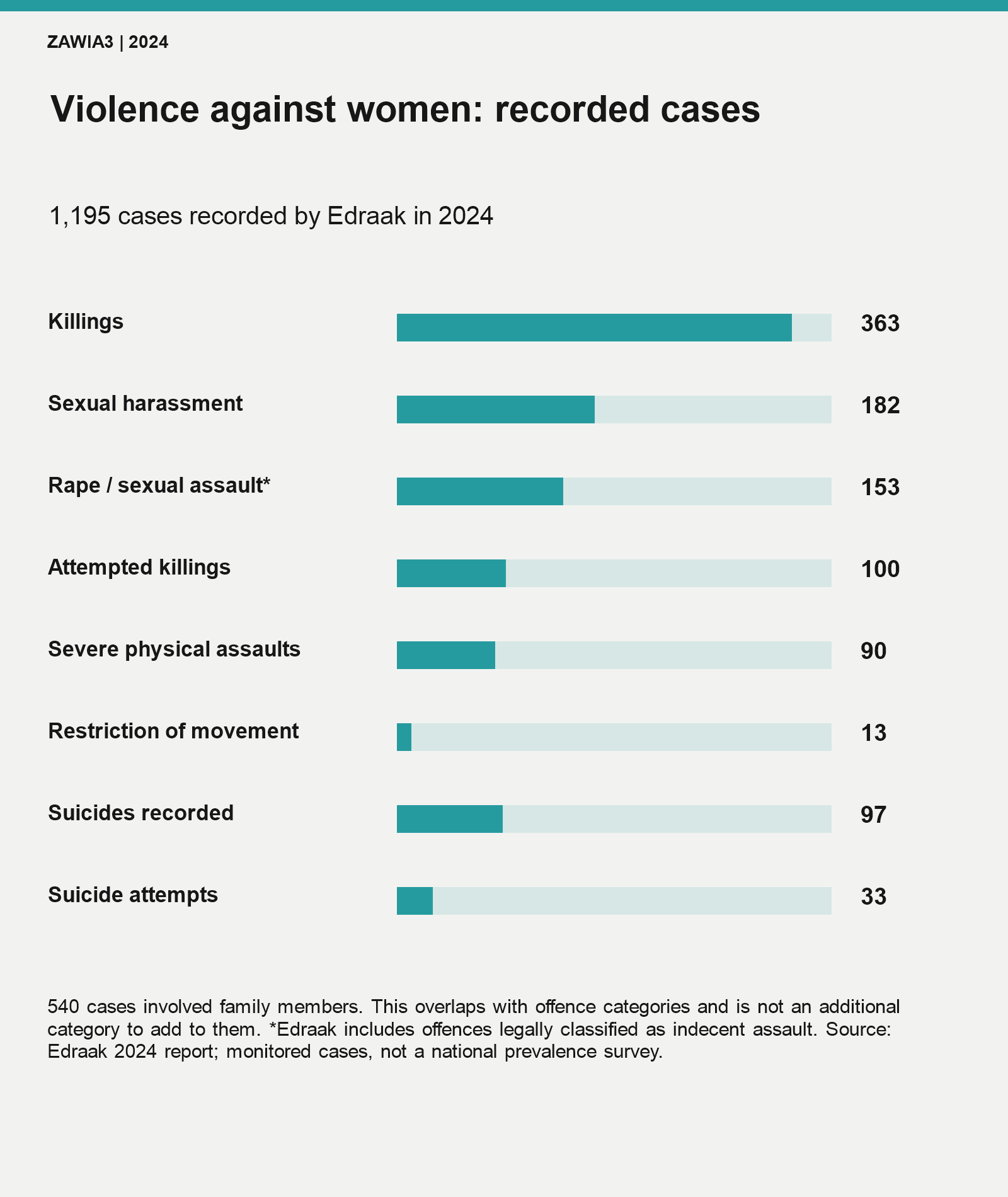
Edraak Foundation for Development and Equality’s observatory recorded 1,195 incidents involving violence against women and girls in Egypt in 2024, the highest total in its 2020–2024 series. That is a monitoring total drawn from reported incidents, media coverage and prosecution statements, not a national survey of the prevalence of violence.
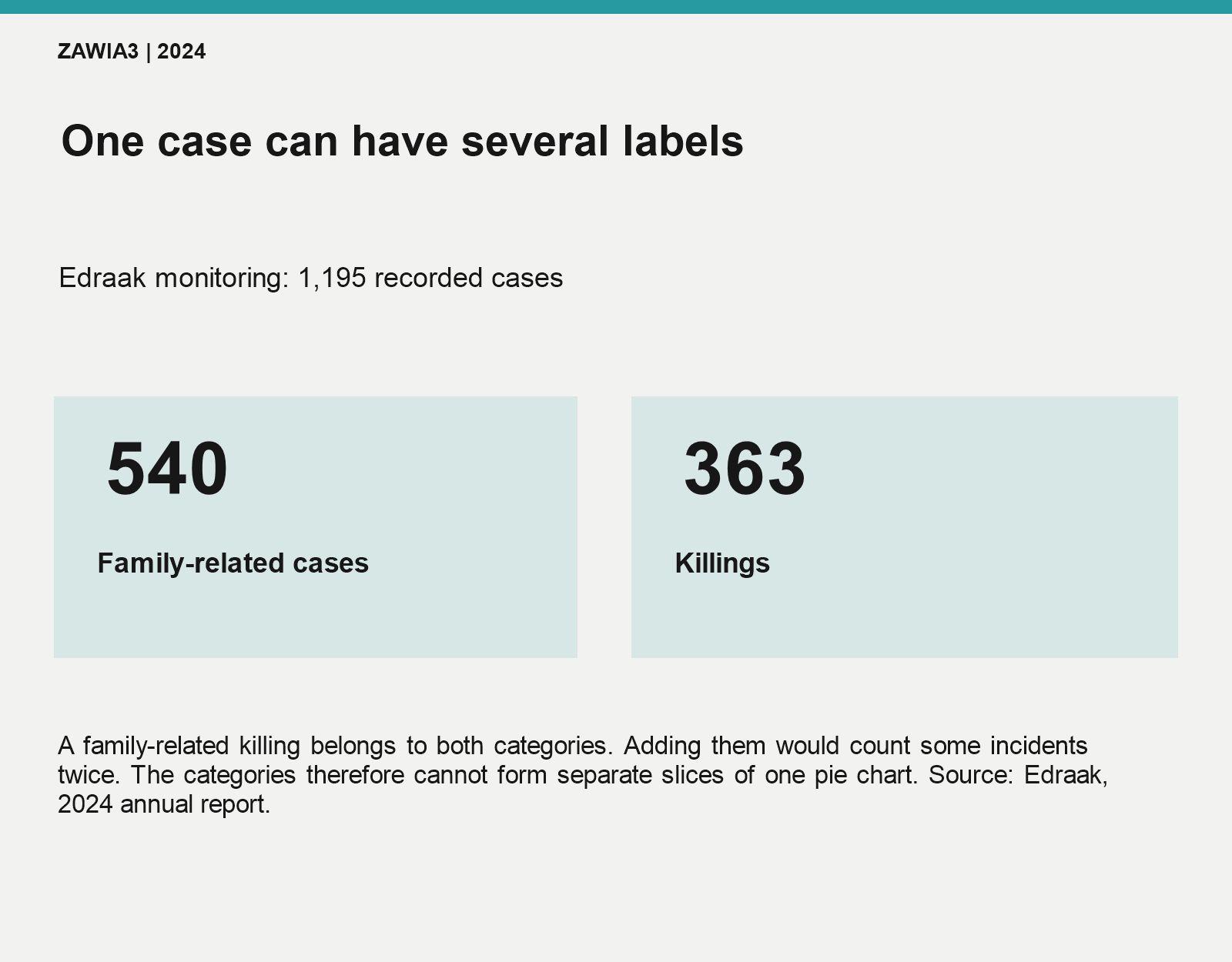
Its categories included 363 killings, 100 attempted killings, 153 rape or sexual-assault cases, 182 cases of sexual harassment, 90 severe physical assaults and 13 restrictions on movement. It also documented 97 suicides and 33 suicide attempts. Such records alone cannot establish the cause of each death or attempt.
The report identified 540 family-related cases. This classification overlaps with offence categories: a killing within a family, for example, can appear under both headings. Its rape category also includes conduct classified in Egyptian law as indecent assault.
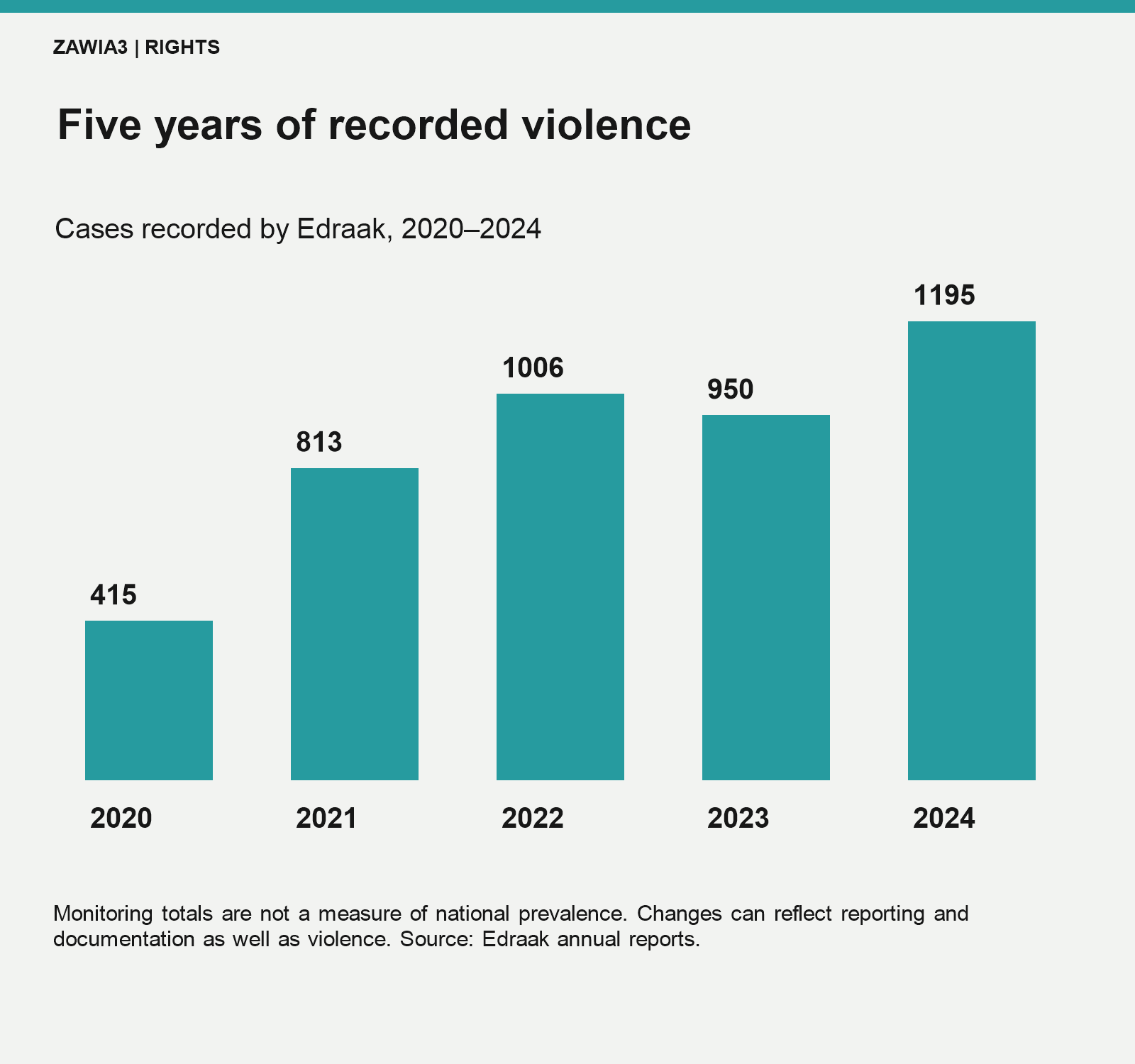
Recorded incidents rose from 415 in 2020 to 1,195 in 2024, an increase of about 188%. Changes in reporting and documentation can affect that trend as well as changes in violence itself.
The Edraak series gives 813 cases in 2021, 1,006 in 2022 and 950 in 2023. Calculated from those counts, the annual changes were +95.9%, +23.7%, −5.6% and +25.8%, respectively. The decline occurred in 2023, not 2022.
A separate report by Barah Amen, titled What We Know Only About Crimes of Violence in the Private Sphere in Egypt, recorded 703 incidents across 21 governorates in its published summary and geographical analysis. Its PDF introduction instead gives 772, and some regional totals do not match their breakdowns. These inconsistencies limit precise comparisons.
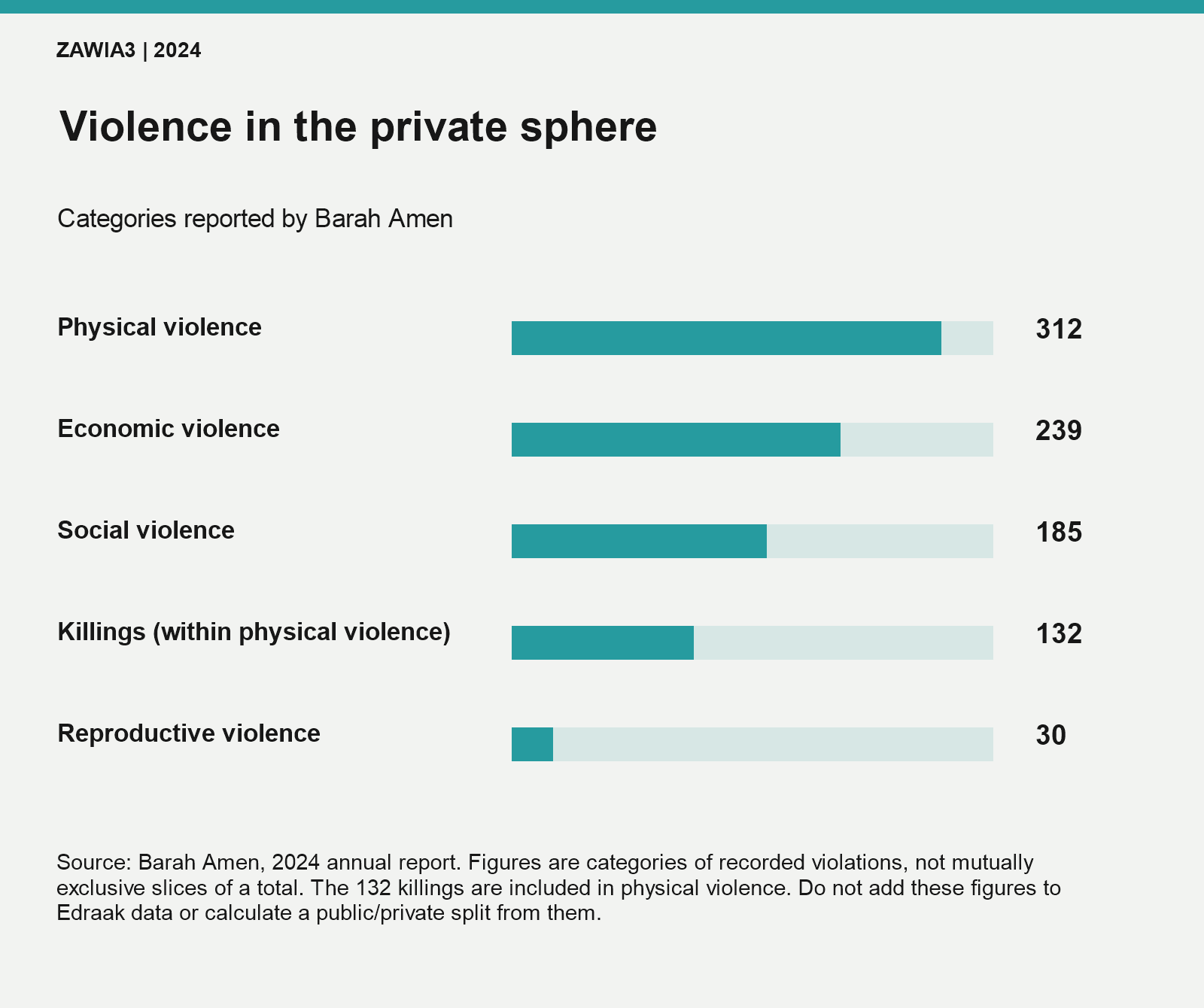
Barah Amen listed 312 cases of physical violence, including 132 killings, alongside 239 economic, 185 social and 30 reproductive-violence cases. They must not be treated as mutually exclusive categories, or added to Edraak’s differently defined data to produce a single national total.
The organisation reported that Greater Cairo accounted for more than half of its monitored incidents. It also listed cases in Upper Egypt, the Delta, Alexandria and Beheira, the canal governorates, North Sinai and the Red Sea. Its Upper Egypt breakdown included 30 in Sohag, ten in Qena, five in Assiut, one in Beni Suef and two in Fayoum.
The report cautioned that absent or low figures in some governorates did not mean women there were safe. Fear of stigma, family pressure, limited media coverage and difficulties obtaining legal or social support can keep violence out of the record.
Economic pressure and escalating abuse
Barah Amen links the circumstances surrounding some 2024 cases to the falling value of the pound and the strain on household finances. It describes physical and economic abuse, including assault, withholding financial support and taking women’s property.
The organisation also highlights killings justified by perpetrators through claims about “honour”, morality or revenge. It discusses the cases known in the media as the Fifth Settlement and Gharbia serial killings as examples of extreme violence and misogynistic rationalisations.
Some cases involved reported drug use or disputes over money for drugs. Those accounts do not demonstrate that drugs caused most killings of women, and economic hardship does not excuse a perpetrator’s actions.
The scale of violence is much broader than the incidents captured by monitors. A 2015 national survey by CAPMAS, the National Council for Women and UNFPA estimated that about 7.8 million women experienced violence annually. That widely quoted estimate belongs to the 2015 study, rather than a count for 2024.
The 2021 Egyptian Family Health Survey found that 31% of ever-married women aged 15–49 had experienced physical, sexual or emotional violence by their current or most recent husband at some point. The figures were 25.5% for physical violence, 22.3% for emotional violence and 26.1% for physical and/or sexual violence. These are overlapping survey measures, not percentages to add together, and the cited figures are not confined to one year.
Separately, a 2023 news report cited 9,538 marital-violence cases in 2021–2022, including 8,529 brought by wives against husbands, or 89.5%. This is a different measure again from either population surveys or civil-society monitoring.
Globally, a WHO estimate released in 2021 put lifetime exposure to physical or sexual intimate-partner violence, or non-partner sexual violence, at around 736 million women. It also found that about one in four women aged 15–24 who had been in a relationship had experienced intimate-partner violence by their mid-twenties.
Edraak’s monitored cases also included blackmail, attacks on women and girls with disabilities and violence linked to a rejected relationship. Its report recorded 60 blackmail cases and 13 rape cases involving girls with disabilities. Among alleged perpetrators, it classified 89% as male and 8% as female; those figures leave a remainder rather than describing every case.
The report identifies girls aged 12–18 as especially prominent among the recorded victims, while women aged 19–30 accounted for 11%. It also noted 39 cases in which a perpetrator reportedly claimed a mental-health condition. Such claims do not establish a diagnosis or, by themselves, determine criminal responsibility.
Reported motives for killings included family or marital disputes, theft and accusations concerning a woman’s conduct. The report’s breakdown identified stabbing, strangulation and severe beating among common methods, at 23.1%, 19% and 15.4%, respectively. It also documented acid attacks and assaults with sharp objects.
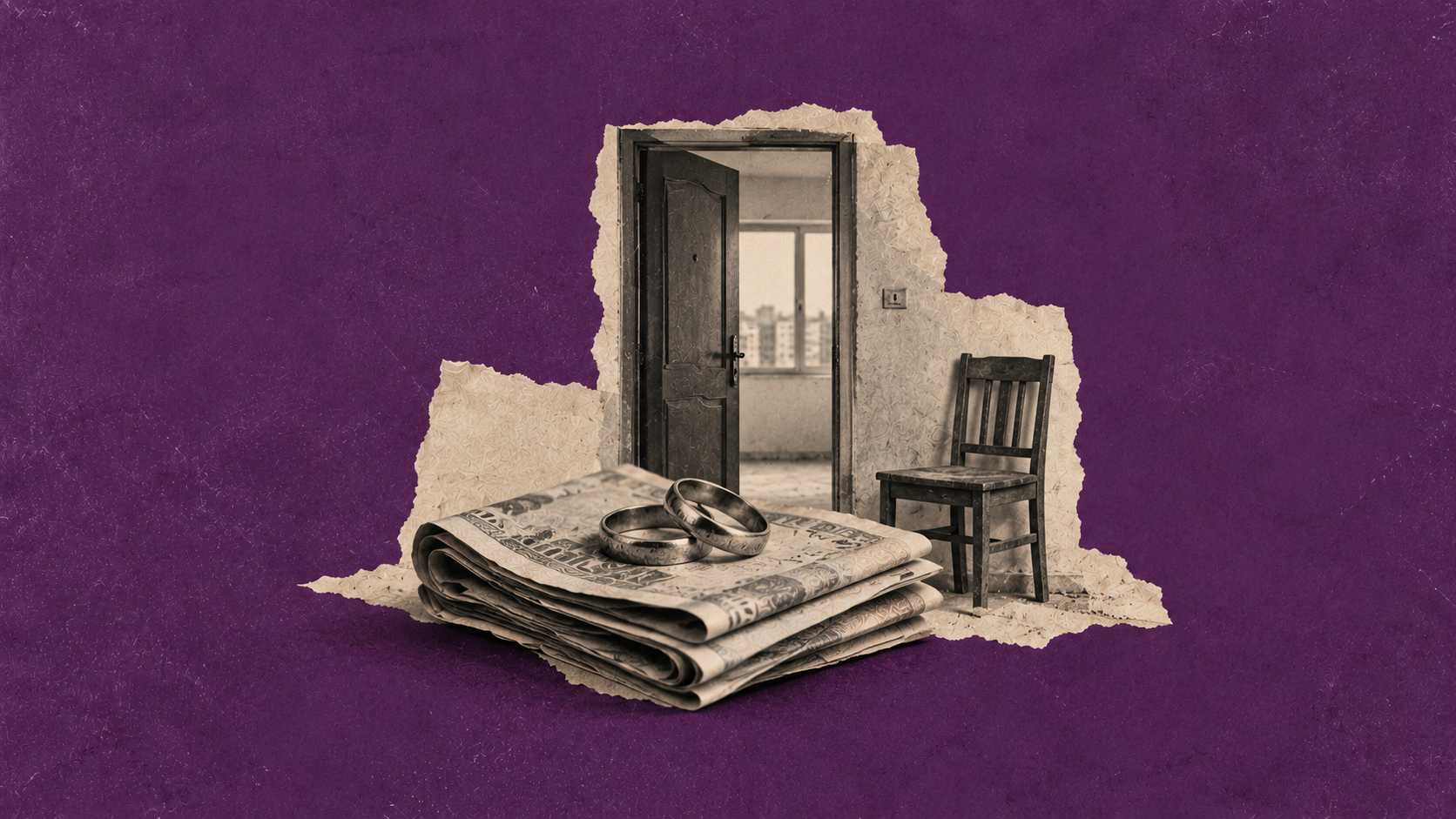
Protection gaps behind closed doors
Aya Abdelhamid, a feminist activist and director of the Alwan Observatory project at the New Woman Foundation, tells Zawia3 that Egypt lacks a comprehensive framework protecting women in the private sphere.
She criticises discriminatory provisions and lenient treatment of violence justified through claims about women’s behaviour or family honour. In her view, social tolerance of men’s supposed authority to “discipline” women helps sustain abuse.
Leaving an abusive relationship can be exceptionally difficult, she says, because of financial dependence and the stigma attached to separation. A survivor may face pressure to remain in the marriage while the abusive partner retains access to her.
Abdelhamid also points to religious interpretations used to justify assault and public sympathy for men who kill women after rejection. She cites expressions of support for Mohamed Adel, who killed Nayera Ashraf, including support that continued after his execution, as part of the culture activists are trying to challenge.
Domestic violence rarely begins with murder, says feminist activist and Barah Amen co-founder Shimaa Tantawy. Threats, beatings and repeated violations can precede a fatal attack, while the woman struggles to find a way out.
Tantawy argues that legal and social protection often fails before violence reaches that point. She describes a conservative, patriarchal response from some authorities that prioritises returning a woman to her husband’s home, alongside films and television dramas that depict women as dependent on men rather than autonomous people.
She says the organisation observes more incidents around Ramadan and other social or religious occasions, and links them to economic strain, time spent with abusers and cultural pressures. She also raises concerns about drug-facilitated sexual violence and assaults linked to separation or financial control.
Although more women appear to be filing reports, Tantawy says many in tribal communities remain unable to do so. Restrictions on leaving the home, stigma and the influence of tribal leaders on local authorities can reinforce their silence.
The violence that monitoring cannot see
Gender consultant Mai Saleh warns that high recorded figures in the capital and other large cities should not be read as evidence of lower violence in rural or border areas.
Access to hotlines, support offices and police reporting is uneven. Customary rules, patriarchal attitudes and restrictions on women’s movement can make disclosure difficult or dangerous. Some women may not recognise their experiences as abuse because their communities treat those practices as normal.
Low reporting is not proof of safety. The violence taking place inside homes may be far greater than the number of incidents that reaches the public record.
Saleh criticises explanations that excuse perpetrators through economic pressure or alleged provocation. She also points to reconciliation, pressure to waive civil claims and the use of judicial leniency, arguing that these can weaken accountability. Women face abuse at work too, she says, and need stronger protections there.
She sees gender stereotypes as central to the problem: boys are encouraged to be loud and forceful, while girls are expected to be submissive, patient and willing to endure mistreatment for their children. Challenging those expectations requires work with men and women together.
Edraak’s geographical figures cited in the report put Cairo at 32.7% and Giza at 23.3% of recorded cases. These are shares of monitored incidents, not population-adjusted crime rates or rankings of an individual woman’s risk.
A culture that pressures women to stay
Sociologist Saeed Sadek tells Zawia3 that violence against women has multiple causes, including patriarchal social attitudes and religious interpretations that tolerate abuse within marriage.
He stresses that the figures in monitoring reports capture what reaches news coverage and police records, rather than the full scale of violence. Many victims remain silent because economic dependence and social pressure tell them to preserve the household at any cost.
Sadek warns that separation or a divorce request can itself become a dangerous moment when a controlling partner responds with further violence. Reporting an abuser also does not automatically guarantee lasting protection: a woman may fear retaliation after a sentence has been served.
In his assessment, inadequate protection from further harm is one reason survivors may feel compelled to reconcile with perpetrators.
Demands for legal reform
Lawyer Heba Adel, founder of the Egyptian Women Lawyers initiative, describes a marked increase in the online blackmail and harassment cases reaching advocates between 2020 and 2025. She says the cases involve changing methods and a wider range of targets, including girls under 16 and women over 50.
Her organisation is working with a task force on revisions to a proposed unified law to combat violence against women. At the time of the interview, she expected the latest draft to be announced during Ramadan. She says it would include detailed provisions on online offences, definitions and penalties, as well as a substantial section on prevention and survivor protection.
Adel calls for a broader review of the Penal Code, arguing that discriminatory excuses, judicial discretion and some provisions allowing complaints to be withdrawn can facilitate impunity in practice.
She cites Article 60, concerning acts committed in good faith in exercise of a right recognised under Sharia, and argues that provisions used to justify abuse require scrutiny. She also criticises unequal treatment of men and women for conduct committed in comparable circumstances.
Legal clarification: Article 60 is not a general licence to beat or kill women. Article 237 provides a specific mitigation for a husband who catches his wife in adultery and immediately kills her and the other person; it is not a blanket rule covering daughters or sisters, or mere suspicion. Article 17 allows reduced punishment in specified circumstances, rather than automatic acquittal. Rules permitting withdrawal in certain family-related offences do not generally extinguish homicide or other violent crimes.
For the experts and activists interviewed, reform must combine stronger legislation with practical ways for survivors to reach safety, obtain support and report abuse without being exposed to retaliation.
They warn that much of the violence in homes, rural communities and areas with strong tribal authority remains hidden. Changing discriminatory laws, adopting comprehensive protection and confronting social acceptance of abuse are, in their view, inseparable parts of preventing the next killing.