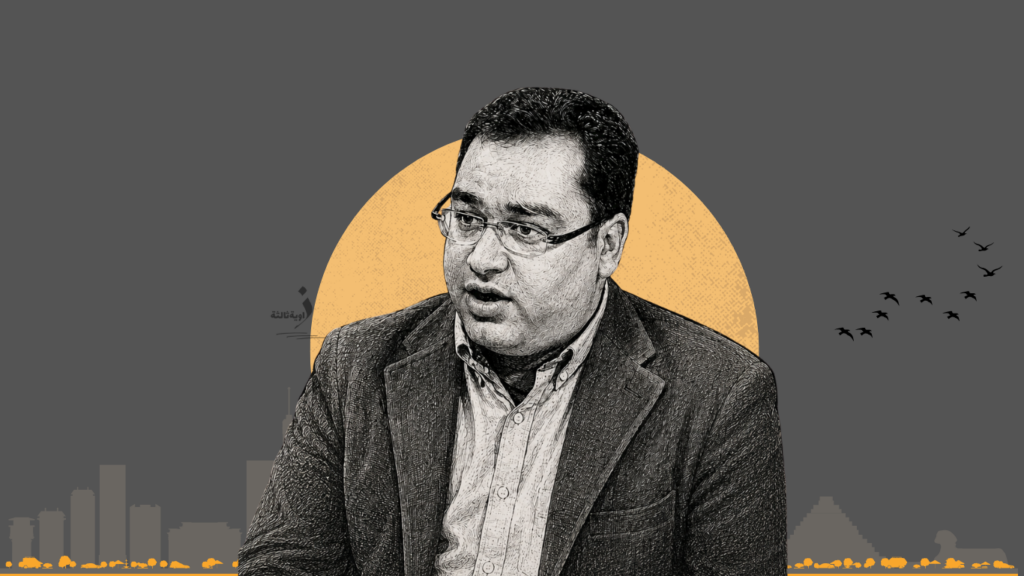
In his first extended interview in years, Zyad Elelaimy presents his reading of a structural crisis he sees rooted in 300 years of Egyptian history — foreign debt that climbed from $46 billion to $165 billion in 12 years, an opposition operating without political space, and a transitional justice provision enshrined in the constitution 11 years ago that has yet to be implemented.
Who is Zyad Elelaimy?
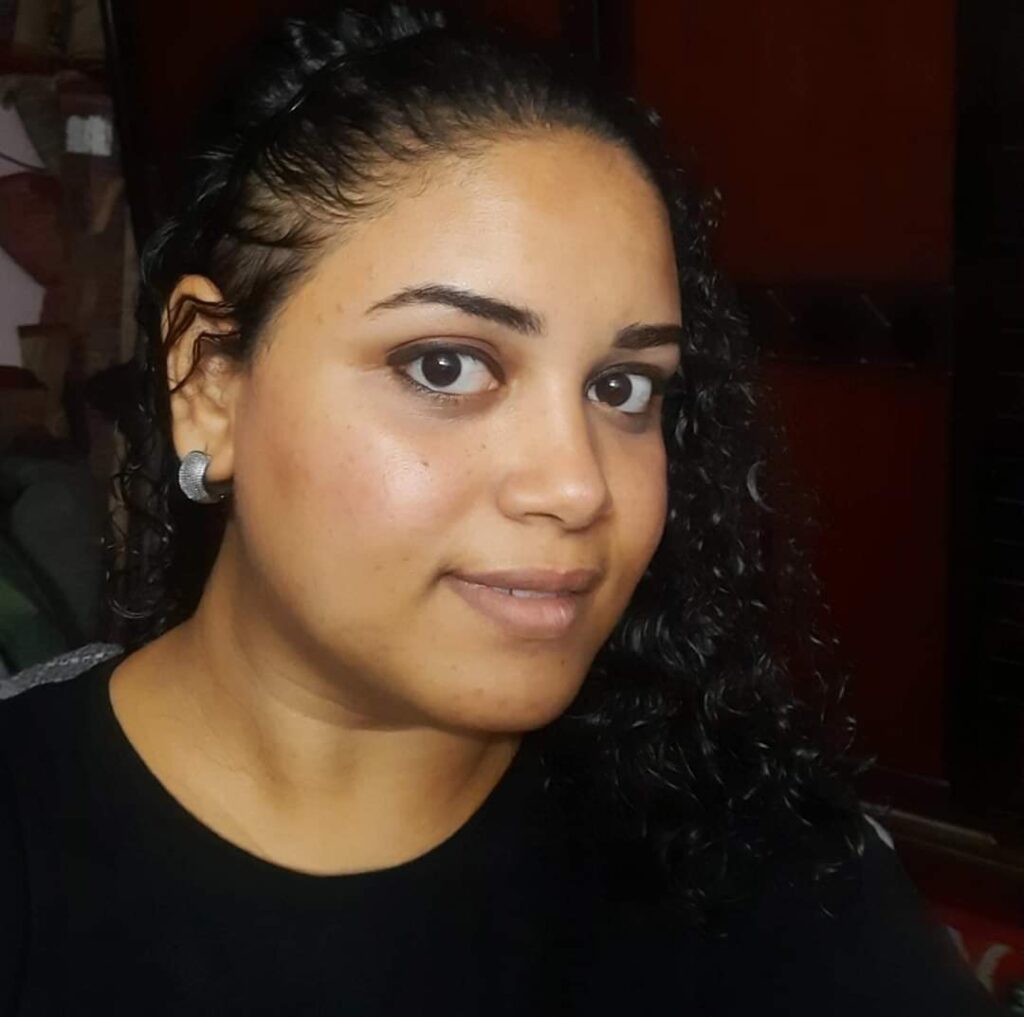
Zyad Elelaimy is an Egyptian lawyer, human rights defender, and politician who rose to national prominence as one of the most recognizable faces of the January 25, 2011 Revolution that toppled President Hosni Mubarak after nearly three decades in power. He went on to serve as a Member of Parliament representing the Egyptian Social Democratic Party in the 2012 legislature, Egypt’s first freely elected parliament in decades.
In June 2019, Elelaimy was arrested along with fellow activists Hossam Mones and Hisham Fouad in what became known as the “Hope Case” — named after their attempt to build a broad secular opposition coalition ahead of the 2020 parliamentary elections. Colleagues and activists said the arrests were aimed at preventing the formation of a secular coalition ahead of parliamentary elections that were dominated by supporters of President Abdel Fattah al-Sisi. The authorities accused the group of being part of an organization funded by the Muslim Brotherhood to incite revolution and commit violence.
In November 2021, an Egyptian emergency state security misdemeanor court sentenced Elelaimy to five years in prison on charges of spreading false news, with journalists Hossam Mones and Hisham Fouad receiving four-year sentences. He was also separately sentenced to one year in prison and fined after being charged with “insulting the president” for a 2017 BBC television interview. Rights organizations reported that Elelaimy was intentionally denied healthcare during his detainment and suffered from unstable blood pressure, asthma, and a rare autoimmune disease while being held in poor conditions at Tora Prison.
Human rights groups described his prosecution as part of the Egyptian government’s retributive campaign against political opponents, with Amnesty International calling for his unconditional release. He spent approximately three and a half years in prison before his release. He has since returned to public life, and this interview — conducted by Zawia3 — marks his first extended public engagement in years.
After years of absence from the media spotlight, we sit down with prominent politician and lawyer Zyad Elelaimy for an extended interview with Zawia3, in which he offers a frank and revealing reading of the trajectory of the state and the opposition in Egypt from the January Revolution to the present day. He speaks about his personal experience from the “Hope Case” and the years of imprisonment and isolation that followed, to the state of the public sphere in Egypt, in an attempt to understand what he calls a “structural crisis” afflicting the Egyptian state — politically, economically, and socially.
Elelaimy offers critical reassessments of the January experience, arguing that the revolution succeeded in bringing about change but failed to “manage the process of change,” and that the persistent impasse stretching back decades lies in the absence of a unifying vision for a peaceful political transition that guarantees stability and prevents the repetition of cycles of conflict and exclusion.
From this vantage point, he presents his vision of transitional justice as the only path capable of building a new social contract based on transparency, accountability, and the rebuilding of state institutions.
The interview also addresses his reading of the crisis of Egyptian opposition, which he believes operates within a “closed political space,” amid the absence of a declared political project from the authorities and the lack of genuine competition.
He asserts that the opposition is obliged to stop limiting itself to reaction, and move toward presenting clear alternatives for the future — warning that the continued closure of public space threatens to turn the political vacuum into fertile ground for extremism and social explosion.
On the economic front, Elelaimy offers a sharp reading of Egypt’s debt trajectory and economy over recent years, criticizing what he sees as the absence of a clear economic vision and an increasing reliance on financial solutions and borrowing, rather than building a productive economy grounded in knowledge and independent institutions.
You were one of the most prominent figures of the January Revolution, then your name appeared in the “Hope Case,” and afterward came a period of disappearance. What caused your absence from the current political scene?
The truth is that media visibility for any politician is a means, not an end. If it becomes an end in itself, it loses its purpose. So I am not interested in appearing unless I have something to add. As for the political reality, in my opinion there is currently no genuine political space in Egypt. We live in a country where people are imprisoned for their opinions, and we all see how elections and parliament are managed — including the presidential elections.
Therefore, I cannot be part of this form of politics, whether in political or parliamentary work. From there I began searching for alternatives through “putting forth ideas” by whatever means are currently appropriate.
As for current events, I express my views clearly on my personal page, including my assessment of the current political situation and the nature of the existing political management — frankly, I see neither management nor policy.
What are the alternatives you are currently working on?
For approximately the past year and a half I have been working on a program about the “history of the national movement in Egypt,” beginning from the end of the Mamluk era in the mid-eighteenth century through to 2011. In reviewing these 300 years of history, I have discovered that we repeat the same mistakes in every attempt to build a modern state or bring about change. I believe this is the right time for people to listen to this history, so we can understand how we arrived here, and how we can benefit from these experiences in the future.
What are the most prominent mistakes you have observed repeating themselves in attempts at change throughout history?
In my view, over the past 300 years we have been committing mistakes tied to our understanding of the process of change. We typically feel that change has been accomplished the moment consensus around it occurs, while what should follow is a clear vision of how to manage that process.
For example, the January Revolution succeeded in bringing about genuine change — such as the trial of presidents and the end of a system that had lasted for decades. I personally was born, completed my education, got married, and had children under the same administration. January truly brought change — but it failed to “manage the process of change.” The enduring crisis, in my view, lies in how to achieve a peaceful political transition, and manage the process of change without causing instability — in fact it would serve stability. We want stability, but we see it as coming through a social contract in which people feel their rights are protected, and the existence of a state of law that guarantees everyone their full rights.
The perennial challenge in Egyptian history, over the past 300 years, has not been the capacity for change — Egyptians have succeeded at that many times, and some instances were far more powerful than what happened in January. But the crisis has always been in “managing the process of change” — that is, how to bring all parties together, including adversaries and those who were in power and against whom the people revolted, because they must be part of the future. So how can these parties be gathered around a comprehensive national project to build a modern state? After that, we can disagree politically within that framework.
What tools must be acquired to achieve this democratic transition?
The truth is I became aware of this idea after the January Revolution. In the beginning, none of us imagined that Mubarak would step down. In my assessment, the Mubarak regime did not fall because of the revolution alone, nor because of a conspiracy or any other explanation, but because it had become “dismantled and exhausted” from within to such a degree that a group of young people was able, after 18 days in the square, to bring it down.
This does not mean we are calling for authoritarianism — the point is that the system itself had reached a state of such severe fragmentation that it was no longer capable of maintaining its cohesion even as an authoritarian power. The conflicting interests within it were sufficient to bring it down sooner or later.
At that moment — and I was like many Egyptians, whether inside the government or the opposition — I was not aware that there were experiences and tools the world had developed to manage democratic transition in an organized way. So between 2012 and 2015, I spent virtually everything I earned from my legal work on travel and studying the experiences of different countries, and meeting people who had participated in democratic transitions, to understand how it worked in practice. I read extensively, studied documents and multiple experiences, and discovered that the modern instrument for achieving democratic transition and building a unifying project for an entire country’s citizens is “transitional justice.”
I studied this subject in depth, met people who had participated in transitional justice programs in various countries. “Transitional justice” has been applied 33 times in 29 countries — all of which transitioned from one condition to another through this path. Brazil experienced it, as did Germany and others. In my view, it is the method through which the system can be moved from its current form to the form we aspire to.
This transition occurs through different tools and mechanisms, and each country creates its own model according to its circumstances, with the goal of building a new social contract between the state and society. After these years, specifically in 2015, I wrote a series of articles on how to apply “transitional justice” in Egypt, published at the time on the “Masr Al-Arabiya” website and later republished on other platforms. I still believe this is the only path that can take us from the current situation to a modern state.
Paradoxically, the Egyptian constitution itself stipulated the necessity of issuing a transitional justice law in the first parliamentary session of 2015 — and after 11 years, that law has still not been issued. This leads me to believe that the constitutional provision was intended to reassure people during the transitional period more than it reflected a genuine commitment to implementation.
Azza Soliman to Zawia3: Egypt Needs a Full Family Law Overhaul, Not Piecemeal Amendments
What do you mean by “transitional justice”?
“Transitional justice” is simply a mechanism used by states emerging from periods of conflict, authoritarianism, or division, with the goal of revealing the truth, achieving accountability, providing redress, and reaching a societal reconciliation that allows for building a new state on just and stable foundations. I wrote about it in my articles, but it did not receive significant media traction at the time, and the political climate then was not conducive to opening a genuine debate around this path or adopting it seriously.
Transitional justice is a project built on several fundamental stages:
The First Stage: (Disclosure) — the stage of revealing the truth. This means knowing what actually happened in terms of violations, crimes, or corruption across different periods such as the Mubarak era or others. This is done through a body that receives complaints from those harmed by human rights violations, corruption, or violence, while opening the floor to documenting all incidents. Committees of victims themselves can be formed to help gather evidence and understand the nature of what happened and how.
The Second Stage: (Accountability) — after gathering evidence, the accountability phase begins. Its forms differ from country to country. In some experiences, such as South Africa, it was sufficient to publicly acknowledge crimes through the media as a form of accountability that achieves general and specific deterrence — the perpetrator becomes known and socially ostracized.
In other cases, trials are held. There are crimes that can be handled administratively or through reform, such as petty bribes or minor corruption, where documentation alone is sufficient to identify systemic failures and address them. Major financial crimes, on the other hand, can involve the restitution of looted funds along with fines and compensation based on the harm caused to individuals or the state, while grave crimes such as torture or killing are subject to judicial accountability, with the possibility of opening the door to reconciliation if both parties agree — as is practiced in some existing legal systems.
The Third Stage: (Building a New Social Contract) — the most important stage. Here, what has been learned from disclosure and accountability is used to formulate a new social contract. This is done through committees comprising victims from various sectors — health, education, and others — alongside legal experts, with the aim of identifying the gaps that led to violations, then drafting a new constitution, laws, and institutions to ensure they are not repeated.
The fundamental idea here is not only to punish those who wronged, but to prevent the recurrence of wrongdoing in the first place, and to build a modern state grounded in rights and law, enabling the transition to a more stable and just state.
What is the philosophy of transitional justice that should be applied in Egypt in your vision?
In some experiences, those who committed crimes publicly acknowledged them, and the philosophy was that this acknowledgment achieves part of the legal objective of punishment — namely general and specific deterrence. Society identifies those who committed the crimes, and this is typically accompanied by a form of social ostracism, even without entering into conventional trial proceedings in some cases.
In other countries, full trials are held. But in the framework I propose, there is a distinction between types of crimes. There are crimes linked to everyday public order — such as bribing a low-ranking official, or simple or repetitive corrupt practices. In my view, these can be handled by documenting them in official records, with the goal of exposing structural failures in the system rather than necessarily focusing solely on punishment — to understand where the fault lies and how it can be restructured or corrected.
Regarding major financial crimes, I proposed the restitution of looted funds — whether directed against individuals or institutions — along with fines determined by the court according to the scale of the crime and the damages and losses caused, whether to individuals, society, or the state.
By contrast, there is another category of crimes that cannot be handled with this flexibility — such as murder, torture, and grave human rights violations. These remain within the scope of direct prosecution, while also opening the door to settlements or reconciliation in some cases, if reached by agreement between victims or their families and those who committed these crimes, as occurs in some existing legal systems, with the court taking this agreement into account if reached freely.
The third stage in the transitional justice framework is the most important at the structural level — the stage of “building a new social contract.” Transitional justice is often misunderstood as being limited to reconciliation alone, whereas it is fundamentally built on three stages: disclosure, then accountability, then reconstruction.
In this third stage, committees are formed representing different categories of those harmed — such as victims from the health sector, or education, or various institutions. They sit with legal experts to understand how violations occurred, and where the gaps were that allowed them to happen. The goal is for these discussions to be translated into genuine reforms in the form of the constitution, laws, and the management of institutions, so that a new state is built that prevents the recurrence of the same violations in the future.
For me, the idea is not only about punishing those who erred, but about ensuring these errors are not repeated. The person who was detained for political reasons — in my case I was imprisoned for political reasons — my primary goal may not be to imprison whoever imprisoned me, but rather to have a guarantee that this pattern will not be repeated with others in the future. Ultimately, people differ in their outlook: some believe that reclaiming one’s right through punishment is essential, while others focus more on ensuring the violation is not repeated.
Therefore, the ultimate goal is to reach a formula that balances these views, so that a new state is built — with different institutions, a new constitution and laws — guaranteeing that the crimes and violations of the past are not repeated.
Do you see the political environment in Egypt as permitting the application of transitional justice? And what would drive state institutions to adopt this idea?
In my assessment, we are heading toward transitional justice sooner or later. Despite the existence of constitutional provisions, there are attempts to circumvent this path and rely solely on the security solution — but this has not achieved societal peace. The world since the 1970s has evolved in its understanding, and the goal has become societal peace, not merely pursuing criminals. Today, more than 15 years after 2011, we see no real solutions, only multiplying crises — which points to a structural problem in the architecture of power and the tools for managing the state and public life. This problem cannot be ignored.
“Transitional justice” will only be implemented when all parties realize it is the only way out of the crisis. I see that “the future passes through an alliance of the defeated.”
As long as one party believes it can govern alone or bring down the others, we will reach no solution. The moment we all acknowledge that we are in a dire situation — particularly economically and politically — is the moment we will sit at one table to establish new general rules. After that, we can build a system within which we compete on the basis of these rules, not outside them.
Egypt is greater than any single party — it was greater than the Mubarak regime, and it is greater than the Islamists, and greater than any party currently in power. Therefore, there is no alternative to consensus — whether through an elected president or through a transitional period — to exit the current cycle.
Social scientists have concluded that security alone cannot achieve societal peace, because public policies themselves produce part of the crime. Poverty, for example, leads to certain types of crime, and closed societies when they open up may see new patterns emerge, such as increased harassment. Therefore, it is necessary to address the roots, not merely the symptoms. This is where the role of research centers — such as criminal research centers — comes in, producing studies and recommendations that help adjust the policies and laws that generate these problems. This is a fundamental part of any transitional justice framework.
Regarding your detention period — what happened behind the scenes of the “Hope Case”?
The “Hope Case” arose because we were attempting to establish an electoral coalition uniting all opposition parties. Our definition of the opposition at the time rested on two criteria: first, those who opposed the 2018 constitutional amendments that modified presidential term limits; and second, those who opposed the cession of Tiran and Sanafir.
We encountered problems at the outset because the different groups — January youth, parties, and independent MPs — were not accustomed to sitting together and had significant disagreements among them. We exerted considerable effort meeting with everyone, including Hamdeen Sabahi and Farid Zahran, and I invited Ahmed Tantawi and Haitham El-Hariri. We met, they were convinced by the idea, spoke with the “25-30 MPs bloc,” and I began reaching out to the youth associated with the January Revolution era who had withdrawn from the scene.
I felt this course of action was appropriate following the “No” vote campaign against the constitutional amendments — 1,800,000 people voted against them, and 600,000 invalidated their votes. I told my colleagues — Hossam Mones and Ahmed Kamel El-Baheiry — that the citizens who voted “No” or invalidated their ballots were our constituency and must find representation in parliament.
We began working a year and a half before the elections, and I met with a large number of researchers in education, health, industry, and energy, with the goal of drafting a “rescue program for Egypt” on which all opposition forces would agree. As soon as we began to move, problems emerged. I recall that Ahmed Tantawi told us in a meeting that he had just come from a meeting with a senior state official warning against this coalition. Others received similar calls.
Despite this, we decided to continue and compete for all parliamentary seats. Before my imprisonment, I was handling an arbitration case outside Egypt, and friends warned me not to return as I would be arrested — but I decided to come back and told them: “No leader flees when his army is defeated.” I arranged the affairs of my law office, and told Hossam Mones two days before we were arrested: “Prepare yourself — we will probably be imprisoned next week.”
We were sent to prison because we said we would contest the elections. The truth is that the coalition did not continue after that, and not even a statement was issued on behalf of those imprisoned. The members scattered — some participated in the “Unified List,” others boycotted. The experience failed in this way, but I learned much from it, and people learned that any serious attempt to participate would carry this price. I have no regrets, because the price is worth people understanding this truth.
I spent three and a half years in prison, nearly isolated, seeing very few people — primarily Hossam Mones and Hisham Fouad. This period gave me the opportunity to reflect on everything I had done, politically and personally, and I revised my views on many things. Even my son learned that there are choices for which we pay a price, and he developed an awareness of what can be surrendered and what cannot. I came out with new experience, new ideas, and ready to face the world once again.
Could Zyad Elelaimy run in the next elections — parliamentary or presidential?
Any opposition movement’s primary goal is to reach power — any other talk has nothing to do with politics. The difference between the opposition in the Mubarak era (and even since the Nasser era) and the post-January opposition is that the former was content with protest without offering a vision as an alternative or as a policymaker.
We learned this lesson. We now have alternatives and a vision for how to manage a transition in the interests of all Egyptians. The pursuit of power is the means of guaranteeing the implementation of policies that protect people’s interests and grant them security and freedom simultaneously — without trading one for the other — and achieve the economic standing they deserve.
As for running for the presidency in 2030 or 2034, first we do not know what will happen with the constitution. But in the end, every Egyptian citizen has the right to run — whether for local councils (which have been absent since 2011), for parliament, or for the presidency.
The fundamental battle I see as worth fighting is defending every citizen’s right to run, to express their political opinion, and to present the alternatives they believe are capable of improving the country’s conditions. This is not merely an individual right — it is the right of society as a whole, and the right of the state itself.
Ultimately, people deserve to find those who present different visions and alternative policies, and they also deserve to choose freely among them.
What are the most important reassessments you consider necessary regarding the January Revolution, and what do you believe, if handled differently, could have most benefited political organization in Egypt?
The answer can be divided into two parts: what pertains to the past, and what pertains to the present. As for the notion of “if only this had happened” or “if we had chosen a different course” — I am by nature not preoccupied with that kind of thinking. I am a political man, and politics for me is about the future more than about rehashing the past.
Even when I addressed the January Revolution critically, I did so as one of the participants in its leadership, and after coming to see that there were strategic errors that should be discussed openly. The articles I wrote stemmed from precisely this idea — my goal was not to say: “In this situation we should have done this instead of that,” or to present myself as the person who had the right answer and was not listened to. That is not the role of a political leader.
The role of a leader, in my view, is to point to the strategic mistakes that occurred so they are not repeated in the future. Therefore, when I discussed January, I was interested in discussing its structural and strategic errors, not in distributing blame or settling scores with the past.
“January” was not a personal project, and political transition in Egypt is not a personal project either. Therefore, what matters most is thinking about how to avoid the same mistakes in the future.
If we speak about the opposition today, I frankly believe that the existence of a genuine opposition first requires the existence of a clearly defined system of governance. The function of the opposition anywhere is to confront policies put forward by the authorities, to say that these policies are wrong, and to offer an alternative. But the question here is: what policies are actually on the table? We know what the regime did yesterday, and we know what happened this morning, but we do not know what it intends to do in the future. There is no declared political project, no clear economic project that can be discussed or disagreed upon — and so the opposition always finds itself in a position of reacting to events that have already occurred.
We are continually surprised by political, economic, and international alliance decisions — but is there a declared direction? Is there a clear vision put forward for public debate? And if that does not exist, what exactly is the opposition opposing?
From this came one of the most important lessons I have learned: as long as the governance system does not put forward a clear political or economic project, my role as opposition is to put forward the alternative I consider appropriate, and for the system in turn to explain what it intends to do.
The fundamental crisis the opposition is experiencing today is the absence of a normal political space and the absence of a system of governance. There is also another crisis related to generations: there is an older generation present by virtue of time and history, and a new generation trying to rise, but neither is the older generation willing to cede the space, nor is the new generation capable of assuming it, because the public sphere itself is closed.
The truth is that the opposition’s own constituency has become either frightened or imprisoned. We are talking about people who may be imprisoned for a post on Facebook. The closure of political space in this manner cannot lead any country to a healthy or stable condition. In my assessment — both for the government and the opposition — there is a fundamental question that must be asked: what is the form of the state we want?
The world has tried different models for governance. If we are talking about a democratic system with competent state institutions, the state could come to resemble Sweden. If the system is authoritarian but state institutions are effective, it might be closer to the Chinese model. If there is democracy with weak institutions, we will have a fragile state. And the greatest danger is having an authoritarian system with institutions incapable of performing their functions — which is the fate Egypt must avoid.
The fundamental issue here is the competence of state institutions — meaning that the Ministry of Health performs its role in providing healthcare rather than becoming a party to economic interests; that the Ministry of Interior assumes responsibility for security rather than managing political life and elections; and that the Ministry of Defense focuses on protecting the country rather than managing economic activity.
The genuine starting point for any reform is for each institution to return to performing its natural constitutional role. In my view, this could be a point of agreement between very different parties — Islamists, civil forces, leftists, liberals, and even within state institutions themselves — because any state ultimately needs effective institutions capable of performing their functions.
Do you see the opposition as performing its supposed role? Or does it need to redraw its map and reintroduce itself to Egyptian society — especially given the volume of criticism directed at opposition parties within or outside the civil movement?
I return once again to the idea of the opposition itself — because the existence of an opposition presupposes the existence of a political system. We do not have a political system in the genuine sense, and therefore there is no real opposition in the full sense of the word. What I see is a state of political vacuum, and in politics there is no such thing as a vacuum — because that vacuum is always filled by extremism or terrorism. In the end, any system in the world must have forces that oppose it — and when all those who oppose are thrown into prison, whoever opposes next will be entirely outside the system.
Therefore, saving the country begins with people’s ability to express their opinions without fear, and being able to organize themselves and participate in elections — whether parliamentary, local, or presidential. These are basic rules, and without them one cannot speak of political life or a genuine political space. The essence of politics is competition — and when competition disappears, politics disappears.
Is this the fault of the opposition? In truth, the opposition has for many years remained in the position of the “acted upon” rather than the “actor.” At some moments, more rebellious opposition forces with a vision did emerge, but they failed to sustain themselves.
Therefore, I believe what is required of the opposition today is not to remain captive to opposing the past or to mere reaction to what has already occurred — because we are always preoccupied with opposing things that have already happened. What is required is for the opposition to begin presenting a vision for the future: how do we want this country to be? What is the project we offer? And after that, it is up to the authorities to respond.
I noticed you spoke of Islamists, leftists, liberals, and the state — a combination that seems extremely complex. Does this mean you are speaking of political and societal reconciliation?
The truth is this is one of the ideas that changed most for me after January. After the revolution, I believed that the fall of the regime simply meant implementing what we saw as correct — and perhaps that was natural, because we are children of “the experience of authoritarianism.” I personally was born, graduated, got married, and had children under one president, and therefore we had not experienced a genuine democracy before. So our assumption was that societies like ours, the moment a political change occurs, automatically move toward implementing what the victorious forces consider correct.
Today I believe that assumption was wrong. We are “pre-democratic” societies, still learning the meaning of political coexistence. Therefore the fundamental role of politicians in societies like ours is not for one party to defeat another, but to convince people not to imprison each other, and not to kill each other when they disagree.
From this I began to think differently. The matter for me is no longer “with me or against me,” but rather: to what extent do we agree? What common ground is possible between us? I believe there is a wide common ground between very different parties within Egyptian society — from the far right to the far left — despite all these conflicts. Everyone ultimately wants Egypt to become a modern state. The real question now is: how do we get there? There are basic conditions we must agree on first so that everyone does not drown — after that we can disagree politically as we wish, but the important thing is that we do not drown.
This is also connected to economics. In my professional experience, I have seen how investment flees Egypt. The investor looks for a state of law, stable institutions, and clear contracts. The current system chose an economic model based on attracting investments tied to political alliances — which is not necessarily a wrong or bad choice, it is one of the options on the table. But it later collided with global crises — first the COVID-19 pandemic, then the Russia-Ukraine war. The countries that had been injecting investments or economic support began to be preoccupied with their own internal crises.
The real solution now is not in waiting for massive investments tied to political relationships, but in attracting small and medium foreign investments — ranging for example between $50 and $500 million. This type of investor needs a stable and clear environment. The investor does not throw his money into a country where he does not know: who he will deal with, who his competitors are, and what the limits of authority and influence within the market are. Any investor simply wants to know: if I put in this amount, what are the procedures? What is the return? What are the guarantees? And the current climate of uncertainty is the biggest deterrent to investment.
Therefore, there must be an independent judiciary that guarantees the investor their rights, and also guarantees that they will not be competed against by a party wielding power or influence against them. We also need genuine governance and sound management of state institutions, and the exit of state institutions from economic activity so they do not become competitors to investors.
Investment based on trust in a person inside the power structure is not stable investment — because people leave, while what endures are institutions and clear rules. Therefore, the real guarantee of investment is the existence of modern state institutions, an independent judiciary, and stable economic policies that prevent sharp and sudden fluctuations.
From this I say that democracy is no longer merely a political demand for us — it has also become an economic necessity, because reforming the economy itself requires transparency, accountability, independent institutions, and fair rules that everyone feels protect them and preserve their rights.
You spoke of “economic democracy” — how would you describe Egypt’s economic situation today? What brought us to this point? And what is expected over the coming years?
When speaking about the economy in Egypt, I cannot offer a comprehensive critique of an economic vision held by the authorities, because I simply do not see a declared economic vision. What is happening is decisions and measures being taken, and we then discover their effects afterward and bear their cost collectively — without genuine societal discussion.
Over the past fifteen years, real economic solutions have not so much been offered as financial policies alone. When the state faces a liquidity crisis it prints money; when it faces a crisis in the pound’s exchange rate it resorts to financial and monetary measures to attempt to control the market or repay debts. But all of this constitutes financial solutions, not a comprehensive economic policy.
When we look at the projects, construction, and housing file, we find the state expanding in luxury housing — yet this is not its natural role. Luxury housing is supposed to be built by the private sector for those with financial means. The state’s primary function is to solve citizens’ problems and provide for their basic needs.
We also have a massive debt crisis. In 2014, Egypt’s external debt stood at approximately $46 billion, and today it has reached approximately $165 billion. This means that over approximately 12 years we borrowed an additional $119 billion. Egyptians have the right to know: why was this money borrowed? What alternatives were on the table? What returns were achieved? And did the ordinary citizen feel any effect from these billions?
The problem is that these debts will not be repaid by the current regime — regimes change, but it is the citizens and their children who will pay the cost. How, then, are people not to be a party to these fateful decisions?
From this I see several fundamental things that must be worked on: “First, redirecting the economy toward genuine production rather than focusing on real estate and luxury housing. Second, identifying the sectors and products in which Egypt can compete. Third, building a scientific and technological base to develop these products. Fourth, investing in trained labor and technical education. And finally, building competent and capable state institutions to manage the economy soundly.”
When we succeed in achieving these fundamental elements, the financing and investment file becomes much easier. If a state has a clear and stable environment, a strong educational structure, a trained workforce, and competent institutions, and then announces that it is opening the door to investment in specific sectors — the money will come automatically.
We always treat population growth as an economic burden, while the modern economy views it as an “opportunity.” Having a large population can be a tremendous advantage if properly invested in, because it means a wide market, a large workforce, and an opportunity for rapid growth compared to low-density countries.
But the fundamental problem is that we lack a clear economic vision. The economic path we have taken over the past twelve years has brought us to massive debts totaling approximately $119 billion in additional borrowing, while we still do not know how these debts will be repaid.
This crisis is not new in Egyptian history. Take Khedive Ismail — the man genuinely dreamed of building a modern state and wanted to make Egypt part of Europe. Even today, when we look at Khedival Cairo we are impressed by what he accomplished. But the problem is that he did not think sufficiently about how to repay the loans he obtained, and this is where the major colonial powers — England and France — found an opportunity to intervene and take control.
Therefore, when we look at these historical moments, we do not look at them to flagellate ourselves, but to understand: how do we avoid repeating the same mistakes in the future? No one wishes the country ruin except its enemies. All Egyptians, whatever their differences, want the state to advance. The difference is that some rely on science and research, while others rely on improvisation and the idea that any project, once implemented, will produce results automatically — and this does not happen.
Why does Egypt lack vision? Is the problem a shortage of competencies? Absence of experience? Or the lack of genuine feasibility studies?
I do not believe the problem is an absence of vision altogether, but I do believe there is a different vision held by the ruling elites — one that historically extends from the era of Khedive Ismail to today.
The essence of this vision rests on the idea that the people are “incapable” or “unproductive” or “unqualified,” and that the solution always comes from above — not through genuine investment in people. This idea later evolved, particularly since the Sadat era, into a continuous reliance on borrowing, on the basis that Egypt “is too big to fail,” and that the world will continue injecting money into it to prevent its collapse.
But the real question is: does injecting money alone prevent collapse? The money enters and then disappears without the citizen feeling any genuine improvement in their standard of living, while debts continue to grow. Therefore, the problem lies in the vision itself.
What must be thought about is: how do we convert this large number of Egyptians into a trained workforce? How do we invest in scientific research? How do we develop our products? How do we build strong and independent state institutions, so the investor becomes capable of calculating their gains and losses in a clear and stable environment?
I am convinced there is a vision within the authorities, but the problem is that it is either undeclared, or it is a mistaken vision that has been repeating for many years and whose harmful effects are increasing over time.
Do you see that the government must exit the economy? How is this done in practice? And which sectors should the state stop operating in, and where should it remain?
The state should fundamentally not be a direct player in all investment sectors. Its role is to exit the fields of general commercial investment and leave the largest space to the private sector, with specific exceptions.
There are sectors the private sector will not enter because they have low returns or long time horizons — such as affordable housing — and here the state can intervene. There are also heavy industries or slow-return investments — sectors where the state can play a supporting or direct role. One can also look at sectors such as military manufacturing, where some countries have armies that enter industry and achieve economic returns — a model that exists globally.
But on the other hand, state competition with the private sector must be reduced, because the state’s presence as a direct competitor leads to market distortion and weakens the investment environment — since the state becomes a party, and the state must not be a party in a relationship involving competition with anyone, nor must it take revenge on anyone.
These are the main rules of modern governance related to accountability — the state is too large to be in conflict with anyone, and it competes with no one, for it represents all Egyptians. Therefore I see the necessity of the state exiting this competition, and establishing clear rules to prevent monopoly, ensure fair pricing, and provide transparent investment incentives — so the investor knows what they are entitled to and what they are obligated to, without undisclosed privileges or opaque practices. Only in this way can a more balanced economy be built, in which the state is a regulator and guarantor of the rules, not a player competing with others on the same field.
Moving to the file of political conflict — two cases have been raised recently: the case of Sayed Mashageb, who was released and then returned to prison a few hours later, and the case of Ahmed Douma, who was released after years and then returned again. How do we understand extended pre-trial detention, and why are some people re-imprisoned after release, even after long periods?
The truth is that over the past years, some politicians who have connections with state or security institutions continued to spread word that a political opening was coming and that certain people would be released — and so on. The truth is that the national dialogue itself was built on the premise that everyone would be released before it began — and this has not happened to this day.
The truth is that yes, releases do occur — but at the same time people are re-imprisoned. When Sayed Mashageb sits in his home for three hours and then returns to prison because people welcomed him after 11 years of imprisonment — or when Ahmed Douma returns to prison again because of something he said, an article he wrote, or an opinion someone disliked — this reflects a major problem. Because speech does not go to court, and a person must not be tried for their opinion. They are held accountable if they commit a criminal act — but expressing one’s opinion is not a criminal act. When I express my opinion, the response is another opinion.
From this emerges a problem in the whole system. Political opposition has come to negotiate for the release of one or two people, or “take these and I will do this” — and we enter an endless cycle.
Therefore, there must be a societal discussion about how to resolve this file entirely. When there are thousands in prison on political charges, how can you tell them: help me? Among them are scholars, incidentally. How do you tell them: participate in building a modern state? How do you address their families by saying that what is happening is being done for their benefit? And how do you make their children feel that all this is being done for their sake? This will not be possible in this way.
Under these conditions, you will not be capable of it. And this impedes the ability to build a modern state. Building the modern state requires mobilizing all possible energies. Therefore, I see this as an obstacle to development — and I am not alone in seeing that.
At the present time, all that preoccupies me is how this country does not sink, how it does not enter further crises, how we preserve the existence of real institutions, and an economic condition that allows for stability.
But there will be no stability built on people’s anger at people. Real stability is built on strong institutions — institutions not destabilized by public opinion in the sense that they are not disrupted by it, yet at the same time respond to opinion with opinion and carry out their duties.
When that happens, people feel change through the modernization that touches their lives and notice a real difference in their living conditions. If people do not feel a difference in their lives, the problem is not those who say three words or express their opinions. The fundamental problem is that people do not feel any real improvement in their lives.
The problem is not Ahmed Douma, nor Ismail Al-Iskandarani, nor Sayed Mashageb, nor anyone else in the prisons. The real problem is that people do not see positive change in their lives. And this is the greatest danger: that those who feel but do not speak are the greatest danger to any system.
How do you view the National Dialogue experience? And if the invitation were renewed, would you participate or not?
Any dialogue is by its nature between different parties — otherwise it does not deserve to be called dialogue. Therefore, when speaking of a “national dialogue,” there should be clear parties that exchange debate on specific issues.
It was said that the state was the one that called for the national dialogue — but the question is: is there, within this dialogue, a party representing decision-making? Is there anyone representing the state as institutions? The answer is no. And is there anyone representing the system of governance itself? Also no. With whom, then, am I in dialogue? There are parties that are predominantly opposition-leaning and others that are loyalist — but in the end, none of them possesses genuine capacity to influence or make decisions, because their presence in the dialogue is not tied to any actual executive or political authority.
Any serious dialogue anywhere must be built on clear parties, a defined agenda, and a known timeline, with the goal of reaching implementable outcomes. But what happened in the national dialogue is that it lacked a clear agenda. There was also no party being directly negotiated with, because the essence of the negotiation was taking place outside the dialogue framework itself.
If the negotiations are taking place outside the dialogue, why not take place there directly? Why gather similar or close-minded parties inside a dialogue hall? They don’t actually need that hall — they can meet or communicate without it.
Therefore, is this a genuine national dialogue? In my opinion, it is not. Genuine dialogue is that which brings together different parties with divergent positions, within a clear time frame and a defined agenda, reaching announced and binding outcomes.
What exists is closer to image management or the creation of a climate of appeasement — not a genuine political process.
As in parliamentary work, the genuine MP must be backed by a clear, elected popular base. But in the absence of trust in the electoral process, the MP loses this support and becomes incapable of genuine representation — because they are not backed by an effective popular will. This is what makes those in power say to the MP: “Get out — I don’t want to talk to you.”
Therefore, the fundamental question remains: is the goal to produce an image suggesting things are going well? Or is the goal genuine political openness? Because genuine openness is what produces actual change that is reflected for everyone — for my children, for my adversaries, and even for those who differed with me or imprisoned me.
On foreign policy — how do you view the relationship between Egypt and the Gulf states, politically and economically?
To understand what is happening now, we must look at the international picture more broadly. Before the First World War there were great empires controlling spheres of influence and wealth. After the First World War, empires such as the Ottoman state and the Austro-Hungarian Empire collapsed, and modern nation-states began to emerge.
Then came the Second World War, after which the modern world order was formed under Western leadership, through international institutions whose goal was to organize the world in a way that guaranteed the continuity of these powers’ influence and their benefit from the wealth of other countries at the lowest possible cost.
Any world order creates in turn forces that resist it. Initially there was the communist bloc, then national liberation movements, then in recent decades new regional and international powers emerged — large countries such as China, Iran, Russia, and Turkey, alongside a large number of other countries that began building their economic and political capacities and growing in power — against a traditional world order that formed after the Second World War and which seemed, in part, to reflect the logic of control over the wealth of weaker nations.
What we are witnessing today is a clear conflict between the powers that have dominated the world since the end of the Second World War and rising states seeking to redistribute the balance of power on the international stage. In this picture, the question for Egypt as a state and as a political project is: what is its role?
First, we must think about our distinctive advantages that we can offer the world — particularly at the economic level — such as developing the educational infrastructure, building a scientific research system, qualifying trained labor, and establishing competent state institutions.
Second, no country can move alone in this complex world, and therefore we must think about the alliances Egypt can be part of, in a way that serves its interests and gives it capacity to influence the global economy and politics.
Here a series of fundamental questions arise: how do we develop? How do we build a modern state? How do we establish an industrial structure based on science and knowledge? What is the appropriate alliance for Egypt in this phase? Who are the parties with whom we share common interests? Where are the points of minor difference? And who are the parties whose interests diverge significantly from ours or with whom we differ fundamentally — “adversaries”? These questions must be clear and defined for everyone, because answering them is what will determine Egypt’s position in the future.
The future is not waited for — it is made now. If we continue managing things on a day-to-day basis without a strategic vision, we will find ourselves falling behind while history moves forward, and become merely part of the past — like the dinosaurs that were powerful and then became extinct.
Therefore, the real challenge before Egypt is to think about how not to become a state of the past, but to be part of the new world taking shape. And in the end, the two fundamental questions remain: how do we manage our relationship with the outside world — whether in the region or in the global economy — and how do we define our position within this changing world order?
The future is made now, and if we continue managing things day by day without a strategic vision, we will find ourselves outside history. A state may be large and powerful, but if it does not evolve, it can become a “dinosaur” — massive and powerful, but ultimately extinct.
As for the Gulf, I reject looking at it as a single bloc. The Gulf comprises countries and companies — meaning there are countries run with a mentality closer to corporate management, thinking in terms of quick profit and direct gain without strategic thinking or consideration of the future. I would like to reference what Saudi journalist Abdulrahman Al-Rashed said — that other countries’ relationship with Egypt remains a strategic relationship, based on the geographical and political weight of the Egyptian state, and that this relationship is likely to continue given what Egypt represents in terms of regional importance.
But relying on this weight alone is not sufficient. The sustainability of any strategic relationship rests not only on historical weight or geography, but on the ability to offer mutual added value.
In other words, Egypt cannot be content with the idea of “being an important party” in the regional or international equation — it must be a party that genuinely contributes something in this relationship. This does not mean turning relations into a purely commercial logic of “buying and selling,” but rather moving from the position of dependence on status, or thinking of Egypt as a company — whereas I as a state must think in terms of a strategic relationship, with clear mutual interests: what do we offer? And what do we receive in return? In this sense, the relationship becomes more balanced and sustainable, because it is built not on weight alone but on the capacity for genuine contribution to shared interests.
From here, when it is said that Gulf states “paid Egypt,” one must distinguish between money that officially entered the state budget and was used in projects and investments, and any other arrangements. As an Egyptian citizen, what concerns me is: where did the money go? How was it spent? And what returns were achieved for society and the economy?
You as an investor are not here to extract money from us. And if you gave something to someone else informally, that is not my responsibility — go and hold them accountable. My responsibility, as an Egyptian citizen, is the money officially paid to you. And the truth is this is my responsibility — even though the decision was already taken without my participation or involvement.
Some see the Gulf as dealing with Egypt through a logic of political and economic blackmail. What is your comment?
In politics there is no such thing as “blackmail.” In the end, there is a party that is either capable of bearing the decisions it makes or not. A party cannot come and say: “I am being blackmailed because I paid money to invest” — the correct framing is: did you make this decision freely or not? Were the terms clear or not? And are you capable, as a state, of bearing the consequences of your decisions or not?
This is not a defense of anyone — it is a description of the political reality. If a state reaches a point where it cannot bear the consequences of its decisions, this is a problem in the structure of power and the tools of political management within that state — not in the other party.
Therefore, instead of talking about blackmail, the more important question is: how do we build a state capable of making decisions from a position of strength, with a clear vision of its interests and what it is willing and not willing to offer in return?
What is your reading of the Palestinian cause today and Egypt’s role in it?
The Palestinian cause is a central issue in Egyptian national security, not merely a humanitarian or moral concern — though it is that too. Egypt’s geography, its border with Gaza, the Sinai, and the Canal, all make the Palestinian issue directly connected to Egyptian stability.
What is happening in Gaza today is a humanitarian catastrophe by any standard. But beyond the humanitarian dimension, what concerns me as someone thinking about Egypt’s future is the political management of this file.
Egypt historically played a central role in every round of negotiations, and this role is tied to its weight — geographically, politically, and demographically. But the question that must be asked today is: is Egypt exercising this role from a position of genuine strength, with a clear national project and capable institutions — or is it playing the role of mediator from a position of internal weakness?
Because a country that manages its internal affairs well, that has a strong economy and real political legitimacy, is capable of playing a more effective regional role. The external role is always a reflection of the internal condition.
A final question — how do you see the next ten years for Egypt?
I will be honest: I am neither pessimistic nor optimistic by nature. I am a realist who looks at available data and possibilities.
The data before us points to serious structural problems — economic, political, and institutional. The debt crisis is real, the closure of political space is real, and the absence of a clear vision is real. These are not opinions — they are measurable facts.
At the same time, Egypt has enormous potential — a large and young population, a strategic geographic location, civilizational depth, and human competencies that, if properly invested in, could produce qualitative leaps.
The question is not whether Egypt has the capacity to change — history proves it does. The question is always the same one that has been repeated over 300 years: can we manage the process of change this time in a way that builds rather than destroys?
My answer is that this is possible — but it requires first acknowledging that we have a structural crisis, not just a passing crisis that will resolve on its own. It requires all parties to sit at one table not from a position of “I will impose my vision,” but from the question: what are the minimum rules we all agree on so this country does not sink?
If we reach that point — and I believe we will reach it sooner or later, whether we want to or not — then Egypt has every capacity to rebuild itself into a state worthy of its people and its history.
The future is not a gift — it is a choice. And choices require courage.