The 55th Cairo International Book Fair has opened, running from 24 January to 6 February. Shortly before the opening of the fair, which is ranked among the most prominent book fairs in the world and is visited by about two million people every year, followers were surprised by the announcement by the publishing house “Al-Kotob Khan” that it had been excluded without justification from taking part in the fair’s activities. According to the house, it was surprised by the exclusion a few hours before receiving its allocated pavilion, despite having completed all the paperwork.
It says in a statement on its official Facebook page: “We were surprised at the last minute, a few hours before receiving our pavilion, to be arbitrarily banned from taking part in this edition by the fair’s management, without any clear reasons or prior official notification. Moreover, the space agreed for our pavilion was handed over to another publishing house, despite our having paid all the fees and completed the papers required to take part in the fair, according to the announced conditions. This means wasting the efforts of a distinguished group of male and female writers, as well as the house’s staff, over many months of preparing to take part in the most important cultural season of every year”.
“Al-Kotob Khan” was not the only house banned the day before the fair opened; the ban list also included the publishing houses “Tanweer” and “Diwan Al-Arab”, joining the “Tanmia” bookshop and the Azbakeya Wall booksellers, which were banned in previous editions. This heightened the anger of readers and those interested in Egyptian cultural affairs, who asked about the reasons for the ban and the mechanism by which officials accept publishing houses and their lists for the fair, especially as the three houses whose exclusion was announced have a wide presence in Egyptian cultural circles and a literary character, without clear political leanings, and “Tanweer” publishes intellectual, philosophical and religious works and does not offer political content against the authorities.
“Diwan Al-Arab” announced its return to the fair hours later, but without explaining the reasons for its exclusion or its participation. Referring to the fair’s organising regulations, clause 12 allows the fair’s management to accept or reject the participation of any publishing house without giving reasons. According to the organising authority, the cases in which a publishing house’s participation may be cancelled are: displaying a book that is the subject of a legal dispute; displaying a forged, copied or counterfeit book; displaying books that violate freedom of thought and creativity, as well as the principles imposed by Egyptian law and public morals, or that offend religions; violating the conditions of the necessary agency licences inside the fair for publishing houses; holding seminars inside sales venues; or violating the design conditions inside the pavilion. But the three houses said they had not violated any of those criteria set by the body in charge of organising the fair; on the contrary, they offer publications of great importance to Egyptian and Arab readers.
On the other hand, this leads us to another very important issue, according to questions monitored by Zawia3 after the ban on these houses was announced in recent hours: some social media users asked whether the book fair would turn into a platform for new publishers and social media influencers, excluding every year a number of influential houses that took part in past editions and offer important works by writers of the older generation. This is especially so as publishing houses began years ago, because of the escalating economic crisis and rising prices of printing, paper and ink, to shed their full responsibility for publishing costs. Publishing houses are now divided into three categories: houses that bear the full publishing costs, which are the big, renowned ones that accept works only by major writers and authors, or are affiliated with government bodies such as the National Centre for Translation or one of the Ministry of Culture’s bodies; houses where costs are split between the house and the writer, usually medium-sized in level and capacity; and others in which the writer bears the publishing costs, the latter having become the most widespread and popular, most of them newly founded or with limited resources.
A New Generation of Writers
Social media has taken the lead, with millions of writers, influencers and audiences who prefer reading online hiding behind electronic keyboards; yet intellectuals still pant and race for printed writing. By the calculations of today’s publishing market, a person with thousands of followers means a potential writer with thousands of readers, in a market losing its lustre in the face of other temptations attracting readers, so publishing houses look for every means to guarantee their survival, even if they marginalise writers and attract influencers.
In the world of “Gen Z“, its stars are drawn from the most important medium of its day, social media. So how can we judge the participation of influencers, the stars of these media, in the writing market?
Since the beginning of the second decade of the third millennium (the current millennium, extending from 2001 to the year 3000), experiences of what we might call “influencers”, whose stars shone on social media, spread timidly. These experiences did not receive enough attention from critics in general, perhaps because at the time they were closer to a limited phenomenon that had not yet imposed itself. At the same time, the digital transformation affected the publication of printed books, and e-commerce in online bookshops had the strongest impact on the book publishing market, while competition in e-commerce reduced bookshops’ ability to survive. Publishing houses thus sought to bring the digital reality down to earth and benefit from it.
Publisher Ashraf Shaheen, a member of the Egyptian Publishers Association, says electronic applications spread rapidly alongside technical development, especially in the last three years, during the spread of the coronavirus and the period of isolation. It began with government directives in schools and universities, which relied on these applications during the school year for remote learning, and then moved to other age groups and segments, so that the e-book, read or audio, became a means of entertainment.
According to the data analysis website “Mordor Intelligence“, the e-book market was estimated at about USD 16.42 billion in 2023 and is expected to reach USD 20.74 billion by 2028, at a compound annual growth rate of 4.78% over the forecast period (2023-2028). We were unable to find accurate Egyptian statistics on the e-book market or publishing houses.
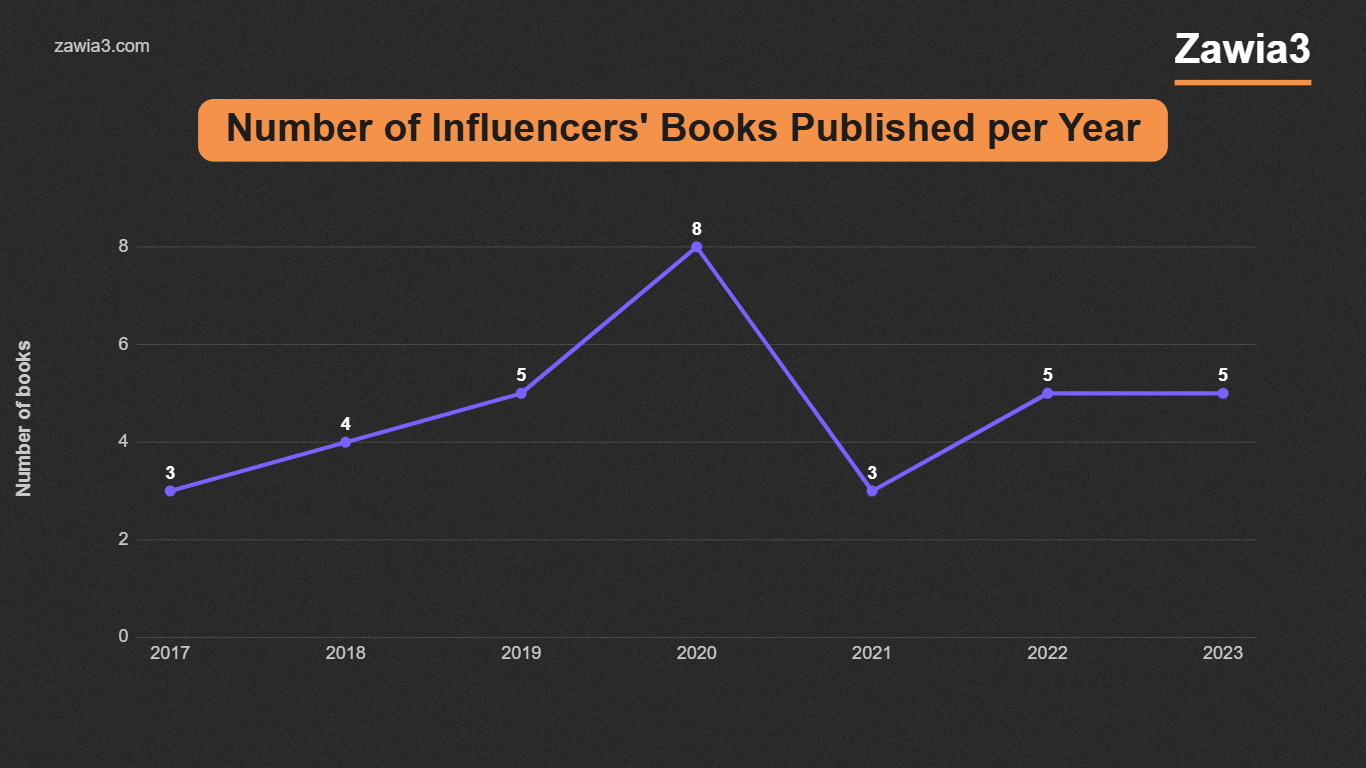
At Zawia3 we analysed data on 23 books by the most famous influencers whose written works have been published in recent years. The following table shows that in 2022 the book market took on the publication of influencers’ writings, and in searching for the main reason that pushed publishers to turn that step into a phenomenon, the facts may lead us to what the coronavirus did to the publishing market!
In a study issued by the International Bureau of the World Intellectual Property Organization, “the decline in revenues of the global book publishing market was estimated at about USD 7 billion in 2020”, and “even online sales only partially compensated for revenue losses”. Hence, publishing house owners turned to looking for a guaranteed alternative, and 2020 was the real beginning of a general trend the publishing market would witness: turning to influencers to cover the economic losses caused by coronavirus.
The first time readers noticed a number of works by social media influencers at the Cairo International Book Fair was at its 51st edition in 2020, when they came across publications with disapproved titles such as “Strip Off Your Clothes, O Time”, “Addicted to Success” and “Sweet Soul”, which were well received by the younger generation following these influencers, while an atmosphere of disapproval and criticism prevailed among the fair’s longtime visitors. In support, influencer Esraa Ahmed, whose book “Sweet Soul” was published in 2019, points out that most of the writings by influencers she knows came in the following years.
What Do Influencers Write?
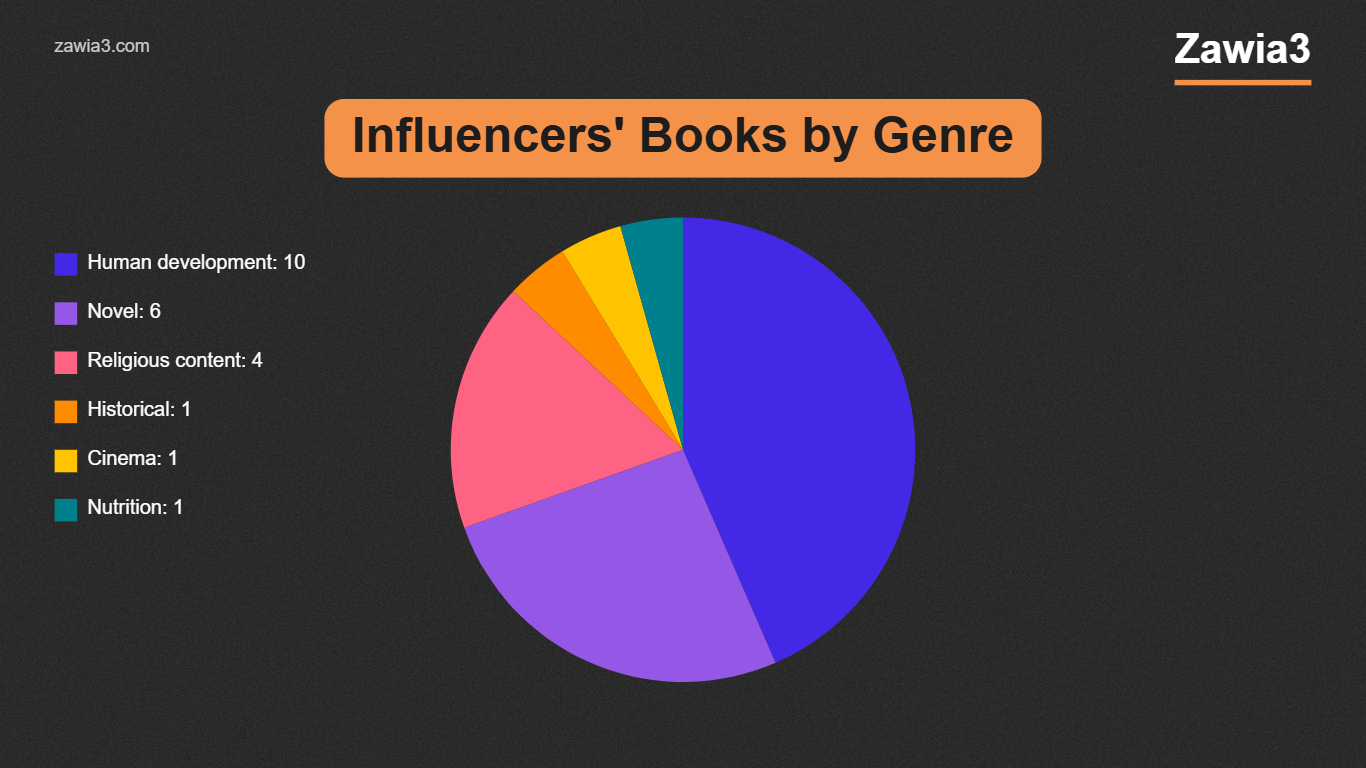
Most influencers have focused on self-development, making it the material of their publications. They present and market themselves as material for “success”. This means that the self-development field, whose star shone at the start of the 2000s, is now being recycled through video clips on their pages, and as part of marketing themselves as a commodity of success, many of them decided to turn their experience or the essence of their ideas into written content.
For her part, critic Aya Tantawy explains in her conversation with Zawia3 that one reason for the temptation to turn this visual product into a written one is influencers’ feeling that they are “attacked by society, because it does not value them and considers them without a real job and without culture, and obtaining the title of writer and having a publication in bookshops simply gives them weight and their audience’s respect; it is also an effective way to leave their mark and gain a new segment of followers.”
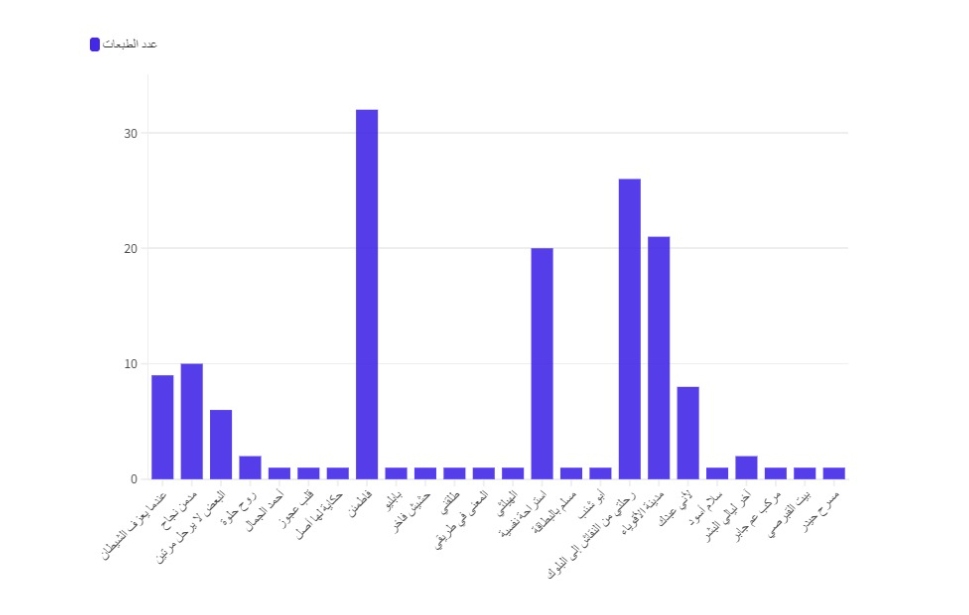
Despite having millions of followers, influencers’ books have not achieved the success publishing houses hoped for: according to the previous table, which is based on information from the book-buying website “Neel wa Furat”, almost the only website we found that gives the number of a book’s editions, more than half of the books we searched for did not go beyond a single edition! Only three books exceeded 20 editions!
Influencer Esraa Ahmed points out that she did not receive much help in marketing from the publishing house; it relied mostly on what she posted herself, which was met with a violent attack, as she describes it: “The reaction was hard. I wrote a book about bullying, and they bullied me and the book, because they saw I had no right to express myself and write or enter the literary field, and they did not give me a chance to talk about the book’s content from its launch, accusing me of using my disability to promote it”.
Turning to “Goodreads”, a book rating website, many of these works received poor ratings from the writers’ own followers, who commented mostly, as our research showed, that they were “disappointed in their awaited writer”. Many followers did not like the use of the same tone in the book as on social media, objecting to the weak style that did not take into account the new medium, which requires a narrative different from that offered on electronic applications.
Between Polarisation and the Customer
In marketing there is what is known as the “target group”, the group the seller must plan for carefully, to the point of imagining what it looks like; for their part, influencers target Gen Z primarily.
This generation has returned to reading globally, especially through e-books. Perhaps the matter lies, according to analysts, in global publishers understanding what this generation wants to read: according to statistics, 83% of Gen Z readers have completely bypassed traditional books and turned to comics and novel series, looking especially for diversity and excitement, not a set of tips they can easily get through social media.
Tantawy points out that “publishing houses aim first at profit and second at spreading culture and knowledge, and each publishing house has its own way of achieving its first goal. There are those who choose to drift towards attracting influencers and achieving the greatest possible sales, and here either the house is interested only in influencers, or there are those who care about striking a balance to attract the influencers’ audience on the one hand and the intellectuals’ audience on the other.”
Influencers’ Books: Where To?
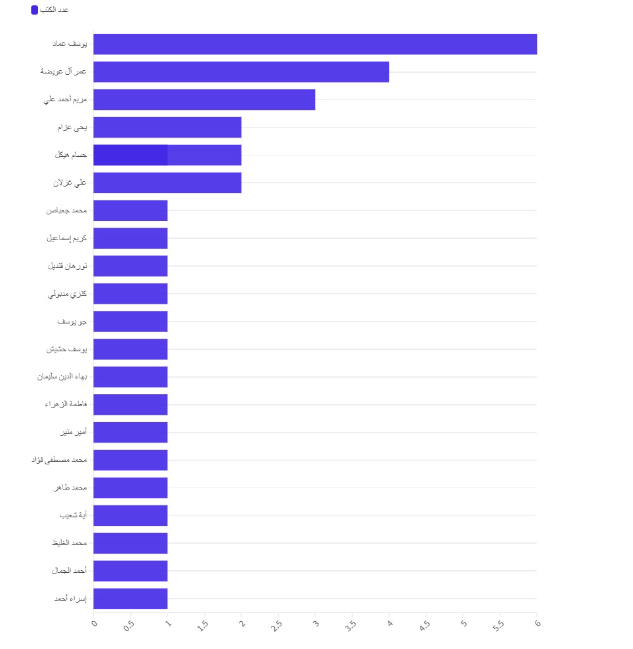
Publication rates fell after 2020, perhaps because the step publishing houses expected to be their ticket to publishing success did not achieve the desired success; rather, it is an experience the influencers themselves will not repeat after the attacks they faced, as shown in the previous table of writers who published only one book. Esraa Ahmed confirms to the platform that she will not repeat the publishing experience, an experience she would not have undertaken had it not been for a writer’s advice to record her experience and that of other people with disabilities.
Contrary to expectations, a report published by The Guardian this year showed that in 2023 children’s reading rates rose by 24% compared with 2020 and 2022, and according to local and international reports, the “TikTok” app played a major role in this increase.
For example, according to our search, the book titled “My Journey From Debate to Block” by TikToker “Jo Moussa”, who has 10 million followers, reached 26 editions this year! According to its online description, the book discusses many issues that concern young people. The same goes for TikToker “Omar Al-Owaida”, who has 5 million followers.
Nevertheless, critic Aya Tantawy says she is still convinced that “time does justice to real writing; many famous and best-selling writers of their eras are unknown to us now. New writing by celebrities in the market will not diminish my value as a writer. Each of us has an audience and readers, readers’ tastes are diverse, and it is fine for writings that please everyone to be published all the time. It is important that everyone gets a chance to express themselves; the critical judgement of the value of that writing is another matter.”
Influencers and Publishing
In a video by influencer Yahia Azzam titled “How I published my first novel after being rejected in the past because I was not famous”, he explains that his ticket to publication came through posting videos, especially after the first house he approached asked him about his number of followers. Influencer Salsabil, owner of the page “Your Food Is Tastier With Bella”, explains that one of the houses asked her to write a book on whatever she wished, expressing her surprise since she is still a child!
We put the question to Dar El Rawaq, which published three of the influencers on the list, and its founder Hany Abdallah explained its publishing conditions, saying the house seeks to “offer works that we know from our experience will interest different segments of readers, while at the same time not compromising on a high level of quality in our books”. Regarding the market’s role in the publishing process, he said “the market is an important indicator of reading trends, which we rely on to know what topics readers prefer, and at the same time the economic changes that constantly affect the market greatly influence the publishing plan”.
Abdallah explains that he also took risks with some of the house’s publications, as he did with the novel “The Papers of Shamoun the Egyptian”, which “exceeds six hundred pages, but the quality of the work and our willingness to take risks pushed us into the adventure, and the novel achieved astonishing success beyond all expectations”. As for publishing influencers, he explained that the house looks first and foremost at the quality and distinctiveness of the work; if a good work is submitted by a social media influencer, “we approve it for its quality first and foremost”.
The changes affecting the publishing and book printing market remain rapid and successive, especially amid strong competition from the e-book market, which is also growing rapidly. Yet the Egyptian public still follows printed book news and finds the Cairo fair an annual opportunity to buy everything it needs for the year, so the printed book remains its first medium, despite the millennial generation entering the scene with its aspirations and preferences.