
Controversy prevailed on social media after blogger “Ben Schlappig” posted on his famous travel blog “ONE MILE AT A TIME” that his experience in Cairo was bad, that he was mistreated at the airport, and that he had to wait hours for his procedures to be completed.
For his part, the Minister of Civil Aviation, Sameh El-Hefny, directed that the incident be examined to establish the accuracy of what was published, by reviewing the surveillance camera footage, and explained that the video contains fallacies and is untrue, stressing that there is deliberate targeting of the international airport’s reputation, especially since some of the footage shown does not relate to Cairo International Airport at all.
In this context, Eman Mostafa, an Egyptian who travelled from the airport last month, recounts the experience of three doctors who were heading to Portugal last month to attend a medical conference that was supposed to last three days, but after they reached their destination they discovered that their bags had not been loaded onto the plane. After contacting the airport management in Egypt, they expected the bags to be shipped on the following flights, but that did not happen. She stressed the poor service they received and the recurrence of this problem with many passengers travelling with EgyptAir.
That is the experience of some passengers with EgyptAir, which in recent years has suffered various crises, starting with incurring numerous losses and extending to repeated breakdowns and various problems with aircraft and the services provided to passengers, which prompted the company to offer 20 airports out of the 24 owned by Egypt to the private sector to take over responsibility for management and operation.
Private Sector Control
The International Finance Corporation completed, in the middle of last month, the technical study and timetable for offering the management and operation of 20 airports in Egypt to the private sector, including four new airports. The International Finance Corporation, which is considered the adviser to Egypt’s government offerings programme, recommended that the offerings programme include Egyptian airports as assets that can be developed, utilised and maximised, by offering their management, operation and development to the private sector and international companies, in a way that contributes to increasing the capacity of these airports.
The airports on offer include four new airports developed over the past nine years, out of a total of 20 airports in the offerings plan. The corporation has completed the technical study for offering these airports, and the timetable for the offering plan has been handed to the Egyptian government. Egypt owns 23 airports, in addition to Cairo International Airport, the largest and main one.
In a previous statement, Egyptian Minister of Civil Aviation Sameh El-Hefny said that there are plans to develop and increase the capacity of Egyptian airports, aiming to bring their capacity to 72.2 million passengers annually by the end of 2025, compared with 66.27 million passengers in December 2023, as an interim target, reaching 109.20 million passengers annually as a strategic target by the end of 2030.
EgyptAir had dropped out of the list of the world’s top 100 airlines in the ranking issued in June 2023, assessing 2022 performance, on the list of the “Skytrax World Airline Awards” programme, which specialises in ranking aviation quality worldwide. This sparked wide parliamentary and popular criticism, amid assertions that efforts were being made to develop the company. Then-Minister of Civil Aviation Mohamed Abbas revealed, in press statements in February 2023, that EgyptAir’s losses had reached EGP 30 billion from the start of the coronavirus pandemic until June 2022.
Financial adviser at the International Development Agency Mohamed Owais Shalaby comments that the company’s financial losses in the recent period have not been transparently disclosed, but the latest published data, at the end of June 2021, indicate that the company’s revenues amounted to only about EGP 17 billion, while operating expenses, burdens and losses amounted to nearly EGP 32 billion.
For her part, Maha Abdel Nasser, a member of the House of Representatives, explains, speaking to Zawia3, that the decision to offer 20 airports to the private sector aims to improve operating efficiency and the services provided at these airports by drawing on the expertise and capabilities offered by private companies, noting that this decision comes within the government’s efforts to strengthen infrastructure and develop the aviation sector in Egypt.
She points out that the current level of service at Egyptian airports is considered poor, and that a lot of money is paid for unsatisfactory services. This criticism reflects the urgent need to improve the quality of services provided at airports, which the government hopes to achieve by transferring the management of airports to the private sector. She expects that transferring airport management to the private sector could have a positive impact on the state budget if implemented in the right way, by improving operational efficiency and increasing revenues, in addition to improving the travellers’ experience.
EgyptAir
Nader Adly says that he was travelling to a European country with some of his friends last year on an EgyptAir flight, but the plane’s delay of a few hours was one of the obstacles that disrupted the trip completely, especially since the responsible company did not disclose the reason for the delay, in addition to the mistreatment he faced during that trip. He noted that it was his first trip with EgyptAir, and the problems did not stop at the plane’s delay, but increased as soon as they arrived, when their luggage was lost and did not arrive with them on the same flight. He explained that they contacted the company and received their belongings after a few days of continuous follow-up with the airport and the airline.
He explains, speaking to Zawia3, that after the problems he encountered on his first trip with EgyptAir, he decided that it would be the last option available to him on his frequent trips. He noted that he travelled twice afterwards and decided not to use EgyptAir flights, especially as its prices are close to those of other competing companies, which reinforces his decision to look for other companies.
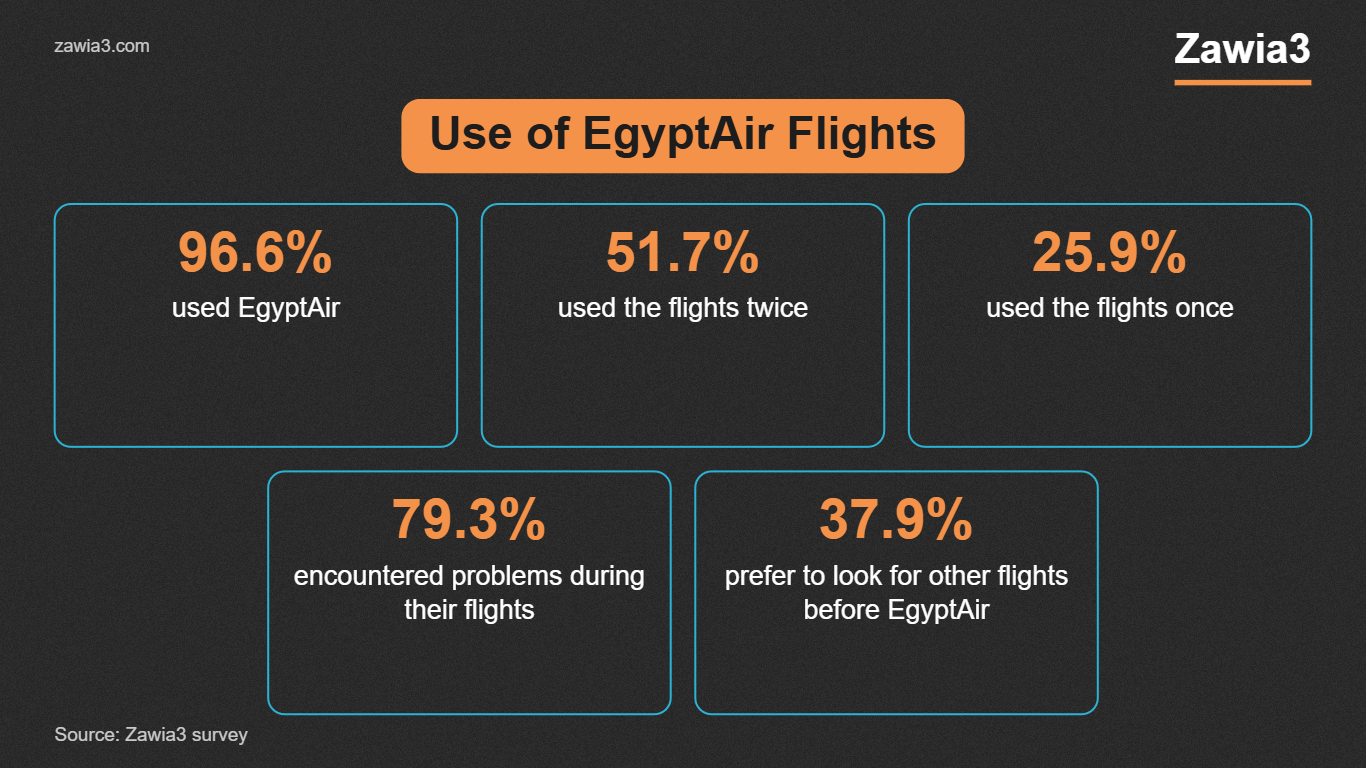
Through a nine-question survey conducted by Zawia3, in which about 50 people participated, to measure the scale of the problems they face during their trips with EgyptAir, participants agreed that there are problems in the services provided by the company. 96.6% of survey participants had used EgyptAir flights, 51.7% of them had used the company’s flights twice while 25.9% had used them once, and 37.9% of survey participants explained that they might prefer to look for their flights with another company before EgyptAir, especially as 79.3% of them confirmed that they had encountered various problems during their EgyptAir trips.
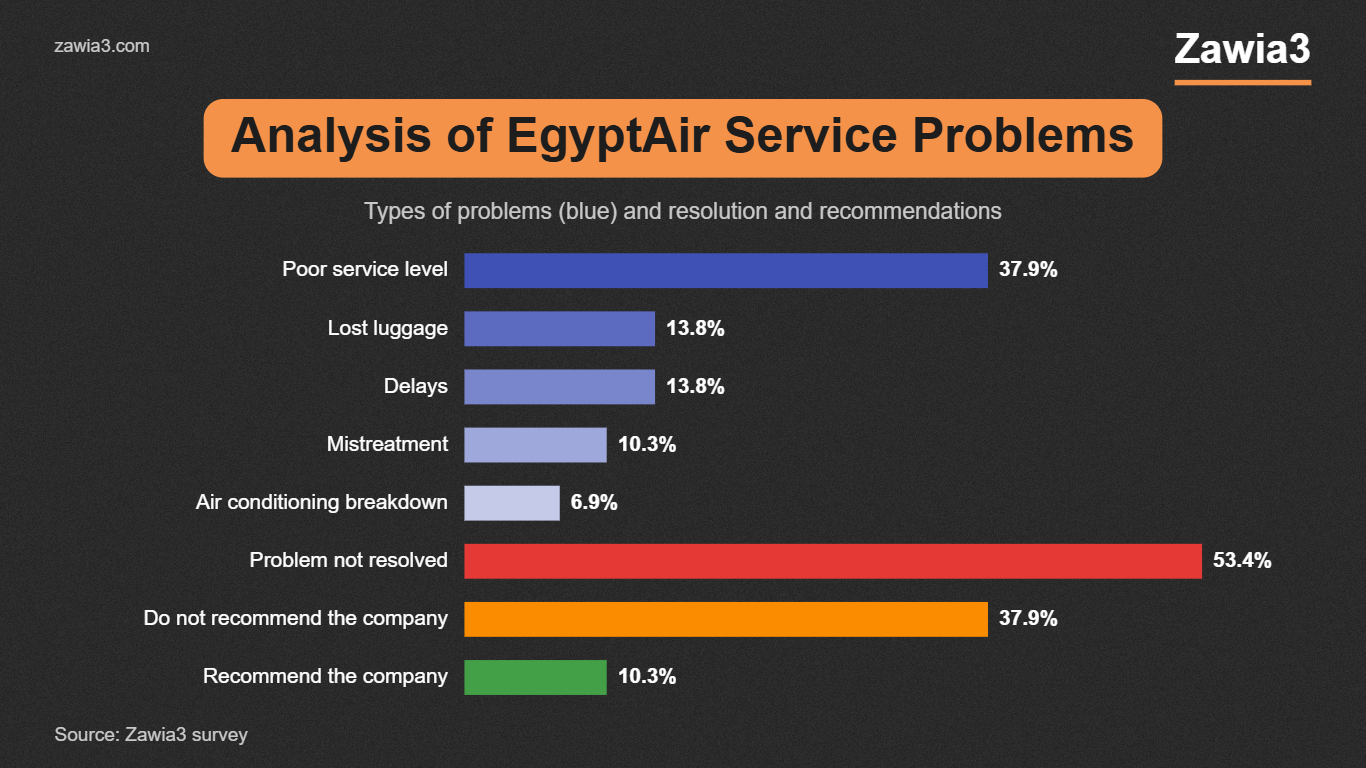
According to the problems raised in the survey, they ranged from lost luggage at 13.8%, mistreatment at 10.3%, air-conditioning failure at 6.9% and delays to scheduled take-off and arrival times at 13.8%, while the low level of service provided by the company received 37.9% of all survey participants. Meanwhile, 53.4% of survey participants confirmed that the problem they faced was not resolved, and only 10.3% of them recommend EgyptAir to others, while 37.9% do not.
56.9% of survey participants indicated that the prices offered by EgyptAir are not commensurate with the service provided, compared with 31% who indicated that they might not be commensurate, and only 12.1% of survey participants believe that the prices are commensurate with the services provided.
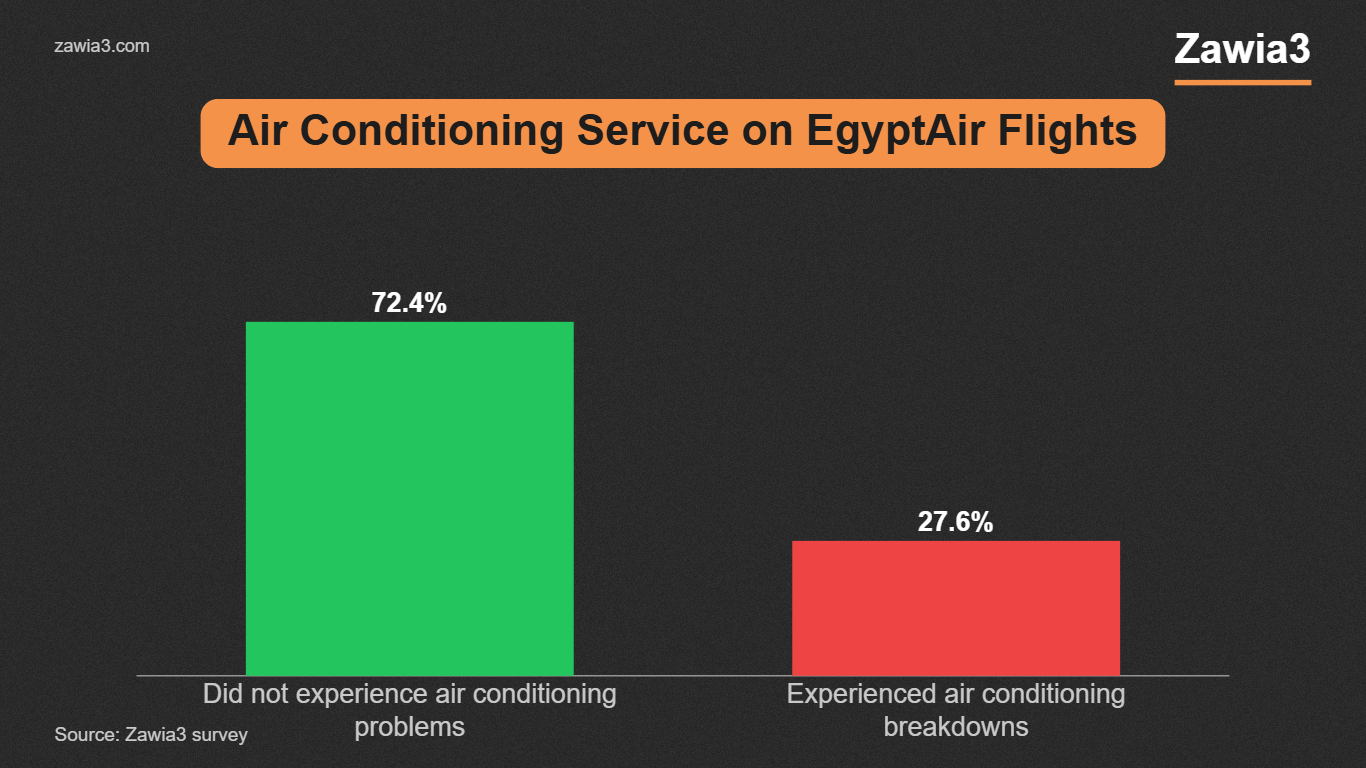
In the last survey question, on the cutting of air-conditioning on any of the EgyptAir flights they used, 27.6% confirmed that the air-conditioning had indeed been cut during their flights, while 72.4% explained that they had not experienced this problem.
In this context, a study titled “The Role of Cost Accounting in Improving the Level of Ground Service Provided by Cairo International Airport”, issued by the Faculty of Tourism and Hotels at Mansoura University, which carried out its applied study on EgyptAir Ground Services, confirmed that the main problem lies in EgyptAir Ground Services’ lack of knowledge of the difference between traditional and modern methods of managing and reducing costs, and the importance of the latter in providing financial and non-financial data and information to senior management to make accurate administrative decisions and improve the level of services it provides inside Cairo International Airport. The study explained the need to follow advanced methods to remedy the problems of the services provided by the company.
EgyptAir Ground Services is one of the subsidiaries of the EgyptAir Holding Company. Its establishment dates back to 2002, when EgyptAir was restructured, and the restructuring produced a holding company and seven subsidiaries, including EgyptAir Ground Services. The company provides ground services to more than 130 airlines operating at Cairo International Airport and all Egyptian airports. It annually serves more than 100,000 flights, nearly 11 million passengers and one million tonnes of cargo. The company employs nearly five thousand staff, including (engineers, agency officers, loading workers, loading officers, reception and dispatch technicians, professionals and administrators).
Commenting, a source who works at EgyptAir’s ground services company, and who preferred not to be named, says that the company has a large number of employees across all its subsidiaries, and some of them do not have sufficient competence to work in this sector, which is considered Egypt’s face to all different nationalities. He explained that this is among the financial burdens borne by the company, with a large increase in employment beyond the company’s needs.
He explains that most ground services are directly linked to the actual flight of the aircraft, and they also include other service tasks, as they ensure cabin services for passengers’ comfort and safety. These include tasks such as cleaning the passenger cabin and replenishing consumables on board or washable items such as soap, pillows, tissues, blankets and magazines. He explained that security checks are also carried out to ensure that no threats are left on the aircraft, and that the ground services company owns a variety of vehicles and equipment needed to service aircraft during the loading and unloading of passengers and cargo, maintenance and other ground operations.
The source adds that the ground services company’s fleet carries out the activities related to aircraft ground operations, from loading and unloading cargo, boarding and disembarking passengers, storing drinking water, and draining the toilet water and waste tank, to refuelling aircraft, inspecting and maintaining the engine and fuselage, and also providing food and drinks.
He says that airlines use airport equipment specially designed to support all these operations. Moreover, electrical power and air-conditioning are required throughout gate operating periods for the comfort and safety of passengers and crew, and these services are often provided by the airport.
The source comments on the repeated complaints about air-conditioning cuts on aircraft and the low level of service provided by saying that EgyptAir seeks in the coming period to resolve these problems and improve its services by providing the training courses needed to qualify its staff, in addition to contracting with new companies to provide ground handling services at Egyptian airports and develop them in the coming period.
Suspicion of Corruption
EgyptAir Ground Services signed a new contract last month with the Turkish company “AJet” to provide ground handling services at Egyptian airports, during the Egypt International Airshow 2024 in the city of El Alamein.
The company is a subsidiary of Turkish Airlines, which is considered a major client of EgyptAir’s ground services. It began its operations at Cairo International Airport with five weekly flights, and the airline plans to expand its services to other local airports in the near future.
The company’s fleet includes more than 80 aircraft, including Airbus A320 and A321 and Boeing B737-800 and B737 MAX aircraft. These are the same type of aircraft that the company recently decided to sell on the pretext that they are not compatible with the Egyptian climate, which prompted MP Maha Abdel Nasser to submit a briefing request to the Speaker of the House of Representatives regarding suspected waste of public money in the deal to sell 12 aircraft from EgyptAir’s fleet. In the briefing request submitted last April, she asked who would bear the interest on the loan to buy the Airbus aircraft, estimated at between 5 and 7% annually.
EgyptAir obtained loans worth EGP 15 billion in the period between 2019 and 2022: in 2019 it obtained a parallel loan worth EGP 2 billion; in 2020 EgyptAir obtained EGP 3 billion from the National Bank of Egypt and Banque Misr with a term of 10 years; and in 2021 it obtained EGP 5 billion through a bill submitted by the government authorising the Minister of Finance to guarantee the EgyptAir Holding Company in obtaining a long-term loan worth EGP 5 billion from the National Bank of Egypt and Banque Misr, under Law No. 20 of 2022 on the Ministry of Finance’s guarantee for EgyptAir, dated 11 April 2022.
Commenting on this contract, MP Maha Abdel Nasser stressed, speaking to Zawia3, that this confirms the corruption issue in the sale of these aircraft, which are similar in type to AJet’s aircraft, noting that the entire sector suffers from many crises and from corruption as well, which multiplies its continuing losses.
The member of the House of Representatives says that there is an ongoing dialogue among officials in the House Tourism and Aviation Committee about the mechanism for developing airport management and ways to improve its contribution to the state’s general budget. She added that this came after the failure of the current management to achieve a good level of services at Egyptian airports, which resulted in a low level of service and major losses in that sector.
She expresses her deep dismay at the level EgyptAir has reached, having been one of the most prominent airlines in the region, especially after it dropped out of the British global ranking last year.
Recovery Attempts
In 2023, the national carrier “EgyptAir” ranked 88th in the list of the world’s best airlines according to the global “Skytrax” ranking, and the company also came second worldwide as the most improved airline, in addition to coming first in Africa as the most improved airline in terms of development and service improvement.
This assessment reflects some of the development the company has witnessed in customer service and the services provided on board and at airports. This comes as a result of the strategy set by the company, according to a long-term plan for modernising the air fleet, expanding its route network and raising the level of services provided to passengers at airports and on board aircraft, as well as developing the company’s digital platforms. The company seeks to improve the level of services it provides to travellers on its flights to strengthen its position at the regional and global level.
Minister of Civil Aviation Sameh El-Hefny explained that EgyptAir’s losses fell to EGP 16 billion, after accumulated losses had been EGP 30 billion due to the accumulated events of the past period. El-Hefny added, during a press meeting at the ministry’s headquarters: “We are now seeking an internal restructuring of EgyptAir and establishing strategic units within the company to resolve any problems or overlap between the subsidiaries.” He pointed out that there is a new system aimed at fixing defects and holding those at fault accountable.
In a related context, Air Major General Gad El-Karim Nasr, former adviser to the Minister of Aviation for airport affairs, stresses, speaking to Zawia3, the importance of paying attention to periodic maintenance of aircraft and the services provided, whether at airports or inside the aircraft themselves. This attention aims to ensure passengers receive high-quality service, which helps the company return to its normal level of work and achieve maximum financial return. This is among the responsibilities of Egypt Ground Services in cooperation with EgyptAir’s aircraft maintenance company.
He praises the strong infrastructure of the airports Egypt owns, including modern and advanced airports: in addition to Egypt owning 24 airports, many of them have witnessed major development projects to improve the level of service, such as the development of Hurghada Airport by expanding the terminal and modernising the security system, as well as Sharm El-Sheikh Airport, which witnessed a major expansion to increase its capacity. He explained that the ranking evaluates the passenger’s experience on the plane and with the airline from the moment they enter the airline’s website, the booking method, airport services and the look of the aircraft.
At Zawia3, we contacted Nora Ali, head of the House of Representatives’ Tourism and Aviation Committee, over two weeks, to learn the committee’s position on the decision to offer the management and operation of 20 airports to the private sector, and to comment on the performance of the services provided by EgyptAir’s subsidiaries, but she said she had no comment.
Between the new contracts and the recovery attempts EgyptAir has recently made to stop the haemorrhage of losses in this sector and to try to catch up with international companies, many questions remain about it until its results and its contribution to the state’s general budget improve.