
Behind Egypt’s visible election campaigns, another contest is under way: the struggle for a recognisable ballot symbol. A palm tree, crescent or pair of scales can carry associations of prestige, reassurance or justice. For candidates, that symbolic capital may be almost as valuable as a political message.
The historical framework included the Political Rights Law No. 73 of 1956 and its later amendments, which provided for electoral symbols. Over the decades, the competition for familiar images has become entwined with political influence. Candidates interviewed by Zawia3 say access to preferred symbols and favourable positions on the ballot is not always a straightforward matter of following published procedures.
Ahead of the first round of domestic voting scheduled for 10 November 2025, the National Election Authority made 183 symbols available for individual-seat candidates and 148 for lists. They range from plants and animals to machinery and everyday objects. Some—such as the palm tree, lion, key and scales—have more immediately positive associations than others.
Sources familiar with the process describe last-minute calls, pressure and manoeuvring to secure attractive symbols for candidates close to the authorities. These are allegations about implementation, distinct from the rules that permit parties to request previously allocated symbols.
Ahmed Abd Rabbo, the Egyptian Social Democratic Party’s candidate in Tanta’s first constituency, describes his own attempt to secure a favourable position. He says he arrived at the court well before applications opened on 8 October, accompanied by friends, hoping to be first in line.
“I was the first person standing at the court door. Nobody was there before me,” he tells Zawia3. But, he alleges, a group of men forced him out of the queue before the committee opened at 8 a.m. “They attacked me, took my glasses and pushed me out. It ended in a confrontation.”
Abd Rabbo says he filed a complaint with prosecutors and requested examination of security-camera footage. Despite arriving early, he received ballot number 15. He questions how candidates who were not in the queue, according to his account, obtained the earliest numbers.
He argues that repeated favourable placements for the same parties suggest prior arrangements rather than chance. His account raises questions about the application process, but does not itself establish the outcome of the complaint or prove coordination in every constituency.
Symbols, parties and political advantage
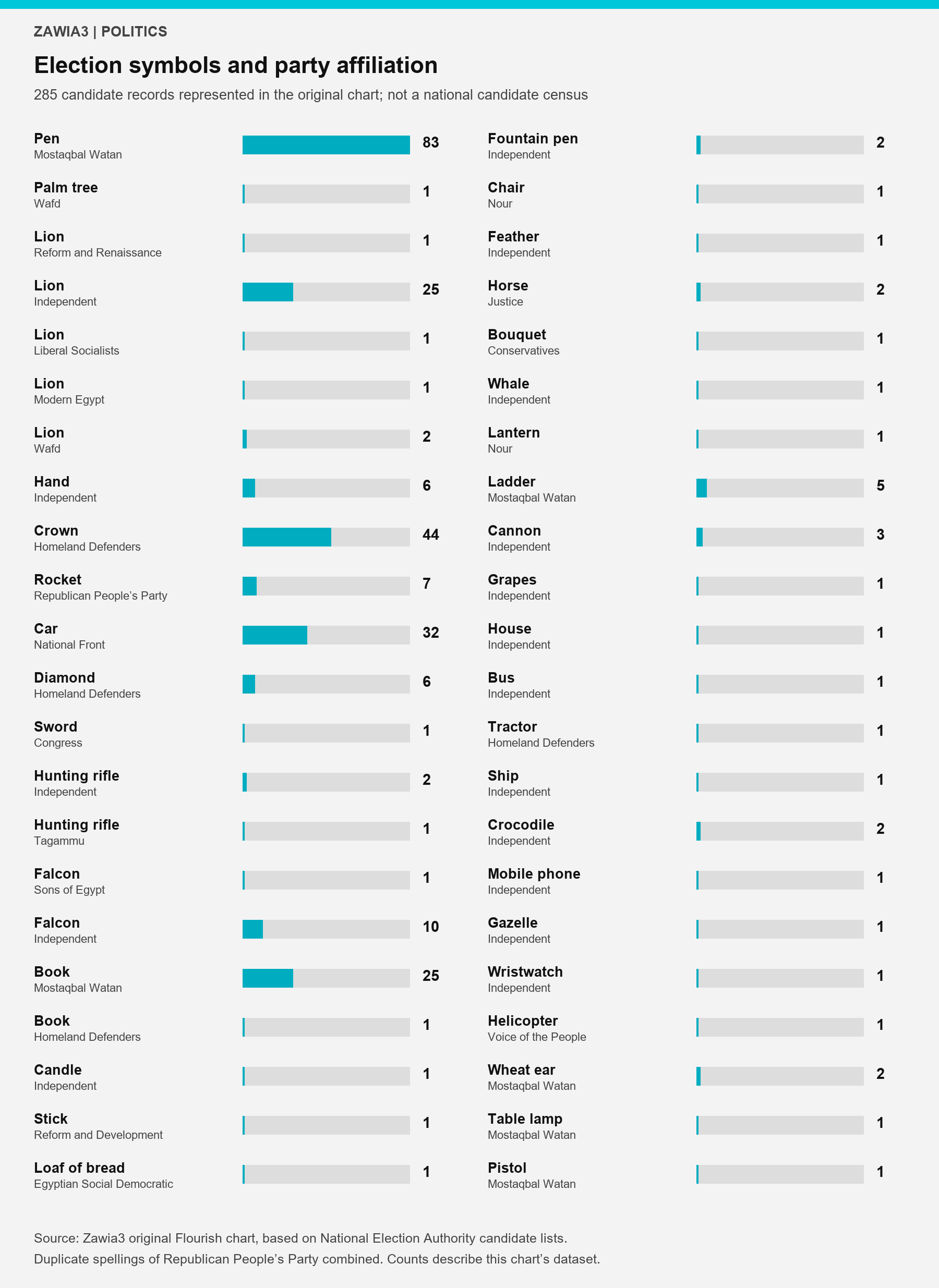
Zawia3’s review of the published candidate lists found prominent early positions for Mostaqbal Watan, Homeland Defenders and the National Front. Their candidates were strongly associated with recognisable symbols: the pen and book, the crown and diamond, and the car, respectively.
The accompanying dataset supports a strong pattern, rather than complete exclusivity. It records Mostaqbal Watan candidates with other symbols too, and one Homeland Defenders candidate using the book. These exceptions matter when describing the distribution.
Independents and smaller-party candidates appear with a much wider variety of everyday objects, including a router, loaf of bread, remote control, banana, knife, glasses case, clothes brush, shirt, matchbox, trousers, garden bench, train, domino, tyre, kerosene lamp, ATM, saw and microwave.
In Talkha, Dakahlia, independent candidate Atef Moawad, number 31, received the knife; Mohamed Magdy, number 35, the saw. Ayman al-Prince, an independent in Cairo’s Zawya al-Hamra, received the toothbrush. In Khankah, Qalyubia, independent Emad Abdel Salam Enaba, number 13, had a hockey stick.
Other examples include a cooker for Medhat Abdel Tawab, number 13 in Omraniya, Giza, and a safe for Osama al-Prince, number 33 in the same constituency. Alaa Mazen, number 32 in Sohag, had carrots; Amal Wali, number 17 in al-Monshaa, a cup; and Abdel Qader Sorour, number 24 in Kafr al-Zayat, a comb.
In Beni Suef, Osama al-Matrawi, number 11, received a pencil case, while Ali Badr, number 9 in Ehnasia, used a seahorse. Mohamed Khater, number 19 in Mit Ghamr, Dakahlia, received a sickle.


In Faqous, Sharqia, Walaa al-Sayed of the Nidaa Masr party, number 17, received a map. Independent candidates included Abu Ragab with a lighter, Ayman Shaaban with a fire extinguisher, and Salah Shereiba with a refrigerator. The variety illustrates why candidates attach such importance to recognition and familiarity.
Amr Hashem Rabie, deputy director of the Al-Ahram Center for Political and Strategic Studies, tells Zawia3 that using electoral symbols is familiar in many countries. His objection concerns how access to them and ballot positions is managed.
Rabie sees preferential access as a question of fairness: when particular candidates or parties repeatedly secure favoured symbols and early ballot positions, others begin the contest at a disadvantage.

The historical legal framework gave election administrators responsibility for the symbol system and campaign rules, including restrictions on religious slogans and discriminatory campaigning. The existence of formal rules, however, does not resolve candidates’ complaints about how allocation operates in practice.
The lists examined for this report also showed a gender imbalance in the leading positions. The article’s review found men occupying the top places, while Monica Magdy of the Reform and Renaissance Party appeared at number two in Cairo’s Rod al-Farag constituency. This observation describes the lists reviewed and should not be treated as a separately verified census of every candidate nationwide.
Abd Rabbo offers two explanations for the appeal of low ballot numbers. First, campaigners assume some voters will find the first few names easier to identify than a candidate farther down the page. Second, directing supporters is simpler: “Vote for the first candidate” or “the first three” is easier to communicate than “find number 15”.
He also points to the perceived relationship with state power. Some voters interpret a leading position as evidence that the candidate enjoys official approval and is likely to win, recalling patterns associated with the former National Democratic Party.
Rabie criticises what he regards as uneven freedom to campaign and spend, alongside allegations of political money and the buying and selling of nominations. These remain his criticisms and allegations, not findings established by the ballot-symbol data.
The National Election Authority’s 2025 rules allow candidates belonging to a party to request a symbol previously allocated to that party from the 2020 parliamentary election onwards, supported by a letter from the party leader. The provisions do not apply to parties whose leadership is disputed. A party’s retention of a symbol is therefore not, by itself, evidence of a breach.
For Abd Rabbo, the unresolved question is what happened at the application queue and how candidates’ order was determined. He says his experience undermined confidence in the fairness of the process.
Sometimes a familiar symbol comes down to luck
Nashwa al-Deeb, an independent candidate in Imbaba, Giza, sees continuity differently. She notes the longstanding association of the Wafd Party with the palm tree and the former National Democratic Party with the crescent. “Parties have the right to choose a stable symbol that represents them from one election to another,” she tells Zawia3.
When she applies, she says, she is shown the symbols still available. Her own symbol has been the ring for three election cycles. “I was lucky to get it again. I was afraid I would not, because people have known me by it for ten years.” Familiarity matters particularly to voters who have limited schooling or cannot easily read candidates’ names.
Abdel Qader Sorour was less fortunate. The independent candidate, number 24 in Kafr al-Zayat, hoped to retain the bunch of grapes with which he had previously reached a run-off. Another candidate who applied earlier would not relinquish it, so he chose a comb instead.
“Most people in my constituency are ordinary people, and a comb is easy to remember,” he says. “I respected other people’s wish to keep their symbols, but others did not show me the same consideration. In any case, people know me and will become familiar with the new symbol.”
Abd Rabbo eventually chose a loaf of bread. He says it reflects his wish to represent people hoping for better living standards. “Elections are about people choosing someone who expresses their concerns. It is important that citizens feel they are partners in political life rather than marginalised. That ultimately serves the country.”
What would equal treatment look like?
The law establishing the National Election Authority, No. 198 of 2017, charges it with safeguarding voting rights and equality between voters and candidates. Its responsibilities include nomination procedures, examining applications, announcing candidates and setting arrangements intended to ensure integrity and transparency.
Rabie points to Belqas, Dakahlia, as an example that stood out in his review: Ahmed Arafa of the Reform and Development Party appeared first with the stick, ahead of a Homeland Defenders candidate. He says this was unusual compared with the patterns he had been following.
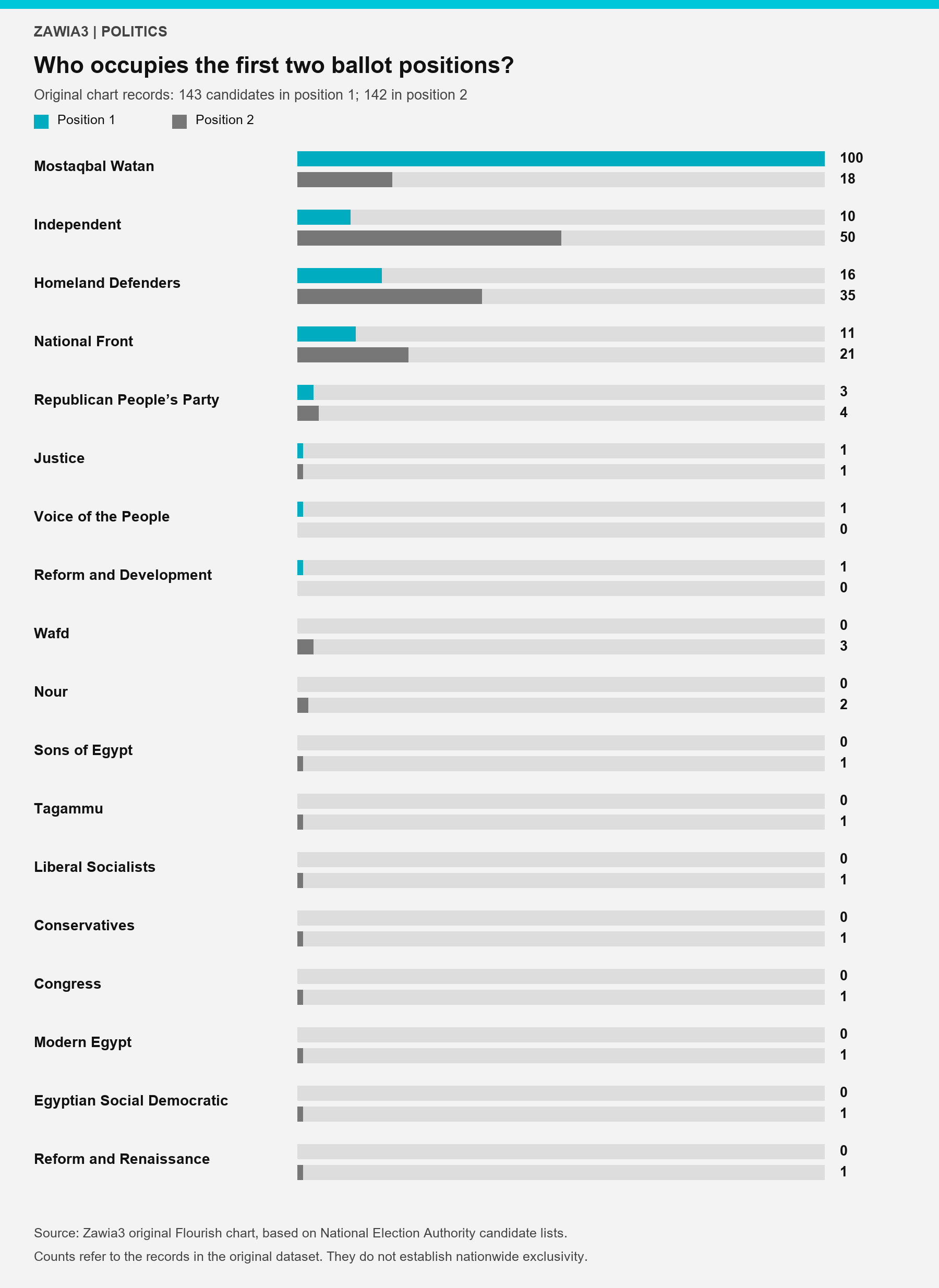
The original chart records 100 Mostaqbal Watan candidates in the first position and 18 in the second. Homeland Defenders accounts for 16 first positions and 35 second positions; the National Front for 11 and 21 respectively. Independents account for ten first positions and 50 second positions. These are the records represented in the chart, not proof that a single party occupied every first position wherever it stood.
Al-Deeb argues that a candidate’s record matters more than a number. “What matters is the person: are they influential in their constituency and working among people?” she asks. “If my number were 50 or even 90, it would not change things for me.”
She wanted to retain the ring, but says losing it would mainly have required additional work to introduce a new symbol. For Rabie, some of the available images are themselves questionable: he regards knives, sickles and other sharp implements as inappropriate choices.
Competition over symbols long predates the present election. During the National Democratic Party’s dominance, familiar images became associated with organisation, influence and proximity to power. After the January 2011 uprising, demands for a fairer distribution formed part of wider calls for equal opportunities between candidates.
The dispute is therefore about more than pictures on a ballot. Clear rules on party continuity must coexist with fair access for independents, transparent application procedures and a credible response to complaints. Without that distinction, familiar symbols and early numbers risk becoming signs of political privilege before a vote has been cast.