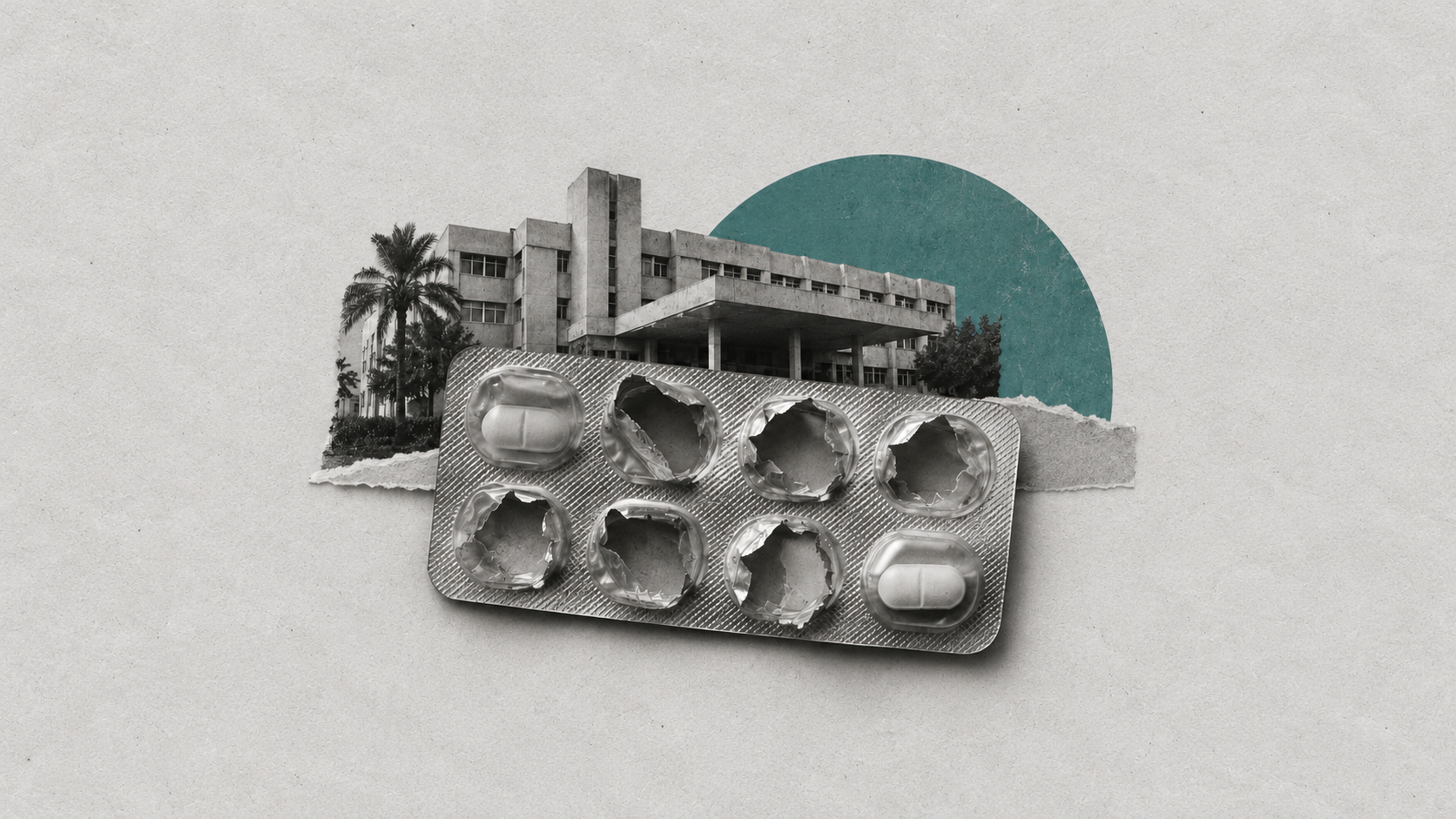

More than a year after the Egyptian Drug Authority launched the expired medication withdrawal initiative known as the “Wash Out,” which aimed to clear the pharmaceutical market of millions of expired units and compensate pharmacies for them, complaints from pharmacists are escalating over stalled implementation and the continued accumulation of expired stock inside pharmacies, amid accusations leveled at production and distribution companies of deliberate delay and selective acceptance of returns and compensation.
In February 2025, the head of the Egyptian Drug Authority issued a decision to withdraw expired pharmaceutical preparations from pharmacy establishments, known as the market cleanse or “Wash Out” initiative, which had aimed to clear the market of expired medications before October 30, 2025.
The decision obligated companies to accept returns of expired preparations they produced or imported from pharmacies, warehouses, or storage facilities within 90 days from the effective date of the decision, with sorting to be completed within 30 days from the date of receipt, and compensation for returned preparations to be settled within a maximum of 180 days from the decision’s issuance.
Factories were also obligated to destroy returned preparations within 40 days from the date of receipt, with importing companies and contract manufacturers required to destroy their returned preparations within 40 days from the date the warehouse or storage facility notifies the company of receiving the expired preparations.
With the implementation of the first phase of the initiative, which began on the first of March last year, many pharmacists encountered technical challenges and difficulties related to registering certain expired pharmaceutical categories on the electronic system and using the Drug Authority’s product search tool, particularly product codes, due to price discrepancies and concentration variations in some medications, preventing them from registering the products and benefiting from the initiative, as they told Zawia3.
In May of last year, the Egyptian Drug Authority announced the registration of 22,645 pharmacies through the electronic link designated for the recall process, representing 51.4% of pharmaceutical establishments in Egypt, having submitted requests covering 4 million and 976,606 expired pharmaceutical units, with distribution companies having recalled 3 million and 404,392 of them, while the remaining 1 million and 572,214 units were still pending recall.
A year later, specifically this May, the Authority issued a statement thanking some production companies that had completed compensation for the value of expired medications to distribution companies, and called on production companies to comply and distribution companies to compensate pharmacies before the end of the month. In contrast, field testimonies from pharmacists, union representatives, and pharmaceutical sector experts reveal the stalling of the “Wash Out” initiative in clearing the market of expired pharmaceutical categories and compensating pharmacies, as a result of what they described as manipulation and circumvention by some distribution companies.
Pharmacist Mohamed Ghallab, who owns a pharmacy in Alexandria governorate, accuses some pharmaceutical companies in Egypt of circumventing the returns recovery system or outright refusing to accept expired medications within the “Wash Out” framework. Pharmacies are required to sell medications by the ampoule or strip according to Health Ministry instructions, but distribution companies refuse to accept the remainder of packages after their expiry, whether strips or ampoules, leaving the pharmacist to bear the loss alone.
He reveals to Zawia3 one form of circumvention within returns registration systems, where some categories appear on return systems with data different from what is actually circulating, whether in terms of price, concentration, or number of tablets, resulting in the return being rejected on the grounds of data mismatch.
He notes that categories whose price changed following recent increases often appear on the returns system at a price entirely different from the price at which the packages were placed on the market, leading to the rejection of the request whether the pharmacist selects the old or new price, in his words. He adds that some companies list concentrations or packages on their systems that have not been in circulation for years, obstructing the return process and undermining the whole system.
He further notes that many imported medications, dietary supplements falling under the Food Authority, some preparations without full pharmaceutical licenses, and cosmetic and personal care products are not accepted within the “Wash Out” system, with the majority of companies refusing to accept them as expired returns, noting that pharmacists have been bearing the resulting financial losses for years.
Pharmacist Amro Abd al-Hadi, who owns a pharmacy in Mansoura in Dakahlia governorate, agrees with him on the circumvention by a number of companies of the expired medication withdrawal system, through listing different data for categories on return systems, such as changing the price, number of tablets, or concentrations, leading to the rejection of the return on the grounds of data mismatch. He argues the solution lies in obligating companies to accept expired medications without conditions, with fines imposed on companies that refuse to comply.
He told Zawia3: “The continuation of the crisis stems from the target and commission system inside production and distribution companies. Accepting returns leads to deductions from sales targets set for representatives and companies, which drives them to reduce or reject returns to preserve profit margins and commissions.”
He also criticizes monthly recovery systems that set a limited financial ceiling for returns, affirming that pharmacies lose their right to any unused portion within that same month, with no carryover to subsequent months, even when expired medications continue to accumulate.
The pharmacist estimates the losses he personally incurred due to expired medications at approximately 100,000 to 120,000 Egyptian pounds ($1,923.08 to $2,307.69) at current prices, arguing that the pharmacist alone bears the financial burden produced by the current system, in what he described as “collusion among some market players to avoid recovering returns.”
For her part, pharmacist Ola Abd al-Monem, who owns a pharmacy in Asyut governorate, affirms that the expired medication crisis represents a chronic loss for pharmacies, given the restrictions imposed by pharmaceutical companies on the recovery of returns, explaining that acceptance of expired medications is linked to the volume of the pharmacy’s dealings with the company, with recovery percentages determined based on the value of monthly withdrawals, while some companies refuse to accept any expired medications whatsoever.
She told Zawia3: “Pharmacies are forced to store large quantities of expired medications in warehouses or external locations due to space constraints and the illegality of keeping them inside the pharmacy, and some pharmacies now hold a stock of expired medications that exceeds the volume of those fit for sale.”
She explains that the initiative launched by the Drug Authority last year prompted pharmacists to register large quantities of expired medications hoping to recover them, noting that some pharmacies registered medications worth 20,000, 30,000, and 50,000 Egyptian pounds ($384.62, $576.92, and $961.54), but what was actually accepted was extremely limited, with some pharmacies receiving only discounts ranging between 800 and 2,000 Egyptian pounds ($15.38 and $38.46).
She adds: “The mechanism for accepting returns appeared incomprehensible. There were no clear criteria for determining accepted or rejected quantities, and the actual losses remained far greater than the value of what was recovered.”
She reveals that she still holds expired medications dating back to 2017 and 2018, noting that some of these medications were previously disposed of through burning or by handing them to waste collectors in exchange for small sums, due to the absence of any entity responsible for regularly recalling these returns.
She links the worsening of the crisis to the repeated changes in drug prices following the pound float, explaining that small pharmacies without storage capacity were forced to purchase new packages at higher prices after selling old stock at lower prices, while differing prices of packages from different production runs caused disputes with consumers.
The pharmacist holds that the initiative did not offer a root-and-branch solution to the crisis, but merely served to pacify pharmacists’ anger, at a time when the syndicate, in her words, suffers from administrative paralysis due to the continuation of court-ordered administration, which has weakened the union’s role in defending pharmacists’ professional problems.
Dr. Amira Mahjob, head of the Central Administration for Pharmaceutical Establishments Inspection, had announced in October 2025 that 70.5% of pharmaceutical establishments had registered through the electronic link designated for expired pharmaceutical packages, totaling 56,710 pharmacies, with 20,321,303 expired medication units registered, while 23.5% of pharmaceutical establishments that registered on the electronic link, totaling 16,701 pharmacies, contained no expired medications.
She added that the number of expired units required to be recalled by distribution companies, after review and deletion of units not listed under the Authority head’s decision No. (47) of 2025, stood at 18,300,042 units. She affirmed that expired packages had been recalled from pharmacies to distributors at a total recall rate of 94.2%, covering 17,247,051 expired units out of a total of 18,300,042 units.
Company Manipulation and Pharmacy Losses
Dr. Mahmoud Fattouh, a board member of the Pharmaceuticals Division at the Federation of Egyptian Chambers of Commerce, describes the expired medication file as a “ticking time bomb” inside the pharmacy sector, given the escalating losses borne by small and medium pharmacies as a result of the accumulation of large quantities of unsellable medications.
He explains to Zawia3 that the Egyptian Drug Authority’s decision to withdraw expired medications primarily targets patient protection and the safety of drug circulation, but there are no clear and fair mechanisms for allocating the cost of recall and compensation, with pharmacies facing lengthy procedures that include preparing detailed lists of expired medications and sending them to companies, without any guarantee of recovering all categories or even a large proportion of them.
He adds: “Some companies only accept specific categories and in very limited proportions, responses to return requests may take long periods, and some intermediaries or company representatives exploit the discount percentages allocated for returns in exchange for receiving smaller cash amounts, which has weakened the effectiveness of the expired medication withdrawal system.”
He notes that expired medications occupy storage space inside pharmacies at the expense of needed categories, in addition to pharmacists’ concerns about possible accountability or fines if expired packages are found during inspection campaigns.
He affirms that patient protection must also be coupled with protection of the last link in the pharmaceutical chain, namely pharmacies, by obligating companies to recall returns flexibly and quickly, and establishing clear and fair mechanisms to compensate pharmacists for losses from expired medications.
Dr. Mustafa al-Wakil, deputy head of the General Syndicate of Pharmacists, affirms that the expired medication crisis represents a chronic problem inside Egypt’s pharmaceutical market, opening the door to a shadow market for the illegal circulation of expired medications, in the absence of an effective and binding system for their recovery from pharmacies. He argues that the crisis in Egypt is that the return percentages for expired stock are ultimately subject to the decisions of distribution companies, which control the quantities accepted from pharmacies in coordination with production companies.
He told Zawia3: “The pharmaceutical distribution system involves three main parties: the manufacturer, the distribution company, and the pharmacy. Distribution companies are the ones that set the rules governing the receipt of returns from pharmacies, while some production companies exert pressure to reduce the percentages of medications recovered,” noting that the syndicate had attempted more than once to establish a comprehensive “Wash Out” system that had not achieved the desired results, before the Drug Authority launched the initiative under pressure from the syndicate, but implementation did not proceed as agreed upon, in his description.
He explains that the original concept of the initiative was based on recovering all expired medications, with the exception of some categories falling under the Food Authority or dairy and nutrition products, but what actually happened is that companies began selecting certain categories for recovery while rejecting others, leading to the exclusion of a large portion of the medications held by pharmacies.
He adds: “The quantities recalled from pharmacies represent less than a quarter of the expired medications actually on hand, and pharmacies have not received the full compensation for the medications that were received within the ‘Wash Out’ system. Some pharmacies received only between 5% and 10% of the value of the returns owed to them, despite distribution companies announcing that some factories had already begun compensating them for the medications received.”
He notes that the crisis worsened over the past year and a half, due to distribution companies halting the application of the traditional system that required the monthly recall of a percentage of expired medications from pharmacies, leading to the accumulation of new quantities. He affirms that the problem persists despite recent promises to disburse pharmacies’ dues during May.
The deputy head of the pharmacists’ syndicate calls for the establishment of binding and clear rules that compel production companies to recover their own expired medications, with distribution companies obligated to compensate pharmacies, in a way that ensures all avenues for re-circulating expired medications within the market are closed.
Pharmaceutical expert Dr. Ahmed Abu Taleb, a member of the Pharmacists’ Syndicate, sheds light on a fundamental flaw in the implementation mechanisms of the “Wash Out” system, namely the absence of a binding and unified system for recovering expired medications from production companies. The current implementation relied on multiple and complex procedures including registrations and notifications through more than one entity, which, in his view, contributed to weakening the system’s effectiveness.
He told Zawia3: “The system in its current form has not achieved the desired results, but was undermined by the multiplicity of procedural steps and the overlapping roles between production companies, distribution companies, and pharmacies, creating space for procrastination and non-compliance by some parties.”
He holds that placing the burdens of expired medications and associated fines solely on pharmacies represents a flaw in regulatory justice, whereas production companies are the party most capable of bearing responsibility for recovering medications and dealing with returns as large entities within the market.
The pharmaceutical expert criticizes the Egyptian Drug Authority’s imposition of fines and fees on pharmacies, which constitute a growing burden on small and medium pharmacies in the context of rising operating costs and inflation, particularly given that they are commercial enterprises bearing full taxes and operating expenses, threatening their role as the “first line of defense” for Egypt’s healthcare system, in his words.
He calls for the application of a direct and binding system that places full responsibility on production companies for recovering expired medications and compensating pharmacies, with strict oversight of company compliance, rather than the multiplicity of procedural steps that impede implementation and weaken the system.
The total number of licensed pharmacies operating in Egypt stands at approximately 71,796 pharmacies. The number of pharmacists in Egypt is estimated at approximately 330,000, of whom around 216,000 are officially registered with the General Syndicate.
Egypt has more than 170 pharmaceutical manufacturing plants, while the pharmaceutical distribution market is dominated by a limited number of large companies, most notably “Ibn Sina Pharma,” which leads the distribution market with a market share exceeding 31%, alongside the Egyptian Pharmaceutical Trading Company, the oldest government pharmaceutical distributor in Egypt, United Pharmacists UCP, Pharma Overseas, and Uno Pharma.
Back Channels for the “Expired Drug Trade”
Dr. Ali Abdullah, Director of the Egyptian Center for Pharmaceutical Studies, Statistics, and Addiction Control, explains that companies’ failure to regularly recall expired medications from pharmacies led to the accumulation of large quantities. Some pharmacists disposed of them by throwing them in the trash, while others resorted to selling them to “expired drug traders,” creating a parallel market for expired medications operating through back channels and with the participation of some pharmaceutical company representatives who officially refuse to accept returns.
He reveals that companies had been choosing the categories they wished to accept within the “Wash Out” initiative while rejecting others without clear criteria, affirming that pharmacists have not yet received their full financial dues for the medications handed over within the initiative.
He told Zawia3: “The compensation process has been subject to procrastination and delay since it was announced last October. Personally, I have dues worth approximately half a million Egyptian pounds ($9,615.38) for expired medications, and I have received only around 2,000 Egyptian pounds ($38.46).”
He adds: “The expiry of some categories is not related to pharmacist negligence, but to shifting variables within the market, such as changes in treatment protocols, physicians switching to prescribing other alternatives, the cessation of promotional campaigns for certain categories, or the end of health crises that had raised demand for specific medications, such as the Covid pandemic or Hepatitis C treatments.”
He holds that pharmaceutical companies, which are capable of distributing medications worth billions of Egyptian pounds annually, possess the logistical capacity to regularly collect expired medications from pharmacies, attributing the crisis to corporate negligence and weak oversight and enforcement mechanisms. Large pharmacies or chains are able to force companies to accept returns by virtue of their transaction volume, while small pharmacies face greater difficulties.
He notes that the continuation of the crisis directly impacts patients, as when a pharmacist becomes aware of the difficulty of recovering expired medications, they become more cautious about purchasing certain categories, which may lead to a shortage in the availability of specific medications inside pharmacies.
Dr. Karim Karam, head of the pharmaceutical file at the Egyptian Center for the Right to Medicine, reveals that the danger of expired medications lies in the recycling of expired stock and its re-entry into the market, explaining that some returns are repackaged and given new expiry dates before being resold at heavy discounts and without invoices, which explains the prevalence of offers selling medications at discounts that make no logical sense compared to the official market.
He explains to Zawia3 that some of these medications are recycled inside unlicensed workshops or factories, noting the existence of well-known informal markets where expired medications or used medication strips are sold at low prices, as a result of some low-income groups resorting to them due to the high cost of treatment.
He links the spread of this phenomenon to the economic situation and rising drug prices, as some patients, particularly those with limited incomes and in informal employment, have become unable to purchase full packages, driving them to seek cheaper alternatives in informal markets.
He holds that the “Wash Out” initiative faced numerous problems in implementation mechanisms, most notably the refusal of some production companies to accept returns from distribution companies, the existence of companies that have closed their operations or ceased dealing with certain distributors, in addition to technical problems in category registration systems.
He said: “A similar system was implemented in 2015 during the tenure of former Health Minister Imad Abd al-Ghaffour, and achieved relatively better results because it was based on recovering the categories belonging to each company directly, although problems existed at that time as well.”
He notes that the Drug Authority issued instructions to the five major distribution companies, including Ibn Sina Pharma and Pharma Overseas, requiring them to credit the value of accepted medications at 100% within a specified period, with the threat of fines or regulatory measures against non-compliant companies. Despite this, he holds that evaluating the success of the system must be linked to the extent to which discounts are actually applied to pharmacies’ accounts.
He believes that implementing the electronic pharmaceutical tracking system, which relies on technologies such as “GS1” and “GTN,” will help narrow the spaces for smuggling and recycling, by linking each pharmaceutical package to precise production and distribution data that can be electronically tracked.
The Egyptian Drug Authority had launched in March 2026 a pharmaceutical Track and Trace system to enhance governance of the pharmaceutical market, whereby a unique serial number is assigned to each package to ensure its traceability from the factory to the patient, with the aim of reducing counterfeit medications, ensuring supply safety, and activating real-time surveillance over the movement of pharmaceutical preparations.
While the Drug Authority affirms the rise in the percentages of expired medications withdrawn from the market, pharmacist and expert testimonies reveal a wide gap between the official figures and the reality on the ground, amid the continued accumulation of expired stock inside pharmacies, the stalling of compensation disbursements, and accusations leveled at distribution and production companies of procrastination and selectivity.