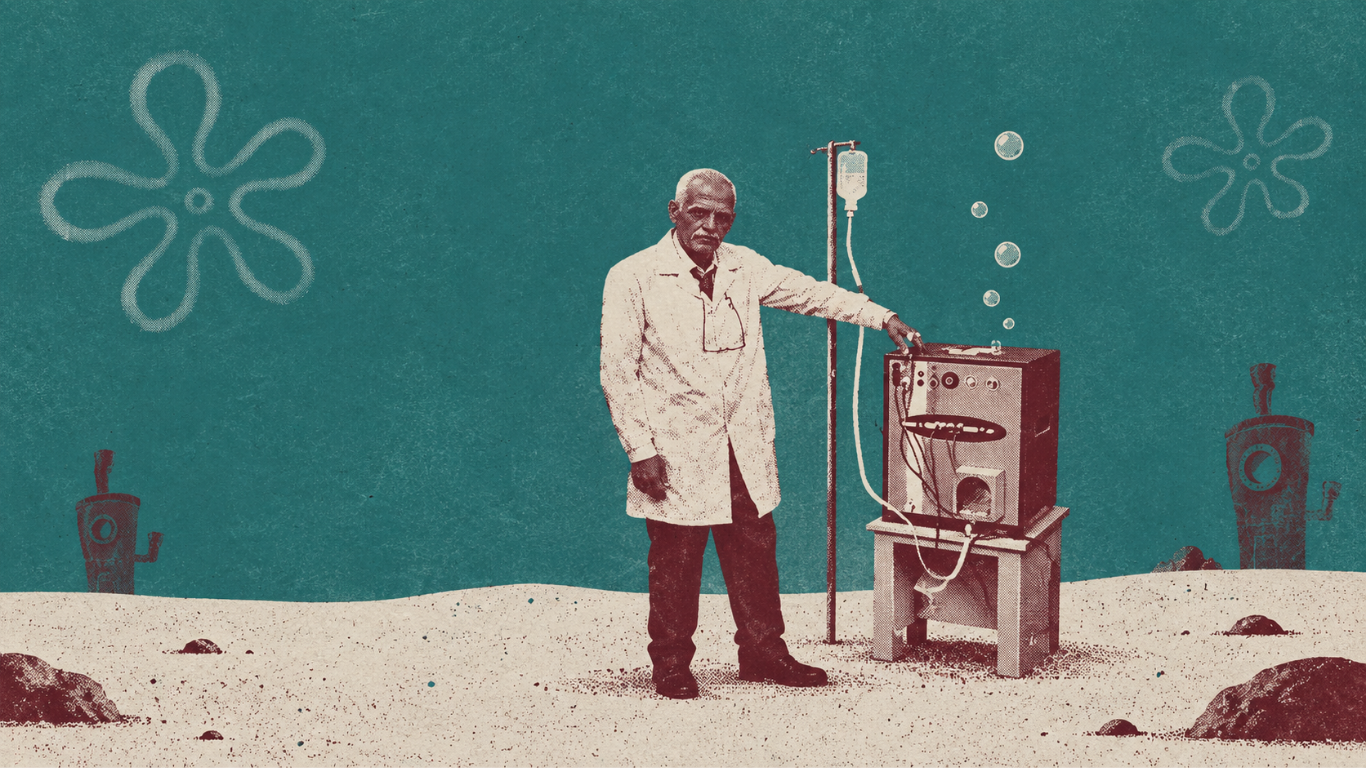
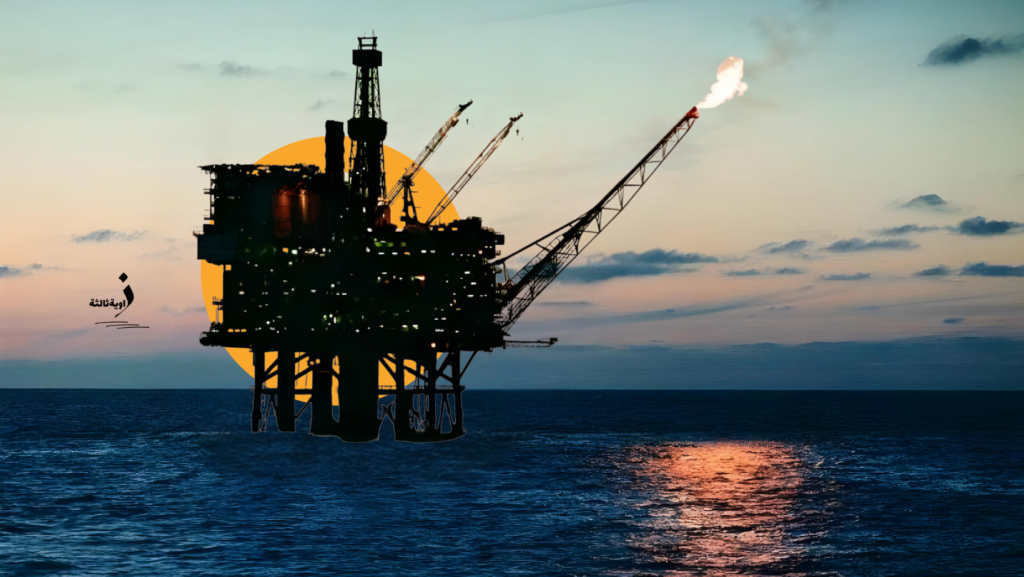

Egyptian factories have gradually resumed operations after gas shortages forced shutdowns in May. The interruption lasted roughly two weeks, and the restored supply reportedly amounts to only 60–70% of normal requirements, with no firm date for a complete return to normal.
Major fertiliser and petrochemical plants, including Alexandria Fertilizers, KIMA in Aswan and Helwan Fertilizers, stopped production entirely. Others, including Abu Qir Fertilizers and MOPCO, operated only one production line. In exchange disclosures on 21 May, Abu Qir and MOPCO anticipated a 30% reduction in output during the supply shortage, according to contemporary reporting.
Gas is especially important to fertiliser manufacturing because it is both a feedstock and a fuel. The estimates cited in that report put it at as much as 60% of the cost of producing a tonne of fertiliser. Fertiliser and petrochemical industries together account for approximately 35–40% of industrial gas consumption.
A shortage of gas does not simply raise a nitrogen fertiliser plant’s energy bill: it can deprive the production process of its essential raw material.
The consequences extend from factory output to fertiliser prices and farming costs. Stable supplies are therefore important not only to manufacturers but also to farmers exposed to changes in the cost of their basic inputs.
The latest interruption comes amid declining domestic production, particularly at Zohr, the giant eastern Mediterranean gas field. Israeli imports were also reported to have fallen from 21 May to around 500 million cubic feet a day. Forecasts cited in the Arabic report suggested a further 15–20% reduction against normal levels during July and August. These were prospective estimates, not recorded summer outcomes.
The decline in deliveries coincided with rising political tension between Egypt and Israel over the war in Gaza. That context does not by itself establish the cause of every supply reduction.
A recurring industrial shutdown
Gas-dependent factories have faced similar interruptions before. In June 2024, the Petroleum Ministry reduced fertiliser supplies by 20–30%, forcing some plants to stop while sufficient gas was arranged.
The Egyptian Natural Gas Holding Company, EGAS, had also interrupted petrochemical supplies in May 2024, in an episode reported to have lasted 11 days. The ministry subsequently announced the gradual restoration of fertiliser supplies from 6 June that year.
Abu Qir Fertilizers, Sidi Kerir and KIMA were among the companies that announced temporary stoppages while waiting for pressure in regional gas networks to stabilise and for necessary maintenance before restarting.
Zohr’s discovery in 2015 had raised expectations of a lasting change in Egypt’s energy position. Production began in 2017, helping Egypt reach the gas self-sufficiency it announced in 2018. Discovery, first production and self-sufficiency were separate milestones.
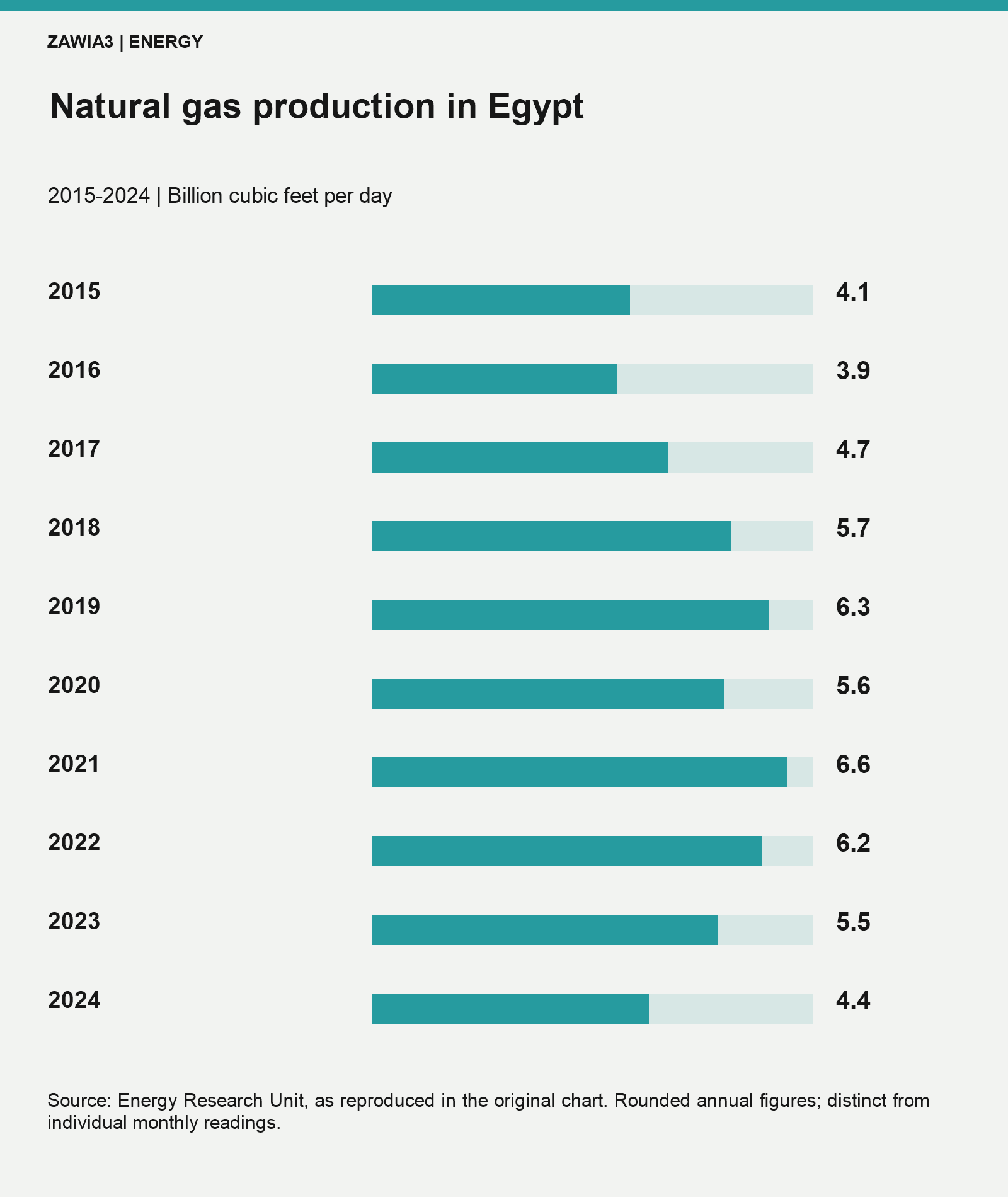
Less than a decade after the discovery, Egypt is again struggling with a widening gap between production and consumption. The annual estimates reproduced later in this report put output at 5.5 billion cubic feet a day in 2023 and 4.4 billion in 2024—a decline of around 20% using those rounded figures. The separate readings of 5.8 billion in May 2023 and 7.2 billion in September 2021 are monthly snapshots, not a comparison between the two annual totals.
Experts point to natural field decline, ageing wells and technical problems, including water ingress, as possible contributors. Domestic demand has meanwhile increased, especially for power generation during hotter weather.
The earlier drive to export LNG to Europe during the energy-price surge following Russia’s invasion of Ukraine is also part of the debate. Exports provided urgently needed foreign currency, but researchers question whether Egypt secured sufficient supplies for its own industries over the longer term.
Mohamed Ramadan, an economic researcher at the Egyptian Initiative for Personal Rights, tells Zawia3 that falling production can occur naturally as fields mature. The government’s responsibility, he argues, is to anticipate that decline and secure fuel for important industrial users, including cement plants, through other sources when necessary.
He calls for a broader approach to energy rather than a policy focused overwhelmingly on gas. Egypt does not possess unlimited petroleum resources, he says, and Zohr’s contribution cannot guarantee domestic supplies for decades.
Ramadan argues that the central failure is long-term planning: a major discovery can improve supplies temporarily, but cannot replace a diversified energy strategy.
Renewables should have been developed much more quickly, he says. Small and medium-sized companies face barriers including the pricing arrangements for connecting to the national grid, limiting their growth and ability to compete.
Ramadan also criticises the heavy reliance on gas-fired generating capacity built at a cost exceeding €6 billion. He regards this as a risky commitment when gas production fluctuates. Proposals to sell power stations form part of the financial debate, although transferring ownership would not itself reduce the fuel required to generate a given amount of electricity.
He wants an energy transition that allows Egyptian companies to acquire technology and build expertise, rather than attracting foreign investment without a comparable domestic development benefit.
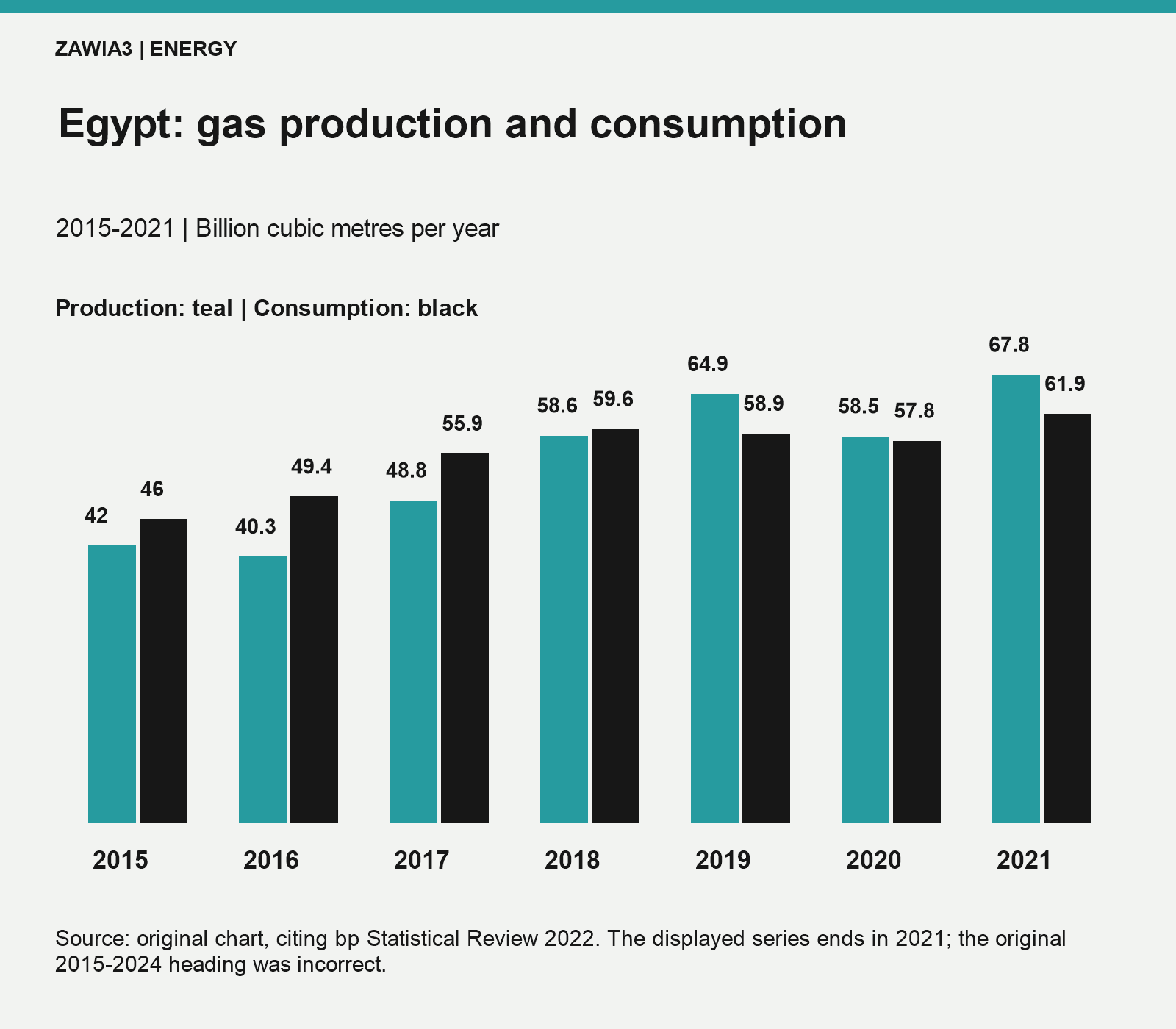
The first chart shows production and consumption from 2015 to 2021, based on the series attributed to bp’s 2022 Statistical Review. Its data do not extend to 2024.
The Energy Research Unit’s review of 2024 estimated Egyptian LNG imports at 2.8 million tonnes, including 300,000 tonnes through Jordan—the highest level since 2017. Its preliminary production estimates were 4.4 billion cubic feet a day in 2024, against 5.5 billion in 2023.
Relinquishing exploration blocks
Reports that energy companies had given up Red Sea exploration acreage intensified concern about investment. The detailed April account named Shell, Chevron and Mubadala, rather than four companies including ExxonMobil.
The companies reportedly decided not to proceed to the next exploration stage after seismic findings failed to meet their commercial expectations. Initial investment commitments associated with the areas totalled approximately $326 million; commitments should not be presented as proof that the full sum had already been spent.
Unpromising survey results, geological complexity and high costs were central to the discussion. Regional instability was another potential concern, but does not establish a single motive shared by every company.
Prime Minister Mostafa Madbouly said relinquishing particular exploration areas did not amount to leaving the Egyptian market. Companies assess prospects and may redirect resources when early studies are unpromising, he said.
Ramadan believes the economic crisis has affected the management of the gas sector, but identifies delayed payments to foreign producers as a particularly important factor. Unpaid receivables can discourage exploration and field development, progressively reducing output.
He says Egypt has experienced this pattern during earlier gas expansions, including those of the 2000s, and interprets some companies’ withdrawal decisions as pressure to recover outstanding payments. That is his analysis of the investment environment, not confirmation of the motivation behind each relinquished block.
Economics professor Karim El Omda places greater emphasis on technical problems in deep-water fields, particularly Zohr. He argues that difficult extraction conditions and the pace of production help explain the decline, and does not see economic policy as the sole or direct cause.
Ramadan acknowledges that LNG exports helped Egypt financially during the European energy crisis. Nevertheless, he argues that exporting too aggressively put pressure on domestic availability.
The report cites approximately eight million tonnes of LNG exports and $8.4 billion in gas export receipts in 2022, attributed to then-finance minister Mohamed Maait. The surge in global prices following the invasion of Ukraine increased the value of those sales. Receipts, physical volumes and their annual growth rates are different measures and should not be conflated.
Searching for alternatives
Amid political tension and declining supplies, Egypt has sought to diversify its gas arrangements. Estimates cited in the report put Israeli imports at 15–20% of domestic consumption, underlining the exposure created by dependence on one source.
The options discussed include longer-term supplies from Qatar and arrangements to bring gas from Cypriot offshore fields into Egyptian infrastructure. The latter concerns Cypriot fields connected to Egypt’s processing and export facilities, not fields jointly straddling the two countries.
Cairo has also discussed LNG reception infrastructure and floating storage and regasification units with Russia and Turkey. Such equipment would allow imports from a wider range of suppliers. It does not itself guarantee the purchase or arrival of the gas.
At home, Egypt is seeking additional output through new wells, work on existing wells and exploration acreage. The report highlights several developments announced in January 2025.
ExxonMobil reported gas-bearing reservoirs at the Nefertari-1 well in the North Marakia area of the western Mediterranean. The results remained under evaluation. ExxonMobil operates the concession with a 60% stake and QatarEnergy holds 40%.
The Petroleum Ministry announced in January the completion of drilling at two additional Raven wells. The contemporary forecast cited in the report was approximately 200 million cubic feet of gas and 10,000 barrels of condensate a day, with first production expected in February. Those figures describe the project expectations reported at that stage.
Ramadan welcomes diversification and argues that reliance on Israel should be reduced. He supports seeking other suppliers and sees domestic industrial use as especially important when international gas prices fall.
Gas used to manufacture products at home can generate more value than selling it as a raw material, Ramadan argues. Energy policy should balance foreign-currency needs against the requirements of domestic industry.
He says the 2022 decision to pursue European sales was understandable when prices were unusually high and Egypt needed dollars. With a different price environment and local shortages, priorities should also change.
El Omda stresses the role Israeli gas has played in Egypt’s regional liquefaction and re-export arrangements. However, those flows are not exclusively for re-export: imported gas also enters Egypt’s network and can meet domestic needs, as the consumption estimates in this report indicate.
He interprets reduced dependence on Israeli supplies as a potential step towards greater energy independence. This is his reading of the situation, rather than evidence of an announced government decision voluntarily to cut imports. Egypt still needs alternatives to cover any resulting shortfall.
Beyond Zohr, the report identifies Atoll, with estimated resources of around 1.5 trillion cubic feet, and Nooros, at approximately two trillion. It also lists the Taurus, Libra, Giza, Fayoum and Raven fields associated with the West Nile Delta development, with a combined estimate of around five trillion cubic feet. Resource estimates do not indicate how much can be delivered immediately.
Further discoveries were announced in the Mediterranean in 2020, including one roughly 11 kilometres offshore in July and the Greater Nooros discovery in September, about five kilometres from the coast and four kilometres from the Nooros field discovered in 2015.
Nargis was officially announced on 15 January 2023, rather than at the end of 2024. Like other discoveries, its contribution depends on appraisal, investment and development.
The challenge is therefore broader than finding another field. It is to align production, reliable imports, industrial demand and a faster transition to renewable energy so that Egypt’s factories are not repeatedly left waiting for fuel.