Despite the mediation efforts made by a number of governments and international organisations to stop the war of genocide waged by the Israeli occupation forces on the Gaza Strip since 7 October, and although the whole world witnessed the trial of the occupation before the International Court of Justice on 11 and 12 January in the case filed by South Africa over accusations that the Israeli entity committed crimes of genocide in its continuing aggression on Gaza, the party accused of genocide, despite its efforts to clear itself of these accusations, has not succeeded in doing so on the ground. The occupation is still continuing its aggressive operations against civilians and isolating the population of the Gaza Strip, with the aim of displacing them to the Egyptian border, seeking to liquidate the Palestinian cause.
In this report, we review the chronological sequence of events and the most prominent stages the people of Gaza have gone through during the ongoing war since its beginning.
The Beginning
The Israeli occupation army began an attack on the Strip it called “Iron Swords” after fighters of the Palestinian factions and the Qassam Brigades launched a surprise attack on military posts and the surrounding towns known as the Gaza envelope on 7 October, after they succeeded in breaching the Iron Dome without being detected by advanced radars, and killed, according to the Israeli account, about 1,200 people and took more than 200 hostages. For the first time in its history, the resistance used parachute units it called the “Saqr Squadron”, which infiltrated by land, sea and air, in a qualitative development of the Palestinian factions’ weapons. It also fired, in its first wave, five thousand rockets in successive barrages.
In an audio recording released at the time of the attack, Mohammed Deif, a commander of the Qassam Brigades, the military wing of Hamas, said Al-Aqsa Flood came in response to what he called “the daily attacks on Al-Aqsa Mosque” by some nationalist Israeli settlers.
Where Do the Resistance’s Weapons Come From?
It is difficult to determine how Hamas is funded and the source of its weapons, which have become advanced and qualitative; but analysts point out that Iran plays a role in funding, which may reach $100 million over the past two or three years. According to Hebrew reports, Hamas called in 2019 for collecting donations through the encrypted digital currency “Bitcoin” via electronic communication channels (most notably Telegram), assisted in this by Lebanon’s Hezbollah.
In previous statements, the Secretary-General of the Islamic Jihad movement, Ziyad al-Nakhalah, said conventional weapons reach them mainly via Hezbollah and Syria, as smuggling takes place by land or sea or through the tunnel network believed to be the largest in the world and run by Hamas, which is thought to be a place for storing weapons, food, water and fuel; it is believed to include 1,300 tunnels about 500 kilometres long, with some tunnels reaching a depth of 70 metres underground.
Hamas has an unspecified stockpile of short-range rockets such as the Qassam (with a range of 10 kilometres), the Quds 101 (with a range of about 16 kilometres), Grad rockets (with a range of up to 55 kilometres) and the Sejjil 55 rocket with a range of up to 55 kilometres. It also has a range of long-range rocket systems such as the M-75 (with a range of up to 75 kilometres), the Fajr (with a range of up to 100 kilometres), the R-160 (with a range of up to 120 kilometres) and some M-302S rockets with a range of 200 kilometres.
In a report, the CNN news network pointed to the “World Factbook” issued by the US Central Intelligence Agency, which stated that Hamas obtains its weapons through smuggling or local manufacturing, and that Iran shipped its most advanced ballistic missiles by sea to Hamas among construction components in Gaza. The movement also has a variety of surface-to-surface missiles and Kornet anti-tank missiles, which are believed to have been smuggled through tunnels from Egypt’s Sinai Peninsula at earlier times.
According to Hamas, it has local factories making rockets with ranges of up to 250 kilometres, 160 kilometres, 80 kilometres and 10 kilometres, factories for mortars and their shells, and factories for Kalashnikovs and their bullets. According to analysts, Hamas recycles unexploded Israeli munitions and turns them into explosive materials and parts that can be used in manufacturing weapons, in addition to metal sheets and pipes, reinforcing steel and electrical wires resulting from the destruction of the Strip’s infrastructure in every attack the occupation launches.
A Timeline of the War
On 8 October, the Israeli authority declared a state of war and called up 300,000 reservists, and US Defense Secretary Lloyd Austin ordered the deployment of the aircraft carrier “Gerald Ford” to the eastern Mediterranean. On 9 October, a total siege was imposed on the Gaza Strip and it began its operations against the Strip, especially with shelling of Syrian territory in response to mortar shells fired from inside Syria towards the occupied Golan Heights, and other shelling of southern Lebanon after Hezbollah’s first intervention. Meanwhile, the first US munitions plane arrived to join the war waged against Gazans on 10 October, the same day the Houthis threatened to intervene if the United States intervened in favour of the Israeli occupation.
On 11 October, the Strip’s only power plant stopped working after running out of fuel because of the siege, and the occupation bombed the humanitarian corridor announced by Egypt in agreement with the United States. On 12 and 13 October, the occupation army directed about one million one hundred thousand Palestinians to evacuate the north of the Strip, and humanitarian aid arrived for the first time at Al-Arish airport in preparation for its entry into Gaza. Egypt announced on 14 October the opening of the Rafah crossing to begin evacuating foreign nationals. By 15 October, at least 12 journalists had been killed, while eight others were wounded and two were considered missing. European Commission President Ursula von der Leyen announced that the European Union would launch a humanitarian air bridge operation to Egypt to transport supplies to Gaza, and the first five UN fuel trucks entered on 16 October.
On the 17th of the same month, the occupation committed the first massacre when it bombed the Al-Ahli Baptist Hospital, which sheltered thousands of displaced people, resulting in the killing of more than 500 Gazans and the injury of hundreds, which led to the cancellation of the Arab-American summit in Jordan. This was followed by Hamas’s release of the first two American hostages. On 18 October, Egyptian media figure Bassem Youssef appeared in a televised interview with Briton Piers Morgan, which sparked a global debate and represented a beginning in spreading global popular awareness about the reality of what is happening in Gaza. Then on 21 October food aid trucks were allowed to enter the Strip for the first time, and on 25 October Russia and China used their veto and thwarted the US draft resolution in the Security Council, which rejected a ceasefire. In return, the United States used its veto to abort a Russian draft resolution calling for a ceasefire in Gaza and facilitating the entry of aid into the Strip. The occupation expanded its ground attack on 26 October for the first time, and on 1 November evacuation from Gaza through the Rafah crossing began, with about seven thousand foreign passport holders, dual nationals and their families crossing, as well as people needing urgent medical treatment.
On 15 November, the occupation attacked Al-Shifa Hospital, which houses thousands of wounded and displaced people, and on 22 November Reporters Without Borders accused the occupation of turning Gaza into a graveyard for journalists, after 48 journalists were killed. On 24 November, the truce between the resistance and the occupation began, and a number of hostages held by Hamas were released; but the occupation violated the terms of the truce on 1 December and began extending its operations from the north of Gaza to its south. On 19 November, the Houthis in Yemen hijacked a cargo ship in the Red Sea and held its crew hostage, citing the ship’s links to Israeli commercial interests, and they attacked two Israeli commercial ships on 3 December. The group has launched a number of attacks with ballistic missiles and drones on the occupation continuously until now.
11 January marked the most prominent event and the first strong international reaction towards the Israeli occupation, when the first sessions of the International Court of Justice began in the case filed by South Africa against the Israeli occupation, accusing it of committing crimes of genocide against Gazans. American and British warplanes, ships and submarines, with the help of Bahrain, also launched dozens of air strikes across Yemen in response to Houthi attacks on ships in the Red Sea.
Losses of the War
Casualties
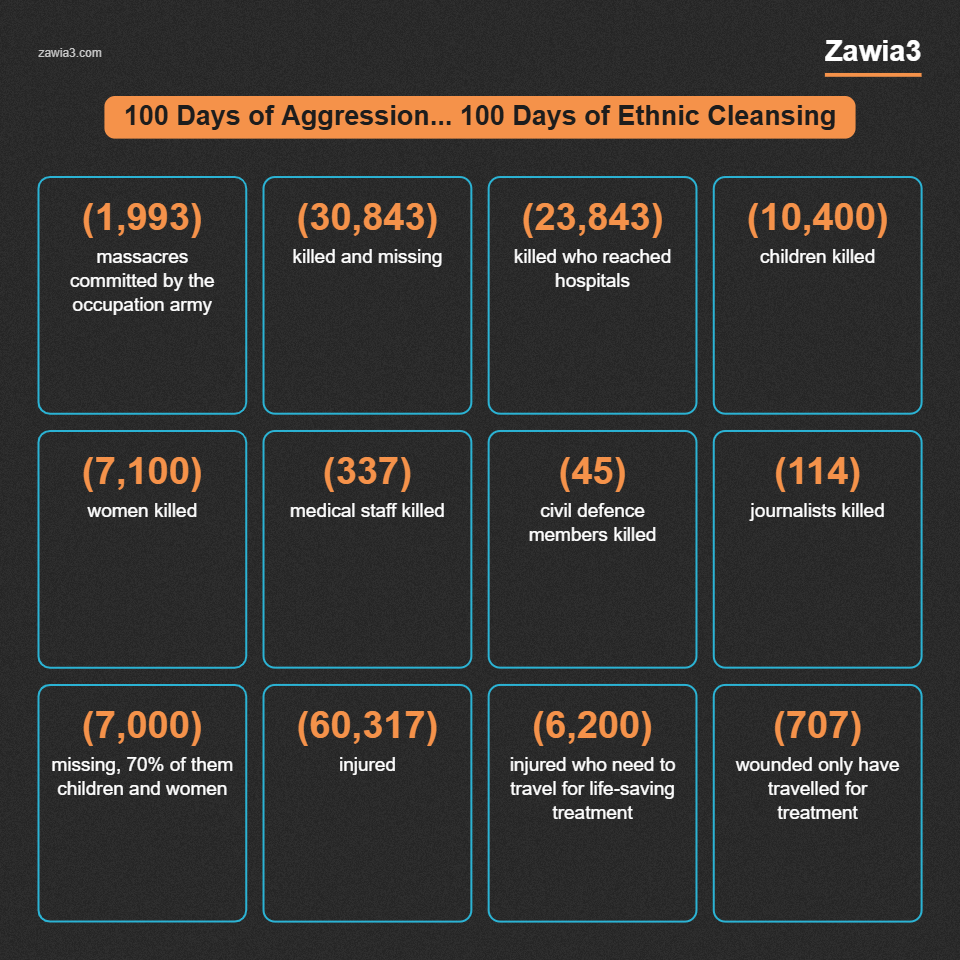
The number of victims in the Strip reached about 24,100 killed by the occupation’s weapons and 61,000 wounded, 70% of them children and women (about 7,100 women and 10,400 children), according to the Ministry of Health in Gaza, in addition to more than 8,000 missing, besides thousands under the rubble. And 900,000 have become displaced, threatened by famine, the spread of epidemics and infectious diseases and lack of shelter, along with the continued cutting of communications and internet services in the Strip. The occupation has also committed more than 2,000 massacres against Palestinian families.
The Hebrew Channel 12 said 11,000 rockets have been fired at the occupation since 7 October, explaining that 9,000 rockets were fired from the Gaza Strip and 2,000 rockets from Lebanon. Also, 2,300 Palestinians from Gaza were arrested on claims of participating in Operation Al-Aqsa Flood.
Forced Displacement
According to the Palestinian Authority, about 85% of Gazans have been forcibly displaced from their homes, representing about 1,930,000 Palestinians. About 1,200,000 internally displaced people have been registered in 325 community shelters or facilities of the UN Relief and Works Agency (UNRWA).
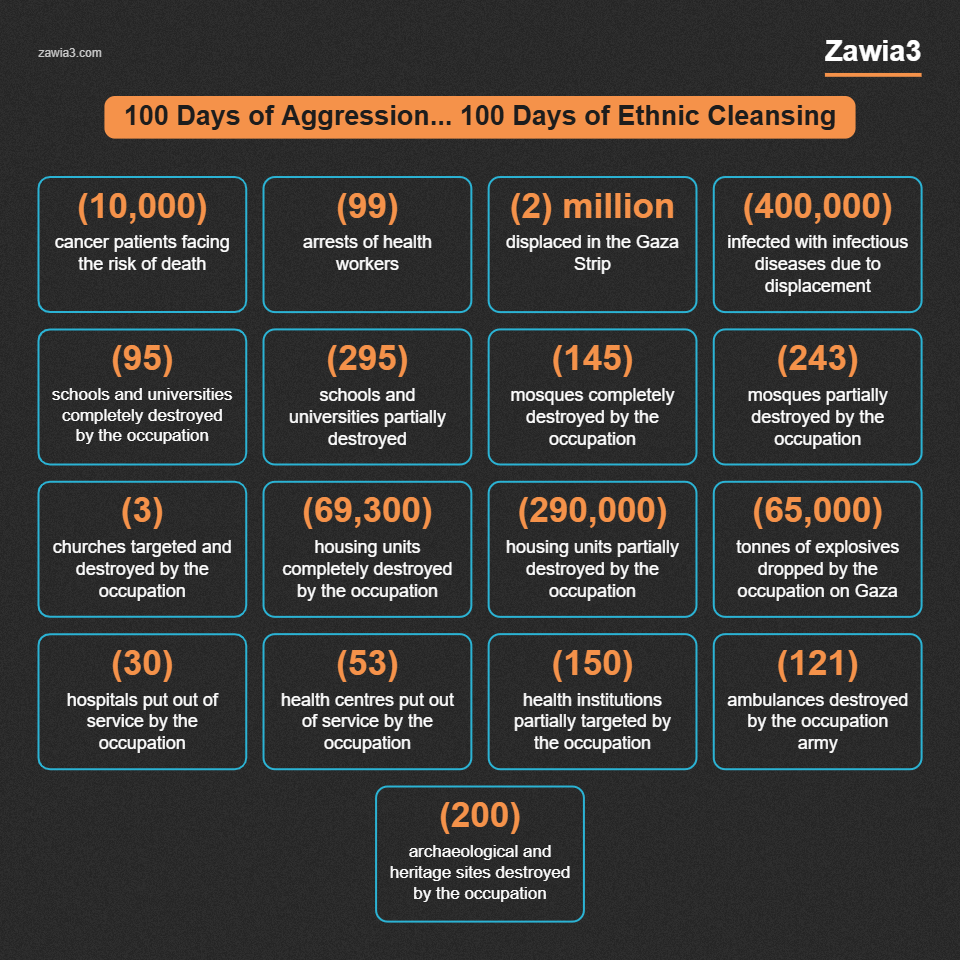
The Palestinian governorate of Rafah near the Egyptian border has become the main refuge for all the displaced from the Strip, which has led to great pressure on it and a scarcity of basic life requirements of food, water and medicine. Estimates indicated that by 30 December the occupation had destroyed about 65,000 housing units, while more than 290,000 other units were damaged by the continuous shelling.
Health Care
According to the Palestinian Ministry of Health, Gaza now has only six working ambulances in the entire Strip, after the occupation targeted medical crews and ambulance services and destroyed them completely. Also, only 15 out of 36 hospitals are now working, and only partially, without the minimum health care requirements that enable medical staff to continue their work.
Occupancy rates in working hospitals have risen to about three times their capacity, reaching 206%, while the occupancy rate of intensive care units reached about 250% of their capacity. The Strip suffers from a severe shortage of supplies for health facilities, including electricity, water, medicines and equipment.
More than 360,000 cases of infectious diseases have been recorded in UNRWA shelters as a result of overcrowding and lack of water and hygiene, in addition to 179,000 cases of respiratory infections, about 137,000 cases of diarrhoea, 55,000 cases of scabies, 38,000 cases of skin rash, about 5,000 cases of chickenpox and fewer than 5,000 cases of jaundice.
There were 485,000 people with mental health disorders before the war, expected to double because of the weapons and destruction inflicted on the Strip, along with 225,000 people with hypertension, 45,000 heart patients and 71,000 diabetics. 51,000 pregnant women need special health care and places equipped for childbirth, while 61% of incubators in the north need electricity.
About 337 doctors have been killed and 770 others injured, while 65 medical staff were arrested, with the total number of attacks on medical facilities reaching 294. 26 hospitals, 53 health centres and 121 ambulances were destroyed and put out of service.
Food Security
The entire population of the Strip is at risk of imminent famine; more than two million people suffer from acute food insecurity, representing 21% of the population, while 930,000 are at the emergency level, representing 53%, and 378,000 have reached the level of food catastrophe and famine, representing 26% of the total population.
Facilities
20 water and sanitation facilities had been destroyed by the beginning of this January, along with 352 educational facilities, and 3 churches and 115 mosques were damaged.
The Israeli occupation is still continuing its expanded operations and its war aimed at exterminating Gazans and displacing them from the Strip to quash the Palestinian cause, in what resembles systematic crimes of ethnic cleansing.