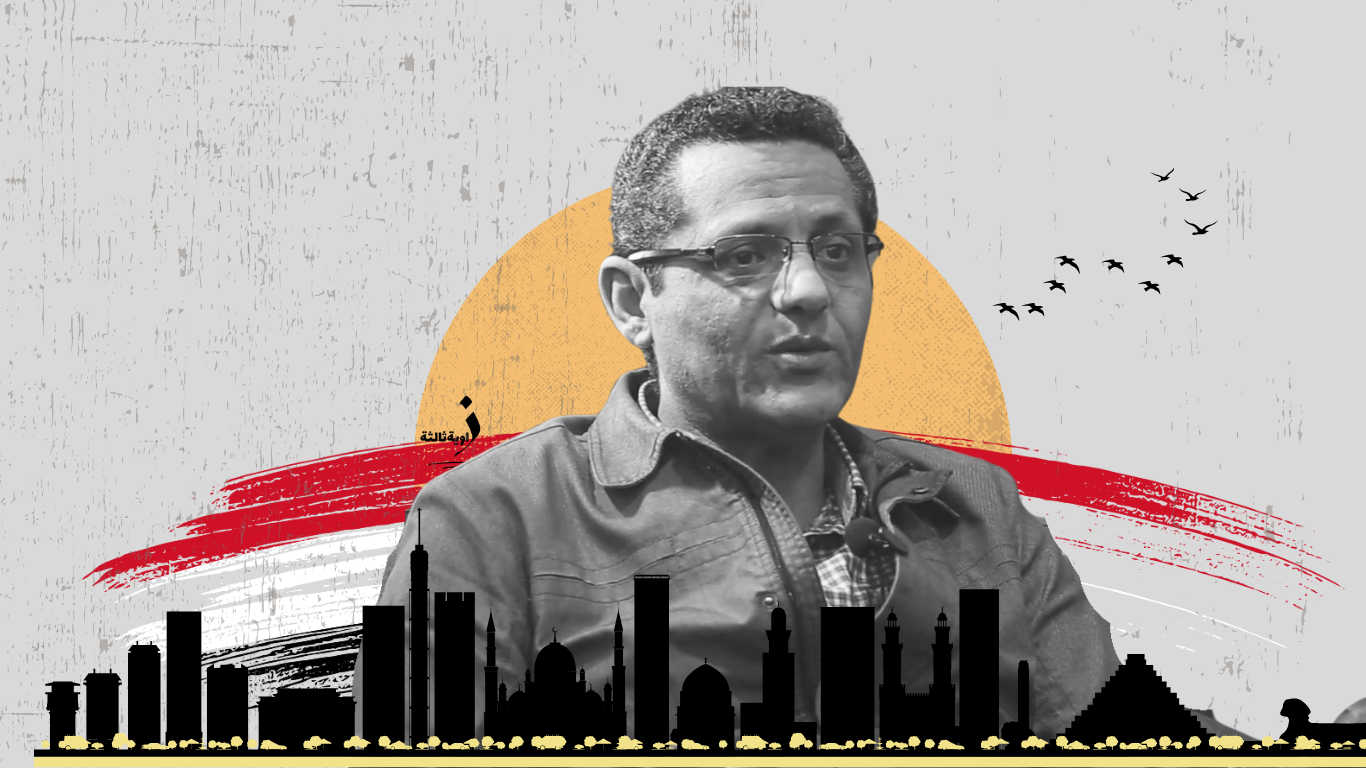
On 30 July 2025, the East Tanta Court of First Instance ruled to dismiss worker Hisham El-Banna from his job, on the basis of the lawsuit filed by the management of Samanoud Textiles, which accused him of “inciting workers to strike and causing losses to the company as a result of the work stoppage”.
The case dates back to August 2024, when the company, located in Gharbia Governorate, witnessed a workers’ strike that lasted more than a month in protest at its exemption from the application of the minimum wage decision, and to demand an improvement in the financial conditions of the workers. During the strike, security forces arrested a number of male and female workers, among them Hisham El-Banna, and levelled similar charges against them, before they were later released.
In September 2024, the management of the Samanoud Textiles and Pile Fabrics Company issued a decision suspending ten of the female and male workers accused in case No. 7648 of 2024 (Samanoud administrative), and decided to pay them half of their basic wage pending a ruling in the case, against the backdrop of the workers’ strike demanding the application of the minimum wage. The list included seven of those who were later released, in addition to the union leader Hisham El-Banna.
Since the August strike, the workers have staged protest stands and strikes during the past months of March, April and May, in protest at what they described as mismanagement and delays in paying their dues. This period saw repeated accusations against the management of failing to pay the periodic bonuses and delaying the payment of wages, which deepened the crisis and kept it open on a complex judicial and union track.
Samanoud Textiles was founded in Gharbia Governorate in 1974 as one of the spinning and weaving factories affiliated with the Ghazl El-Mahalla company, before its ownership passed to the National Investment Bank and other government bodies. It was known for producing fabrics, pile fabrics and denim, but it has seen a sharp decline since the early 2000s, and it stopped operating for about three years before being partially restarted in 2014 as part of a restructuring plan that included an early retirement programme which ended the service of about half of the workers. Despite the injection of government funds to rescue it, the company continued to suffer from low wages and deteriorating working conditions, which led to repeated waves of protest, the most recent being the series of strikes that has continued since 2024.
The Labour Court Ordered Dismissal Despite Acquittal of the Charges
Labour leader Hisham El-Banna tells Zawia3 that he was surprised by the decision of the East Tanta Court of First Instance to dismiss him from his job, even though the criminal court had acquitted him of the very same charges, which included “inciting workers to strike” and “causing losses to the company”. He explained that the case began as a criminal lawsuit following the August 2024 strike, when he and nine of his colleagues were detained for a period pending investigation, before the criminal court acquitted them all; the dispute then ended with nine of them, while the case remained pending against him alone before the labour court.
El-Banna adds that the labour court based its ruling on the investigations of National Security and the criminal investigation police, which the prosecution and the criminal court had refused to accept, noting that the company did not present any other evidence to prove the charges, including its claims that it lost half a million pounds a day as a result of the strike.
The labour leader stresses that the company’s actual figures, which he presented before the prosecution, indicate that its monthly income ranges between EGP 800,000 and EGP 900,000, sometimes reaching EGP 1,100,000 at best, and that, in his capacity as sales manager, he sought to cover the workers’ wages by selling scrap and surplus stock when needed, considering that the loss estimates presented against them are “unrealistic and not based on evidence”.
Repeated Attempts at Dismissal
Labour leader Hisham El-Banna believes that the decision to dismiss him in July 2025 was not merely a direct result of the August 2024 strike, but rather the culmination of continuous attempts to remove him from the company since 2014, in his words. He tells Zawia3 that these attempts began when ownership of Samanoud Textiles passed to the National Investment Bank, after the government, headed by former Prime Minister Ibrahim Mahlab, compelled the bank to acquire the company; at that time about EGP 72 million was injected to settle the workers out, of which nearly EGP 35 million was spent, when the dollar was equivalent to six pounds, on an early retirement programme that resulted in the departure of about 600 workers, that is, half of the workforce, and the company was scheduled to be fully liquidated by February 2015.
El-Banna stresses that he was among the most prominent opponents of the liquidation plan and contributed to freezing it, until a decision was issued by the Presidency to restart the company. Since then, according to his account, the National Investment Bank considered his position a challenge to the liquidation scheme, and so the attempts to dismiss him began, first embodied in a decision in 2016, but he returned to his job by a court ruling in his favour. Since that time, he has been embroiled in a series of legal disputes with the company’s management.
El-Banna says that in January 2015, after the restart, the company’s management went as far as deleting his higher educational qualification from his employment file, which prompted him to resort to the courts, which ruled in his favour by obliging the company to calculate his wage on the basis of the higher qualification retroactively from 2010, and to compensate him with EGP 10,000.
He adds that over the past years he has fought between seven and nine lawsuits, including challenges to dismissal decisions and penalties he considered arbitrary, and won a number of them, among them the cancellation of the 2016 dismissal decision. He points out that the labour court’s ruling to dismiss him in July 2025 comes in the context of this long path, and that he is preparing to appeal it as soon as he obtains a copy of the ruling and its reasoning.
El-Banna also explains that after the ruling the company’s management began taking additional measures, including stopping payment of the half of his basic wage that he had been receiving for a year, in addition to cancelling the monthly medical voucher on which he relies for the follow-up of chronic illnesses such as diabetes, blood pressure and heart disease. He comments: “Since 2014, I have practically been living in the corridors of the courts.”
Breaking the Will of the Workers
Hassan El-Barbary, a researcher on labour affairs, considers the Tanta Court of First Instance’s ruling to dismiss Hisham El-Banna “a dangerous precedent” that infringes on the constitutional rights to strike and to work, and contradicts Egypt’s international obligations that protect union leaders from retaliatory measures because of their activity. He tells Zawia3 that the Public Prosecution had previously shelved the complaints filed against El-Banna, which, in his view, reinforces the absence of any legal basis for the dismissal and reveals a “retaliatory character” of the decision, aimed at breaking the will of the workers and deterring any collective action to demand rights.
El-Barbary points out that the ruling contradicts several international conventions ratified by Egypt, including the International Labour Organisation’s Convention No. 87 of 1948 on Freedom of Association, which guarantees the exercise of union activity without exposure to dismissal or penalties, Convention No. 98 on Collective Bargaining, and Convention No. 135 on the protection of workers’ representatives from arbitrary measures. The ruling also violates, according to El-Barbary, the International Covenant on Economic, Social and Cultural Rights, and the Arab Charter on Human Rights.
He believes that the ruling also contradicts articles of the Egyptian Constitution, in particular Article 15, which stipulates that “peaceful strike is a right regulated by law”, Article 13, which obliges the state to protect workers from arbitrary dismissal and to guarantee conditions of security and safety, Article 76, which guarantees the freedom and independence of unions, and Article 93, which obliges the state to respect international human rights conventions.
A Drift Towards Privatising Samanoud Textiles
Despite the absence of any official announcement regarding the liquidation of “Samanoud Textiles”, its current situation raises fears among workers and union activists of a premeditated intention to end its activity.
Hassan El-Barbary, a researcher on labour affairs, believes that the recurring disputes with the workers and the long, successive strikes that accompany them, as well as the constant recourse to the security agencies to break up sit-ins, arrest workers and obstruct their union activity, are all factors that weaken the working environment and aggravate the crisis.
But, according to El-Barbary, the strongest indicator lies in what he described as the “policy of neglect” practised by the company’s management, a policy that other public sector companies previously witnessed before their liquidation. He explains that this pattern is based on leaving crises to pile up without solutions, which leads to accumulated losses, especially operating losses linked to production, making the continuation of activity economically unviable.
El-Barbary points out that such a path may open the door to decisions to sell or liquidate, even if there was no declared intention at the outset, as the accumulated losses become an official pretext for taking the decision. Nevertheless, any measure of this kind remains contingent on the issuance of clear administrative decisions and procedures by the competent authorities.
In this context, Wafaa Ashry, a member of the central committee of the Bread and Freedom Party (under establishment), believes that the dismissal of Hisham El-Banna, the most prominent leader at Samanoud Textiles and known for his position rejecting the liquidation of the company, may be a preparatory step or part of a pressure plan to remove any internal resistance to the liquidation project.
She tells Zawia3 that this method is recurrent in a number of public sector companies or state-owned companies, where the management or the owning entity begins by weakening opposing voices from within to pave the way for sale or liquidation.
Ashry adds that the insistence on liquidating “Samanoud Textiles” may be linked to several factors, most notably that the company sits on a large plot of land in a strategic location in the city of Samanoud, which makes it a tempting target for investors or for future real estate and commercial projects. She also pointed to a general trend towards reducing the role of the state in traditional industrial sectors, especially textiles, which is sometimes carried out through what she describes as “disguised privatisation”.
She noted that “Samanoud Textiles” has represented a symbol of resistance to privatisation since the 1990s, and therefore the dismissal of its labour leaders sends a clear message to the rest of the workers that opposition will come at a heavy price. Ashry points out that many of the companies that are liquidated have been deliberately neglected, loaded with debts or badly managed, so that they appear to public opinion as beyond rescue, and liquidation is thus presented as “the logical solution”.
Workers’ Trust in the Law?
The Centre for Trade Union and Workers’ Services (CTUWS) condemned the ruling issued by the labour court in Tanta dismissing labour leader Hisham El-Banna from his job at Samanoud Textiles, and considered it contrary to the expectations of most of the legal experts who reviewed the case. It stressed, in a statement published on its official page, that it will follow up the appeal proceedings in cooperation with lawyers and jurists in solidarity, and described the ruling as having “missed the mark”. The statement pointed out that the Samanoud Prosecution had shelved the complaint filed by the company’s management against nine of the workers, including El-Banna, on charges of striking and harming the company, which the Centre considered evidence that the case lacked legal evidence.
The statement added that the company’s management had, while the case was being heard, withdrawn its demand to suspend the nine workers from work, with the exception of El-Banna, and considered this an indication that he was “being targeted individually” because of his union role and his colleagues’ trust in him as their representative in negotiations with the management.
In the same context, lawyer Rahma Refaat, programme coordinator at the Centre for Trade Union and Workers’ Services, believes that the ruling was “disappointing”, stressing to Zawia3 that El-Banna played an important role in defending the interests of the company’s male and female workers, which has suffered for years from accumulated problems, most notably repeated changes in ownership and legal form, which resulted in a number of workers losing their jobs after their pensions were settled, while the rest still face administrative decisions she described as “arbitrary”.
Refaat explains that the demands for the application of the minimum wage in 2024 came as part of a legitimate protest movement, especially after the company refused to comply on the pretext of waiting for an official response to its request to be exempted from the decision, which prompted the workers to file a complaint with the labour office, to which the management responded with complaints to the prosecution against nine of them. According to Refaat, the prosecution ended up shelving the investigation, which weakens the merits of the lawsuit on which the court later relied to dismiss El-Banna.
She added that the company demanded the suspension of the nine workers while the case was being heard, but then went back and waived the request for all of them except El-Banna, considering that this measure “clearly reveals the weakness of the charges and the deliberate targeting of El-Banna in his union capacity”.
Refaat concludes by saying that this ruling does not only affect El-Banna and his family, by depriving them of their only source of income, but also sends negative messages to the labour community and entrenches the impression that legal paths are blocked for those who demand the application of the law, while none of the management officials is held accountable for what she described as “the violation”. She expressed her hope that the appeal will be accepted “to restore some hope to El-Banna and his colleagues”.
Amid the escalation of decisions to liquidate public sector companies in recent years, especially in the fields of spinning and weaving and heavy industries, the debate is growing between the government narrative, which justifies liquidation by the need to stop the haemorrhage of losses and declining competitiveness, and the view of unionists and experts who see it as the result of a systematic policy of neglect. They point out that the deterioration begins with leaving equipment to wear out without modernisation, which leads to the accumulation of losses that are then used as a legal justification for closure. Although Law No. 203 of 1991 grants the authorities the right to liquidate companies by decision of the general assemblies, previous experiences, such as the National Cement Company, El Nasr Automotive and several spinning companies, have raised questions about the fate of public assets and the workforce, in the absence of a clear plan to protect national industries from decline.