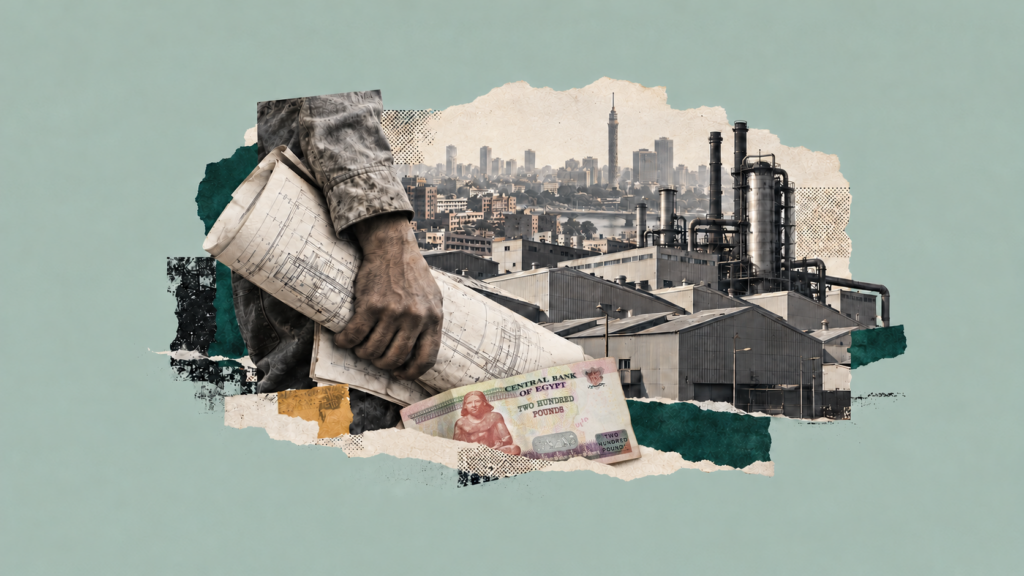

An International Monetary Fund mission will begin talks next Sunday on the eighth and final review of Egypt’s financing programme. In December, the existing financial cooperation programme with the Fund will officially end: the $8 billion Extended Fund Facility agreement, alongside the $1.3 billion Resilience and Sustainability Facility.
This procedural exit comes as the Egyptian government seeks to establish a new phase of economic policymaking, based on a national vision for reform and an end to continued reliance on borrowing programmes from international institutions.
During the Egypt Forum 2026, the cabinet announced the outlines of the National Programme for Economic Transformation 2027–2030, which aims to move the economy from crisis management and financial stabilisation to growth driven by productivity and private-sector empowerment.
Yet this transition faces a complex economic equation. Official data indicate a marked improvement in external liquidity, reflected in net international reserves rising to $57.35 billion at the end of September 2026 and growth in remittances from Egyptians abroad. Structural financial pressures nevertheless remain clearly evident at home, with debt interest consuming roughly two-thirds to three-quarters of Egyptian budget revenues and inflation remaining high enough to affect living standards and investment activity, according to observers who spoke to Zawia3.
What Is the National Programme for Economic Transformation 2027–2030?
The programme is a government attempt to answer questions from investors and economic circles about the direction of public policy once the IMF’s direct oversight ends. According to official statements from the cabinet and the Ministry of Planning and Economic Development, it is an integrated four-year framework drawing on the outcomes of the National Dialogue, the State Ownership Policy Document and the National Structural Reform Programme.
It includes a package of ambitious numerical targets that the government seeks to reach by the 2029/2030 fiscal year. Foremost is gradually raising real gross domestic product growth to 6.8% by the end of the decade, compared with the roughly 5.1% expected for the current fiscal year, by expanding the productive base and encouraging exports.
The plan also envisages raising total investment as a share of GDP from its current 12.7% to 20% by 2029/2030. Alongside this, it aims to change the composition of investment by increasing the private sector’s share to 67% of total investment carried out, up from about 57.7% currently. This reflects the state’s intention to reduce public investment spending in favour of private initiatives.
The government has made lowering inflation to a range of 5% to 7% a top priority, compared with levels currently exceeding 13%, alongside reducing the external current account deficit from 5.1% to 2.3% of GDP and bringing unemployment down from 5.8% to about 5.5%.
The programme also targets a two-percentage-point increase in tax revenues, from 13% to 15% of GDP. Officials emphasise that this will be achieved by broadening the tax base, digitising procedures and integrating the informal economy, without introducing new tax burdens or brackets.
The programme is divided into four main areas of work encompassing 40 targets and 185 implementation measures, alongside 20 legislative reforms and 25 institutional reforms. These measures are to be continually evaluated through 150 performance indicators.
It focuses on five sectors described as engines of sustainable growth: agriculture, manufacturing, communications and information technology, tourism, and energy. Official indicators show that these sectors contributed around 50% of the real growth rate recently achieved, account for nearly 40% of GDP and employ about 40% of the working population. They also attracted investment flows approaching $3.1 billion in the first half of the previous fiscal year.
How Do Experts View It?
Economist Mohamed Fouad, head of the Al-Adl Party’s parliamentary bloc in the House of Representatives, considers that the central problem facing the government is no longer its ability to present ambitious numerical targets, but the absence of implementation mechanisms.
“When we talk about raising total investment to 20% of GDP and increasing the private sector’s share to 67%, at a time when the real domestic savings rate does not exceed roughly 3%, the central question should not be how ambitious the target is,” he tells Zawia3. “It should be how to finance it realistically, identify the sources that will close the existing savings-investment gap, and assess how sustainable those sources are over the medium and long term.”
Turning to public debt and its relationship to the state’s fiscal space, the head of Al-Adl’s parliamentary bloc explains: “The same applies to debt management. Interest payments absorbing roughly 68% of state revenues impose extremely severe constraints on the effectiveness and flexibility of fiscal policy. Yet it remains impossible to assess or determine the fiscal space available for development and public services without a clear government implementation plan for managing the debt principal, reducing its servicing cost and fundamentally reordering public spending priorities.”
The economist criticises the repeated introduction of theoretical frameworks for government plans without evaluating their outcomes, describing it as a recurring syndrome: “The truth is that we have seen this scene at least twice in recent years: first with the launch of Egypt Vision 2030, and second with the introduction of the National Narrative for Economic Development. At every stage, we find ourselves back at the starting point, discussing almost the same goals and re-explaining what has already been explained, before rapidly moving to a new theoretical framework without troubling ourselves to measure the results of the previous one or subject it to objective evaluation.”
“This constant competition to explain what has already been explained, and the successive move from one plan to another without clear implementation rules or genuine accountability for results, has over time become a real drain on time and effort,” he adds. “It cannot in any way be considered a substitute for serious structural economic reform.”
“The vulnerability of the existing economic model is no longer a theoretical proposition open to debate,” he says. “The sharp movements in the exchange rate, and the economy’s high sensitivity to hot-money flows and changing external conditions, reveal unequivocally the persistence of structural imbalances that all those successive plans and programmes were supposed to address.”
Political economy professor Karim El-Omda agrees. He considers what has been presented about the economic transformation programme to be general and complex, and not something that can be commented on or evaluated in the abstract. Talk of increasing industrial output, deepening local manufacturing, expanding exports, raising growth and reducing unemployment and inflation is not new in itself. These targets have been put forward more than once in earlier strategies, such as Egypt’s sustainable development plan, Vision 2030, and the National Narrative.
El-Omda tells Zawia3 that a genuine assessment of the government’s ability to implement the programme cannot stop at the strategy’s general targets or broad headings, which are general statements heard before. It depends entirely on knowing the nature and details of the 185 measures the government has announced it intends to take to achieve those goals. Implementation measures are the basis for a scientific, objective judgement of whether the programme can be put into practice.
He notes that setting targets over a long timeframe extending to 2030 raises concerns about repeating earlier experiences. For example, in 2021 the prime minister spoke about reaching self-sufficiency in 2023, which some at the time considered a positive proposal. What often happens, however, is that targets are set for distant dates, and by the time 2030 arrives everyone will have forgotten what was said and announced at the end of 2026.
He stresses that an accurate, detailed assessment cannot be based merely on discussing plans in general terms: “We need these specific 185 measures and their substance to be announced and explained, so specialists can determine whether they are actually feasible on the ground.”
Figures That Inspire Optimism, But…
For his part, Ahmed Aboud, professor of economics and finance at the University of Portsmouth in Britain, considers the announced targets of raising investment to 20% of GDP and the private sector’s share to 67% to be, in essence, figures that inspire optimism. But the greater challenge lies not simply in wanting to raise investment, but in securing the financing to achieve it. Comparing the current domestic savings rate, at around 3% of GDP, with an investment target of 20% reveals a financing gap approaching 17%, he notes.
He tells Zawia3 that achieving this goal is not impossible, but depends on securing clear financing resources by raising domestic savings, attracting substantial foreign direct investment flows and reducing the crowding out of private projects by the public sector, so that there is real room to increase the private sector’s contribution.
On public finances, Aboud explains that debt interest absorbing roughly two-thirds of government revenues, around 67%, is a major constraint and a high proportion that clearly affects the economy’s ability to provide resources for other activities and sectors. He notes that the state is currently seeking to broaden tax bases and gradually adjust certain tax rates to increase receipts, while adopting policies to reduce borrowing and thus interest costs, and accelerating economic growth. In practice, there is no adequate room for development spending without real reforms to the structure of public debt.
On monetary policy, he says that high interest rates remain a necessity imposed on the Egyptian economy to confront current inflation. This is a normal measure used even in advanced economies such as Europe and the United States to curb inflation. He notes that the policy also aims to protect the stability of the Egyptian pound’s exchange rate and keep the market attractive to foreign investment to prevent outflows, since any departure of those funds would put pressure on foreign reserves and the local currency.
Despite these gains, he sees a tangible cost to raising interest rates: higher borrowing burdens, the postponement of some investment plans and a slowdown in domestic markets, particularly real estate and industry, as well as a direct effect on household consumption patterns.
According to the available figures, the government’s plan faces the problem of the savings-investment gap. Data indicate that Egypt’s gross domestic savings rate is only about 3% of GDP, a modest level that cannot on its own finance an investment leap to 20% without relying on foreign savings, whether in the form of loans or direct investment flows.
Furthermore, the ambition to increase the private sector’s share to 67% depends on the state’s ability to actually apply competitive neutrality rules and implement the State Ownership Policy Document without selectivity. The private sector continues to demand real guarantees concerning the stability of tax and customs policies, easier allocation of industrial land, an end to preferential privileges granted to certain companies and public entities, and lighter bureaucratic burdens.
Broadening the tax base also raises practical questions about implementation. Integrating the parallel economy requires genuine incentives that outweigh the cost of formal compliance, while efforts to collect additional resources amid inflationary pressures and declining purchasing power may in practice increase the burden on taxpayers who are already compliant.
The accumulation of public debt and its high servicing cost also constitute the greatest challenge constraining the room for manoeuvre in public finances and the implementation of economic and social development plans. Prime Minister Mostafa Madbouly’s official statements clearly revealed the scale of this burden: he explained that debt interest payments currently absorb between 67% and 68% of total state revenues, describing this high level as the main problem facing sustainable financial stability. Total debt-service allocations, principal and interest, in the current fiscal year’s budget reach roughly EGP 2.3 trillion.
Egypt and the IMF: What Happens When the Loan Ends?
Meanwhile, as December approaches, attention is turning to the future relationship between Egypt and the IMF, after years of intensive financial cooperation that began in late 2016 and was renewed through multiple programmes, most recently the Extended Fund Facility agreement amended in March 2024.
Official data, supported by consistent statements from senior government officials, confirm that Egypt is not currently negotiating a new credit facility or loan from the Fund. The prime minister’s statements indicate that the Egyptian economy will not require new IMF financing in its next phase, and that the direction is firmly towards relying on the independent national programme and meeting dollar needs through other sources.
Egypt has received a total of roughly $7.3 billion under the current programme, following the seventh review approved last July, which released $1.8 billion, including $1.5 billion under the Extended Fund Facility and about $273 million from the Resilience and Sustainability Facility. A final tranche of around $1.7 billion remains linked to completion of the final review.
By contrast, Jihad Azour, director of the IMF’s Middle East and Central Asia Department, said that the Fund was focused first on completing the current programme’s final review. He explained that the institution remained ready to discuss the Egyptian government’s plans and priorities and consider any future request for a new programme if the authorities wished, noting that the final decision remained with the Egyptian side.
Ahmed Aboud stresses that freeing the economy from the IMF programme and ending the current agreement in December would be a good development and a positive step supporting financial independence. Leaving the programme would naturally mean slowing external borrowing in general and avoiding continued reliance on IMF funds, as long as the government does not signal an intention to seek a new financing programme.
Mohamed Fouad, meanwhile, warns against confusing creditor diversification with economic sovereignty: “Obtaining external financing from alternative sources does not necessarily mean greater economic independence. Nor does formally bringing the IMF programme to a close mean that the obligations and commitments associated with it disappear.” He stresses that the sole genuine measure of recovery is the productive structure’s ability to generate sustainable dollar inflows of its own and narrow the financing gap, rather than simply replacing one lender with another.
Alternative External Financing: Managing Dollar Needs
As Egypt moves towards stopping IMF borrowing, questions arise about how it will cover its external financing needs and meet debt-service obligations. Documents from international institutions indicate that Egypt has stated that its external financing requirements to meet foreign-reserve targets amount to about $12.9 billion in the 2025/2026 fiscal year, declining to around $5 billion in 2026/2027.
To meet these needs, Egypt’s strategy relies on three alternative financing paths. First is the strategic partnership with the European Union. European support is one of the most important pillars of external liquidity through 2027, within the framework of a comprehensive €7.4 billion financing package.
The package comprises €5 billion in concessional loans to support financial and budget stability, €1.8 billion in additional investment in renewable energy, green hydrogen and industry, and €600 million in non-repayable grants, including around €200 million allocated to migration management programmes and efforts to curb irregular migration flows.
Under this partnership, Egypt has received regular disbursements, including €1 billion in late 2024, €1 billion in January 2026 and about €1.5 billion in July 2026, helping to strengthen official foreign-currency liquidity.
Egypt is also moving to secure stable financing commitments from regional and international development institutions. In May 2026, the World Bank approved a $1 billion financing package under the GROWTH II programme, aimed at strengthening the private sector’s role, supporting fiscal sustainability and advancing the green transition.
This package includes a $200 million international credit guarantee from Britain and attracts parallel financing from the Asian Infrastructure Investment Bank (AIIB). These instruments aim to replace short-term commercial loans with low-interest, long-term development loans that ease pressure on the repayment schedule.
Direct investment from the Gulf also constitutes a strategic alternative to debt-based policies. Economic relations between Egypt and the Gulf states have shifted from a bank-deposit model to one based on investment in assets and major projects.
The Economy Between Macroeconomic Indicators and Pressures on the Street
Ahmed Aboud, professor of economics and finance at the University of Portsmouth in Britain, believes that the Egyptian economy’s trajectory through mid-2027 depends on three factors: political stability, developments in the regional situation and the volume of external capital inflows.
Aboud sets out two main scenarios. The first rests on the state’s success in attracting sufficient investment and financing flows to strengthen dollar liquidity and reserves, leading to gradual growth, a steady decline in inflation and more effective monetary policy.
The second assumes that the economy faces external shocks, such as rising global energy prices, a continued decline in Suez Canal revenues and slower foreign direct investment due to geopolitical tensions. This path would intensify pressure on the currency and growth, potentially forcing the state once again to arrange new financing packages, whether through the IMF or alternative channels.
Indicators for the final quarter of 2026 reflect the accuracy of this assessment of a two-sided performance. The economy shows external resilience while domestic pressures on living standards and public finances persist. Net international reserves reached a record $57.35 billion at the end of September, a 15.8% annual increase covering more than eight months of imports, alongside recovering expatriate remittances of $33.9 billion in eight months. By contrast, internal pressures remain entrenched, despite annual urban inflation falling to 13.9% and core inflation to 14.1% in September.
As the current IMF financing programme nears its end, Egypt faces a test that goes beyond simply ending borrowing from the international institution or diversifying external financing sources. The real challenge is the economy’s ability to move from dependence on loans and external financial flows to a more sustainable model based on production, exports and private investment, generating dollar resources capable of meeting growing financing needs without reproducing the debt crisis.
The experts’ views reveal that the National Programme for Economic Transformation, despite its ambitious targets, will not gain credibility simply through announcing figures or setting timelines extending to 2030. Its credibility will depend on the clarity of its implementation measures, the government’s ability to address structural imbalances and lower debt costs, the provision of greater room for the private sector, and the evaluation of, and accountability for, actual results.