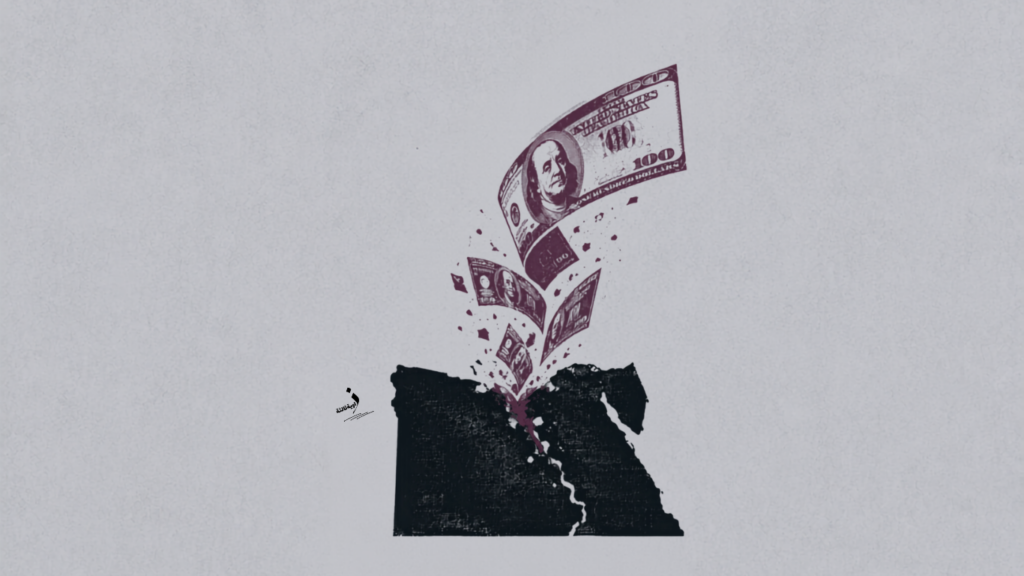

Over the 5 months since the start of the 2026 US-Iranian war, interspersed with a pause that did not exceed 20 days, the Egyptian pound lost about 7% of its value against the dollar, including 4% in the month of July alone, affected by the consequences of this regional tension in the form of a rapid exit of hot money, a reflection of an economic fragility that experts attributed to the state’s reliance on monetary policy tools alone, instead of the real economy.
While the exchange rate of the pound against the dollar at the Central Bank of Egypt on 28 February (the day the US-Israeli war on Iran broke out) stood at EGP 47.99 to the dollar, it jumped to EGP 51.42 to the dollar in July, in the wake of the war.
This came as Egypt was preparing to complete the credit facility programme it signed at the end of 2022 with the International Monetary Fund, worth $3 billion, which later rose to $8 billion, of which it has received $5.5 billion so far, and with its announcement that it had begun work on preparing a “comprehensive national economic programme” to lead the next phase of the economy after the end of the IMF era, aiming to move from consolidating stability to achieving sustainable growth that is directly reflected in citizens’ standard of living, according to statements by President Abdel Fattah El-Sisi during his speech at the inauguration of the headquarters of the State’s Strategic Command in the New Administrative Capital.
The period of the Iranian-US war saw waves of fluctuation in hot money inflows and outflows in the Egyptian market. After the war broke out at the end of last February, foreign investments in treasury bills and bonds fell during March by about $11 billion, to stand at $27.1 billion, the lowest level since September 2025, according to the Egyptian Ministry of Finance. With the temporary calm of the situation, hot money returned to flow in, recording $8.76 billion during last June’s trading, before it began to exit again during the first half of July with the escalation of military tensions, recording a net outflow of about $1.92 billion over two weeks, of which $1.46 billion was in a single week.
Mariana Azmy, a financial analyst and board member of McKinsey Financial Consulting, says that the state’s reliance in its monetary policy on foreigners’ investments in government debt instruments, or what is known as hot money, means that it relies in its economy on what it neither owns nor controls, since the owners of hot money are the ones who control the entry and exit of funds according to the surrounding circumstances, which makes us hostage to their decisions that serve their interests.
She explains to Zawia3 that the value of the pound should reflect the size of the economy and not the extent to which currency is available through attracting hot money, noting that this is a problem we have suffered from for 10 years, and the state still relies on it for dollar inflows.
Hot money, which is short-term foreign investment pumped into government debt instruments such as treasury bills and bonds or into the stock exchange, is no longer counted by Egypt as part of its foreign currency reserves, which reached $55.07 billion at the end of last June, because it is considered a fast-exiting liability and not the state’s outright property.
But hot money has roles in the economy, consisting of boosting foreign currency liquidity, supporting the exchange rate because of the increased supply of foreign currency in the Egyptian market, and stimulating trading in the financial markets by pumping money into the stock exchange.
According to a report prepared by the Egyptian Initiative for Personal Rights (EIPR), as part of its “Eye on Debt” series of reports, in recent years Egypt has offered one of the highest real interest rates on hot money investments among emerging markets, which kept Egyptian sovereign treasury bills attractive throughout the past period: at the end of 2023 they stood at around $10 billion, and they rose to $42 billion by the end of 2025 (representing one fifth of the domestic debt),
The report pointed out that keeping interest rates high means that hot money investors made large profits during 2025, explaining that hot money’s holding of a 20% share of the debt makes it a source of structural fragility that makes the stability of the Egyptian economy difficult, and means that we are more fragile in the face of external economic factors, which became clearly apparent with the outbreak of the US-Iranian war.
A Fragile Economy Built on Monetary Policy
Dr Medhat Nafei, an expert in economics and finance, says that the data of past years indicate that the Egyptian pound loses part of its value against the dollar on an almost regular basis: over the last fifteen years, the average decline in the value of the pound approached 16% a year, with this rate clearly accelerating over the last five years, which raises a constant question about what supports periods of stability in exchange rates.
Nafei stresses in a post on Facebook that the strength of a currency is not built on the exchange rate alone, but on an economy capable of producing, exporting and attracting real investment; therefore, if the stability of the Egyptian pound is not supported by increased productivity, exports and added value, it is a temporary stability.
He adds that in the past the pound maintained its stability by draining foreign currency reserves, whereas now the reserves are not being drained at the same pace, with reduced reliance on hot money in their composition, but this does not necessarily mean that the pound has become stronger in a sustainable way.
The economic expert explains that if maintaining the exchange rate is not done by draining the reserves, its price may sometimes be rising external liabilities or reliance on inflows of capital seeking high interest rates; therefore, assessing the strength of the pound should no longer be limited to following the monetary reserves alone, but must include the development of external debt, the volume of external liabilities and the extent to which the real economy’s capacity to generate foreign currency in a sustainable way has improved, stressing that the real economy is the permanent guarantor of the strength of any currency.
According to the main features of the economic and social development plan for 2026/2027, issued by the Ministry of Planning and Economic Development, the gross domestic product expected during the current year, estimated at 24.5 trillion dollars, is more than 62% contributed by real economy sectors, namely agriculture at 16.7%, industry at 16.2%, construction at 15.3%, and wholesale and retail trade at 14.2%.
Despite the real economy’s considerable contribution to gross national product, this does not reflect the management of the economy through real economy sectors to a greater extent than through monetary policy, because the banking sector, which contributes only 3.4% of GDP, directly affects the cost of growth for the 62% share, as a result of the real economy’s dependence on imports, its constant need for hard currency, and the weakness of its export proceeds and dollar returns compared with the enormity of its urgent financial needs.
Egypt’s foreign trade indicators for 2025 revealed a gap between the value of Egyptian exports and imports, as the value of non-oil exports stood at about $48.5 billion, while imports stood at about $83 billion.
According to the Ministry of Planning, Egypt’s external debt stood at $164.78 billion at the end of March 2026, up by about 0.5%, equivalent to about $868 million, compared with the last quarter of 2025, affected by an increase in net external borrowing inflows of about $2.8 billion on the one hand, and a decline in the exchange rates of the borrowing currencies against the dollar on the other.
Dr Rashad Abdo, an economic expert, agrees with Nafei, saying that the government has not paid attention to the most important aspect of the economy, which is manufacturing, and asking: “How many factories have been opened in the last 30 years? And how many factories have the governments of Dr Mostafa Madbouly opened?”, pointing out that the lack of attention to the real economy means that the cost of the deficit is paid out of the citizen’s pocket.
Abdo adds to Zawia3 that the accelerating decline of the pound points to the fragility of the economy, citing the example of Russia, which has been engaged in war for 3 years and is classified among the largest economies in the world, whereas Egypt is affected by any problem, such as the coronavirus crisis, the Russian-Ukrainian war and now the Iran war, because its economy depends on specific sources for providing currency that are affected by the surrounding changes, including: Suez Canal revenues, which were affected by the war; the remittances of Egyptians abroad, which were also affected by the Gulf states’ involvement in the war; and trade traffic, which was affected by the closure of the Strait of Hormuz, which means that the Egyptian economy is a reaction to the surrounding crises.
Suez Canal revenues are affected by the surrounding tensions: they took a heavy blow during 2024/2026, because of the repercussions of the Houthi attacks on cargo shipping, but they rose again during the last 9 months of the 2025/2026 fiscal year, recording about $3.2 billion, against $2.6 billion in the same period of the previous year.
According to Central Bank of Egypt data, the remittances of Egyptians abroad during the first 9 months of the 2025/2026 fiscal year, up to the end of March 2026, amounted to about $34.9 billion, with the month of March alone recording $5.5 billion, before the rates returned to $3.9 billion in May 2026. The remittances of Egyptians in the Gulf are affected by the Iran war, which pushed many to transfer their money as a hedge against the crisis.
In the first days of the US-Iranian war, affected by the closure of the Strait of Hormuz and the rise in global energy prices, Egypt moved to raise fuel prices by about 17% on average, which affected various economic activities, and the Institute of International Finance (IIF) warned that the rise in global oil prices could increase pressure on public finances in Egypt, pointing out that an increase of one dollar in the price of a barrel of oil raises the burdens on the Egyptian budget by between EGP 4 billion and EGP 4.5 billion.
The Egyptian general budget for the current fiscal year 2026/2027 estimates the average price of a barrel of oil at $75 per barrel, while Brent crude futures prices hover around $100 per barrel, and with the escalation of political tensions in the region, the major global banks and investment firms have revised their forecasts, up to levels that could reach $150 if the Strait of Hormuz crisis worsens, and $80 if tensions calm down.
The “Eye on Debt” report by the Egyptian Initiative for Personal Rights concluded that the government is not addressing the structural problems of the economy, represented by the high cost of debt, the fragility of foreign currency sources, weak productive investment and the decline of social protection; rather, it and the IMF insist on managing the crisis from the monetary and fiscal side only, by focusing on exchange rate flexibility, high interest rates, cutting spending on subsidies, public services and investment, selling assets, and targeting a primary surplus.
Half an Economy
In another post, Dr Medhat Nafei says that during 2025 Egypt paid EGP 8 billion in interest alone on its external debts, as external debt payments amounted to $33.4 billion, of which $25.36 billion were instalments and $8.06 billion interest, at a rate of 24% of the total paid.
He asked what we could do if we were able to reduce these interest payments or avoid part of them: how many schools would be built, and how many hospitals could be upgraded? How many jobs could be created? And how much fiscal space would become available for investment in people instead of debt service? He stressed that the real challenge lies in reducing reliance on high-cost borrowing so that the state’s resources shift from paying interest to financing development.
According to the 2026/2027 budget, the allocations directed to paying the instalments and interest of domestic and foreign debts account for 63.9% of the total expenditure allocated for the fiscal year, at a value of EGP 5.2 trillion, while only about 36.1% of total allocations remains to finance wages, subsidies, spending on education and health, investments and the purchase of goods.
According to the Egyptian Initiative for Personal Rights, the largest part of the new debts that the state plans to borrow during the fiscal year, 68%, is directed to repaying the instalments of previous domestic and foreign loans.
The “Eye on Debt” report explains that the government relies constantly on rolling over debt, that is, borrowing new debts to repay older ones, instead of reducing the debt by stopping borrowing to finance major infrastructure projects or reducing the pace of borrowing until the economic crisis is over.
Financial analyst Mariana Azmy says that relying on monetary policy alone means that we are moving at half the real strength of the actual economy, since the basic principle is for the state to focus on structural economic policies so that they become the main driver of monetary policy.
She explains that monetary policy represents a quick, strong and short-term remedy, which can be resorted to until economic policies bear fruit over the medium or long term, but it cannot be relied upon as a permanent solution to the economy’s crises, because this means moving the figures of improvement or stability in an unreal way, and that the state does not have a real, stable economy in the face of crises.