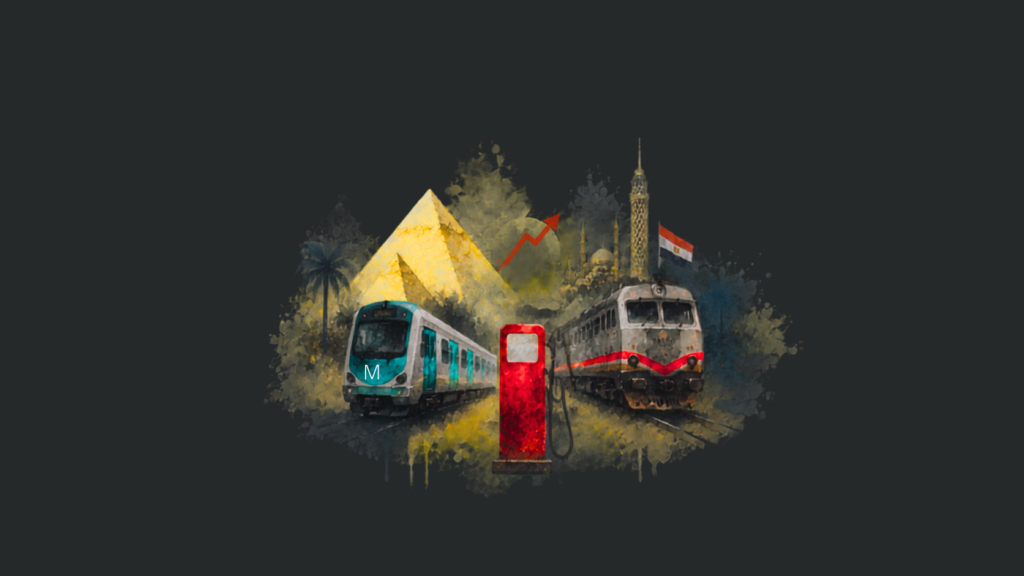

The Ministry of Transport recently approved a new increase in the prices of railway train and metro tickets, at a rate of 25%, less than two weeks after fuel prices were raised by 30% in the wake of the repercussions of the escalating war between the United States, Israel and Iran.
The decision provoked widespread discontent, as it coincides with doubled economic pressures on Egyptians resulting from rising energy prices, while the government justified it as coming within a policy of “gradual repricing” of public transport services, in line with the continuous rise in operating costs, foremost among them fuel and electricity.
The ministry stated, in an official statement, that it was raising metro ticket prices to EGP 10 for up to 9 stations instead of EGP 8 (an increase of 25%), and EGP 12 for up to 16 stations instead of EGP 10 (an increase of 20%), while keeping the price at EGP 15 for up to 23 stations, and EGP 20 for longer journeys.
Ticket price before and after the 27 March 2026 increase, by number of stations, with the rise in brackets
| Number of stations | Before | After |
|---|---|---|
| Up to 9 stations (+25%) | 8 | 10 |
| Up to 16 stations (+20%) | 10 | 12 |
| Up to 23 stations (unchanged) | 15 | 15 |
| More than 23 stations (unchanged) | 20 | 20 |
As for the railways, it was decided to raise train ticket prices by 12.5% for long-distance lines and 25% for short lines, with the increases directed more heavily towards air-conditioned trains and higher travel classes, against limited increases on third-class trains, on which a broad segment of citizens in the various governorates relies.
In a statement that, according to observers, added to the discontent, Lieutenant General Kamel El-Wazir, Minister of Transport and Communications, ruled out the possibility of reducing ticket prices if the price of fuel falls, stressing that this will not happen in sectors that already suffer from a financial deficit in covering their operating needs, and pointing out in televised statements that the other scheduled increases may be extended to a later period.
According to press reports, the government seeks to collect an additional EGP 3 billion during the next fiscal year (2026-2027), as the recent increases aim to achieve additional revenues estimated at EGP 2 billion, bringing them to EGP 12 billion, compared with EGP 9.5 billion in the last fiscal year. The revenues of the National Authority for Tunnels are also expected to rise by about an additional EGP 1 billion, to record EGP 6.5 billion by the end of the year, compared with EGP 5 billion and 800 million in the previous fiscal year, in addition to raising revenues in the sleeping-car sector, amounting to about EGP 1.8 billion.
Anger in parliament
In the first parliamentary move, MP Maha Abdel Nasser, a member of the House of Representatives for the Egyptian Social Democratic Party, submitted an urgent statement to the Prime Minister and the Minister of Petroleum on 27 March regarding the new increase in railway and metro ticket prices, stressing that it comes at a time of economic pressure and noting that metro ticket prices have seen large cumulative increases since 2014.
The MP said that the metro represents the main means of transport for millions of citizens, and that any increase in its prices is reflected directly in the cost of daily living. Despite acknowledging the existence of economic challenges and the rise in operating costs globally, she questioned, in her statement, the continued loading of the greatest burden onto the citizen without sufficient protection.
She also criticised the repeated reliance on raising prices without clear social protection policies, considering that alternatives such as subscriptions are not sufficient, and called for a review of the current approach and for striking a balance between economic reform and citizens' ability to bear the burdens.
MP Freddy El-Bayadi, a member of the House of Representatives and deputy head of the Egyptian Social Democratic Party, agrees with her, as he considers that the recent increases come within the framework of a continuing government approach of gradually lifting subsidies, and do not stem solely from the impact of global energy prices.
El-Bayadi tells Zawia3: "The state does not bear part of the burdens; rather, it transfers the cost entirely to citizens, amid the absence of clear information about the size of fuel stocks or the actual operating cost. The absence of transparency represents a major crisis, and there are no accurate data on the budgets and operating costs of public transport facilities," noting that MPs submitted requests for briefing demanding that the information be made available, especially in light of the regional developments, but they received no response.
El-Bayadi believes that social protection programmes are not commensurate with the scale of the successive price increases, noting that the effects of these policies are clearly reflected in the erosion of the middle class and the increased pressure on lower-income groups, in the absence of sufficient compensatory measures to confront the high inflation rates.
El-Bayadi points out that a number of MPs have repeatedly demanded feasibility studies for road and transport projects to determine the extent of the benefit expected from these projects, and that they recently rejected some loans because of the lack of sufficient data on their economic and social feasibility.
The total loans obtained by the Ministry of Transport to implement a number of national projects, up to March 2026, amount to about $18 billion, according to televised statements by the Minister of Transport, Kamel El-Wazir, who explained that the loans will be directed to the railway and metro authorities only, and that the last loans the ministry will resort to will be for the high-speed train and the sixth metro line.
MP Sanaa El-Saeed, a member of the House of Representatives, does not consider the adjustment of transport prices in Egypt to be a direct result of regional tensions, but attributes it instead to the state's gradual orientation towards abolishing energy subsidies, which leads to raising prices on citizens, stressing that freezing citizens' salaries in the face of a continuous rise in prices places families under increasing economic pressures, to the extent that the middle-class segment is almost eroded, while poverty rates are rising.
She tells Zawia3: "The rise in prices includes all basic services, including public transport, electricity, water and the butane gas cylinder, and these increases exhaust citizens without a clear vision for balancing their effect on purchasing power, while any policy of raising prices must be backed by a complete social study of citizens' economic conditions, with prices being fixed or salaries raised in proportion to the rise in costs."
The MP believes that the increase in transport prices will lead to a large rise in inflation rates and will negatively affect families' purchasing power, and that the continuation of these policies will make the ordinary citizen the main casualty, noting that state support for transport should be concentrated on the groups most in need, instead of the ordinary citizen bearing the consequences of any contradiction between government decisions and plans.
A historic increase
Since the opening of the metro on 27 September 1987, its operation relied on a symbolic, uniform price, with a ticket price of 10 piastres, which saw slight increases over two decades, ranging from 25 piastres to 75 piastres in 2002, and reaching one pound in 2006 for any number of stations, from Helwan to El-Marg or along the second line, until March 2017, when it was decided to raise prices for the first time to EGP 2, after which an entirely new stage of pricing based on the number of stations and zones began, as the Ministry of Transport divided metro stations in 2018 into zones that differ in their pricing, which rose to EGP 3 for 9 stations, five pounds for 16 stations and more, and EGP 7 for 16 stations.
With the start of operation of the third metro line in June 2019, ticket prices rose in the first zone, of 9 stations, to EGP 5, and in the second zone, of 16 stations, to EGP 7, while for anything beyond that the ticket price was ten pounds, and the ticket for the first and second lines remained fixed.
In 2020, the Tunnels Authority, which owns the metro, was transformed from a service authority into a profit-oriented economic authority with a budget independent of the state's general budget, in a way that allows it to invest its funds through activities that cover the costs of expenditure and maintenance outside the state budget. Price increases then followed, ranging in 2020 from EGP 3 to 7 for the first tier and from EGP 5 to 10 for the second tier, with increase rates of 40 to 67%.
After each increase
| Year | Lowest price | Highest price |
|---|---|---|
| 1987 | 0.1 | 0.1 |
| 2002 | 0.25 | 0.75 |
| 2006 | 1 | 1 |
| 2017 | 2 | 2 |
| 2018 | 3 | 7 |
| 2019 | 5 | 10 |
| 2020 | 3 | 10 |
| 2024 (Jan) | 6 | 15 |
| 2024 (Aug) | 8 | 20 |
| 2026 (Mar) | 10 | 20 |
In March 2022, the National Authority for Tunnels acquired 51% of the shares of the Egyptian Company for the Management and Operation of the Cairo Metro, and during 2024 the ministry raised the metro ticket price twice, the first in January, to range between EGP 6 for a single zone and EGP 15 for more than 23 stations, and in August of the same year ticket prices increased to EGP 8 for a single zone and up to EGP 20 as the highest ticket price. These prices remained in force throughout 2025: EGP 8 for up to 9 stations, EGP 10 for up to 16 stations, EGP 15 for up to 23 stations and EGP 20 for more than 23 stations.
On 27 March, the Ministry of Transport raised ticket prices for up to 9 stations to EGP 10 instead of EGP 8, and increased the ticket price for up to 16 stations to EGP 12 instead of EGP 10, while keeping the ticket prices for the larger numbers of stations unchanged.
The waves of ticket price increases were not confined to the metro alone; they also extended to railway trains, as train ticket prices in Egypt, especially for long-distance journeys and Lower Egypt, saw accelerating increases over the last decade, with notable jumps in first-class prices on air-conditioned and luxury trains.
The Egyptian government approved an increase in air-conditioned train ticket prices starting from July 2015, by EGP 20 for first class and EGP 10 for second class for full journeys, and in April 2016 prices rose again, by as much as 100%, bringing the ticket for a passenger from Aswan to Cairo and vice versa to EGP 135 instead of EGP 67, before rising again in August 2024 by rates ranging between 12.5% and 25% to cover all lines. Finally, the Transport Ministry approved a new increase of 12.5% for long-distance lines and 25% for short lines.
For long journeys on the (Cairo – Aswan) line, first-class prices on the Spanish train rose from about EGP 80 in 2016 to EGP 200 in 2024, while first-class train prices jumped from EGP 145 in 2016 to about EGP 335 in 2024, before rising again after the latest increase in March 2026 to reach EGP 430.
As for the Russian trains, which entered service for the first time in July 2020 at relatively lower prices, these ranged at their launch between EGP 25 and EGP 50 for medium-distance journeys, and rose during the same year to reach EGP 130 to Aswan, with an increase ranging between 25% and 83 % for the air-conditioned trains.
In 2024, the first-class price jumped to EGP 335, and the ordinary Spanish train to about EGP 200, before further increases in March 2026 of 12.5%, bringing the price of a first-class ticket on the Cairo - Aswan train to EGP 430, and second class to EGP 280.
As for first-class tickets on the luxury-service "Talgo" trains, on the Cairo/Alexandria line, they stood in 2022 at about EGP 150 to 200, and in January 2026 first-class prices stood at EGP 350 instead of EGP 275, while the second-class ticket recorded EGP 750 instead of EGP 550.
Last March they rose to EGP 400 for first class and 275 for second class, while the price of a ticket on the Cairo/Aswan line ranged between EGP 500-700 in 2016, and it rose to EGP 1,000 for first class and EGP 750 for second class in March 2026.
Doubled pressures
The adjustment of metro and railway ticket prices came less than a month after the increase in public and private transport fares in the public and mass transport sector across Egypt's various governorates, as Cairo Governorate announced, on 10 March, that the fares of a number of mass transport lines had been amended, with the increases ranging between one pound and three pounds depending on the type of line and the distance, and the fare of the ordinary minibus rose from EGP 18 to EGP 19, while the fare of the air-conditioned minibus increased from EGP 22 to EGP 25.
Likewise, some large bus lines saw increases ranging between two and three pounds, especially the lines connecting Cairo with the neighbouring governorates, and in other governorates such as Gharbia, Menoufia and Suez, the local administrations announced that boards containing the new fares would be posted at the stations, with increases ranging on average between 10% and 20% in bus and mass transport prices.
In the private transport sector, the fares of service vehicles and taxis rose by varying rates ranging between 15% and 20% depending on the routes and distances; in Cairo, the fares of some internal service lines increased by about EGP 2 to 5 per trip, and the white taxi fare was amended, as the meter-opening price rose from EGP 11 to EGP 13, and the price per kilometre from EGP 5 to EGP 6.
The latest increases in transport prices came after the Egyptian government's announcement, on 10 March, that it was raising the prices of a number of petroleum products and natural gas for vehicles, for the third time within a year.
Dr Mohamed Saad El-Din, an energy expert and deputy chairman of the board of the Chamber of Petroleum and Mining, explains that the impact of the fuel price increase on the cost of transport is not at the same rate as the announced increase, as fuel represents a limited part of the total operating cost, which also includes maintenance, depreciation and labour wages, indicating that the logical increase in transport fares should be calculated according to fuel's share of the total cost, while reality shows that some of the increases applied go beyond this framework and do not accurately reflect the actual rates of increase in the cost elements.
He tells Zawia3 that "separating the operating cost of means of transport from fluctuations in energy prices is possible if the state intervenes through subsidy mechanisms, so that it bears part of the increase instead of loading it entirely onto the consumer."
The deputy chairman of the board of the Chamber of Petroleum believes that the current increases in fuel prices are temporary and are linked to exceptional factors, including geopolitical tensions, the global rise in oil prices, the dollar exchange rate, and shipping and insurance costs, noting that there is a historical gap between the cost of producing fuel and its local selling price, as a result of the continuation of subsidy policies for decades, which has made it difficult to reach fair pricing gradually, and this explains (in his view) the repeated increases in recent years.
For his part, Shehab Abu Zeid, policy adviser and programmes director at the "NADA Foundation for Safer Egyptian Roads", believes that the recent increases in fuel prices and the subsequent rise in the cost of transport come within the framework of a broader orientation of the state towards restructuring the economy and reducing public spending in exchange for maximising revenues, considering that linking them only to regional tensions contradicts the truth, as the deeper aim is to liberalise fuel prices so that they align with global prices, citing as evidence that the latest increase affected the various types of fuel by almost the same amount, despite the different nature of each product.
He tells Zawia3: "This orientation may be understandable from the perspective of the state's pursuit of fiscal balance, but it raises a fundamental problem related to the distribution of burdens, as the lower-income groups bear the largest share of the effects of these policies, being the largest segment of mass transport users, which makes them the most affected by rising prices," stressing that any economic reform must coincide with effective social protection policies that ensure that low-income groups do not bear the cost of economic transformations alone.
Abu Zeid stresses the need to strengthen transparency and accountability and to make available detailed information on the size of the losses announced by the transport authorities, their causes and the mechanisms by which they occurred, so as to allow an understanding of the decision-making paths or of the efficiency of operational management, noting that decisions often come in the form of final measures, such as raising ticket prices or expanding the involvement of the private sector, without sufficient discussion of the alternatives or of the roots of the problem.
Abu Zeid stresses that the shift towards an economic model based on free pricing and running utilities with a profit logic may be an option on the table, but in return it requires a strong social protection network that ensures that the majority of citizens are not harmed, especially under the current economic conditions.
Official data show that the revenues of the National Authority for Tunnels reached about EGP 3.166 billion in fiscal year (2021-2022), while the cost of activity amounted to about EGP 651 million, divided between wages worth EGP 193 million and fuel, raw materials and spare parts worth about EGP 458.2 million. The authority made profits of about EGP 2.515 billion, and in the year (2022-2023) the authority achieved a net profit of about EGP 3.536 billion, while in the year (2023-2024) profits approached EGP 3 billion, and its profits in fiscal year (2024-2025) amounted to EGP 4.350 billion.
Despite that, the authority faces financial losses that amounted to about EGP 1 billion and 300 million in fiscal year 2021-2022, according to Dr Tarek Gweily, its chairman of the board, while losses in the following year amounted to EGP 1.896 billion, against an increase in long-term liabilities and suppliers' dues to EGP 105.5 billion by fiscal year 2023-2024, an increase of EGP 31.2 billion over the previous year, according to media reports.
Meanwhile, the budget of the Cairo Public Transport Authority for 2025-2026 amounted to about EGP 6.423 billion, with costs and expenses of about EGP 4.068 billion, divided into EGP 2.378 billion for wages and EGP 1.690 billion for other expenses, against total revenues of EGP 3.585 billion, including EGP 1.881 billion in subsidies; losses were estimated at about EGP 482.7 million.
Increasing inflationary pressures
In this context, Dr Khaled El-Shafei, an economic expert and head of the Capital Centre for Economic Studies and Research, attributes the recent increases in transport prices to the overlap between the external pressures resulting from the global rise in fuel prices and the government policies linked to restructuring subsidies.
He expects the increases in transport and fuel prices to contribute to raising inflation rates in the coming period by between 5% and 10% at a minimum, which will be reflected directly in the erosion of families' purchasing power, especially given stagnant incomes, stressing that these conditions will lead to increasing living pressures on various groups, particularly the poor and middle classes, at a time when social protection programmes and the announced wage increases do not cover all groups.
He tells Zawia3: "Weak oversight of the private transport sector leads to uncontrolled price increases, while public transport pricing remains subject to the estimates of the government, which considers it the fair price, despite real doubts about the extent to which it matches the actual operating cost."
El-Shafei casts doubt on the continuation of the losses announced for the metro and railway sectors, stressing the need to review the facility's financial and administrative data, and considering that talk of losses in a vital facility serving millions of citizens daily may be linked to mismanagement or to weakness in maximising revenues, and not only to rising operating costs.
The economic expert calls for adopting a comprehensive economic vision based on strengthening local production, increasing exports, localising industries and reducing dependence on imports, in a way that contributes to reducing the budget deficit and the trade balance deficit and to achieving higher growth rates that are reflected positively in citizens' standard of living, instead of relying on raising prices as a main tool for dealing with economic challenges.
Meanwhile, the economic expert Zohdy El-Shamy, deputy head of the Socialist Popular Alliance Party, does not express surprise at the decisions to raise transport prices, explaining this by the fact that the government had intended to do so for some time, and noting that ticket prices on mass transport have seen unprecedented cumulative increases over the past ten years, exceeding citizens' purchasing power, describing this as "a method of levying" that does not take people's circumstances into account and is not accompanied by an adjustment of salaries or pensions commensurate with the rise in costs.
He warns of the repercussions of these policies on inflation rates and on the prices of goods and services, which leads to the erosion of families' purchasing power, explaining to Zawia3 that inflation over the past years has seen a continuous rise, and that the current situation leaves the citizen trapped between rising prices, frozen salaries and the falling value of the pound, which increases the economic pressures on the Egyptian family.
The annual inflation rate in Egypt's cities rose to 13.4% in February 2026, compared with 11.9% in January, driven by the increase in the prices of petroleum products and food, amid regional geopolitical pressures, and the monthly inflation rate reached 2.8%, while core inflation recorded about 3%.
Mohamed Ramadan, a researcher in the Social and Economic Justice Unit at the Egyptian Initiative for Personal Rights, explains that the transport item represents one of the basic components of Egyptian households' spending, especially as most citizens rely on means of transport to reach their places of work, which are often far from their place of residence, and any increase in this item leads to a redistribution of the household budget, through cutting spending on other basic needs such as food.
He explains to Zawia3 that these policies come within a broader framework of economic orientations that pass the impact of external shocks, such as the rise in oil prices, directly onto the local market, without sufficient mechanisms to absorb these shocks or mitigate their effect on citizens, stressing that this approach contributes to inflation remaining at high levels for longer periods, in what is known as sticky inflation, and will therefore exacerbate the pressures on the economy and on households.
He says: "The groups most affected by these increases include workers in the informal economy, who do not benefit from official wage increases, as well as a broad segment of the middle class with fixed incomes, as the rise in transport costs increases its share of total spending, at the expense of other items such as education and health."
He stresses that mass transport, foremost among it the metro, is a vital service for millions of citizens every day, and that maintaining its availability at appropriate prices should be a priority, given its role in supporting the movement of work and production, adding that "social protection programmes are insufficient to compensate for the growing gap between wages and the cost of living, given the decline in the real value of wages in recent years as a result of inflation and the change in the exchange rate."
He criticises the focus on addressing the crisis from a narrow fiscal perspective, through reducing public spending, instead of adopting comprehensive economic policies aimed at limiting the effects of inflation on the economy as a whole, noting that making citizens bear the cost of limited increases in support for public utilities, such as the metro, may lead to wider economic effects, including a rise in the cost of mobility and production, with a negative impact on economic activity.
The data reveal an upward trajectory linked to the policies of lifting subsidies and liberalising energy prices, which puts direct pressure on citizens' lives. While the government justifies these increases at times by rising operating costs and at others by international crises and regional turmoil, citizens bear the greater burden of the cost, without being covered by a parallel expansion in social protection programmes and packages.
Editorial correction: The first version of the report stated that the latest increase in train ticket prices took place in March 2027, whereas the correct date is March 2026, and it described fiscal year 2026-2027 as the current year, whereas it is in fact the next fiscal year.
Editorial correction: The first version of this report said a new increase in metro ticket prices was applied in 2025. The prices cited (EGP 8 to EGP 20) are those of the August 2024 increase, which remained in force until the increase of 27 March 2026, according to the Ministry of Transport statement.