

Repeated industrial accidents in Egypt are exposing the gap between occupational safety rules and conditions on the factory floor. Workers face dangerous equipment, inadequate protection and an inspection system that labour advocates say too often fails to prevent injury and death.
Among the latest cases was the death of three workers following a boiler accident at a spinning and weaving factory in El-Mahalla El-Kubra.
After the incident, the Center for Trade Union and Workers Services (CTUWS) called on the authorities responsible for occupational health and safety to review industrial inspections, enforce them rigorously and hold those responsible for negligence accountable.
MP Evelyn Matta, a member of parliament’s Industry Committee, submitted a request for a briefing addressed to the public enterprise minister, the head of the textile holding company and the factory’s executive director. She alleged failures in monitoring the boilers and asked that the matter be considered jointly by parliament’s industry and human rights committees.
On February 27, MP Abdel Moneim Emam also submitted a parliamentary question and briefing request to the public enterprise minister. He sought an explanation of the technical and administrative causes, the initial investigation findings and the body responsible for maintenance and equipment inspections at the power station.
Emam asked for corrective measures, immediate safeguards against another accident and a clear timetable for reassessing and upgrading critical equipment to meet safety standards. He also demanded accountability for any established negligence or breach of technical requirements.
Occupational safety cannot be treated as an optional precaution: the demands following the Mahalla accident concern both the condition of equipment and responsibility for maintaining it.
A law exists. Where is its enforcement?
Labour Law No. 12 of 2003, in force at the time of this report in March 2025, devotes its fifth book, Articles 202–231, to occupational safety, health and the working environment. Article 224 specifically addresses the specialist inspection apparatus; it is not the starting point of the entire safety framework.
The law requires protective measures, health checks and action against workplace hazards. It also gives inspectors powers to examine conditions, with provision for stopping machinery or closing a facility where an imminent danger threatens workers or the working environment.
Labour researcher Hassan El-Barbary tells Zawia3 that the central problem is implementation. He argues that regular inspections are missing and that, when visits occur, they can be formalities rather than effective scrutiny.
He says the Labour Ministry has cited a shortage of inspectors and notes cooperation between Egypt and the International Labour Organization (ILO) to improve inspection. In his assessment, however, the results on the ground remain inadequate.
El-Barbary also criticises employers who treat workers as cheap and replaceable labour. He argues that even established safety practices are poorly implemented, while responses to emerging risks, including extreme heat and climate-related hazards, lag behind.
International obligations reinforce the right to protection. Article 7 of the International Covenant on Economic, Social and Cultural Rights addresses safe and healthy working conditions, while Article 12 includes improvement of environmental and industrial hygiene.
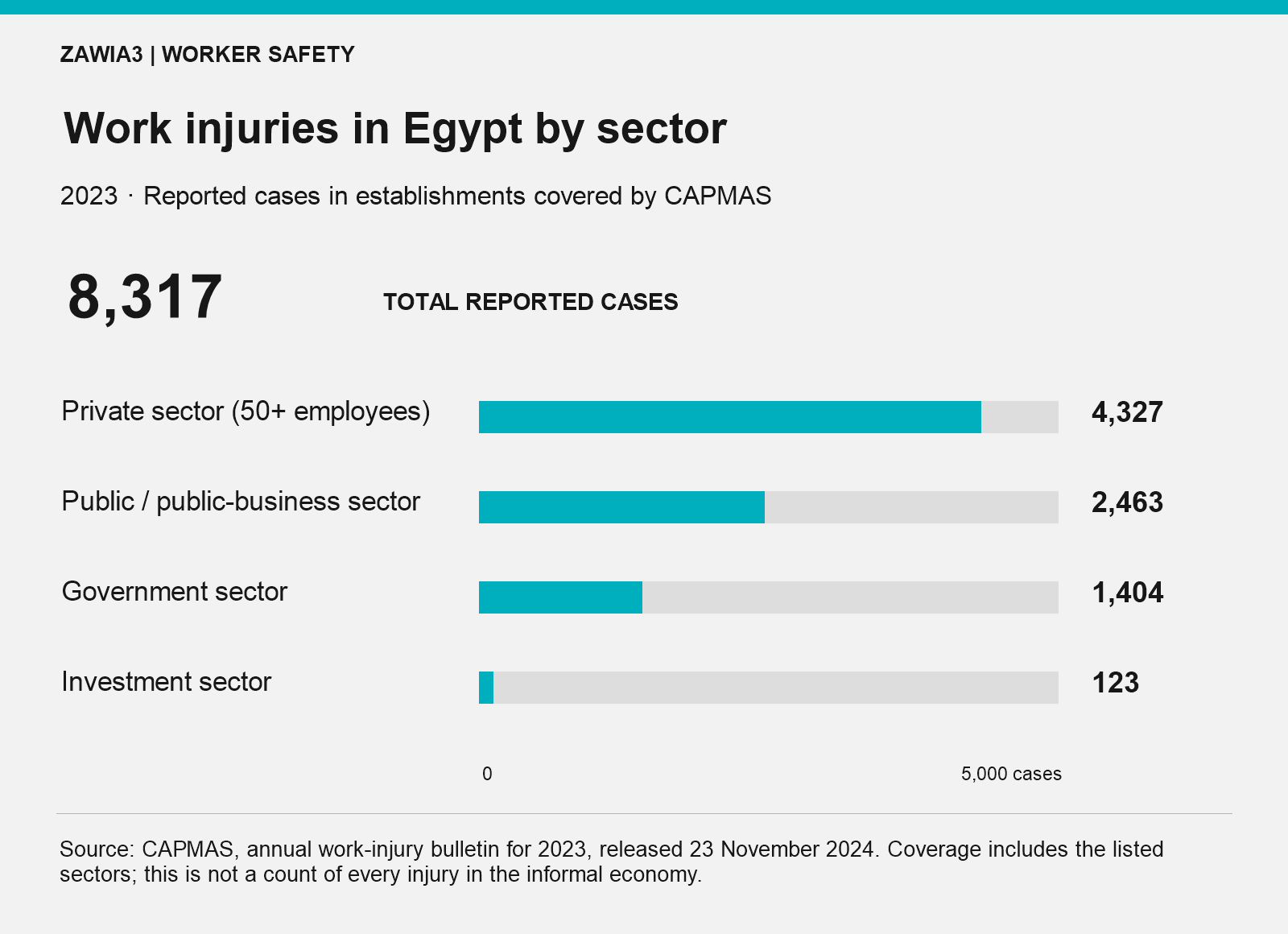
CAPMAS recorded 8,317 work injuries in 2023 in the establishments covered by its bulletin: 1,404 in government, 2,463 in the public and public-business sector, 4,327 in private establishments with at least 50 workers, and 123 in the investment sector. The figures cover those reporting categories and should not be read as a complete count of injuries throughout the informal economy.
Unions, training and the cost of neglect
The ILO’s guide to basic occupational safety and health principles describes responsibilities shared by governments, employers and workers’ representatives. Governments establish and enforce standards. Employers implement protective measures and provide suitable equipment and conditions, including ventilation and lighting. Unions help inform workers and participate in workplace safety committees.
Mona Ezzat, a researcher on economic and social rights, says attention to safety varies between industries. Food producers, she argues, can have a stronger incentive to comply because failures directly affect product quality.
In other industries, the immediate harm may fall more heavily on workers than on the finished product. She points to cement production, where protection against emissions, fumes and dust is costly. Factories not exposed to export requirements, she says, may have fewer incentives to improve protection, increasing the risk of occupational illness.
Ezzat also identifies ageing factories whose equipment has not been modernised. Where sale or privatisation is anticipated, she argues, investment in machinery and workers’ safety can be neglected, leaving employees exposed to more accidents.
Workers themselves may accept harsh conditions because they fear losing their jobs. She describes a combination of insecurity, limited ability to object and fatalistic attitudes that discourage demands for practical safeguards. Workplace protests tend to centre on wages and allowances rather than health and safety.
For Ezzat, unions are failing to provide enough education and training to help workers protect their health and demand safer conditions.
The neglected psychological dimension
A policy paper from the Egyptian Center for Economic and Social Rights, prepared by El-Barbary, examines the neglect of workers’ mental health in occupational safety policy.
It argues that economic and social pressures at work can undermine psychological wellbeing, with consequences for workers and the wider production process. Its critique is that legislation and policy concentrate on physical protection while giving inadequate attention to psychological risks.
Speaking to Zawia3, El-Barbary says labour, social insurance and health insurance frameworks fail to provide sufficient practical protection for workers’ mental health. He links severe pressure and the absence of adequate support to serious harm, including cases of suicide among workers. Suicide has multiple contributing factors; an individual death cannot be attributed to one workplace pressure alone.
He says some workers use medication, including unregulated substances, to continue working under pressure. He also argues that the recognition of work-related mental illness in occupational injury arrangements is inadequate.
Although the state established a Higher Advisory Council for Occupational Safety and Health and announced a national strategy, El-Barbary says he has seen little tangible effect on workers’ lives.
He criticises the punitive approach associated with Law No. 73 of 2021 on drug testing and employment eligibility. In his view, dismissing workers following drug-use findings, without sufficient attention to treatment and support, can deepen hardship rather than address its causes.
Loss of employment affects families as well as workers, he says, while stigma can prevent people from using their experience to find another job. He sees inadequate mental-health protection as a wider problem across the Arab region.
El-Barbary says an attempt during 2024 to collect information on workers’ psychological difficulties was hindered by scarce data and the difficulty of documenting conditions that are not recorded as occupational injuries.
Danger on the way to work and inside it
The accidents recorded in 2024 extended beyond factory gates. On February 25, a ferry accident killed 10 workers and injured five as they travelled to a water-station project. They had boarded a wooden ferry near Ezbet Rabie in Nekla, north of Giza.
On May 21, a minibus fell from a ferry crossing the Rayah El-Beheiri waterway at Abu Ghalib in Manshaat El-Qanater. Sixteen girls and young women were reported dead as they travelled to work at a fruit-export site.
On December 19, four workers died and two were injured in a sewage chamber at El-Mai village in Shebin El-Kom, Menoufia. Contemporary reports described workers being overcome while trying to help a colleague. A water-company source also gave a toll of four dead and two injured during maintenance work at the station.
Kamal Abbas, CTUWS’s general coordinator, distinguishes between accidents inside workplaces and those occurring during workers’ journeys. Among the latter, he cites the Matariya–Port Said bus crash, whose reported death toll reached 14.
Abbas attributes such risks to inadequately equipped transport and roads, alongside recurrent ferry accidents. Vessels intended for goods or livestock are used to carry workers, he says, including informal workers and children.
He criticises the contrast between heavy investment in bridges and inadequate attention to making ferries safer.
Inside factories, he identifies fires, explosions, gas leaks and machinery accidents. The problem, he argues, is not simply a lack of legislation: employers may fail to provide protective equipment, while some workers do not use equipment that is available.
“There is a law and a body responsible for occupational safety and health, but the problem is that these laws are not being implemented,” Abbas says.
He describes shortcomings both in management’s application of safety standards and in workers’ use of protection. The requirement for periodic medical examinations, he argues, also suffers from weak enforcement.
Unlicensed workshops and informal factories present another challenge. Abbas says serious hazards there often become visible only after a major fatal accident. He calls for stronger attention to pollution affecting both employees and neighbouring residents, and criticises what he considers insufficient intervention by environmental authorities.
CTUWS’s 2024 report on violations of trade-union freedoms reaches a similar conclusion: legal protections remain ineffective without sustained oversight. It describes workers facing unhealthy conditions and dangerous commutes, and calls for practical protection both inside workplaces and along the routes workers must take to reach them.