A decision by Cairo Court of Appeal president Mohamed Nasr Sayed to increase charges for court and digitised services has provoked a confrontation with Egypt’s lawyers. Issued on February 20 and implemented from March 1, 2025, the decision has drawn objections that it breaches the Constitution, existing legislation and Egypt’s commitments to equal access to justice.
Lawyers have announced a legal challenge invoking Article 114 of the Penal Code against Prime Minister Mostafa Madbouly, Justice Minister Adnan Fangary and court presidents responsible for the increases. The provision concerns public officials who knowingly demand or collect taxes, fees or similar payments that are not due, or exceed the amount legally payable. The offence is commonly called “ghadr” in Arabic: unlawful exaction by a public official, rather than political treason.
The original reporting describes both a direct criminal complaint and preparations to bring it. Without a case number or filing document establishing its procedural status, the challenge should be understood here as the lawyers’ announced action. Their allegation does not establish that any official has committed an offence or that a court has accepted the claim.
The Lawyers Syndicate has responded by suspending dealings with court cash offices and threatening a broader boycott. Its members argue that higher charges risk turning access to courts into a service reserved for people who can afford it.
Zawia3 obtained a schedule covering 38 court and digitised services affected by the increases. These include adding enforcement wording to judgments, filing appeals, restoring struck-out proceedings, resuming stayed cases, amending the form of an appeal, joining parties and serving or re-serving court documents.
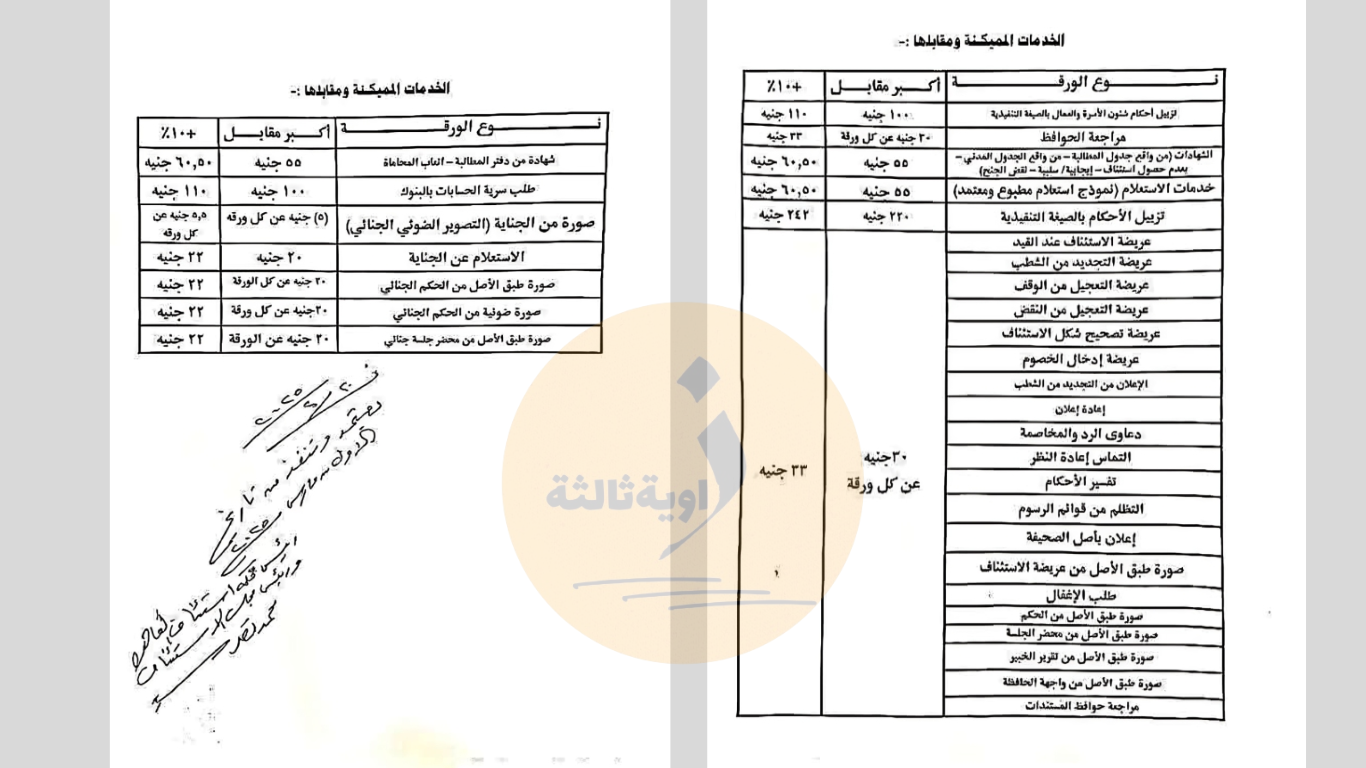
The schedule also covers certificates confirming whether an appeal has been filed, positive and negative certificates, searches of civil-court registers, copies of criminal judgments, certified copies of hearing minutes and expert reports, criminal-case searches and photocopying. Other entries concern applications relating to confidential bank-account information, lawyers’ fees, document-file checks and objections to fee assessments.
The dispute is not only about how much courts charge. Lawyers are also challenging whether the authorities issuing the charges have a lawful basis for doing so.
Earlier judgments have struck down particular charges. A Supreme Administrative Court ruling reported on December 23, 2023 upheld the cancellation of a decision by the Mansoura Court of Appeal president imposing scanning or digitisation fees on appeal petitions in personal-status cases.
A separate report published on January 6, 2022 described a ruling by the sixth civil circuit of Cairo’s Court of Appeal cancelling a judicial-fee assessment for lack of a legal basis. That dispute concerned the basis for imposing the fees, not merely their amount. These judgments relate to specific decisions and assessments; they should not be read as a blanket cancellation of every court fee.
Lawyers suspend dealings with court cash offices
The Egyptian Lawyers Syndicate announced that its members would stop dealing with court cash offices at all levels across the country in protest at the increases.
The decision followed an emergency meeting on March 8 attended by syndicate president and Arab Lawyers Union head Abdel Halim Allam, members of the national board and heads of local branches. They discussed increases covering 38 services under the heading “service charges”, which they described as unprecedented.
In its statement, the syndicate argued that the decisions exceeded constitutional and legal limits on the imposition of fees and infringed the right of all citizens to litigate without discrimination.
The meeting instructed Allam to contact the responsible authorities to seek a resolution. The national board and branch heads remained in continuous session until a substantive solution could be reached.
A financial barrier to justice
Mohamed Nagy Derbala, a former deputy president of the Court of Cassation, tells Zawia3 that the decisions are defective and violate constitutional principles. He points to Article 97, which protects the right to litigate and requires the state to bring judicial bodies closer to citizens and facilitate procedures.
In his assessment, the increased charges create a substantial financial barrier between people and the judge entitled to hear their case. He also invokes Article 53’s protection of equality before the law, arguing that excessive costs discriminate between citizens on the basis of means.
Derbala warns that people priced out of courts may turn to other ways of settling disputes. He calls for the decisions to be reversed and for attention to shift toward judicial independence and easier access to justice.
Nasser Amin, head of the Arab Center for the Independence of the Judiciary and the Legal Profession, describes the increases as an unprecedented violation of the law and Constitution. He characterises collection under the disputed decisions as unlawful exaction and says the centre is preparing a direct criminal complaint under Article 114.
Amin fears that rising charges will entrench a two-tier system of justice: people with money can pursue their claims, while poorer citizens are discouraged from approaching a court at all.
He views the increases as part of a policy, extending back around a decade, through which the state has withdrawn from obligations to provide essential services. He argues that access to justice must not be obstructed by unaffordable financial demands.
The constitutional position requires a distinction. Article 38 distinguishes taxes imposed by law from other taxes and fees payable within the limits of the law. Articles 53 and 97 protect equality and access to courts. These provisions do not themselves establish that every judicial service must be free; the dispute concerns legal authority, the level of the charges and their effect on access.
International-law lecturer Mohamed Mahmoud Mahran likewise argues that such high charges conflict with Egypt’s constitutional and international commitments. He invokes Article 14 of the International Covenant on Civil and Political Rights, which safeguards equality before courts and fair proceedings.
The UN Human Rights Committee’s General Comment No. 32 explains that fees which effectively prevent access to justice can raise issues under Article 14. This is a protection against barriers to effective access, rather than a general rule abolishing every court fee.
Mahran criticises the expanding use of “service charges”. He says copying the papers in some cases has cost more than EGP 8,000, while fee assessments in other disputes have reached millions of pounds and led to attachment measures against people unable to pay. These are examples he cites, not uniform tariffs applicable to every case.
He expects higher costs to deter litigation and encourage alternative dispute-resolution routes, including some outside the law. He also points to private arbitration, which he says has become less costly in some cases. The relative cost of arbitration depends on the dispute and procedure; it is not necessarily cheaper for every claimant.
Ahmed Helmy, a lawyer practising before the Court of Cassation and Supreme Constitutional Court who has defended hundreds of defendants in political and terrorism-related cases, says the increases could make work on large cases extremely difficult.
Some terrorism-case files run to thousands of pages, he explains, placing photocopying alone in the tens of thousands of pounds before other charges are considered. He questions how defendants’ families can afford these demands.
Helmy says some law firms have already begun declining new cases. He says he has decided to stop taking civil and commercial work and concentrate on finishing his remaining Supreme State Security cases before retiring. He fears proceedings will increasingly depend on court-appointed lawyers or become accessible in practice only to those with financial resources.
Where is the promised improvement?
Human-rights lawyer Mohamed Afifi challenges the claim that higher charges have improved the justice system. He says that despite fee increases over roughly a decade, services for litigants, lawyers and court staff have not noticeably improved.
He describes people waiting in poorly equipped corridors and courtrooms lacking basic facilities. Even if improving services were accepted as a justification, he asks, what improvements have actually been delivered?
Afifi argues that court presidents should not impose administrative charges without a lawful basis. If courts need additional resources, he says, the Ministry of Justice should seek budget allocations through the Finance Ministry and Parliament instead of transferring the burden directly to litigants.
Afifi asks why litigants are paying more when, in his account, the conditions they encounter in court remain unchanged.
He also cites fees that can reach 7.5% of the value of disputed land or property, describing them as a heavy burden. The percentage is his account of particular assessments and should not be treated as a single rate applying to all property litigation.
He warns that high costs, combined with lengthy proceedings, may push poor and middle-income litigants toward customary councils, tribal settlements or force rather than formal legal remedies.
Omnia Hassouna, who also practises before the Court of Cassation and Supreme Constitutional Court, says the decisions ignore citizens’ difficult financial circumstances. She fears a parallel system of justice will expand as litigants seek cheaper alternatives.
Lawyers are complying with their syndicate’s decision to stop dealing with court cash offices, she says, but clients feel the immediate effects. Some have already abandoned plans to file cases because they cannot afford the fees and have asked her to look for other ways to recover their rights.
One litigant tells Zawia3 that he was asked to pay judicial fees equivalent to 20% of the value of a disputed residential unit even after he and the company opposing him reached a settlement and both withdrew their claims. He says he challenged the fee assessment.
He fears that failure to pay could lead to attachment of his property by the authorities, rather than by the opposing company. His testimony concerns his individual assessment; Zawia3’s account does not establish that 20% is a general fee for residential-property disputes.
A confrontation without a resolution
A Lawyers Syndicate board member, speaking on condition of anonymity, says the syndicate will escalate its action if the increases are not withdrawn.
Allam has begun discussions with judicial leaders and other state officials, the board member says. With the board in continuous session, options include a wider court boycott and suspension of lawyers’ work. The member describes the charges as damaging to both legal practice and the wider justice system.
A senior judicial source at Cairo’s Court of Appeal offers a different explanation. Speaking to Zawia3, the source says general price increases have created new financial pressures that make additional revenue necessary.
Courts receive daily requests for copies of case papers, certificates and other documents, the source says, and meeting that demand costs millions of pounds each month. In the source’s view, court budgets cannot absorb the entire expense without charging users.
The source notes that other state institutions charge for services and argues that courts are no exception. Fees, the source says, help cover costs, maintain regular provision and manage demand. Removing or reducing them could place further pressure on courts’ ability to respond to litigants and lawyers.
The judicial source presents the increases as necessary to sustain services. Lawyers interviewed by Zawia3 dispute their legal basis and warn that the cost is excluding the people those services are meant to serve.
The confrontation leaves several possible outcomes. Authorities could amend or withdraw some charges under pressure, legal challenges could lead to decisions cancelling particular measures, or the dispute could develop into a prolonged standoff.
Further strikes or sit-ins by lawyers could increase pressure for a settlement. Alternatively, maintaining the charges may deepen public reluctance to litigate. A complete withdrawal remains among the syndicate’s demands.
At the time of publication, the central question remained unresolved: how can the courts finance their work while ensuring that citizens’ ability to pursue a legal right does not depend on their ability to meet an unaffordable bill?