


For four years, Amani Abd El-Rahman (a pseudonym) never missed a day of work at the afforestation department of the Ministry of Agriculture in Fayoum Governorate, leaving her three children behind each morning and walking long distances to save on tuk-tuk fares, paying 25 Egyptian pounds in minibus fares to and from her government job — the job for which she has received no salary since 2022.
Amani joined the afforestation department of the Ministry of Agriculture in 1995 as a trainee on a temporary contract, earning 45 Egyptian pounds per month at the time, with the hope of securing permanent appointment — a hope that went unrealized over the course of thirty years.
Following the January revolution, her hopes and those of her colleagues were rekindled when former Agriculture Minister Dr. Ayman Farid Abu Hadid issued Ministerial Decree No. 702 of 2011, to permanently appoint workers on temporary contracts in the Central Administration for Afforestation, Environment, Seeds, and Financial Affairs. However, the decree was implemented only for a limited number of workers.
The following year, Law No. 19 of 2012 on the Civil Service System was issued, which permitted the permanent appointment of temporary and seasonal labor (under Budget Chapter One: Wages) and the regularization of cases of employees who had obtained higher qualifications while in service. That law, too, was not implemented.
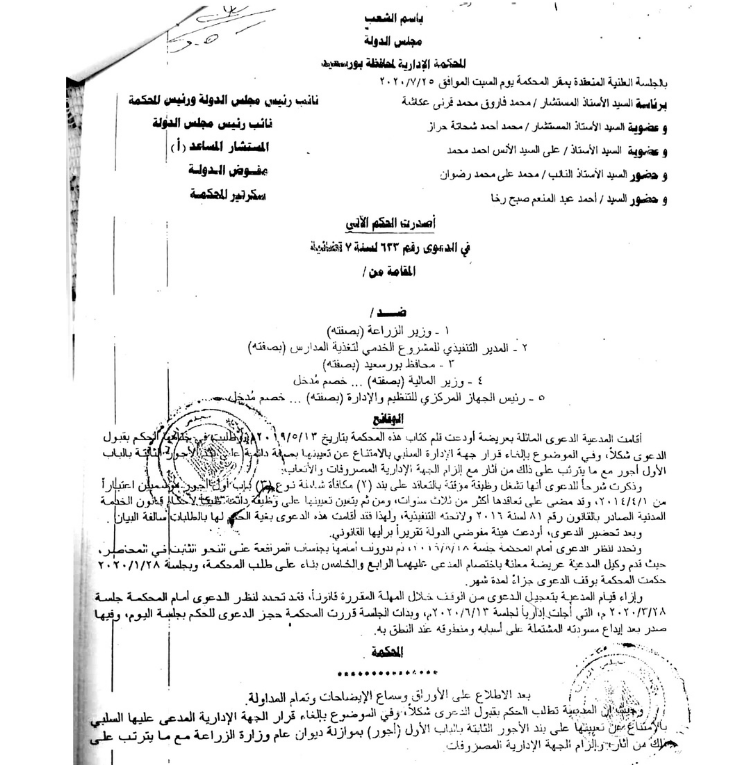
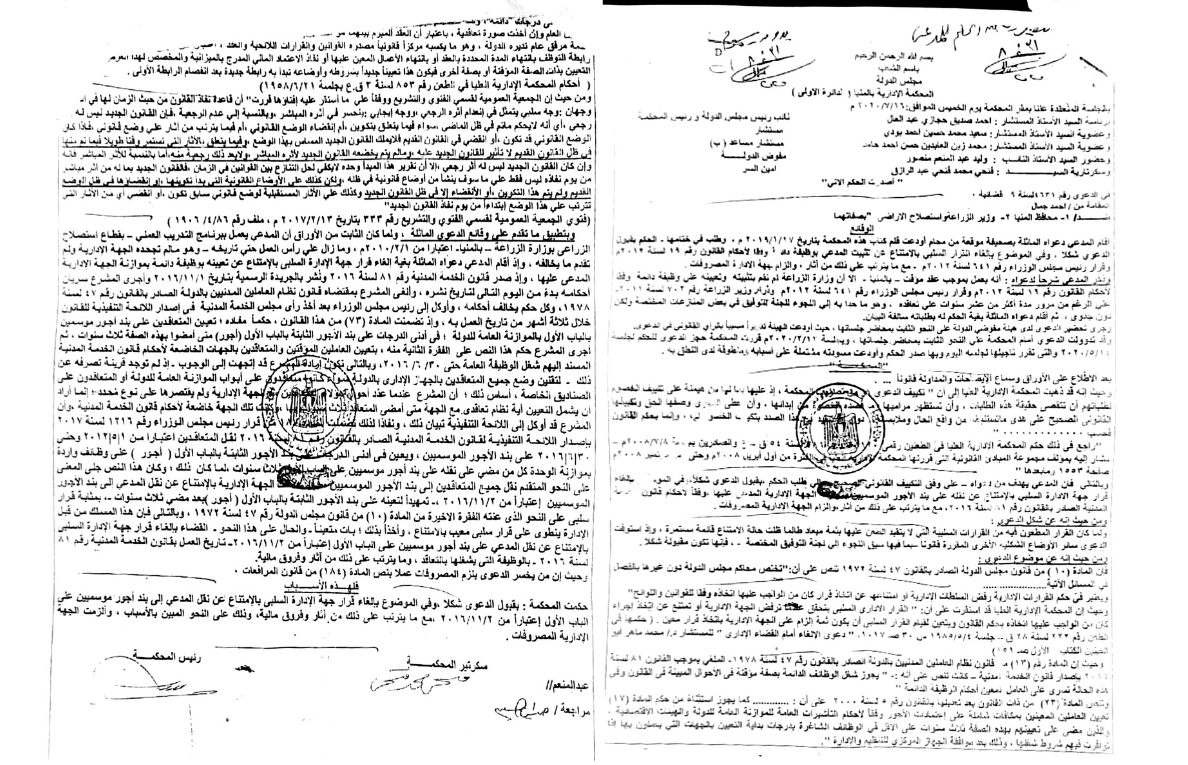
A legal opinion issued by the General Assembly of the Fatwa and Legislation Sections in 2021 also mandated the implementation of rulings issued in favor of certain trainees who had joined the Ministry of Agriculture and Land Reclamation on training contracts, recognizing their right to permanent appointment on permanent grades under the fixed wages line, along with all resulting entitlements. That opinion came after Amani and a number of her colleagues had resorted to litigation.
Amani is not alone. More than 3,000 employees across various sectors within the Ministry of Agriculture share her plight, according to sources who spoke with us, despite a number of them having obtained final court rulings ordering their appointment in 2022.
Amani recalls how she and her fellow temporary workers had, over the years, become the backbone of operations after many veteran employees were retired — taking on the management of offices and agricultural cooperatives, overseeing work, handling safes and equipment, and bearing daily responsibilities and accountabilities, all while their salaries were delayed for nearly four years.
She told Zawia3: “We have been working at the ministry since the nineties and endured years of struggle until we obtained court rulings for our appointment, but we are now facing a crisis of unpaid entitlements — responsibility for which is shared between the Ministry of Agriculture, the Ministry of Finance, and the Central Agency for Organization and Administration. We have received repeated promises of inclusion in the budget or of imminent financial release, none of which has materialized, and we are afraid to stop coming to work for fear of being dismissed,” calling for urgent intervention by the responsible authorities to resolve the matter.
The situation differs slightly for agricultural engineer Ahmed Gamal, who works at an agricultural cooperative in Minya Governorate. He began working on a daily-wage basis in 2010, before the Ministry of Agriculture contracted him on a temporary contract in 2013 that lasted until 2020, during which he received a monthly allowance of just 500 Egyptian pounds, with no prospect of permanent appointment in sight — prompting him to file a lawsuit demanding his right to permanent status.
In 2021, a ruling was issued in Ahmed’s favor, granting him an official appointment decree at the third specialist grade as an agricultural specialist. Despite this, his salary was suspended for a full year after the ruling was issued, before a monthly advance of 2,000 Egyptian pounds from his withheld salary was disbursed to him starting in 2022, pending financial release — despite the minimum expected for his position being approximately 8,000 Egyptian pounds — and he has yet to be enrolled in the social insurance system.
He told Zawia3: “I oversee agricultural areas of thousands of feddans and collect daily amounts that can reach one million Egyptian pounds, yet I receive no salary and no social insurance rights. This has forced me to look for additional income sources, so I work irregularly as a supervisor on private farms to cover living expenses. I am married, support three children, and live in a rented home — and that work is seasonal and does not provide sufficient income.”
He notes that the crisis extends beyond wages to the absence of promotions, bonuses, and insurance, explaining that despite his entitlement to advancement to higher grades given his years of service and academic qualifications, he has received none of these rights to date, despite filing several complaints with official bodies, including the Cabinet.
The crisis of temporary workers at the Ministry of Agriculture stretches back decades, with thousands of employees having worked since the 1990s across 14 departments within the ministry, including seed testing and certification, seed production, afforestation, agrarian reform, agricultural cooperation and extension — all of which have branches across the country. For many years they received meager wages from special funds despite performing duties identical to those of permanent employees, until the Civil Service Law opened a legal avenue for them to demand permanent appointment through the courts, as explained by Salma Ahmed, an employee at the Ministry of Agriculture.
She told Zawia3: “Some of us have already obtained court rulings for transfer to Budget Chapter One wages, but the implementation of these rulings has faced prolonged delays reaching, in most cases, two to three years — except for a limited number of no more than 50 to 60 employees who managed to receive full salaries after implementation of rulings in 2021 and 2022, while the rest continue to work without real pay, despite formally receiving their appointments at grades such as the third specialist or fourth grade.”
She adds that most employees receive nothing more than a “grade incentive” of no more than 300 Egyptian pounds per month, compared to salaries of 6,000 to 7,000 Egyptian pounds received by their counterparts permanently appointed at the same grades.
In response, some administrations have attempted to partially ease the crisis — such as the Agrarian Reform Department, which provides temporary advances of 2,000 Egyptian pounds per month to workers pending the arrangement of their salaries. However, this remains an isolated case covering only small numbers of employees, while other departments rely on disbursing intermittent bonuses not exceeding 1,000 Egyptian pounds per month — amounts that cannot be considered a regular salary, in her description.
She points out that before receiving their appointments, workers earned a monthly income of between 700 and 800 Egyptian pounds as temporary employees, along with some incentives — but after their judicial appointment, they found themselves in a worse position, working as official employees without real pay while bearing commuting and living expenses. She attributes the worsening of the crisis to overlapping responsibilities between the Ministries of Agriculture and Finance and the Central Agency for Organization and Administration, with each body shifting responsibility to the other, resulting in the suspension of salary payments for years despite the submission of paperwork and the completion of procedures.
She reveals that a number of those affected have been compelled to file new lawsuits demanding their right to receive salaries retroactively, while others are still waiting for their rulings to be implemented or even to formally assume their positions — amid fears that these rulings may lapse with the passage of time — calling for urgent and decisive intervention to clarify the situation and disburse entitlements.
Mahmoud Mohamed, one of the temporary contract workers at the Ministry of Agriculture, explains that ministry officials justified the non-payment of salaries to workers who had obtained court rulings and assumed their posts by citing the absence of a “financial release,” while Finance Ministry employees told them that the procedural delays originated with the ministry itself, while the Central Agency for Organization and Administration assured them that it had fulfilled all required procedures.
He told Zawia3: “Some of those who obtained court rulings have not yet been able to assume their posts, on the grounds that implementation is not feasible. Meanwhile, multiple forms of contracting continue, including daily labor known as ‘serky’ and training contracts, particularly in sectors such as afforestation and seeds.”
He adds that the crisis has persisted for more than three decades and spans multiple sectors within the Ministry of Agriculture, including seeds, afforestation, and food processing factories, noting that some workers who have obtained rulings are being distributed across various ministry departments while temporary bonuses are paid in some directorates, to be deducted later when official salaries are released.
He affirms that the living conditions of workers are becoming increasingly difficult amid rising living costs and the absence of stable income, along with bearing the cost of daily commutes without real compensation, in addition to the financial burdens associated with litigation procedures — a situation that demands decisive intervention to ensure the implementation of rulings and the payment of entitlements to those who are owed them.
Protests and Rights Condemnation
In an escalatory step, dozens of Ministry of Agriculture employees staged a protest sit-in on June 23rd outside the ministry’s headquarters in Giza Governorate, demanding payment of their salaries, which have been suspended for years.
The Egyptian Commission for Rights and Freedoms confirmed that it had documented complaints from various sectors within the Ministry of Agriculture and Land Reclamation, revealing the continued employment of workers without payment of wages — in some cases for more than five years — to fill human resource shortfalls in ministry departments and agricultural cooperatives.
The Commission stated in a statement that this situation does not merely represent a violation of the right to wages, but reflects the cost of administrative failure being borne by workers and their families, which also affects the efficiency of agricultural services provided to farmers.
It considered that the failure to implement court rulings, or the citing of insufficient financial allocations, does not justify depriving workers of their entitlements, warning of the erosion of the rule of law and employment stability.
The Commission called for immediate implementation of court rulings, payment of overdue salaries retroactively, investigation into the reasons behind the obstruction of implementation, the development of a plan to address staffing shortfalls, and guarantees that no retaliatory measures would be taken against protesters.
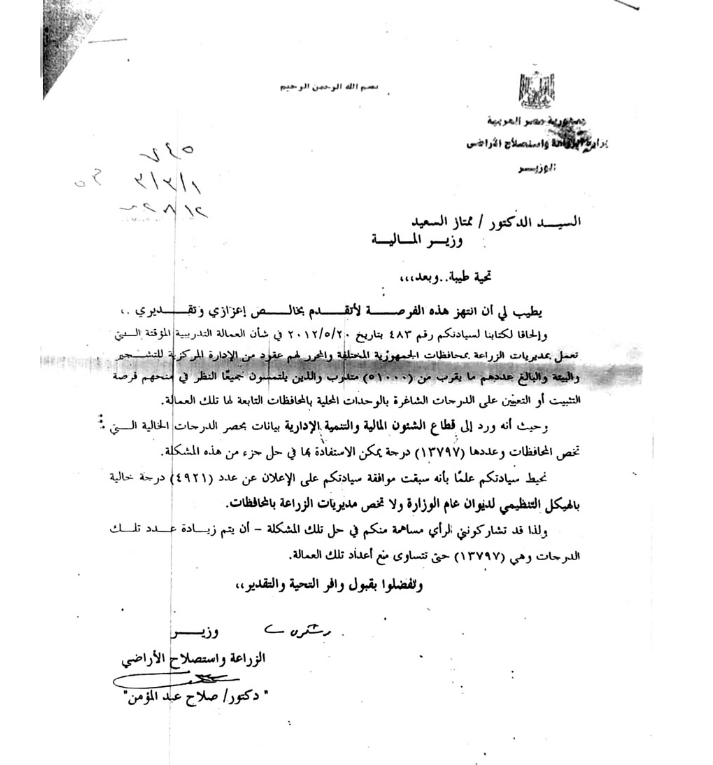
Prior to this, a number of workers on temporary contracts at the Ministry of Agriculture — particularly those on training contracts concluded before May 30, 2012 — submitted a petition addressed to the President of the Republic, a copy of which was reviewed by Zawia3, calling on the Prime Minister and the Ministers of Finance and Agriculture to address their stalled employment situations, citing former Agriculture Minister Decree No. 702 of 2011, Cabinet Decision No. 641 of 2012, and Law No. 19 of 2012 amending State Employees System Law No. 47.
The petition referenced an agreement between the Ministries of Finance and Agriculture and the Central Agency for Organization and Administration to divide this category into three groups (A, B, and C), in preparation for their appointment to vacant grades within the ministry. According to the petition, a decree was indeed issued appointing Group A — comprising the afforestation and procurement sectors — in 2013, totaling 13,997 employees, as a first step toward resolving the crisis.
The petition reveals that the procedures were not completed, as the Ministry of Finance issued decisions in 2015 and 2016 that obstructed the implementation of what had been agreed upon, alongside the formation of a legal opinion committee that issued rulings which workers considered a cause for blocking the appointment of those on training contracts — until another opinion was issued in 2020 permitting the appointment of a limited number from this category, which was also not implemented, leaving large numbers of workers without legal resolution despite meeting the conditions stipulated in previous laws and decisions.
The petitioners called for urgent intervention to review their situations and apply the principle of equality with their counterparts among temporary workers who have been permanently appointed in other government bodies, through the amendment of their contractual status or their appointment to vacant financial grades, in a manner that guarantees them employment and livelihood stability in accordance with what the constitution and the law provide.
On his part, labor leader and former Minister of Manpower Kamal Abu Eita considers that what these workers are suffering is not an exceptional case, but an extension of deeper problems in the labor market, and that the state is called upon to establish a fair employment relationship based on permanent appointment and adherence to the minimum wage, affirming that agricultural workers have suffered from low wages and employment instability for many years despite their entitlement to permanent appointment. He considers that the failure to implement court rulings represents a serious deficiency that undermines the very concept of justice, noting that the decline in the role of trade unions — which previously played a role in resolving disputes before they escalated — has driven workers toward the courts, where their rights are not always guaranteed, and even when obtained, may remain blocked.
He told Zawia3: “Labor rights must be safeguarded, whether through the implementation of court rulings or through fair mechanisms within state institutions. Resorting to the courts has become the only available avenue for workers following the decline of trade union tools in settling disputes, leading to an accumulation of problems and complicating workers’ ability to obtain their rights.”
Abu Eita warns that ignoring the implementation of rulings and delaying the payment of entitlements may lead to worsening social and economic crises for workers, given rising living costs and the absence of stable income sources — a situation that portends serious social repercussions, including escalating feelings of frustration and despair as prospects narrow for certain labor categories. He criticizes the crackdown on trade union activity, which has weakened one of the most important tools of social balance and exacerbated labor crises, calling for respect for court rulings and the activation of effective mechanisms to protect workers’ rights and achieve employment and social stability for them.
Human rights lawyer Malek Adly, Director of the Egyptian Center for Economic and Social Rights, affirms that the temporary labor crisis is not confined to the Ministry of Agriculture, but recurs across multiple government sectors, including the Ministry of Health and the Cabinet — tracing its roots to structural imbalances within the state’s administrative apparatus, particularly regarding employment policies and budget planning.
He notes that the state’s orientation in recent years has aimed at reducing the number of employees, but this has led government bodies to need labor without sufficient job grades being available, driving them to employ workers informally or without actual permanent appointment, despite the workers performing permanent duties.
Adly told Zawia3: “The pressures on the public budget, whether from debts or austerity policies, contribute to the refusal of administrative bodies to implement the financial consequences of court rulings issued in favor of workers,” noting that some ministries resort to partial settlements by disbursing limited amounts instead of full entitlements. He affirms that the crisis does not relate to the issuance of court rulings, but to the slowness or obstruction of their implementation, in the absence of binding mechanisms for administrative bodies — driving workers into negotiations or settlements closer to bargaining in order to obtain part of their rights.
Adly attributes the disparity in workers’ situations to the absence of effective oversight, explaining that the implementation of rulings and the fair distribution of rights are tied to a parliamentary oversight role, affirming the necessity of legislative and oversight intervention, alongside the recalibration of financial and administrative policies, to ensure that workers’ entitlements and the implementation of court rulings are among the state’s priorities.
Parliamentary Moves
The crisis has recently reached parliament. MP Ahmed Al-Sengidy submitted a parliamentary query in February regarding the failure to implement final court rulings and appointment decisions issued in favor of temporary workers at the Ministry of Agriculture, despite more than 25 years of continuous work within the ministry, without achieving any employment stability or payment of their financial entitlements. He called for the disclosure of which body is responsible for obstructing implementation, and whether this constitutes an administrative violation or refusal to enforce a court ruling, along with requiring the relevant bodies to present a clear timeline for implementing the rulings and paying entitlements retroactively.
According to the query, these workers had for many years remained classified as temporary labor without permanent appointment, despite repeated promises from the competent authorities and the issuance of final, binding rulings by the Administrative Court — four years ago — affirming their right to appointment under the fixed wages line of Budget Chapter One (Wages). This was the case even after the Financial Affairs and Administrative Development Sector of the Ministry of Agriculture had issued appointment decrees in implementation of those court rulings.
These decrees stipulated, in their third clause, the placement of appointees on the fixed wages line under a job title, with salaries to be paid from the date of assuming duties. Despite this, salaries have not been paid to these workers to date — in clear violation of court rulings, a disregard for the authority of final judgments, and a deliberate obstruction of implementation without legal justification.
During the same month, MP Mostafa El-Banna also submitted a parliamentary query addressed to the Minister of Finance, regarding the harsh human and living conditions suffered by a number of afforestation workers at the Ministry of Agriculture, as well as a number of employees at the Ministry of Youth and Sports, as a result of their salaries not being paid for years despite their full attendance at work and adherence to their professional duties. He considered this a clear violation of the principles of social justice and equal opportunity and a manifest squandering of workers’ rights, calling for the rapid payment of all overdue financial entitlements retroactively, along with the establishment of a clear and publicly announced timeline for regularizing the situations of these workers and securing their financial and administrative rights.
MP Ihab Mansour, Deputy Chairman of the Manpower Committee of the House of Representatives and Parliamentary Bloc leader of the Egyptian Social Democratic Party, had previously called in February for the suspension of the salaries of Ministry of Agriculture officials responsible for this suffering, in a parliamentary query addressed to the Prime Minister, the Minister of Agriculture and Land Reclamation, the Head of the Central Agency for Organization and Administration, and the Minister of Finance. Mansour confirmed to Zawia3 that the query had not yet been discussed, having been referred to the competent committees of the House of Representatives for discussion in May of the current year, and that he expects the Ministers of Finance and Agriculture to be summoned to parliament to examine the full dimensions of the crisis.
He said: “Failure to implement court rulings is in itself a crime, and these employees have rights — both to permanent appointment and to the payment of their wages. Their numbers are significant, approaching 3,700 employees.” The MP holds the Cabinet responsible for prolonging the crisis, affirming that the file has been before the government for three years.
MP Rawia Mukhtar, Deputy Chairwoman of the Manpower Committee of the House of Representatives, affirms that the committee is already working on the temporary labor file in Egypt, given its broad scope and its reach across multiple sectors, noting that this category suffers from low wages and lack of employment stability despite many years of work.
She told Zawia3: “The committee is aware of the scale of the problem and is working to study it, and measures are expected to be taken in the coming period to address the situations of temporary workers and improve their employment conditions.”
In this context, MP Hossam Al-Omda, a member of the Agriculture and Irrigation Committee of the House of Representatives and Secretary-General of the Mostaqbal Watan Party in Beni Suef Governorate, affirms that the parliamentary committee is following the temporary labor file at the Ministry of Agriculture, pointing to ongoing moves to resolve the crisis in coordination with the Cabinet to ensure that these workers obtain their rights.
He told Zawia3: “The Cabinet is following this problem, and coordination is underway with government bodies, including the Ministry of Finance and the Cabinet, to secure the necessary financial allocations.”
When asked about the number of Ministry of Agriculture employees affected by non-payment of their entitlements, he indicated that estimates suggest the numbers are in the range of figures widely cited — approaching several thousand — expressing hope for the achievement of near-term solutions that would end the suffering of workers holding court-ordered appointment rulings that have not been implemented.
Despite parliamentary moves over the past two months, thousands of employees find themselves caught between binding court rulings and a living reality that grows harsher by the day — continuing to perform their duties without pay, clinging to the hope of obtaining their legitimate rights on par with their colleagues.
In the face of this suffering that has stretched across three decades, the temporary labor crisis at the Ministry of Agriculture can be said to reflect not merely an administrative failure or financial stumble, but a genuine test of the state’s commitment to upholding the law and guaranteeing the basic rights of those who work for it.
By Aya Yasser — Egyptian journalist, writer, and novelist with a BA in Media from Cairo University.