

Saeed was on his way back from work at one of the investment-zone factories in Port Said Governorate, as he does every day, riding the bus heading to Matariya district in Dakahlia Governorate, where he lives. After a nine-hour working day, he noticed unusual traffic congestion that pushed the usual 45-minute journey to more than three hours.
During the journey, Saeed and the passengers were shocked by the scene of a collision between a heavy truck, a pickup truck loaded with timber and a bus carrying male and female workers from a factory, as well as a taxi. The accident killed 12 people, including eight women and four men, and injured others to varying degrees.
Saeed felt a greater shock when he discovered that two women from among his neighbours were among the victims, both of them breadwinning mothers working at an investment-zone factory for extra hours beyond the official hours, to earn additional pay raising their monthly income, which does not exceed EGP 5,000, to provide for their children’s needs. It also became clear to him that many of his neighbours and acquaintances had been injured in the accident and were lying in a Port Said hospital receiving treatment.
The following morning, trucks carrying coffins arrived in Matariya, where the victims were buried in a funeral attended by hundreds of residents, amid sadness and anger over the accident.
Local media had reported, on Wednesday evening last week, a collision between a bus, a heavy truck and a taxi on the Manzala road, known as the new Matariya-Port Said road, which killed 12 people, including eight women and four men, and injured 22 others, who were taken to hospitals in Matariya and Manzala, with critical cases transferred to university and health ministry hospitals in Mansoura. The Ministry of Social Solidarity announced the payment of EGP 50,000 in compensation to the families of victims who were breadwinners, EGP 25,000 for the other victims and EGP 5,000 in compensation for the injured, men and women, as well as covering other treatment expenses.
Saeed recalls that this accident is not the first on this road, which was built in 2020 and opened two years ago; it has witnessed about six or seven serious accidents over the past two years, prompting residents to call it “the road of death”. Residents had previously demanded that heavy trucks be banned from the narrow road, which lacks lighting poles and runs from Matariya district through Lake Manzala to the international coastal road (Port Said-Damietta). Although the local authorities tried to solve the problem last year by installing an iron gate limiting the height of vehicles allowed to pass, a speeding heavy truck smashed the gate, and things went back to the way they were.
Following the issuance by President Abdel Fattah al-Sisi of Presidential Decree No. 294 of 2019 on defining the border-adjacent zone and its governing rules, including Lake Manzala, its shores and surrounding roads, the authorities began in 2020 work on building the Matariya-Port Said road, a shortcut alternative to the Al-Salam Canal road, which had witnessed many accidents, with the aim of preventing encroachments by residents on the shore and buffer zone of Lake Manzala. The cost of the project to develop Lake Manzala and the surrounding areas exceeded EGP 12 billion, according to Adel El-Ghadban, Governor of Port Said, and the cost of developing roads and bridges within Dakahlia Governorate over eight years reached about EGP 4 billion. The development included 97 roads, 21 in the national plan and 76 internal roads, whether roads belonging to the national network or internal roads, according to the Governor of Dakahlia, Ayman Mokhtar.
Saeed explains, speaking to us: “We do not want painkillers in the form of the local authorities placing concrete barriers, artificial speed bumps or new iron gates, but radical solutions to the problem. There must be police checkpoints, patrols and radar devices to ensure heavy trucks do not pass and to catch those exceeding the speed limit, lighting must be provided for the road, and the route of the investment-sector buses must be diverted to another road. There used to be the Al-Salam Canal road, which links four governorates, Dakahlia, Sharqia, Damietta and Port Said, but it is unpaved and full of bumps, and traffic accidents recurred on it, so drivers switched their route to the road passing through Lake Manzala, especially as it is shorter, allowing them to arrive in 45 minutes instead of an hour and a half and save diesel, but this road is narrow and dangerous for buses.”
Residents Protest and Block the Road
The accident and the losses it caused pushed hundreds of Matariya residents, including Ahmed, to take to the street and block the road on Saturday, to express their anger and demand serious action from local officials to improve the road and reduce accidents. Security forces intervened and used tear gas to disperse the protesters.
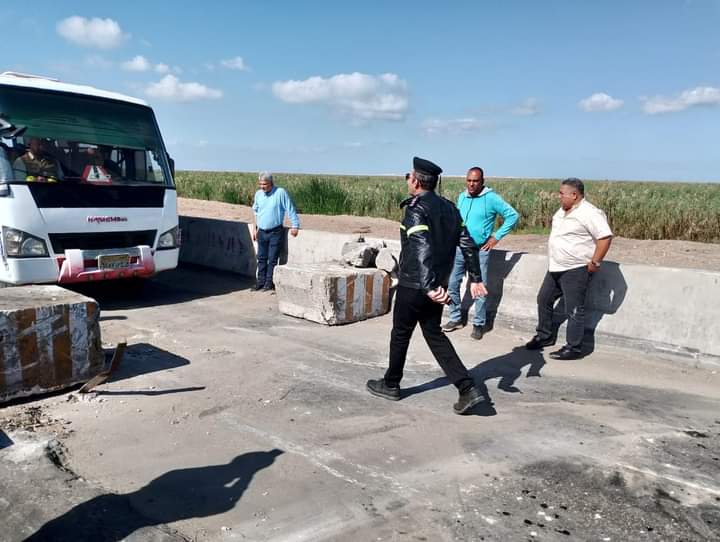
Ahmed says: “We have lost friends and relatives because of the new road, which lacks lighting, speed bumps and speed radars. We went down to the road and prevented the buses of the investment-zone factories from passing, but the police dispersed us with tear gas and arrested a number of residents. After that, the Dakahlia security director and some local leaders came, and the response to our demands began with the placement of iron gates and artificial speed bumps, and banning trucks from passing using huge concrete blocks. But the absence of lighting and warning signs may cause bigger problems.”
The official page of Dakahlia Governorate had published videos showing Tarek Marzouk, Governor of Dakahlia, inspecting work to place concrete barriers to prevent heavy trucks from passing on the Safe Belt road through Gamaliya, Manzala and Matariya, while Port Said Governorate announced on Sunday the start of installing a set of concrete barriers on the (Port Said-Matariya) road to prevent the passage of heavy trucks that violate the guidance signs and warnings on the road within Port Said Governorate, and that work is under way to build the concrete barriers on the road to preserve citizens’ safety.
Adel El-Ghadban, the former Governor of Port Said, had announced in September last year the start of excavation and the pouring of foundations to install a height limiter at the entrance of the Safe Belt (Port Said-Matariya) road from the axis entrance, as part of the work to develop the Port Said-Manzala road, and in September this year Port Said Governorate announced the completion of the first phase of widening and developing the (Port Said-Matariya) road, five kilometres long, and preparations for the second phase, seven metres long, out of the total length of the road, which starts from the Shader Azzam bridge and checkpoint and heads west towards the Haddouth area, totalling 27 kilometres, so that the road links Port Said with the cities and villages of Manzala, Matariya, El-Asafra and El-Hota (Dakahlia), and widening it to nine metres to accommodate two-way traffic in a wide lane.
Lawyer Islam Khairy, head of the lawyers at the Matariya (Dakahlia) partial court and member of the North Dakahlia Lawyers Syndicate council, reveals to Zawia3 that nearly two thousand angry Matariya residents gathered on the (Matariya-Port Said) road, and security forces fired tear gas to disperse them and arrested 29 people on Saturday, who were brought on Sunday before the North Mansoura Total Prosecution and faced charges of blocking a public road, demonstrating and resisting the authorities, without a decision being issued pending the arrival of National Security investigations. The investigations resumed on Monday morning, and the prosecution decided to release 23 on bail of EGP 10,000, to detain five of the residents for four days pending investigation, and to place a minor in a juvenile care institution for a week.
Regarding the horrific accident on the Matariya-Port Said road, Khairy explains that police report No. 3801 of 2024 (South Port Said First misdemeanours) was filed, and police arrested the taxi driver, the pickup truck driver and the heavy truck driver involved in the accident, while the bus driver and a number of its passengers died and the others were injured. The Public Prosecution at the South Port Said court questioned the three accused drivers and released them on bail of EGP 1,000 pending investigation.
The head of the Matariya lawyers says: “Had it not been for the intervention of the sensible among officials and their understanding of the residents’ situation and their grief over their relatives, those arrested would have been tried before a military court, as happened when 60 fishermen were referred to the military prosecution in 2021, as any crimes that occur around Lake Manzala, its adjacent areas and the Safe Belt fall within the jurisdiction of the military prosecution under a presidential decree.”
President Abdel Fattah al-Sisi had issued Presidential Decree No. 444 of 2014, which defined the areas adjacent to the borders of the Arab Republic of Egypt and their governing rules, with the aim of securing the areas adjacent to the country’s western, southern and eastern borders. He also issued Decree No. 294 of 2019, under which seven lakes, (Bardawil, Port Fouad “El-Mallaha”, Manzala, Burullus, Edku, Mariout and Nasser), with their shores and surrounding roads, were added to the border-adjacent areas stipulated in the previous presidential decree. Under the two decrees, former Prosecutor General Hamada El-Sawy ordered that cases related to crimes occurring in the adjacent areas listed in the two presidential decrees be referred to the military prosecution as the competent authority.
Meanwhile, on Monday evening, the prosecution released 24 defendants from among Matariya residents who had been arrested while present on the border road of Lake Manzala, as announced by MP Ahmed El-Hadidi, the representative for the Matariya constituency in Dakahlia Governorate, who stressed that swift action is under way to secure the release of the rest of those arrested, and that those arrested will not be referred to military trials.
A Structural Engineering Problem
Over the past months, several accidents have occurred on the (Matariya-Port Said) road: 26 people were injured in a collision between a bus and a tractor last January, and another accident, a collision between two minibuses, occurred last April, injuring 23 people.
Transport and roads expert Hassan Mahdy, professor of road and transport engineering at the Faculty of Engineering, Ain Shams University, believes that the recurrence of accidents on the same road confirms the existence of a black spot related to a structural engineering problem that must be examined by specialised experts, as the road must be designed according to recognised engineering standards and the codes and specifications for the structural design of roads, and the technical criteria related to the loads it bears, speeds and the technical criteria governing the thickness of the paving layers must be studied.
The professor of road and transport engineering points out that the goal of building the Manzala road was to prevent encroachments on the lake, after which citizens began using it for travel, but the road is narrow and not suited to excessive speeds, which deprive it of the safety standard, and it is not designated for heavy transport. He called for tightening traffic police control to prevent heavy trucks from travelling on the road, through security patrols, installing surveillance cameras and punishing violators in accordance with the law rather than just placing barriers, installing radar devices to catch speeders, and making the tuk-tuk a means of internal transport that does not travel on highways and replacing it with other means of transport and transit lines. He stressed that artificial speed bumps are not the optimal solution on the Manzala-Port Said road, as it could turn into an accident trap, and that the bumps must be painted in a phosphorescent colour and warning signs installed.
Mahdy explains that 67% of road accidents are caused by human errors such as speeding, fatigue while driving and drug use, the absence of lighting or problems with car tyres, and the failure to meet safety requirements in cars in light of economic conditions and the sharp rise in the prices of car tyres and spare parts, which leads to tyres bursting, and if the driver has little experience, traffic disasters and horrific accidents occur. He noted the importance of random technical inspections of cars, changing tyres according to their lifespan of every three years, and establishing safe driving centres to teach drivers how to deal with emergencies such as tyre blowouts or oil spilled on the road.
The transport and roads expert explains that the law stipulates that external roads are not lit, to save energy, and this is applied in many countries of the world, but there are phosphorescent lines and illuminated cat’s eyes, while intersections and city entrances are lit, because there is not enough electrical power to light external roads, and the dusty atmosphere is not suited to using solar-powered lighting poles; there are also some thefts of road lighting poles.
The General Authority for Roads and Bridges had announced in June this year that the Ministry of Transport, represented by the General Authority for Roads and Bridges, was reducing lighting on the Egyptian road network, in implementation of the state’s plan to rationalise energy consumption.
Road Development and Accident Rates
Abdallah Abu Khadra, professor of road, transport and traffic engineering at the Faculty of Engineering, Beni Suef University, believes that the road network the state has built in various governorates aims to create smooth traffic flow, increase safety and security on the various roads, reduce accident rates and ensure ease of movement to facilitate economic activity and attract investment. He stressed that road development has led to a 28.6% decrease in the number of deaths from car accidents, according to Cabinet data, as 5,861 deaths occurred in 2023 as a result of road accidents, instead of 8,211 deaths in 2016. The number of people injured in road accidents also fell by 17.9%, to 71,000 in 2023, compared with 86,500 in 2016, in addition to reducing congestion and car exhaust emissions, reducing fuel consumption and environmental pollution, solving traffic congestion, and shortening distances, time and effort.
Over the past ten years, Egypt jumped 100 places in the global ranking of the road quality index to rank 18th worldwide. According to a report issued by the Cabinet’s Media Centre last June, the National Roads Project aims to develop and build 7,000 km of roads, of which 6,300 km have been implemented at a cost of EGP 155 billion, and 8,400 km of main roads have been developed and upgraded at a cost of EGP 110 billion out of a total of 10,000 km targeted for development. The lengths of main roads are scheduled to increase by 29.8%, to reach 30,500 km by the end of 2024, compared with 23,500 km in 2014.
The professor of road, transport and traffic engineering explains that traffic controls must be set to control road entrances and exits, by specifying a certain angle for cars to enter and exit, in addition to implementing the intelligent transport system on roads to achieve the highest rates of safety and security, which in its first phase includes 8 of the busiest roads most used by citizens, while the second phase includes 14 roads, as well as improving drivers’ sight distances, improving road lighting, providing guidance and phosphorescent signs, and improving the drainage of rain and floods on roads to eliminate car skidding and accidents in winter.
Abu Khadra believes that human error is responsible for 88% to 90% of road accidents in Egypt, and that, alongside traffic deterrence, enforcing the law and drug-testing drivers, attention must be paid to the human element and awareness raised of the importance of safe driving and following traffic instructions; to technical causes, represented in the technical roadworthiness of cars, the timing of tyre changes, periodic maintenance and checking the car’s efficiency before the trip; and to human factors, which lie in driving under the influence of fatigue and exertion, lack of concentration while driving, being preoccupied with the mobile phone, driving under the influence of drugs and alcohol, failing to keep a safe distance between vehicles or to observe the speed limits, especially during bad weather, failing to observe traffic and guidance signs and to wear the seat belt, as well as recklessness and carelessness while driving, lack of concentration, slow reaction to any emergency on the road, and overtaking cars on horizontal curves and in places where overtaking slow vehicles is not permitted. He called for establishing concrete lanes dedicated to heavy transport, reducing at-grade intersections and creating free-flow intersections through tunnels and bridges.
Data from the Central Agency for Public Mobilisation and Statistics show a notable decrease in road accident deaths in Egypt in 2023, as 5,861 people died, compared with 7,762 in 2022, while the number of injuries resulting from accidents rose to 71,000 in 2023, compared with 55,900 in 2022.
Despite the decline in traffic accident death rates and Egypt’s rise in the road quality index, the bleeding on the asphalt has not stopped, despite the large government spending on developing and building new roads and bridges as part of the National Roads Project, which raises questions about the extent to which safety and security factors are applied on roads and their conformity with recognised technical and engineering standards, and about the role of the traffic police in enforcing the law and confronting traffic violations that can cause horrific accidents.